Author Archives: clem.law@usa.net

Canadian POW Sgt. Brian Hodkinson

1942MarManitobaCalling

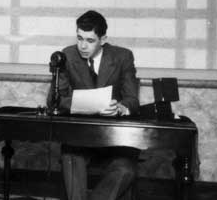
Then 16 year old Hodgkinson at the CKY microphone, circa 1930. Manitoba Historical Society photo.

Then 16 year old Hodgkinson at the CKY microphone, circa 1930. Manitoba Historical Society photo.

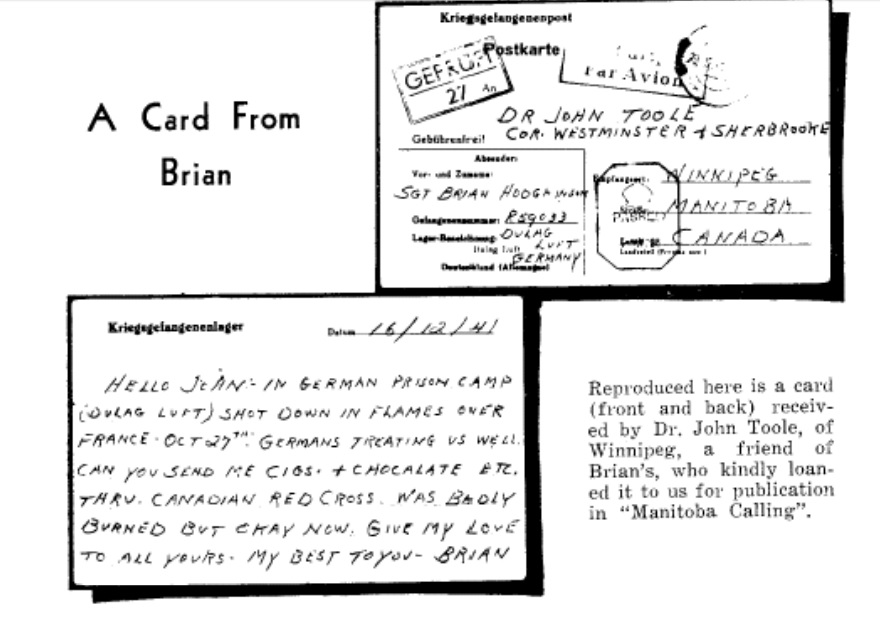
This postcard from RCAF prisoner of war Sgt. Brian Hodkinson appeared 75 years ago this month in the March 1942 issue of CKY’s program guide, Manitoba Calling.  Prior to the war, Hodkinson was an announcer at the Winnipeg station.  With the outbreak of war, he enlisted in the air force, and on one of his first missions over France, he was shot down and held prisoner for the duration of the war.

This card was sent to a friend in WInnipeg, Dr. John Toole, and reports that the Germans were treating him well.  He requested “cigs. & chocolate, etc.” via the Canadian Red Cross.  Dr. Toole shared the card with the radio station.

Hodgkinson spoke little of the war years, but after much prodding by friends, he did put his memoirs on paper.  After the war, Hodgkinson moved to the United States and was for many years a newscaster and commentator at WHK, WERE, and WDOK in Cleveland.

After his death, a manuscript for a book was found.  It was published in Canada in 2000 as Spitfire Down.

The book is a fascinating look not only at Hodgkinson’s time as a POW, but also at his training.  The RCAF had to get pilots in the air as fast as possible, and the training was intense.  Hodgkinson recounts that he got lost on his first solo cross country flight, which was supposed to be from Ottawa to Kingston.  He got lost, and finally spotted an airport, which turned out to be Montreal.  Low on fuel and daylight, he landed and called his base for instructions.  After some discussion, he was told to return to Ottawa the next day.  He got lost again, and once again he landed at an unfamiliar airport.  When a friendly airport worker came out to meet the plane, he asked where he was, and was told that he had landed in Ogdenburg, New York.

Since the United States was still neutral, Hodgkinson realized that his navigation blunder would result in his spending the duration of the war in an American internment camp.  So he asked which way it was to Ottawa, and promptly flew north.

Despite these false starts, Hodgkinson was quickly sent to England, and on one of his first missions over France, he was shot down.  Most of the book recounts his experiences in a hospital in France, and then in prison camps in Germany.

One feature that stood out was the fluent English speakers that Hodgkinson encountered.  While he and his other prisoners in the hospital in France noted that before long they would be speaking a mixture of three languages, there were English speakers among his captors.  The first that he encountered was the doctor who oversaw the treatment of his injuries, Dr. Rudy Meinhoff.  Hodgkinson was surprised to hear the doctor address him with a clearly American accent.  It had turned out that the German doctor had practiced in Milwaukee before the war, and had even attended a medical conference in Winnipeg.
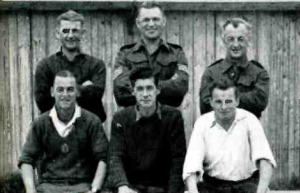
Hodgkinson (front row, center) along with fellow prisoners, 4 New Zealander and 1 English, 1944. Manitoba Calling, Apr. 1944.

Hodgkinson (front row, center) along with fellow prisoners, 4 New Zealander and 1 English. Manitoba Calling, Apr. 1944.

And upon his transfer to the German prison camp, Hodgkinson’s interrogator was Wehrmacht intelligence officer Col. Gustave Metterling, who also surprised Hodgkinson with an American accented English.  Before the war, Metterling had lived in New York, where he made a career of selling forged oil paintings, often made to order by wealthy buyers.

The book is not available in the United States, but used copies are available at a reasonable price on Amazon.  In Canada, it’s also available at Amazon.ca.

The book is a fascinating look at the war by one who had to sit most of it out.  According to Worldcat, relatively few libraries, American or Canadian, have a copy.  But it is apparently still in print from its Canadian publisher, and reasonably priced copies are available on Amazon.  It’s definitely worth seeking out.
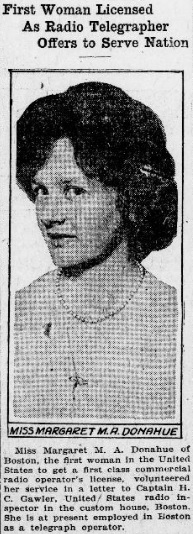


Margaret Donahue, First Woman Licensed as Commercial Radio Operator

MargaretDonahue1917We previously wrote about Margaret Donahue of Boston, who was reportedly the first woman to receive her  first class commercial radio operator’s license.  This fact was reported a hundred years ago today in this clipping from the March 29, 1917, edition of the Bridgeport (CT) Evening Farmer.

She was at that time employed as a wire telegraph operator in Boston.  With her new credential, she had volunteered her service to her country in the upcoming war.


POLICALARM and MONITORADIO Receivers, 1952

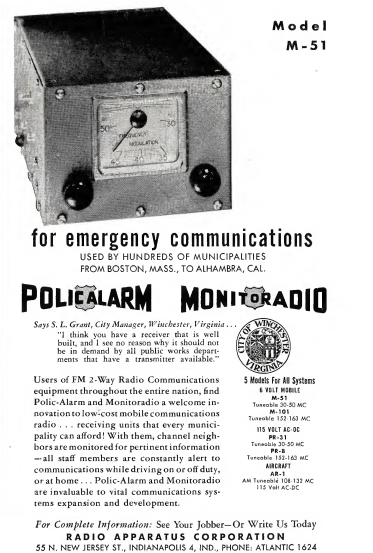
1952MarFMTVSixty five years ago this month, the March 1952 issue of FM-TV magazine carried this ad from the Radio Apparatus Corporation of Indianapolis, Indiana, for its monitor receivers, sold under the POLICALARM and MONITORADIO trademarks.  Five models were available.  For the 30-50 and 152-163 MHz FM public service bands, both 6 volt and 115 volt models were available.  For the AM aircraft band, a 115 volt model was available, covering 108-132 MHz.  All were continuously tunable.

The sets were marketed to police and public service agencies for two purposes.  First, “channel neighbors are monitored for pertinent information.”  In addition,  staff could have receivers in their homes or vehicles to be “constantly alert to communications while driving on or off duty, or at home.”

The ad even carried a testimonial from the city manager of Winchester, Virginia, who thought “you have a receiver that is well built, and I see no reason why it should not be in demand by all public works departments that have a transmitter available.”

There’s no indication that the City of Winchester actually bought one, but the city manager said he could see no reason why other cities wouldn’t want one. The ad did note that the receivers were in use by hundreds of municipalities “from Boston, Mass., to Alhambra, Cal.”

The 120 volt units appear to use the “POLICALARM” name, while the mobile units were “MONITORADIO.”  An example of one of the 120 volt units can be found at this eBay image.  A picture of the 120 volt Monitoradio AR-1 aircraft receiver can be found at The Radio Museum.  The set pictured is one of the 6 volt models, all of which had the same styling.  The units designed for household power resemble a broadcast receiver, with Bakelite cabinets.

Radio Apparatus Corporation later became part of Regency.


Preparing for the End of Civilian Radio Production

1942MarService

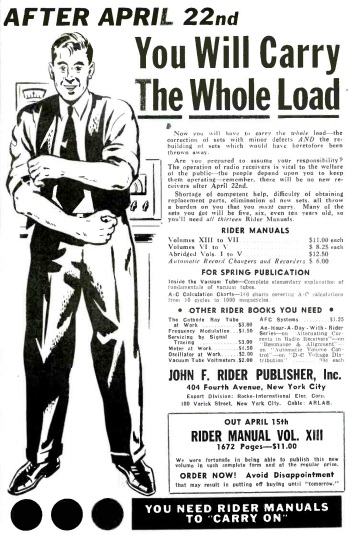
By orders of the War Production Board, manufacturing of civilian radio receivers ended on April 22, 1942, for the duration of the war. Even before this was announced on March 7, radio servicemen knew that at the very least, there would be shortages. When the ban was announced, they knew it was up to them to keep America’s radios in operation for their vital war information and for morale.

When the ban was announced, servicemen knew that it was time to double down, and they were reminded by advertisements such as this one, which appeared in the March 1942 issue of Service magazine.  The ad was from the John F. Rider company, publisher of service manuals.  These manuals contained diagrams and service information of virtually every set ever manufactured, and this data would prove invaluable for the radio servicemen tasked with keeping the nation’s radios in operation for the duration.


1967 One Tube CW Transmitter

1967MarEI

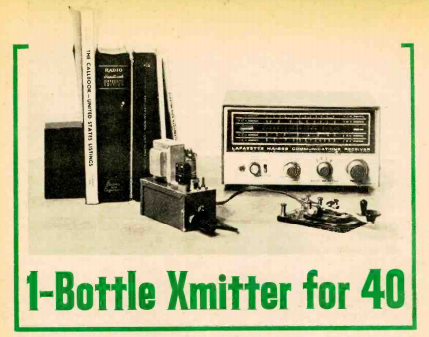
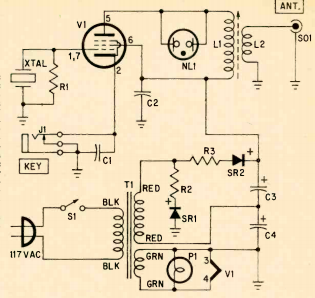
Fifty years ago, the March 1967 issue of Electronics Illustrated carried the plans for this simple 40 meter CW transmitter. The set ran directly off AC power, with a transformer supplying 120 volts B+, rectified through two silicon diodes, as well as 6 volts for the filament of the single 6AQ5A tube. It ran 15 watts input power, with output of about six watts.

The author, James B. White, W5LET, noted that the transmitter would be a good first rig for the Novice, as a perfect second rig for the oldtimer, or tucked away on the corner of the operating table for use as a standby transmitter.

The parts count was kept down by omitting a variable capacitor for tuning the plate circuit to resonance. Instead, the tube’s plate-to-cathode capacitance was tuned against the plate coil, which was adjusted with a slug-tuned core. A neon lamp was used as the RF indicator to assist with the tuning process and to visually monitor sending.

The rig got out, and the author reported that his first CQ from Louisiana was answered immediately from the Midwest. During its first hour on the air, the author worked both coasts.

1967MarEISchematic


1967 Outlet Tester

If you do any electrical work around the house, or even if you don’t, and you want to make sure the electrician did things right, you really ought to have an inexpensive outlet tester like the ones shown here. You’ll be able to tell at a glance whether the outlet is wired correctly, or if there’s some invisible fault. Those errors could include the polarity being reversed, either the neutral or the hot not being hooked up, or the absence of a ground connection. The one shown here is available on Amazon, and they can be had at low cost at any hardware store.

But fifty years ago, they weren’t so readily available, and the home handyman might consider making his own. The plans were shown in the March 1967 issue of Popular Mechanics. As you can see, the device is quite simple. If you want to make your own, here’s the schematic:

1967MarPM


Fire Island Light Ship Distance Measuring Apparatus

FireIslandLightShip

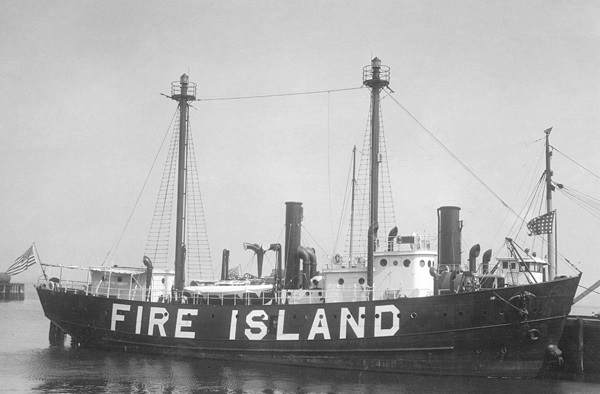
A hundred years ago this month, the March 1917 issue of the Wireless Age carried a description of the distance measuring apparatus in use by the Fire Island Light Ship,  The light vessel, located in New York Harbor, was equipped with apparatus which would allow an approaching ship to accurately measure its distance from the station.

To do this, the light vessel used a radio transmitter (call sign NLS) and a 1000 pound submarine bell. The bell would strike a sequence. At a precise time after the first strike of the bell, the radio would send a series of dots. An approaching ship would hear the bell, followed by the radio signal. The difference in time between these signals would correspond to the distance travelled by the two signals.

The announcement explained that the best way to copy the signal would be with headphones connected so that the wireless signal was played in one ear, with the other receiver connected to the submarine bell detector.  It would then be an easy matter to distinguish the signals.  Since the dots coming from the radio transmitter followed a carefully controlled pattern, it was necessary only to count the dots heard prior to hearing the bell.

The radio operated on a wavelength of 600 meters (500 kHz), and ran continuously during thick weather, and during the first 15 minutes of the hour during clear weather.

The vessel, Lightship LV-68, was built in 1897 at a cost of almost $75,000, and had a length of 122 feet. Each of its masts held a 100 candlepower electric lamp. It also carried a 12 inch steam whistle in addition to the bell.  It remained in operation until 1930.

References


1957 Combination Radio-Geiger Counter

1957MarPMGeiger

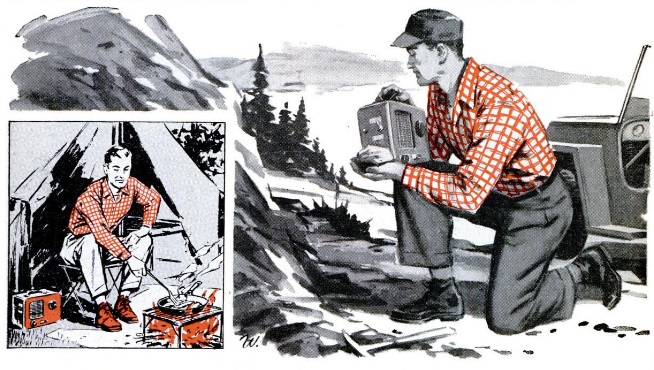
Sixty years ago, prospecting for uranium was a popular pastime, and the gentleman shown here in the March 1957 issue of Popular Mechanics was doing it right. The accompanying article noted that prospecting could be a lonely proposition, and this project allowed you to bring along a companion who would assist and entertain you without demanding a portion of your claim: You could build this combination radio-Geiger counter!

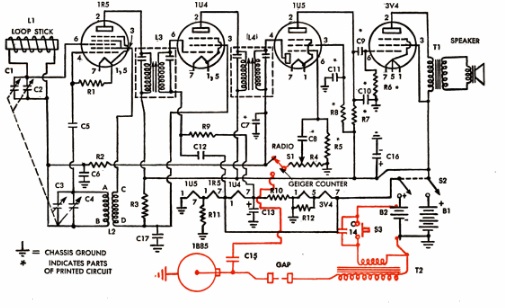
The basic circuit was a superheterodyne radio, using four tubes: 1R5, 1U4, 1U5, and 3V4. The Geiger counter used a 1B85 Geiger tube from the Victoreen Instrument Company. The filaments ran off two cells, and a 45 volt battery supplied the B+. Since 45 volts wasn’t quite enough for the Geiger tube, the circuit used an transformer and spark-gap circuit to charge up a capacitor to a higher voltage. The is was accomplished with a pushbutton in series with the transformer’s primary. You would pump the pushbutton for about 30 seconds to charge the capacitor, which would allow a sufficiently high voltage for the Geiger tube.

The output of the geiger counter went to the audio section of the radio, and when you hit uranium, you would hear the clicks from the speaker.

In the diagram below, the radio is shown in black and Geiger counter in red.  The magazine also noted that if you already had a suitable portable radio, you could add the Geiger counter circuit.

1957MarPMGeigerSchematic


Carbon Button Microphone Amplifier

CarbonMicrophoneAmp

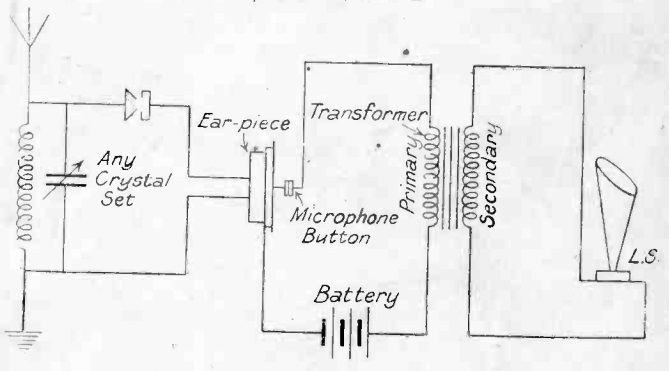
While they were rarely used in radio applications, the diagram here shows how a carbon button microphone amplifier could be used to drive a loudspeaker from a crystal set. This diagram is from 90 years ago, and appeared in the 1927 British Radio Year-Book.  The diagram actually appears in the advertisement for a book entitled Successful Crystal and One Valve Circuits by J.H. Watkins, who according to the ad was the wireless correspondent for the Daily Express.

The principle behind the circuit is very simple and almost self-explanatory.  The audio from the crystal set or other low-level source is fed to the traditional earphone.  A carbon button microphone is in physical contact with the earphone, and produces a stronger AF signal.  In this case, this stage is able to drive a loudspeaker.

This idea was rarely used in radio, since a vacuum tube amplifier provided better results and little additional cost.  The carbon button amplifier was more commonly used in telephone circuits, where they were the only method of amplification available prior to the vacuum tube.  They made long distance telephony possible.  They did have the advantage of a smaller size than a vacuum tube, and required less battery power.  Therefore, they did remain in use in hearing aids until the advent of the transistor three decades later.  You can read more about the carbon button amplifier at this site.

The advantage for the home constructor was probably cost, since driving a speaker this way would not require an expensive vacuum tube.  In fact, the carbon button amplifier could probably be constructed at home, which would be impossible in the case of a vacuum tube.  Students looking for a very novel science fair project might consider making one, since it would be possible to produce loudspeaker volume with entirely homemade components.


Highland Park College, Des Moines, IA

1917MarElecExp

A hundred years ago, magazines devoted to electricity or mechanics were full of ads for learning radio.  A large number of these focused on training ship wireless operators.  There were other exceptions, but most such schools were located near the sea, in locations such as New York.

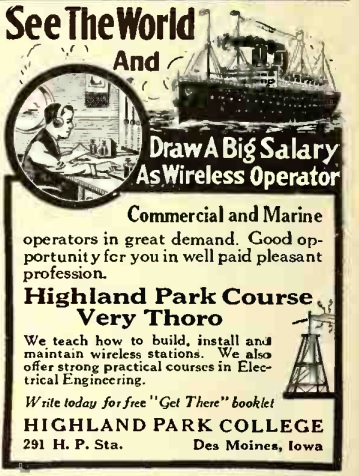
One of the exceptions that caught my eye was this ad for the “very thoro” wireless training program offered by Highland Park College in Des Moines, Iowa, shown here as it appeared in the March 1917 issue of Electrical Experimenter.

The ad promised the opportunity to see the world and draw a big salary as a wireless operator.  And the first stop in seeing the world was Des Moines.  This is actually not surprising, since the Hawkeye State was a hotbed of early wireless activity, with more than its fair share of amateur operators, and later, broadcast stations and companies involved in radio.

The college offering this course, Highland Park College, is no longer in existence, but had its own colorful history.  The school’s Wireless Building, apparently the location where students would be trained to see the world, is pictured here in the school’s 1914 yearbook.

According to the yearbook, the college had a wireless club which had been organized in April 1913, and had a complete sending and receiving set. The book boasted that the station’s large aerial allowed reception of the Arlington, VA, and Key West, FL, stations on a regular basis.

HighlandParkWirelessBuilding

The college was established in 1889 and operated under that name until 1918.  It was apparently independent when founded, and in 1911 was transferred to the Presbyterian church.

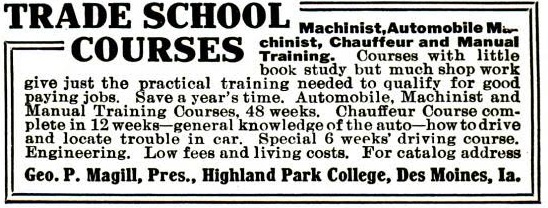
1915MarPMWireless telegraphy was only one trade that could be acquired at Highland Park College, as shown by this ad in the March 1915 issue of Popular Mechanics.  The school also offered courses in machinist, automobile machinist, and chauffeur.  The machinist courses ran 48 weeks, whereas the chauffeur course of study could be completed in 12 weeks.  The school also offered a “special 6 weeks driving course.”

In 1918, the college was acquired by the Baptist church and renamed Des Moines University. Things went smoothly until 1927 when a fundamentalist wing known as the Baptist Bible Union of North America, the forerunner of the General Association of Regular Baptist Churches, took control. The faculty were required to subscribe to eighteen articles of faith. At that time, the University’s school of pharmacy was apparently the strongest department, and the faculty apparently had doctrinal differences to the point where they refused to sign the eighteen articles of faith. They departed and formed the Des Moines College of Pharmacy in downtown Des Moines. All but two of the pharmacy students left to enroll in the new school.

In addition to the doctrinal requirements imposed on the faculty, the students were facing restrictions. Three girls were disciplined for doing cartwheels during a vaudeville skit.

By 1929, the administration had enough, and fired the entire faculty. A riot broke out, and angry students stormed the administration building during a meeting of the board of trustees. Eggs and rocks were thrown, and the angry students attempted to break down the door of the room where the board members were hiding. Police were called, but the school formally closed down in September 1929.

The buildings sat vacant until 1943, when professional baseball player and aviation pioneer Alfred W. Lawson bought the property and founded the Des Moines University of Lawsonomy, Lawsonomy being billed as “the study of everything.” As might be expected for the study of everything, a degree was not something that could be earned quickly. According to Lawson, the students (men only) would need to study for 30 years to get their degree of Knowledgian.”

Enrollment peaked at a hundred students, but dwindled to 20 when the school closed in 1954 (presumably, with none of the students earning the coveted Knowledgian degree).

The property was sold, two weeks before Lawson’s death, and became the site of the Park Fair Shopping Mall.

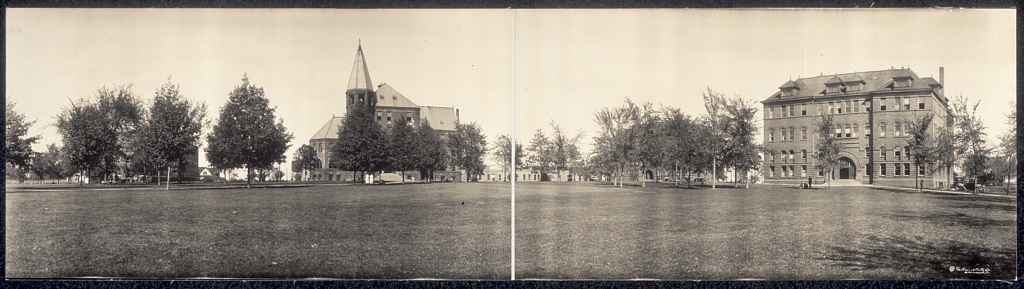
Highland Park College in 1914. Library of Congress.

Highland Park College in 1914. Library of Congress.

ParkFairStreetView

The school’s location today. Google Maps.

References