Author Archives: clem.law@usa.net

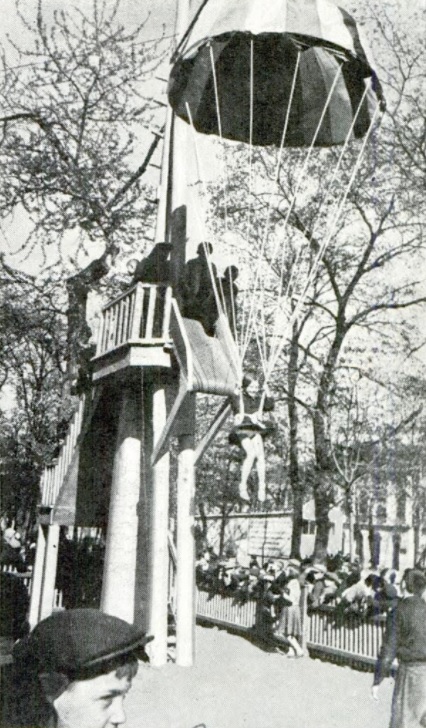
1937 Parachute Jump for Young Comrades

1937OctPMThis photo should put to rest, once and for all, the myth that commie kids never got to have any fun. Eighty years ago, parents the world over apparently weren’t quite as concerned that their children be protected from all conceivable dangers. Today, we might worry that the playground slide is too dangerous, but at least it deposits Junior in very close proximity to terra firma.

But they didn’t worry about things like that in 1937, and they certainly didn’t worry about it in the glorious Soviet Union.

In this Moscow park, the slide ended twelve feet above the ground, and the kids just had to trust the laws of aerodynamics to see them safely to the ground.  The accompanying text in the October 1937 issue of Popular Mechanics notes that this was one of the park’s most popular features.

The first woman in space, Valentina Tereshkova, was born in 1937, so my first hunch was wrong, since the young comrade shown in this 1937 photo obviously wasn’t born in 1937. But Comrade Valentina Vladimirovna was an amateur skydiver when, as a textile worker, she was inducted into the Cosmonaut Corps.  And there is definitely a family resemblance.

RIAN archive 612748 Valentina Tereshkova.jpg

Cosmonaut Valentina Tereshkova. Wikipedia photo.

I’m sticking to my theory that the young comrade jumping from the slide is the future cosmonaut’s older sister.

In any event, if you have kids jumping off twelve foot slides, Hitler should have known that he didn’t stand a chance.
1942: Bringing the Car Radio on a Bike

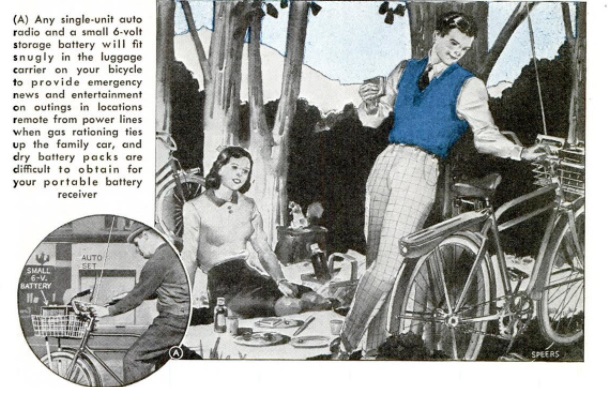
1942OctPMThere was a war going on 75 years ago, but that didn’t stop this young man from enjoying a picnic with his girl, complete with emergency news and entertainment from the radio, as shown in the October 1942 issue of Popular Mechanics.

The war did, however, make planning the outing a bit more challenging.  Gas rationing meant that the family car was out of service, and shortages of B batteries meant that the portable receiver wasn’t an option. Undaunted, he simply borrowed the receiver out of the family car, along with a six-volt battery, probably borrowed from the same car. Dad wasn’t going to be driving anywhere, anyway, so he presumably wouldn’t miss it.

The radio and battery were mounted in the bicycle’s luggage carrier, and Junior and his girl were off to a picnic lunch at this secluded spot.  Junior works on one of the sandwiches as he tunes in some appropriate musical program, and his girl looks on with admiration at his ingenuity.  Not even Hitler and Tojo can put a damper on their romantic picnic.


1942 Crystal-Tube Set

1942SepPM4

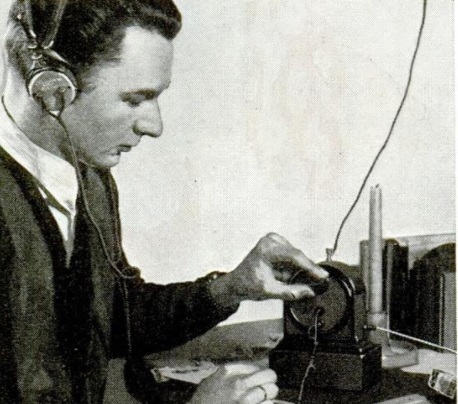
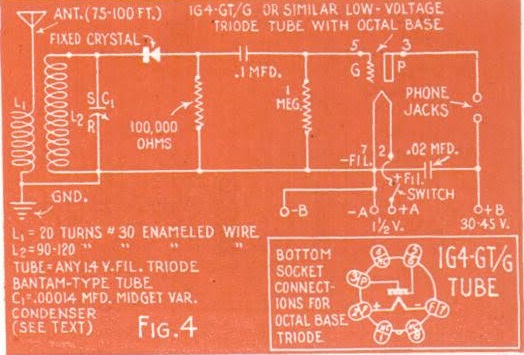
Shown here from the September 1942 issue of Popular Mechanics is a crystal/tube receiver built with junkbox parts. The construction article noted that the set “really goes to town” by combining the fixed crystal with one stage of audio amplification. This set was built into the case of a broken clock, but the article noted that another suitable enclosure could be used. The author noted that many distant stations were pulled in, especially at night.

The batteries were mounted inside the clock case on a base made of cigar-box wood.

1942SepPM5


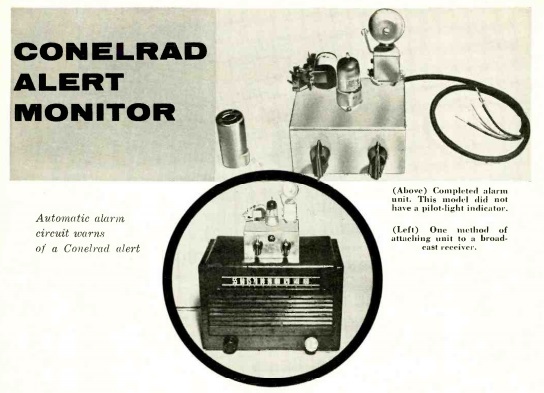
1960 CONELRAD Monitor

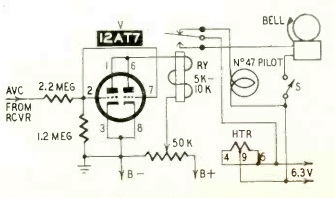
1960JanRadioElecThe plans for this CONELRAD monitor appeared in the January 1960 issue of Radio Electronics magazine. As part of the nation’s civil defense structure, the CONELRAD system was designed to alert Americans to an incoming attack, but also make sure that broadcast signals did not serve as beacons for incoming bombers.

To prevent this from happening, all radio stations ceased broadcasting. Selected stations then resumed broadcasts, but only on two frequencies, 640 and 1240 kHz, in order to confuse the navigators of those incoming bombers.

1960JanRadioElecSchematicWhen the station first left the air, this would serve as the first warning to the public. And this device sounded a bell when the monitored station left the air. In some more remote areas, a more sensitive and selective receiver might be required. But in most areas, the ubiquitous “All American Five” receiver could be used. This alarm tapped into the receiver’s AVC circuit. If the incoming carrier disappeared, the bell would sound.


1942 Kate Smith & Jell-O

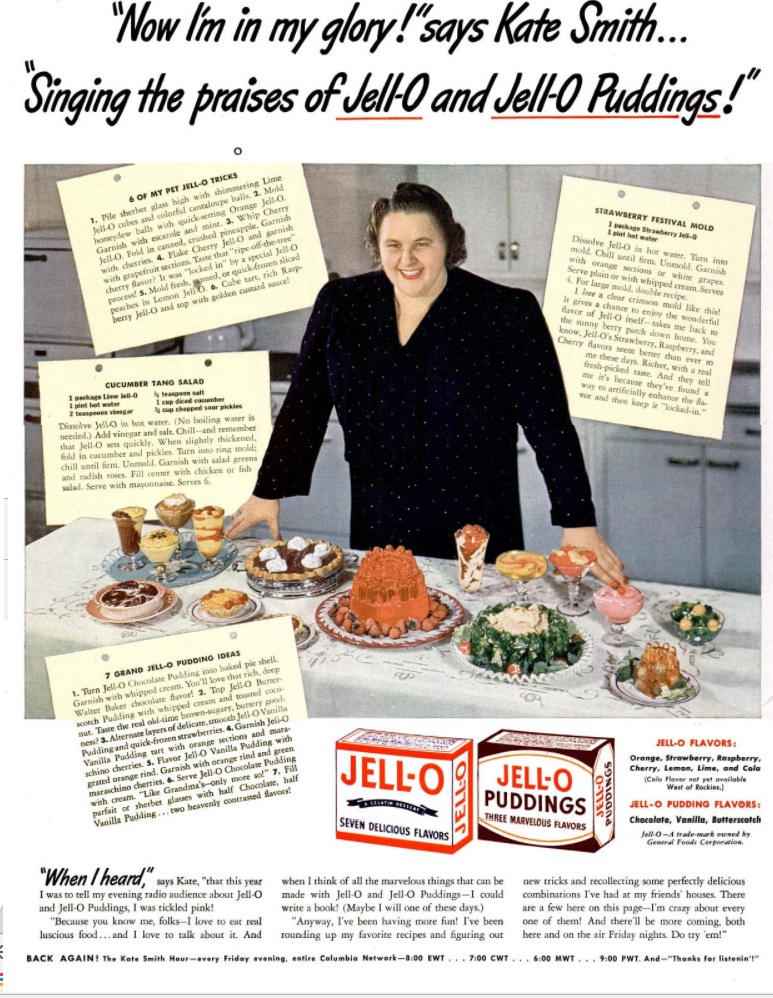
1942Sep28LifeThis Jello ad appeared in Life magazine 75 years ago today, September 28, 1942.

Kate Smith, whose program was heard Friday evenings on CBS, reported that she was tickled pink when she learned that Jell-O and Jell-O puddings would be her sponsor. She loved to eat real lucious food and loved to talk about it.

And when she thought of all of the marvelous things that could be made with Jell-O and Jell-O puddings, she said that she could write a book, and just might write one.

She reported that she was busy rounding up her favorite recipes and figuring out new tricks. A few of those recipes appeared in the ad, and she was crazy about every one of them.  And Kate wasn’t one to jump on the all-natural bandwagon.  “Jell-O’s Strawberry, Raspberry, and Cherry flavors seem better than ever to me these days.  Richer, with a real fresh-picked taste.  And they tell me it’s because they’ve found a way to artificially enhance the flavor and then keep it ‘locked-in.'”

Here’s Kate Smith singing the White Cliffs of Dover in 1942:


GE Touch Tuning, 1937

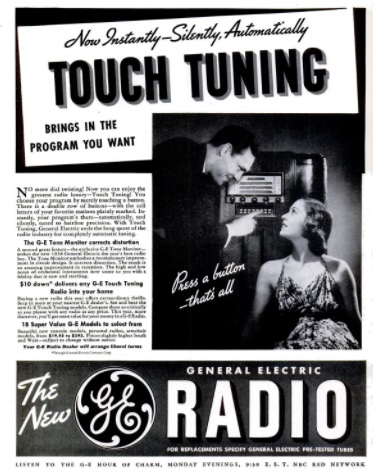
1937Sep27LifeEighty years ago today, the September 27, 1937, issue of Life magazine showed this woman freed, once and for all, form the tyranny of dial twisting, as her heroic man lets her know that from now on, all she need do is “press a button–that’s all.”

The GE ad explained that she could now enjoy the greatest radio luxury, namely Touch Tuning. A double row of buttons was plainly marked with the call letters of her favorite stations. All she had to do was push the correct button, and the program was there, “automatically, silently, tuned to hairline precision.” With this advancement, General Electric finally “ended the long quest of the radio industry for completely automatic tuning.”

A mere $10 down payment would see one of these sets in your living room. Eighteen models were available for 1938, raning from personal radios to armchair sets to beautiful new consoles.

Typically, these pushbutton sets had a separate L-C circuit tuned by the serviceman for the desired stations, and setting the buttons and marking them was taken care of when a new set was purchased.  For those who desired, dial twisting remained an option.  Typically, one button was marked “dial,” and allowed the big tuning dial to be set in the conventional manner.


Dr. Brinkley Answers: 1937

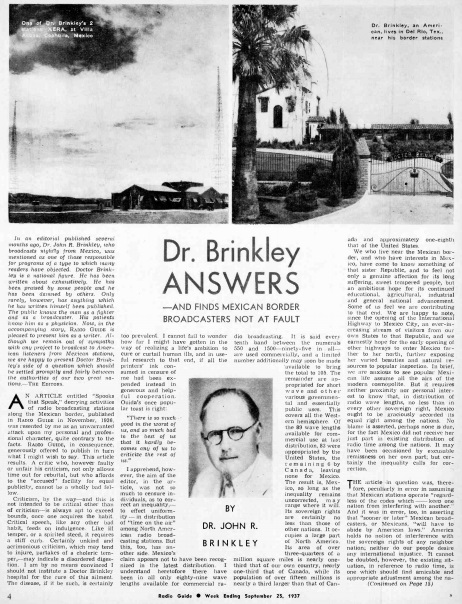
1937Sept25RadioGuideShown here from the September 25, 1937, issue of Radio Guide is an article written by radio pioneer and questionable physician Dr. John Brinkley.  Shown in the upper left is his radio station, XERA, Villa Acuna, Coahuila, Mexico.  At the upper right is a picture of his home in neighboring Del Rio, Texas.

The station was famous not only for promoting the doctor’s dubious cures, but also for causing interference with U.S. broadcast stations.  We previously wrote about how another of Dr. Brinkley’s stations, XEAW, Reynosa, interfered with WCFL, Chicago.

In an editorial published a few months earlier, the editors of Radio Guide opined that Brinkley’s Mexican stations operated “regardless of the codes which keep one nation from interfering with another,” and that “sooner or later, Mexican broadcasters will have to abide by American laws.”

The editors agreed to allow Brinkley to publish a response, and the result is shown here. Brinkley began by noting that he resented the editorial as an unwarranted attack upon his professional and personal character. He did acknowledge that the opportunity to offer a rebuttal showed that the editor “cannot be a wholly bad fellow.”

Brinkley spent most of his time championing the cause of broadcasters in the Mexican Republic, noting that of the 89 channels available on the broadcast dial, 83 had been “appropriated by the United States, and the remaining six by Canada, leaving none for Mexico.

In Brinkley’s mind, the good citizens of Mexico were entitled to radio stations. And those radio stations just happened to be his, broadcasting in English to audiences in the same country that had “appropriated” the rest of the dial.

Brinkley then concludes by testifying as to his own good character, noting that he was the son of a pioneer physician whose life was spent in unselfish, often uncompensated, ministry to the sick, in the rugged and sparsely settled Appalachian mountains. This inspired his “unusual research,” motivated by his “innate, inalienable, perhaps undue, ambition to serve his race.” This drove him to the air, in the service of more than 10,000 patients who found relief in his hospitals.

He concludes by noting that he had recently been elected as President of the Rotarians, and was on his way to Nice, France, to serve as their delegate.


London Air Raids of 25 September 1917

1917Sep25ChicagoTribunex

The Underworld: Taking cover in a Tube Station during a London air raid

The Underworld: Taking cover in a Tube Station during a London air raid.  Imperial War Museum. © IWM (Art.IWM ART 935)

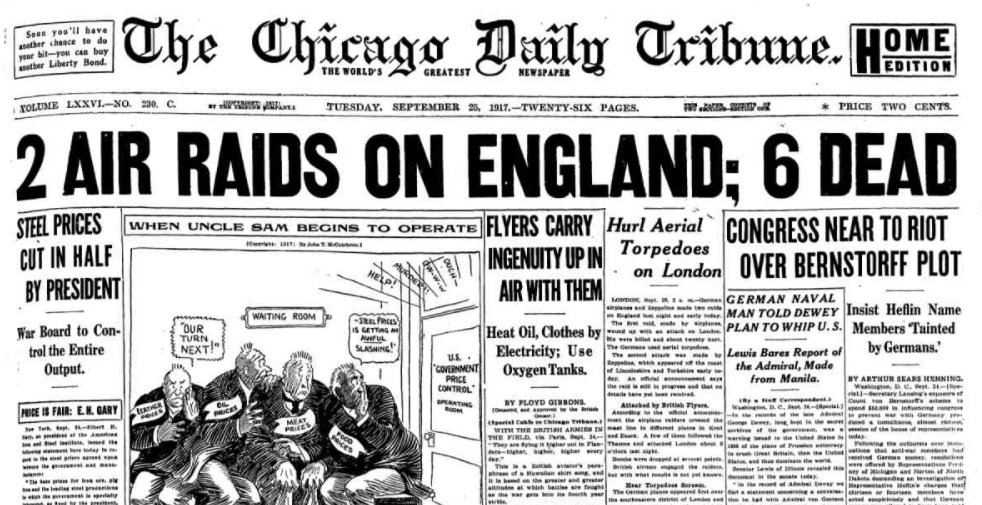
One hundred years ago today, the September 25, 1917, issue of the Chicago Tribune carried this headline of a German air raid earlier that day (3:00 AM London time) on London.

The newspaper reported that the first raid was made by airplanes and resulted in six deaths and about twenty injuries.  This was followed by a Zeppelin attack which first appeared off the coast of Lincolnshire and Yorkshire.

The British government had set up a rudimentary civil defense organization in the summer of 1917, with about 200 observation posts set up. They reported by telephone to military headquarters, and fighter squadrons and spotlights were called into action to shoot down the invading craft. Street lights in central London were turned off at night, and a lake was drained to prevent its distinctive shape from serving as a landmark.

There was, however, no method in place to warn civilians. However, civilians knew that the Germans needed moonlight and good weather. Therefore, many Londoners took shelter in underground stations on nights when bombing seemed likely. It was estimated that some 300,000 Londoners took refuge in these stations, with another half million in their cellars.

References


1942 September Snowstorm

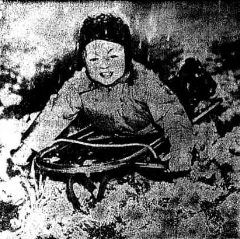
1942Sept26ChiTribThe young man shown here, David Hamilton, then two years old, of 18309 Riegel Road, Homewood, Illinois, got his picture in the Chicago Tribune on August 26, 1942, courtesy of an early snowstorm that covered much of the Midwest, starting 75 years ago today on August 24.

While there was enough snow to keep young Mr. Hamilton amused in the Land of Lincoln, the heaviest snow of the storm was in Minnesota. Numerous overhead wire systems were damaged by the wet snow, with the damage estimated at $25,000 in the state. The heaviest snows were reported in Bird Island, with 8 inches, and Sauk Centre with 9. New records for September snowfall were set throughout the southern half of the state, with a few such records also being set in northern Minnesota.

Since the snow was accompanied by cold temperatures, there was crop damage throughout the state. Many Friday night football games were cancelled, and phone service was out between Minneapolis and Rochester.

Snow was reported from in the Dakotas, Minnesota, Iowa, Wisconsin, Illinois, Missouri, and Indiana during the three day storm.

References


1937 One-Tube Shortwave Regen

1937SeptSWTV

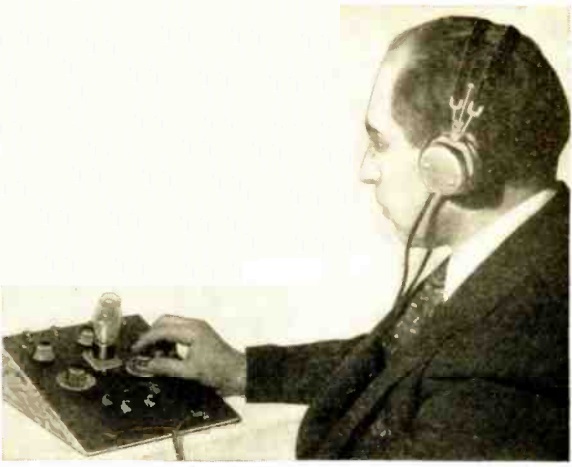
The plans for this handsome little one-tube regenerative shortwave receiver appeared 80 years ago this month in the September, 1937 issue of Short Wave and Television magazine.

The simple circuit was designed for the beginner, and could be put together even by “the man without previous experience in set-building.”

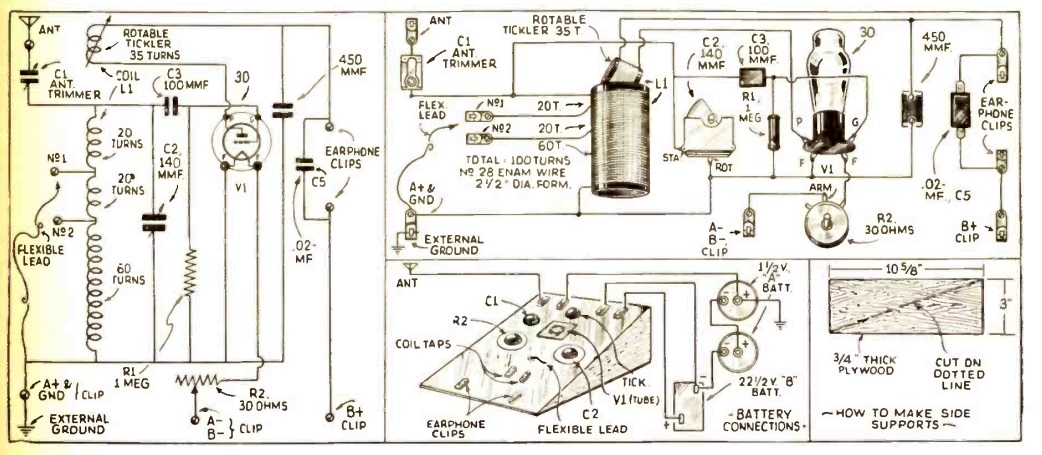
It employed a type 30 tube, although many other triodes could be substituted. The filaments were powered with two 1.5 volt dry cells, and the B+ was supplied by a 22.5 volt battery, although up to 135 volts could be used for added volume.

Band switching was accomplished by a tapped coil, with the wire running to the appropriate tap running up through the angled front panel. From there, it could be connected to a Fahnestock clip for the appropriate tap. Tuning and regeneration controls were on the front panel, as well as a connection to rotate the tickler coil.

As is evident from both the schematic and pictorial diagrams shown here, the set was easy to contruct, and could easily be duplicated with modern parts.  Sources of many of the required parts can be found on my parts page.

1937SeptSWTV2