Author Archives: clem.law@usa.net

1959 One Tube VHF Receiver

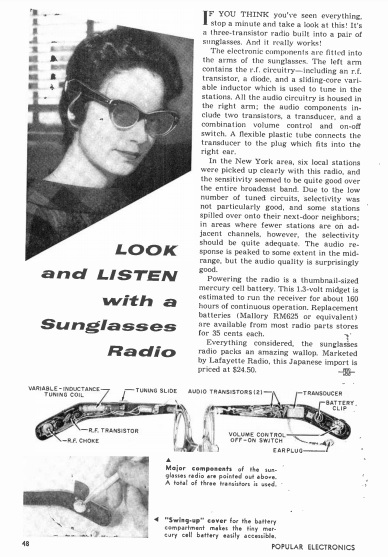
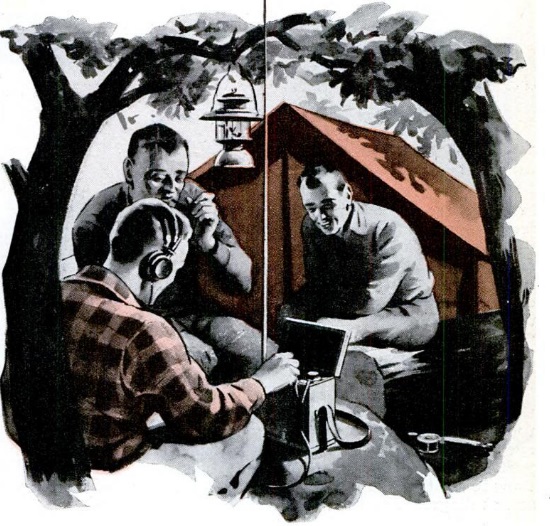
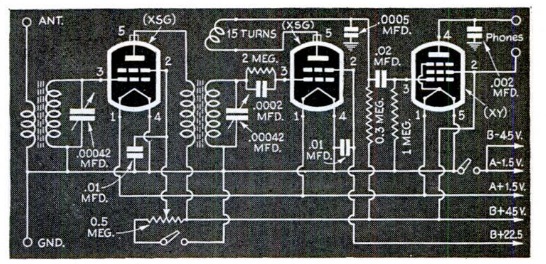
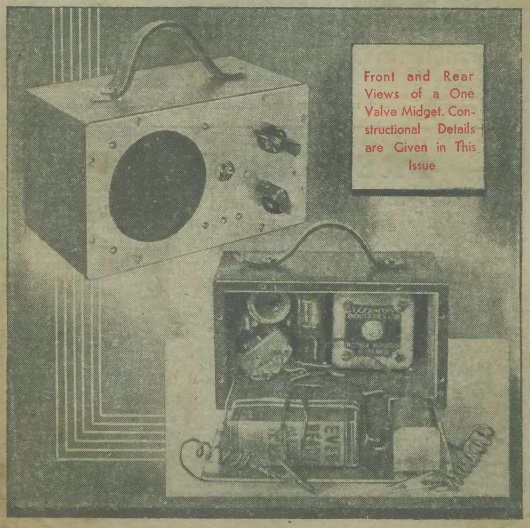
1959RadioTVExpSixty years ago, a 1959 issue of Radio-TV Experimenter carried the plans for this one-tube VHF receiver. The superregenerative set covered 27-200 MHz. Since the sunspot cycle was cooperative in 1959, the set pulled in a lot of DX. On the 10 meter amateur band, the author reported hearing hams in Mexico, Cuba, Alaska, and Japan. In addition, he pulled in paging services in California and Puerto Rico, and police stations in South America, all with an indoor wire antenna. With an outdoor beam antenna, he pulled in the audio of BBC television in London.

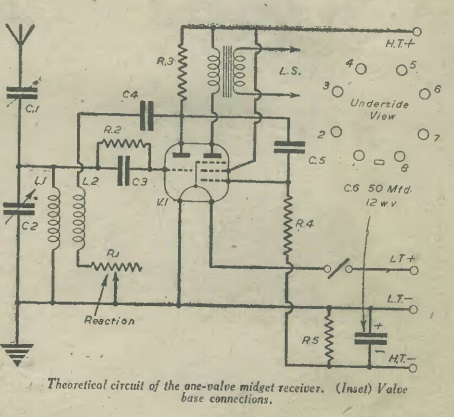
One half of the 12AT7 tube acted as the sensitive detector, with the other half serving as audio amplifier. Plug-in coils were used for band switching.

1959RadioTVExp2


1919 Portable Crystal Set

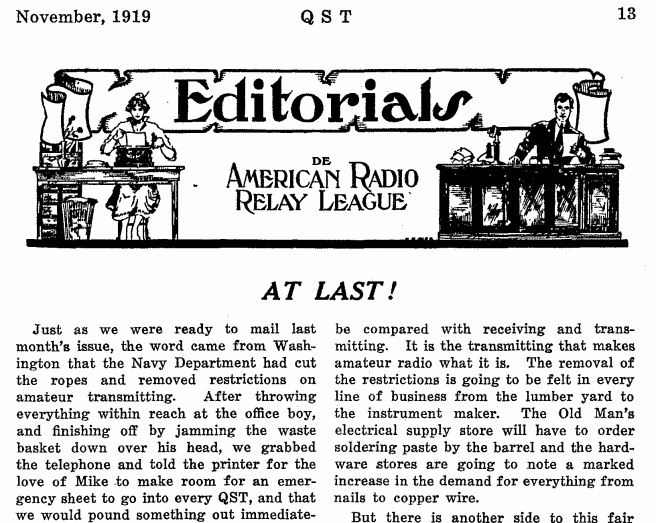
1919SeptRadioAmateurNews1919SeptRadioAmateurNews2A hundred years ago this month, the September 1919 issue of Radio Amateur News carried this “pocket size” (for large pockets, presumably) crystal set. According to the author, the set was, from Illinois with a 140 foot antenna, able to pull in NAA Arlington, NAR Key West, as well as a large number of ships off the Atlantic coast. Tuning was accomplished through taps on both the primary and secondary coils, and could tune to a maximum wavelength of 3500 meters (86 kHz).

The radio was mounted in a leather-covered carrying case for a No. 2 Folding Brownie Camera.  It was set so that one side could be opened completely, allowing access to controls. The detector was a galena crystal, and the set contained a test buzzer for use in finding the “sweet spot” on the crystal. A fixed capacitor was made of two 2×6 inch sheets of tinfoil, separated by wax paper and folded.


University of Wisconsin Extension Classes, 1944

1944Sep17MilJour

For a snapshot of wartime higher education 75 years ago, here is a schedule of extension courses offered by the University of Wisconsin at Milwaukee, from the Milwaukee Journal, September 17, 1944.

The engineering and management courses were offered under sponsorship of the U.S. Office of Education to meet war needs.  Accordingly, no tuition was charged for those courses, other than the cost of texts and materials.  Tuition for other courses ranged from $4 to $25.

For a larger version of the image, from most browsers, click twice to enlarge.


Science Fair Project: Hot Wire Ammeter

1969AugSepRadioTVExpThe young scientist looking for an award-winning science fair project can’t go wrong with this ammeter from the August-September 1969 issue of Radio-TV Experimenter.

The instrument can be constructed with materials from the hardware store, but will do accurate measurements of current, whether it is DC, AC, or even RF. It is a hot-wire ammeter, and was frequently used in the early days of radio for measuring RF current in order to calculate power. As the name implies, the current is measured by the expansion and contraction of a steel wire. As the current flows, the wire heats up. It is attached to a spring-loaded second wire, and that wire moves a pointer. A standard ammeter can be used to calibrate the device once constructed. In the photo here, the meter is shown measuring current from a dry cell battery (and a modern alkaline D cell will work just as well as the old-fashioned battery, especially when used with a battery holder). However, the instrument can also be used to measure AC current, and can be used as part of an experiment measuring current consumption of various kinds of light bulbs.


1969 Greeting Card Radio

1969SeptEICoverFifty years ago, the September 1969 issue of Electronics Illustrated showed how to put together this greeting card radio. The chasis was a 6×9 inch greeting card. On the left side is a homemade circuit board consisting of aluminum foil attached to cardboard with rubber cement. The top half of the circuit board is also the stator of the variable capacitor, with the rotor being another piece of foil cemented to cardboard. The crystal earphone was permanently attached, presumably meaning that extra postage was required.

If the idea looks familiar, it’s because we’ve featured similar ideas in the past, such as this 1947 one-tube set or this 1940 postcard radio.  If you’re looking for parts, see our crystal set parts page.

1969SepEI2


160 Meters in 1949

1949SepRadioElecThe 160 Meter band was reopened to use by Amateur Radio Operators in 1949, but the band was also used for the LORAN radio navigation system. That system allowed ships to plot their location quite accurately. It relied on shore stations that transmitted synchronized signals. The time difference between the two signals placed the ship on a given line, and by noting the intersection of two such lines, the location could be determined.

Because the band was shared, hams were limited in both frequency and power to protect the LORAN signals. The map shown above showed the initial restrictions in 1949, and appeared in the September 1949 issue of Radio Electronics.

Essentially, each state and territory was assigned two 25 kHz segments with specified day and night power levels. The Gulf Coast states were allowed 200 watts power during the day, but this segment of the country was not allowed on the air at all after local sunset.

By the mid-1970s when I got on the air, the restrictions had been relaxed considerably, and the band was quite good for regional contacts at night. While ‘phone operation was allowed, almost all of the activity I remember was CW. The restrictions as of 1975 are shown here, from the 1975 edition of the ARRL License Manual:

1975LicenseManual


1939 Philco Radios

1939Sep13MilJour

This ad showing Philco’s line of radios appeared 80 years ago today in the September 13, 1939, issue of the Milwaukee Journal. From most browsers, you can view a full size copy by clicking twice on the image.


Women’s Royal Canadian Naval Service

1944SepManitobaCallingShown here, in the September 1944 issue of Manitoba Calling, the program guide of CKY Winnipeg, are two “Wrens” of the Women’s Royal Canadian Naval Service. Stationed atop the signal tower over Halifax harbor, these women did the job of Naval signalmen in visual signal work. They flashed and received messages to and from ships and relayed them to the Navy shore offices. The magazine noted that the tools of their trade were projection lamps, signal flags, binoculars, telescopes, telephone, and radio telephones.

The magazine noted that while nothing could compensate for the horror and destruction of war, there were some good results. One of those was the fact that women had been given the opportunity to serve Canada in a variety of jobs with few openings in peace time.

For another look at visual signalling methods, see our earlier post.


1934 HCJB QSL

1934HCJBqsl

Clarence Jones. Call of the Andes blog.

Clarence Jones. Call of the Andes blog.

We’ve previously shared the history of HCJB,

the missionary radio station in Quito, Ecuador. We noted that the station had its real start as a force on the shortwave bands in 1940, when it signed on with its new 10 kW transmitter. But as we noted, the staton really started in 1931 by American missionary Clarence W. Jones with a 200 watt transmitter in his own residence to a wire antenna.


1934JBLHindsThis early QSL card from the station confirms reception of a program on February 7, 1934. The card notes that the station was then on 73 meters running 150 watts. The card bears Jones’ signature, and the illustration suggests that the station was still in his residence and using a wire antenna. The card was addressed to J.B.L. Hinds of New York, shown in the illustration at left. He presumably pulled in the 150 watt signal with the set shown here. Hinds was the editor of the “Foreign Station Department” of Short Wave Radio magazine, and the card and this illustration appeared in the magazine’s September 1934 issue.

The listing of shortwave stations in the same magazine lists HCJB at 73.0 meters, 4.11 MHz.


Review of Keystone School Credit Recovery

My son’s high school freshman year didn’t include stellar grades. In fact, it included failing his geography class. There were two causes of this. The major cause was the traditional reason, namely, a failure to apply himself. He might have squeaked by with a passing grade, but when he finally handed in quality work, the teacher was already convinced that he was incapable of quality work. So she accused him of cheating, even though she admitted that she couldn’t prove it. Since she couldn’t prove it, she instead gave him poor grades, meaning that the average score for the course was still a failing grade.  As a result, he had to make up the course over the summer.

One option, of course, was to send him to summer school.  Logistically, this wasn’t a convenient option for us.  And there was still a chance that subjective grading would keep him from passing the course.  Therefore, after some research, we settled upon The Keystone School, which offers a number of “credit recovery” courses.  The school, even though it is apparently accredited in Pennsylvania, does not actually offer the credit itself.  Instead, before enrollment, an official from his home school, in his case, the counselor, has to sign the application.  Keystone School then reports the scores to the home school, and the home school changes the grade from an F to a grade of P, a passing grade.  The school agreed that this was a suitable option, and signed the application.

We were a bit hesitant, since many of the online reviews I saw were rather poor.  Many of the criticisms in these reviews were justified, but for our purposes, the course actually served us quite well.  For families in different situations, those shortcomings could prove to be very frustrating, so please use caution before registering.

KeystoneReviewImages3The school’s course catalog can be found at this link.  The course my son took was entitled “Geography Online Credit Recovery Grades 9-12,” and the tuition was $155 for two semester credits.  It was also possible to take one semester credit for $116.  The course goes quite fast, so I’m glad I paid for both credits at the same time.

There were many technical glitches with the course.  In fact, he was never able to view some portions of it.  I suspect we would have eventually figured out how to view all of the material, as we probably needed to update some of the software on our computer.  For example, most of the lessons included at least a few videos and Flash presentations that we never were able to open.

KeystoneReviewImages2The bulk of the lessons consisted of slides similar to the one shown at the left.  These are interspersed with videos, links to other websites, and the various Flash plugins that we weren’t able to view.  Fortunately, most, but not all, of the missing elements had a PDF transcript that he could open, which contained the same information.  These actually proved to be more convenient, since the text could be searched when taking the open-book quizzes.

For some students, the missing elements might have caused a major problem.  It’s likely that problem could have been solved by updating our software, but in my son’s case, having the missing items wasn’t a major problem.

This is because the course is set up so that the student takes a quiz for each unit before reviewing that unit.  Each quiz can be taken up to three times, and the student is instructed to take it the first time as a pre-test for the unit.  If the student passes the quiz (it appears that 70% is the passing score), then the student simply moves on to the next unit.

With one exception, my son passed all of the quizzes (usually with a score of 90% or 100%) on the first try.  Therefore, he was never required to actually review the lessons.  However, for many of the chapters, he did open the lessons and quickly review them.  (The method for doing this was somewhat counter-intuitive.  From the course main page, he had to click on “Start Here,” and then on “Table of Contents.”  From the table of contents, he had to right click on the unit he wanted to view, and then open that unit in a new tab.  For some reason, it didn’t work to open the lessons by left clicking.)  He usually had one or more tabs open with the course materials, with the open book quiz in another tab.  He was able to answer most of the questions from his prior knowledge (much of it presumably learned in the class he failed).  Other questions required him to regurgitate material from the lessons, so he would search for the material in the other tab.

Most questions were relevant, but quite a few were somewhat confusing.  A few of the answers were simply wrong, such as the one below.  But he picked the least wrong answer, which turned out to be the right answer.  (Thailand is not east of Cambodia):

KeystoneReviewImages

Over the course of about a month, my son passed the course (with a score in the high 90’s).  He probably learned a few things (such as the true location of Thailand in relation to Cambodia), but more importantly, the school will accept the credits and change his grade from failing to passing.  The technical glitches weren’t a problem, because he used the Keystone course essentially only to “test out” of the subject.  If he needed to actually learn something from the course, it wouldn’t have worked very well.  But despite the shortcomings, it was vastly superior to bringing him to summer school, and the $155 was well spent.