Author Archives: clem.law@usa.net

Crosley B-439A Portable Radio-Phono, 1939

1939DecRadioTodayWhen one thinks of a crank phonograph, one normally associates that with a mechanical reproducer and no electronics. But there’s no reason why a particular phonograph can’t be a hybrid. It could have an electric motor but a mechanical reproducer. Here is the opposite, namely, an electronic phonograph with a wind-up mechanical motor, in this Crosley Model B-5549A portable radio-phonograph, as shown in the December 1939 issue of Radio Today.

The reason why this particular unit is a hybrid is because it can operate on either batteries or household current. With an electric motor, the turntable would rapidly run down the batteries, and there would be no convenient way to have a motor than ran on different voltages. So the easiest solution to the problem was to add a hand crank.

The radio in this unit was the same as the Crosley model 549, a five-tube superhet. It employed a 1A7GT oscillator, 1N5GT IF amplifier, 1H5GT detector and first audio stage, and 1A5GT audio output. A 117Z6GT rectifier rounded out the tube complement. The set included a relay which automatically disconnected the batteries when hooked up to AC power. Since the rectifier was a dual tube, one half was used to power the filaments, with the other half providing the B+.

Up to eight records could be stowed inside, and with the unit weighing only 24 pounds, it could be toted anywhere to provide either radio or recorded music.


Amerika Magazine

1979AmerikaShown here in 1979 is fourteen-year-old Kristi Killi, a volunteer “candystriper” at St. Jospeh Hospital in Denver.

But in addition to providing care and comfort to the hospital patients, she is serving as a goodwill ambassador, since the picture appeared in the March 1979 issue of the Russian-language magazine Америка (America).

The magazine was published by the U.S. State Department from 1944-1952 and from 1956-1994. While the peak circulation was never more than 50,000, it was wildly popular among Soviet readers. Long lines formed as soon as it hit the newsstands, issues were widely shared, and it was often the topic of discussion by Soviet intellectuals. The magazine was described as “polite propaganda,” and featured articles and photos about everyday life in America.

We know that people Google their names, and we’re always happy to hear from people we’ve featured.  Feel free to e-mail us or leave a comment below.  If you would like, we can post a follow up.  This case is more difficult, since the name in the article is in Cyrillic text, Кристи Килли.  So perhaps the last name is Killy, Killey, Keely, or even Kelly.  And the first name could be Kristy, Christy, or some variation.  In any event, our readers would enjoy hearing your reminiscences of being a fighter in the Cold War.


1944 Tuning Dial Helpful Hint

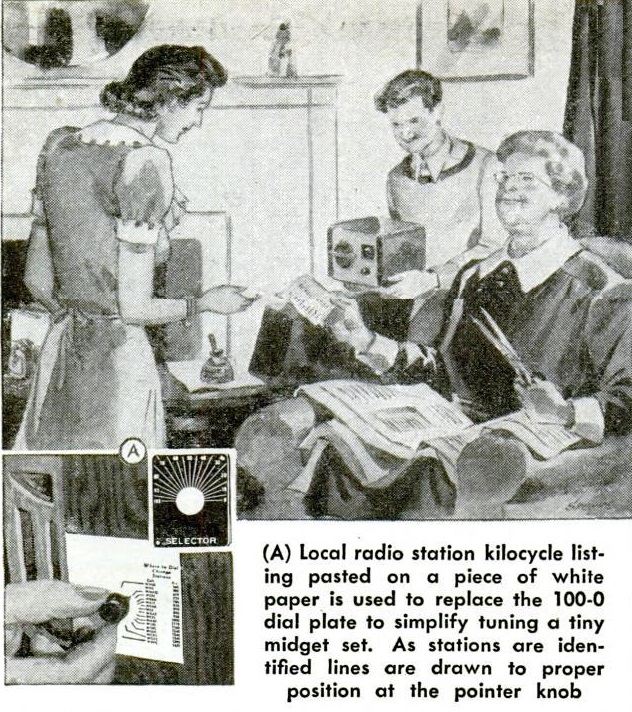
1944DecPM1It looks like Grandma came up with this helpful radio hint from the December 1944 issue of Popular Mechanics. It was hard finding the stations on the dial of the midget set, so she made an alternative tuning dial. As the rest of the family helps, she cuts out the station listing from the local newspaper. There’s a bottle of glue on the table next to her, and Junior is bringing the set. They’re going to glue the station listing to the dial, and then draw lines pointing to each station’s spot on the dial.


Christmas Shopping, 1939

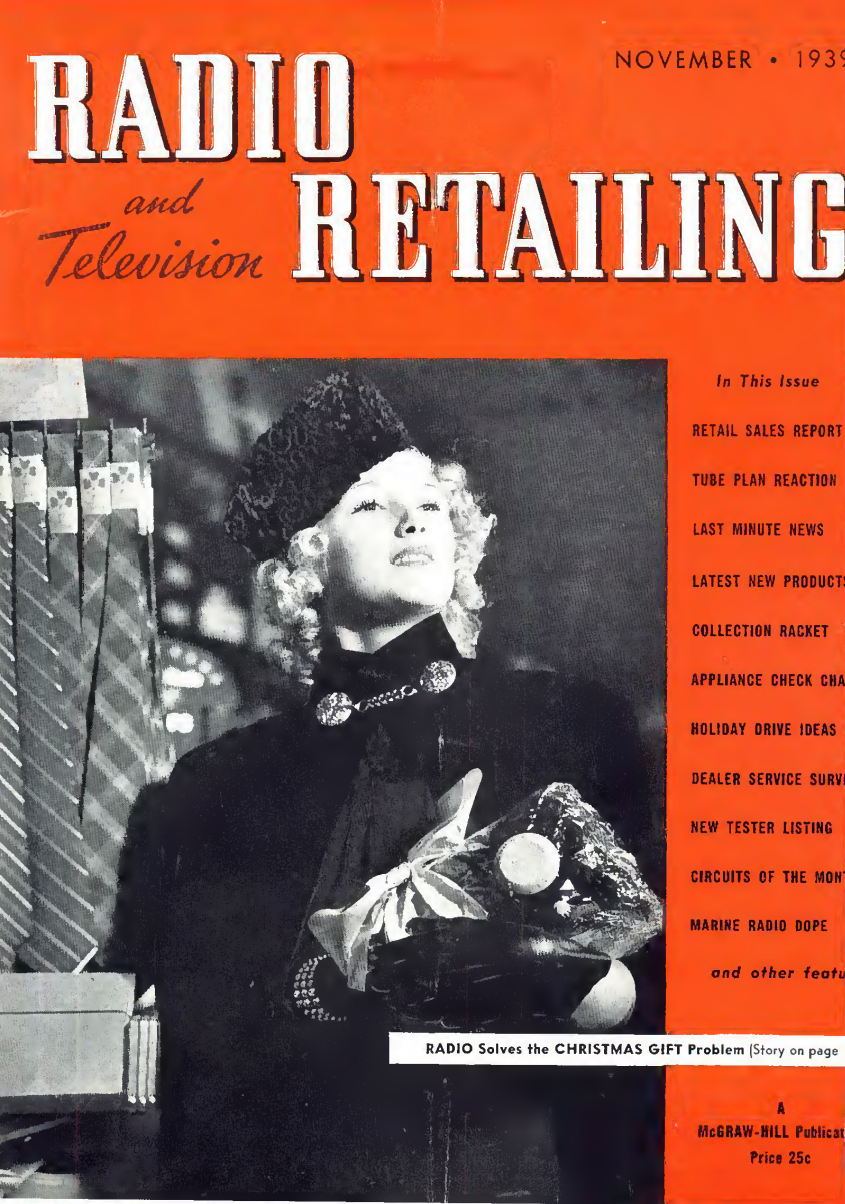
1939NovRadioRetailingOn this day 80 years ago, the Christmas shopping season was in full swing. The shopper shown here, on the cover of Radio Retailing, November 1939, bypassed the neckties and instead headed to the radio department to find the perfect gift. The radio she was carrying probably wasn’t a replacement for the family’s main set. Instead, it was an “extra” set to go in another room. The magazine reminded retailers that they shouldn’t miss out on these sales, just because they’re concentrating on sales of replacements for the main set. This retailer obviously got the message.


1949 Skillet Radio

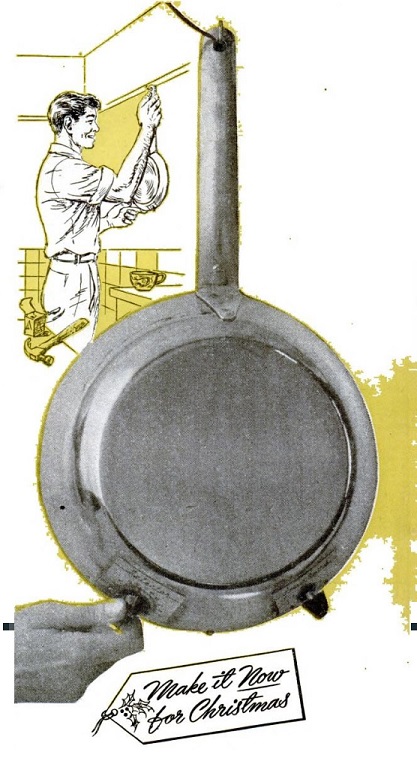
1949NovPSThe gentleman shown here didn’t bother battling Black Friday crowds to get the perfect gift for his wife.  He went down to the workshop and made something not available in any store–a radio concealed in a skillet.  As the article in the November 1949 issue of Popular Science points out, the kitchen was the wife’s workshop, and the radio brightened up hanging among the other pots and pans as a decorative addition.  As the article notes, it would allow her to listen to music, news, and soap operas, “and sometimes remind her that it’s later than she thinks.”

Before constructing the set, the builder had to give some thought to where it would be hung. The circuit shown in the magazine included a loop antenna, but the magazine cautioned that if it were hung on a metal cabinet, the shielding would mean that the loop wouldn’t work very well. In that case, an antenna coil and external antenna could be used.

The set was an “All American Five” five-tube superhet, and the magazine cautioned that one had to be careful making it so that it wouldn’t prove a shock hazard around the water pipes in the kitchen. Since one side of the line cord could be “hot,” there could be no direct connection from the set’s ground to the pan. Any necessary connections needed to be through a capacitor or high-value resistor.

The example shown here was for a ten inch skillet. The first step was to plot out the position of components in the skillet that was used. Virtually any skillet of any material, old or new, could be used.

In fact, the editors add the following P.S. at the end of the article: “P.S. How about giving your wife a new pan and using her old one for this project?”

I bet his wife was overjoyed.


Women’s Division, Royal Canadian Air Force

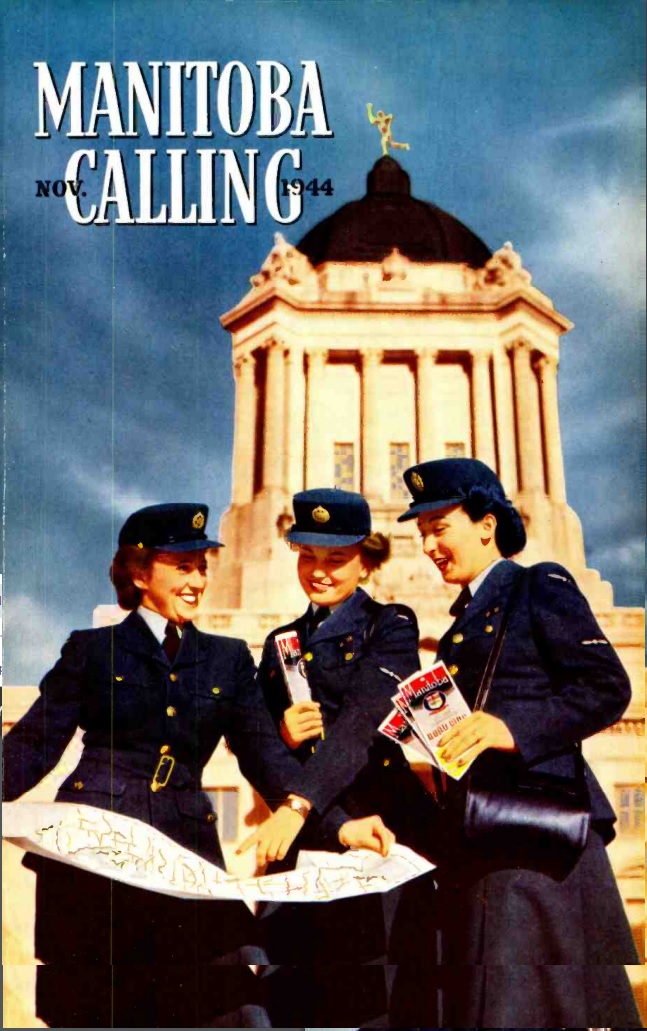
1944NovManitobaCallingShown above, in front of the Manitoba Legislative Building, are three members of the Women’s Division of the Royal Canadian Air Force. They are Airwomen Elsie Flynn of St. John’s, Newfoundland, Ricky Swedesky of Vancouver, and Dorothy Kidd of Winnipeg. They were all stationed at the No. 8 Repair Depot, Stevenson Field, Manitoba.

Elsie served as a cook in the sergeants’ mess. Ricky was a fabric worker, and repaired the skin covering the airframe of training aircraft. She also packed parachutes. Dorothy was en equipment assistant.

1944NovManitobaCalling2The photo appeared on the cover of the November 1944 issue of Manitoba Calling, the program guide for CKY Winnipeg, pointed out that the Women’s Division slogan was, “they serve that men may fly.” The appearance of women in the air force meant that men were freed up from various ground duties and moved to air training. The magazine pointed out that the Women’s Division included not only girls from every corner of Canada, but also from the United States, Newfoundland, and the West Indies.

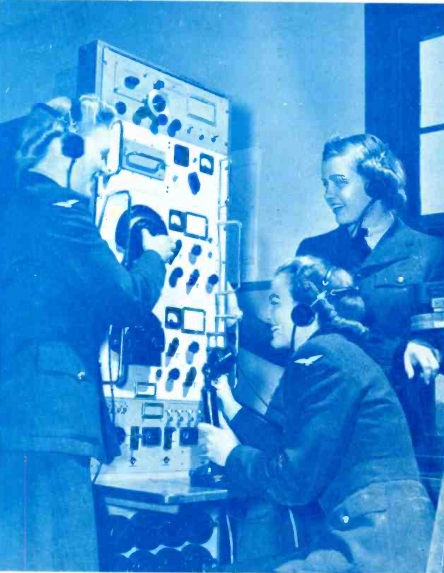
Shown at left are Airwomen Olive Carlson of Nanaimo, B.C., Joyce Urie of Windsor, Ont., and “Petie” Houston of Hamilton, Ont. They are at the controls of radiotelephone equipment and tasked with maintaining contact between the ground and Canadian aircraft aloft.


War Plant Worker – 1944

1944NovRadioNews

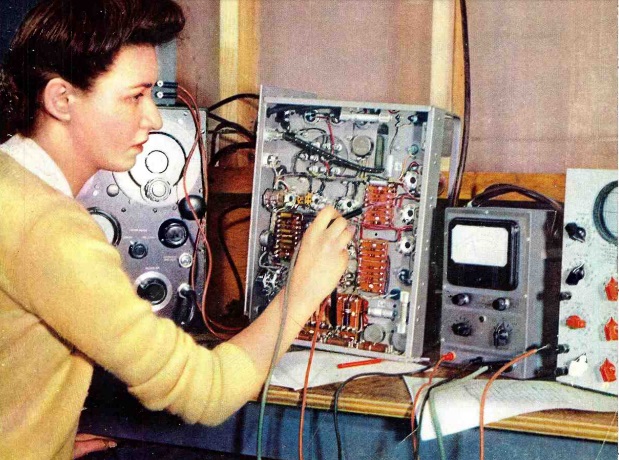
The war plant worker shown here is conducting perfomance tests on a piece of military equipment. She is in a copper-screened booth at RCA laboratory. The picture appeared 75 years ago this month, November 1944, on the cover of Radio News.


Rose Ann “Tex” Barbarite, W3FUS

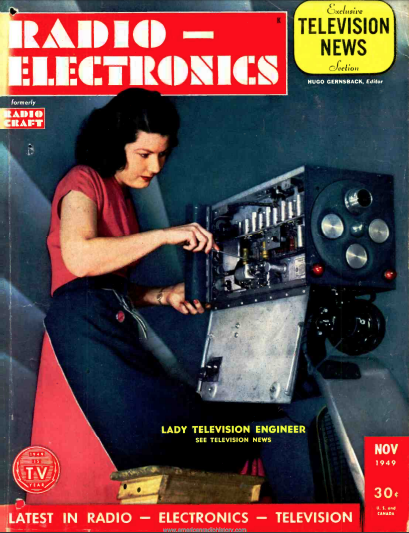
Screen Shot 2019-11-14 at 11.33.00 AMShown here 70 years ago this month on the cover of Radio-Electronics, November 1949, is Rose Ann “Tex” Barbarite (nee Longnecker), described by the magazine as a “lady television engineer.” The magazine contains a brief autobiography of her as a pioneer in engineering.

She writes that radio had been her hobby since her youngest days, when she built crystal sets with her brothers. When those were outgrown, they moved to vacuum tube circuits.

When she started a private girls school, however, she found herself unhappy, since the school viewed science and math as unnecessary for a girl. Undaunted, however, after graduation, she started at the Texas College of Mines in El Paso majoring in math. She was offered an electrical engineering scholarship at Purdue, where she found that the engineering profession was opening up to women, due to wartime labor shortages.

At the time of the magazine article, she was employed by RCA at its Exhibition Hall in New York. She had also taught basic radio theory and code to Civil Air Patrol cadets.

Ms. Barbarite eventually stopped working to raise four children. However, from 1985 to 1987, she was a member of the Peace Corps and taught at a high school in Belize. She died in 1998 at the age of 73 in Columbia, Maryland.

She was licensed as a ham in 1957 as W3FUS.


1939 Cuban Two Tube Transmitter

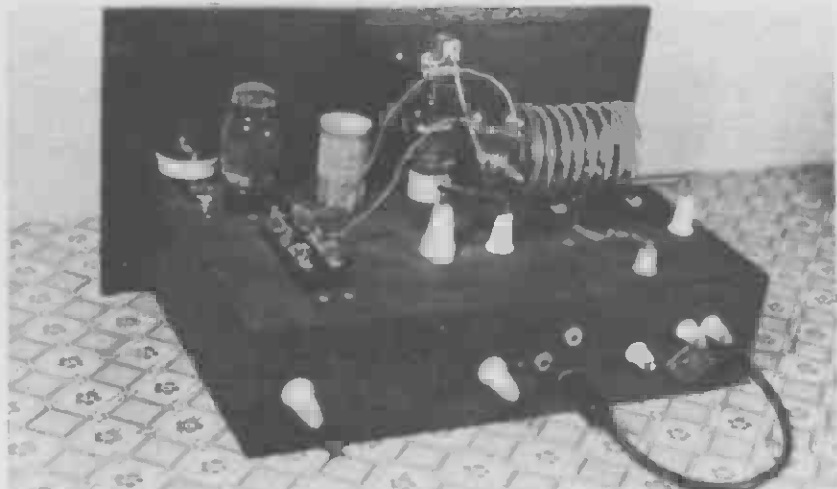
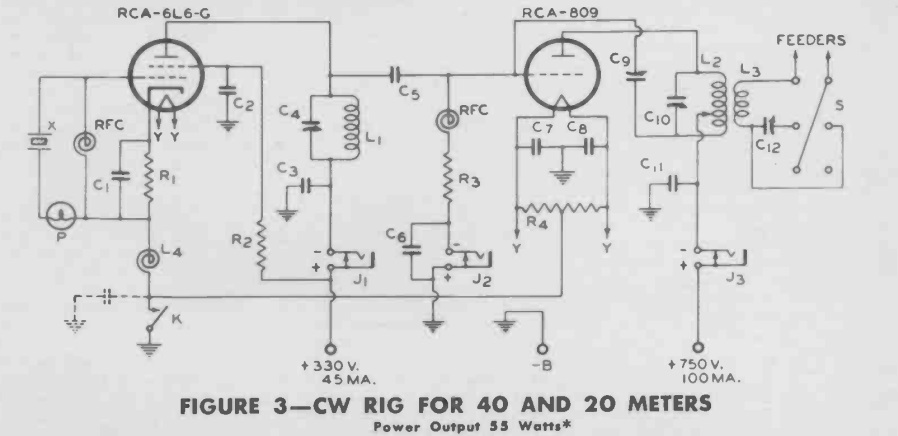
CM2ADtransmitterEighty years ago this month, RCA’s newsletter for hams, RCA Ham Tips, November 1939, carried this two-tube transmitter for 40 and 20 meters. The circuit was submitted to the magazine by Cuban Adolfo Dominguez, Jr., CM2AD, who earned himself a new 809 tube and $5. It used a 6L6-G (an RCA 6L6-G, to be specific) oscillator which drove an 809 final. CM2AD reported that he had built three such rigs for friends, and they all worked well. In fact, he had used the rig himself for Worked All Continents and Worked All States, with 62 countries worked.

The set used 40 meter crystals for both bands. Having first been licensed in the 1970s, to me, Cuban CW signals are synonymous with chirp. That was apparently the case in 1939, as the editors diplomatically raised the subject: “Although CM2AD did not mention trouble from ‘chirps’ when the 6L6-G is keyed, it is possible that a steadier note can be obtained” by making a slight modification to the circuit.

CM2AD had the same circuit published in QST in the May, 1939, issue.

CM2ADtransmitterSchematic