Author Archives: clem.law@usa.net

Winter Field Day 2021

WFD1This previous weekend was Winter Field Day.  While this event is billed as an emergency preparedness exercise, it’s also simply a fun opportunity to get on the air from a portable location, and make the most of limited resources.

As happened with ARRL Field Day this past June, the event was affected by COVID-19.  Since the pandemic generally prevents operation as a group, many who would have otherwise participated stayed home.  But in my opinion, being part of a group is not what defines this event.  The event is not called “Group Day,” it is called “Field Day.”  The focus is operating from out in the field somewhere.  And while groups of people can be dangerous because of COVID, there is absolutely nothing that is unsafe about a field.  I was completely socially distanced during the entire event.  I saw a few other campers and said hello to some of them from 50 feet away.  As I’ve previously written, camping is an excellent safe way to travel during the pandemic.

As an emergency preparedness exercise, it seems to me that it was best to adapt to the actual emergency conditions.  Because of COVID, it wasn’t possible to do it as a group.  But in many emergency situations, a group of helpers might not be available to set up a station and get it on the air.  It seems to me that the ability to get a station on the air, even a minimalist station, without outside assistance, is a valuable skill in an emergency.
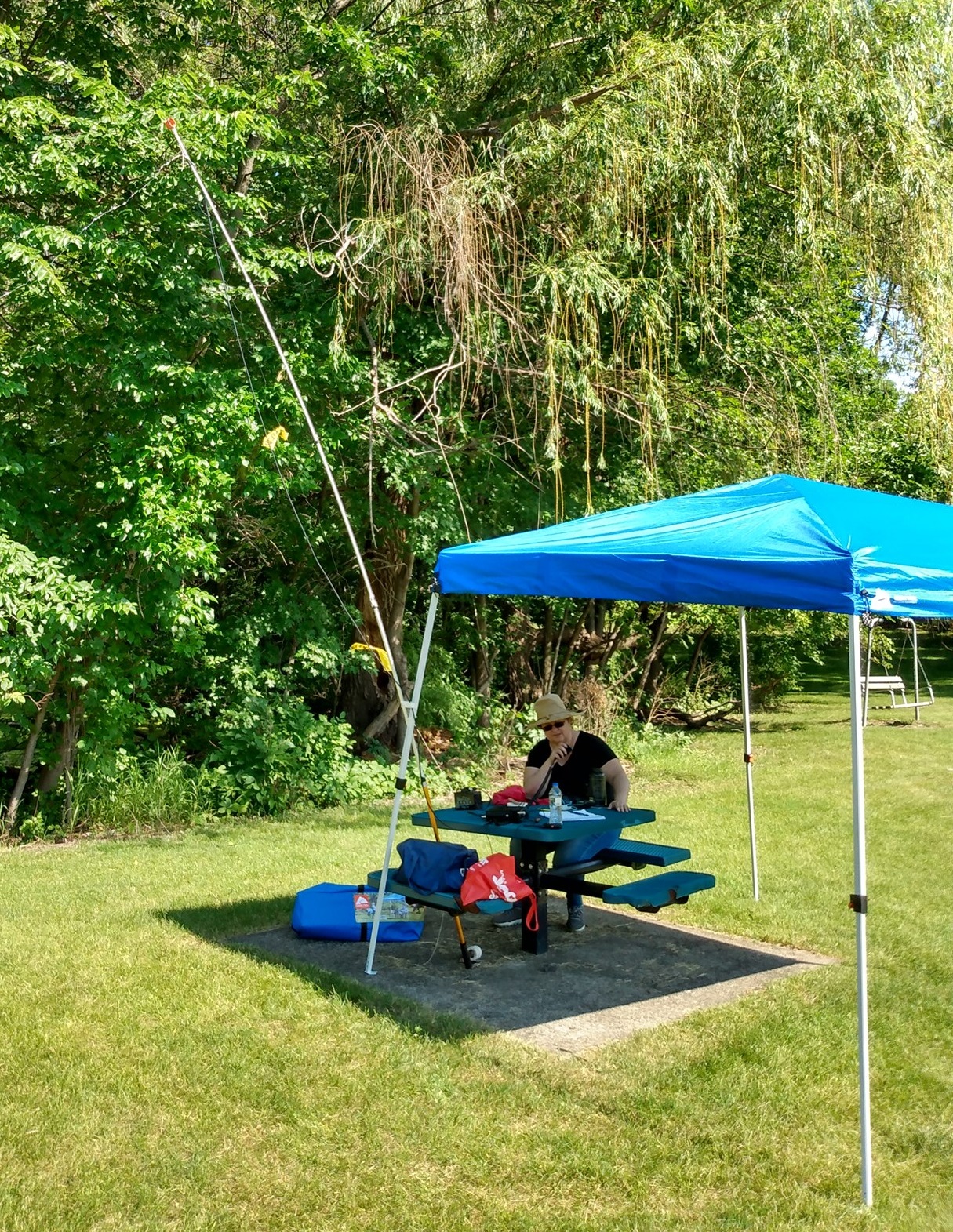
FD1For summer Field Day, my wife and I operated for an hour or two from a city park, shown here.  If it weren’t for all of the naysayers lamenting that they had to stay home for Winter Field Day, I probably would have done something similar and just operated for a while from the back yard, or maybe again from a city park.  But since so many people were lamenting that it was impossible to truly go out and operate away from home, I decided to do a winter camping trip in our popup camper.

I made reservations for William O’Brien State Park, which is only a 45 minute drive from home.  The temperature never got below 20 degrees, and it was actually a very nice weekend for camping.  There were several other campers in the campground.  I spotted three RV’s, as well as three family groups camping in tents.  Also, I believe at least one of the park’s cabins was occupied.  So at least a few non-hams were undaunted by being in the field in the middle of winter, in the middle of a pandemic.

Even though it’s not insulated, the popup camper stays quite warm inside with electric heaters and/or the furnace running.  Since I was paying for the electricity anyway, I used two electric space heaters.  One was plugged into the outlet in the camper, which was hooked up to the campground’s 30 amp circuit.  The other heater was plugged into a separate extension cord going to the campground’s 20 amp circuit.  Therefore, if needed, I could run both heaters full blast.  When I needed the electricity for cooking, I temporarily unplugged one of the heaters.  There was a light dusting of snow Sunday morning, but the camper’s canvas was bone dry by the time I folded it up.
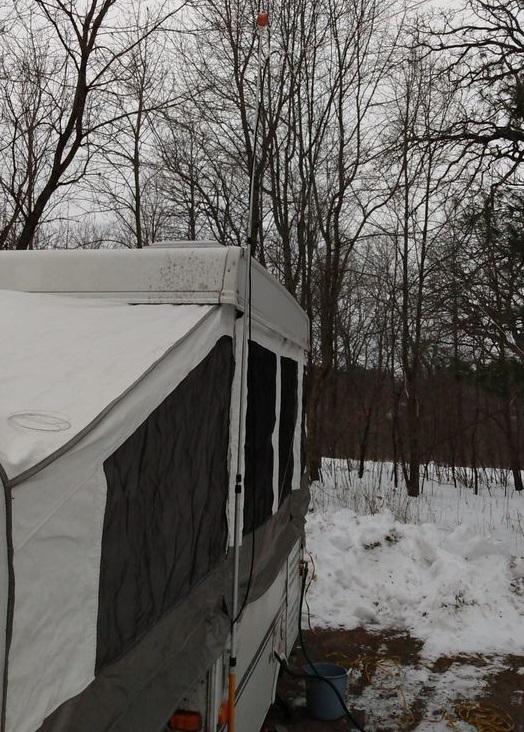
WFD2I didn’t set out to make hundreds of contacts.  In fact, after making the first one, which happened to be with Rhode Island, I felt like I had proved the concept.  But I was on the air for a total of about three hours out of the 24 hours of the contest, and made 27 contacts with 14 states.

Only eight of those contacts were with other portable stations.  Six were outdoors, and two were indoors but at temporary locations.  I’m grateful for the other 19, who were operating at their home stations, since they gave me someone to make contacts with.  But I feel a little sorry for them that they didn’t figure out some way to operate in an actual field for Field Day, even though they couldn’t do it as part of a group.  Also, I was a little bit mystified to hear home stations working other home stations, while calling it Field Day.  For previous Field Days when I’ve stayed home, I’ve often made some contacts, but since it’s Field Day, I’ve made a point to seek out stations who were actually in a field.  There are contests almost every weekend that are geared up for home stations to work other home stations.  I guess I don’t see the point of ignoring those opportunities, and then getting on only for a weekend called Field Day.  Again, I was grateful that I had stations to work, but I really didn’t get the point of home stations spending the whole weekend working other home stations.

My original plan was to use dipoles for 20 and 40 meters, along with a quarter wave wire for 80 meters.  The 80 meter wire was a bust, and didn’t really get out, due undoubtedly to its very low height and lack of much of a ground system.  But the dipole for 20 meters did a great job, and I made all of my contacts on that band.  You can see (just barely) that antenna at left.  It’s held up at the center, inverted-vee style, with my telescoping golf ball retriever, and the ends are tied loosely to some bushes that happened to be at about the right spot.  I was running low on wire before the contest, so I ordered a roll of speaker wire that did the job.  I cut it to the proper length of about 16-1/2 feet, and then unzipped it when it was in place.  I thought I had forgotten to bring a tape measure (it turns out there was one in the toolbox), but I used a six-inch ruler to measure the table, and then used the table to measure the wire.

My original plan was to put up a 40 meter antenna as well, but when 20 meters closed in the early evening, I decided to simply call it a night, and made a few more contacts Sunday morning.  As with most of my NPOTA activations, I operated mostly CW, but also made a few SSB contacts.  I also made one PSK-31 contact using my tablet computer and the DroidPSK app.

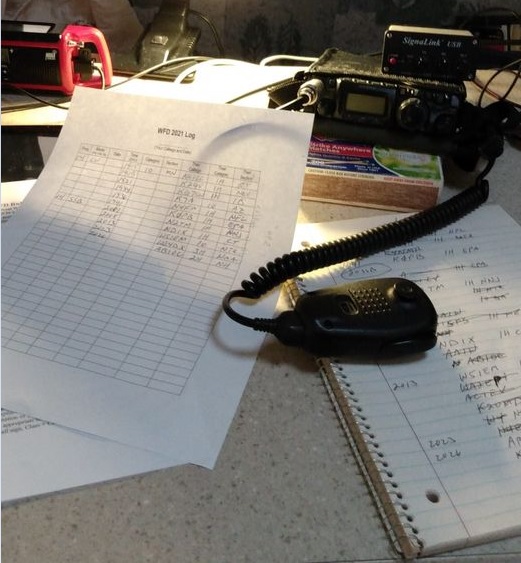
My station consisted of my Yaesu FT-817 powered by a fish-finder battery, which still had plenty of charge left at the end of the contest.  The one digital contact was made possible with the Signalink USB interface, which performed flawlessly with the inexpensive RCA tablet computer.  For some reason, the tablet’s keyboard didn’t work very well with the DroidPSK software, so I had to use the touchscreen, which seemed like a rather laborious process to me.  I probably could have made the process much easier by setting up some macros in advance.  But for the first time using it, I was glad that I was able to make my first ever portable digital contact.

As you can see in the picture above, I needed something to prop up the radio on the table, and a box of matches did a perfect job with this important task.

Am I going to save any lives with my ability to operate a portable station?  Almost certainly not.  On the other hand, if there is ever an emergency, large or small, that makes other forms of communication impossible, I know that I am able to send messages to friends and relatives in other states.  I can do it formally by checking in to a National Traffic System net, or I can do it informally simply by working someone and asking them to make a phone call or send an e-mail for me.  I can also do that for neighbors who want to let their friends in other states know that they’re safe.  I’m also well equipped to receive information from the outside world simply by knowing that I can power up a broadcast receiver to listen to either local or distant stations.  It’s unlikely that I’ll ever have a need, but it’s good to know that I have the ability.

The point of exercises like Field Day is to show that hams can adapt to emergency situations and still be able to communicate.  COVID has shown us that there are some emergencies where you are cut off from the group that normally helps you establish communications.  Can you adapt and still communicate if you are cut off from both this group and your normal station setup?  Field Day and Winter Field Day during COVID gave me the opportunity to show that I can.

Here’s a short video tour of my setup:


Some links on this page are affiliate links, meaning that this site earns a small commission if you make a purchase after clicking on the link.
1941 Breadboard Crystal Set

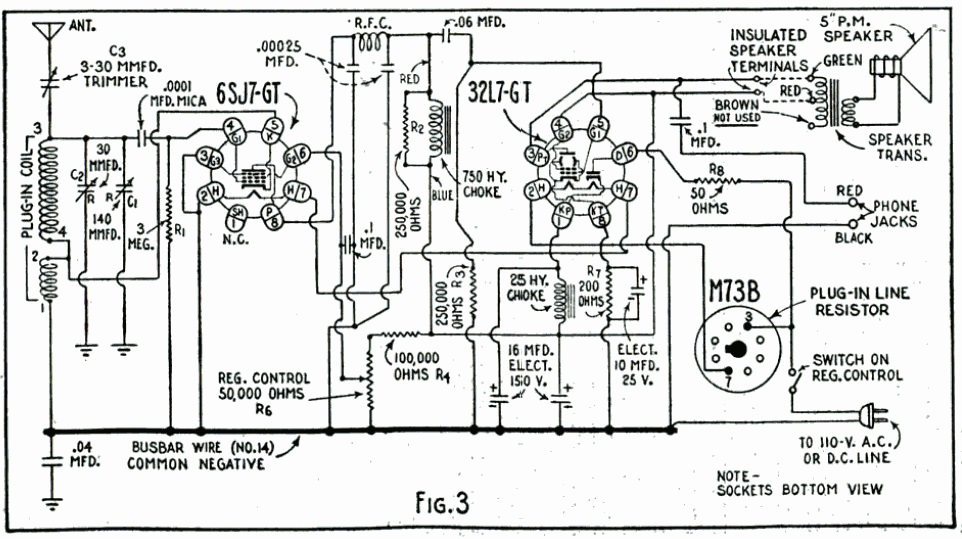
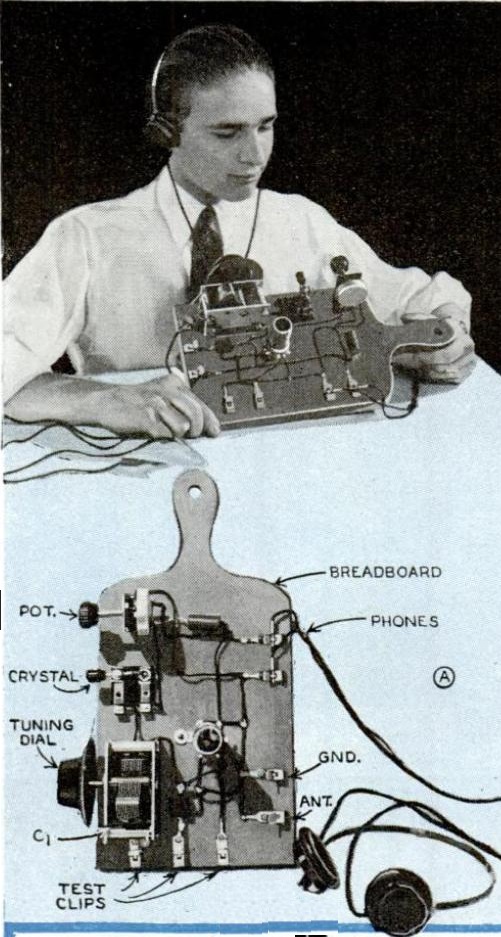
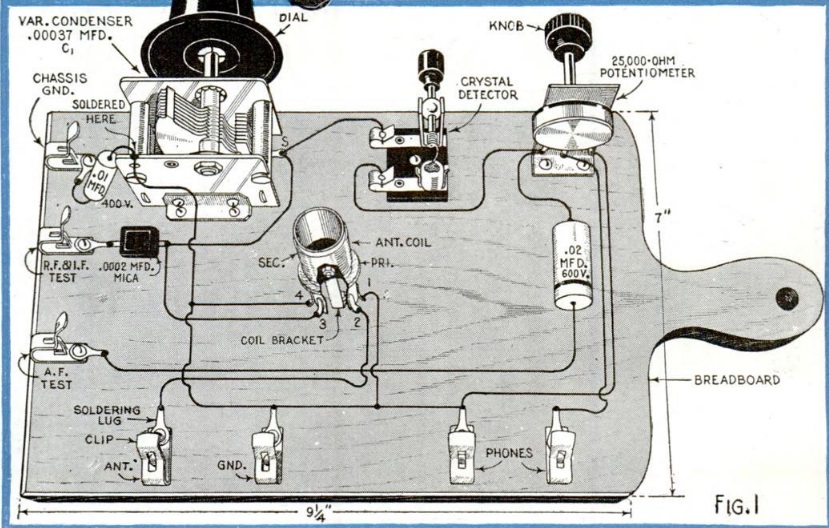
1941JanPM3The plans for this crystal set appeared 80 years ago this month in the January 1941 issue of Popular Mechanics. Laying out a circuit in this manner is often called “breadboarding,” and this picture shows why.  The chassis for the set was a literal breadboard.

In addition to serving as a radio, the set could also be used as a piece of test equipment.  It had terminals for incoming AF or RF, and could be used as a signal tracer to troubleshoot other radios.


1941JanPM4

Detroit Radio Concerts, 1921

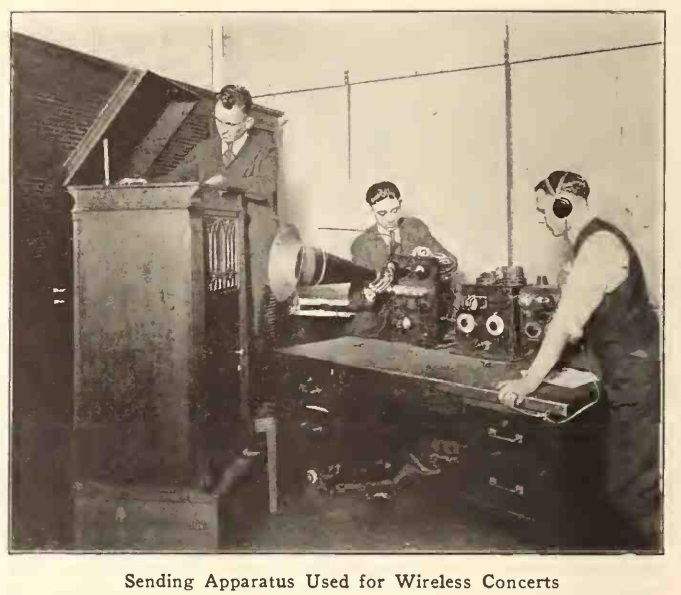
1921JanTalkMachWorld2This photo, in the January 1921 issue of Talking Machine World, shows an early radio broadcast taking place a century ago in Detroit.

The magazine noted that a number of well-to-do residents and members of the Detroit Radio Association were able to tune in radio concerts and dances, furnished by the Edison phonograph, “providing diversion simultaneously in a number of homes, of which some actually are located between four and five miles away.” In some cases, musicians played in unison with the phonograph.

Among the younger set, radio dances had taken a permanent place as a popular pastime, “in the home of those fortunate enough to have had the necessary receiving apparatus installed.”


1961 BSA Radio Gear

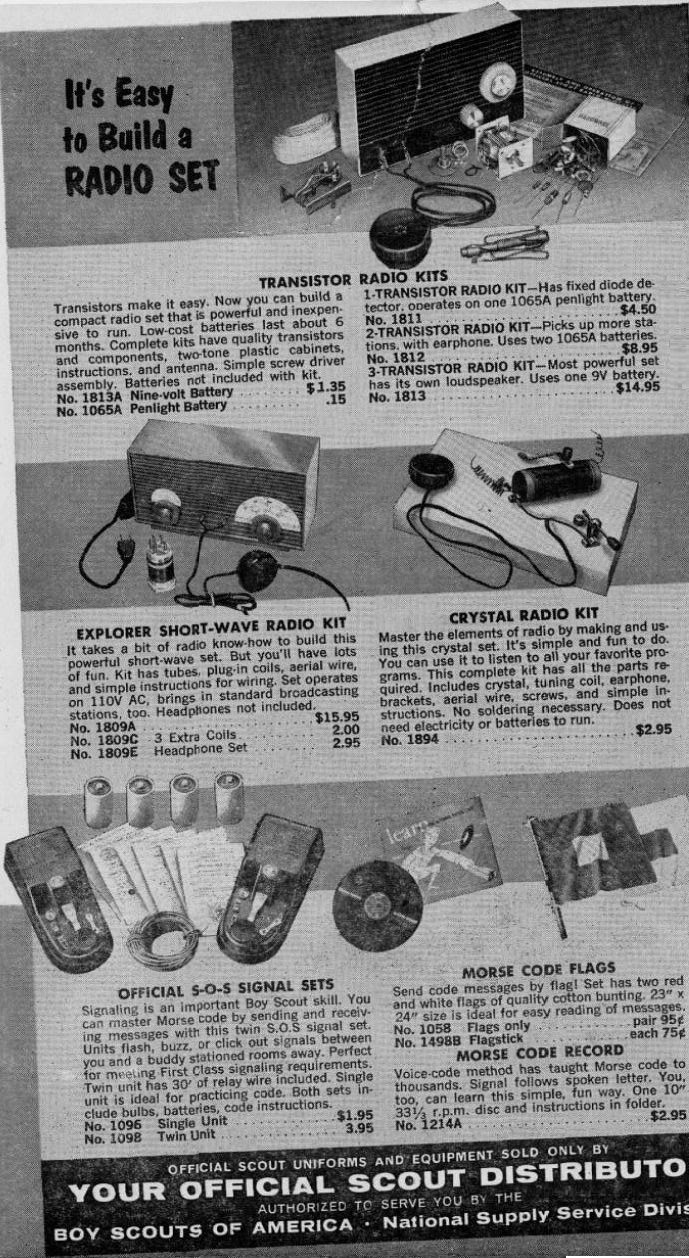
1961JanBLSixty years ago, the Boy Scout with an interest in radio could get everything he needed to get started from the BSA National Supply Division at his local official BSA dealer, as shown here in the January 1961 issue of Boys’ Life.

He would very likely be the first on his block to own a transistor radio by putting together one of three kits. The simplest one, which probably required an outdoor antenna, was a fixed diode plus one transistor, which would set him back $4.50. The two transistor model would pull in more stations for $8.95. And everyone would be impressed if he put together the $14.95 three-transistor set, which would give loudspeaker volume.

The beginner could put together the crystal set for only $2.96, complete with cardboard base. And to pull in the shortwaves, the tube set for $15.95 wouild get both broadcast and shortwave.

For code practice, there was a signal set for $1.95 each or $3.95 for two. If the Scout was good at math, he would realize he was paying a nickel more if he bought two, but that’s explained by the fact that it came with 30 feet of wire. And to get started, a code record could be had for $2.95.


1921 Alarm Clock Extension

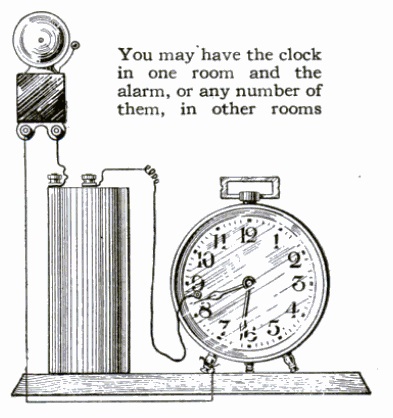
1921JanPMclock

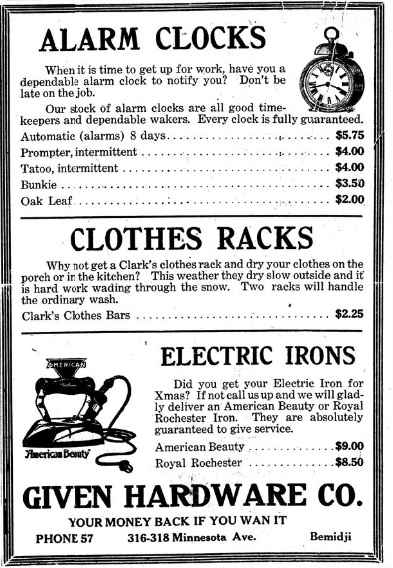
1921Jan4BdjiPioneerAs you can see from the ad at the left, an alarm clock was a non-trivial expense a hundred years ago. This store, the the Given Hardware Company, 316-318 Minnesota Avenue, Bemidji, Minnesota, had models ranging in price from $2.00 to $5.75. That doesn’t sound like a lot of money, but according to this inflation calculator, that works out to a range of $28.92 to $83.14 in today’s money. If you had a clock in one room and wanted to hear the alarm in another room, going out and buying a new one would constitute an unnecessary expense.

You can compare that price to some of the perfectly functional, extremely accurate clocks below, all of which are probably orders of magnitude better than the 1921 model:

In fact, you can probably get a perfectly suitable alarm clock at the closest dollar store. So if you need an alarm clock in another room, or need a louder alarm clock, it’s a simple matter of going to the store or going to Amazon and just buying one.

But a hundred years ago, it was a problem best solved by ingenuity, as shown by the self-explanatory idea shown above. This relied on the fact that the glass of most alarm clocks could be rotated, but would still hold its position. Therefore, a small hole was drilled in the glass and a machine screw was carefully inserted so that it would contact the hour hand, but not interfere with the minute hand. A small piece of spring brass wire was soldered to the hour hand to serve as a brush and make contact. The alarm could be set to any desired time simply by revolving the glass.

In case you’re wondering how much the doorbell cost, this 1918 Western Electric catalog showed them starting for about $1.30, and the dry cell battery was about 60 cents.

This idea appeared in the January, 1928, issue of Popular Science, and had been sent in to the magazine by one G.H. Rouse. The ad appeared in the Bemidji Daily Pioneer, January 4, 1921.


1921 Printing Radiotelegraph

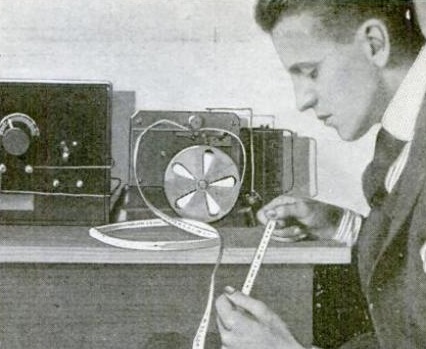
1921JanPScodereaderThis gentleman, shown in the January, 1921, issue of Popular Science, wasn’t a QRQ operator, but he was still able to copy even the fastest radiotelegraph stations thanks to this device developed by William G. Finch of Buffalo, New York.  Instead of the familiar buzz in the headphones, the code was rendered as dots and dashes printed on paper tape, which could be read at the operator’s leisure.  The device employed an ultra-sensitive relay along with an “ordinary printing telegraph machine.”

The “ordinary printing telegraph machine” had actually been around for quite some time, since the first telegraphs were designed to print the dots and dashes, rather than be copied aurally.  It was later discovered that the operators could hear the letters as they came in, and that became the norm.


Science Fair Idea: Barkhausen Effect

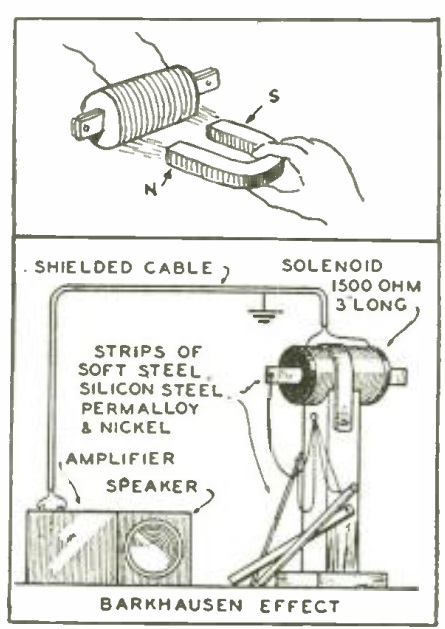
1941JanRadioTV2The young scientist wishing to create a simple but spectacular science fair project is almost assured of taking home the blue ribbon by duplicating the 1919 experiment of German scientist Heinrich Barkhausen establishing the domain theory of magnetism. When a piece of ferrous material is magnetized, it does not magnetize evenly. Instead, tiny pieces of material are magnetized together in discrete pieces. This is known as the Barkhausen effect.

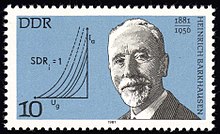
Stamp Heinrich Barkhausen.jpg

Barkhausen on 1981 East German stamp. Wikipedia image.

To prove this, a coil is wrapped around a piece of iron, and the coil is connected to the input of an audio amplifier. As a magnet is brought toward the coil, static is heard in the speaker. But if the iron core is removed and the experiment repeated, the static is absent. A simulation of the effect can be found at this link.

Replica of Barkhausen’s experiment. Wikipedia photo.

Full instructions can be found in the January 1941 issue of Radio & Television magazine. You will need 38 gauge or smaller enamel wire to wind the coil, as well as an audio amplifier and speaker.


Ernest Sperling, 9BBF, W9BKX

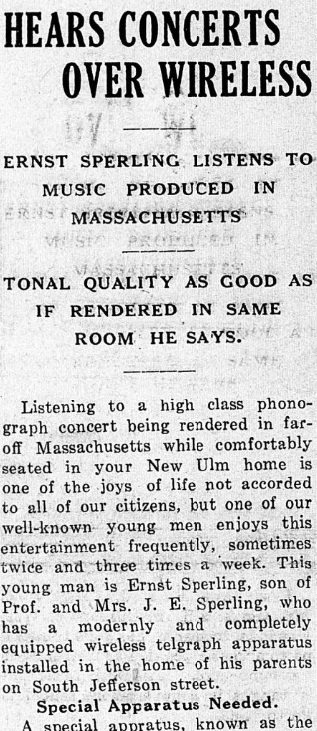
1921Jan26NewUlmThis article appeared a hundred years ago today, in the January 26, 1921 issue of the New Ulm (MN) Review.

HEARS CONCERTS OVER WIRELESS

ERNST SPERLING LISTENS TO MUSIC PRODUCED IN MASSACHUSSETS

TONAL QUALITY AS GOOD AS IF RENDERED IN SAME ROOM HE SAYS

Listening to a high class phonograph concert being rendered in far off Massachusetts while comfortably seated your New Ulm home is one of the joys of life not accorded to all of our citizens, but one of our well-known young men enjoys this entertainment frequently, sometimes twice and three times a week. This young man is Ernst Sperling, son of Prof. and Mrs. J. E. Sperling, who has a modernly a completely equipped wireless telegraph apparatus installed the home of his parents on [21] South Jefferson street.

Special Apparatus Needed.

A special apparatus, known as the audion receiving set, is necessary to receive music by wireless. This apparatus is more sensitive and of a better grade than the regular wireless receiving instrument. There is very little electrical energy used in transmitting music waves by wireless, so that the detector must be unusually sensitive, or the other tones will not be clear. Another important factor in the transmission of music via wireless is the prevailing weather conditions. If the air is clear and quiet, with no perceptible wind, the music is much more audible and there is no rising or falling of the tone During a wind that is strong enough to sway the antenna the music sounds as if it were being played on a phonograph, the modultor of which is being changed constantly.

News Every Night.

Mr. Sperling spends a considerable part of his spare time evenings at his wireless instrument and receives many messages containing accounts of important happenings not only in this country but abroad also. One of the principal sources of this in formation is the big wireless station on Arlington Heights, near Washington, D. C., from which such messages are sent out every evening. He also receives messages from commercial stations every section of the United States, the most distant one being located in Alaska.

“Connect” With Europe.

Mr Sperling is at present working on a large receiving set, which, when completed, will enable him to get wireless messages direct from Europe, thus enlarging the scope of his wire less work. Quite a number of interested New Ulmites have visited the Sperling home to view the young man’s wireless apparatus and have him explain its workings.

Later in the year, the newspaper’s June 1, 1921, edition reported that young Mr. Sperling had agreed to supply farm market reports to the telephone company, which made them available to local farmers.

Sperling is listed in the 1922 callbook as being licensed as 9BBF (with his name spelled Ernest). His father, Prof. J.E. Sperling of Dr. Martin Luther College is listed in this yearbook as a Pastor Emeritus of the Joint Wisconsin Synod of the Lutheran Church.

In the 1937 callbook, Ernest is listed as one of two licensees, along with one Victor H. Schleuder, as licensee of W9BKX of 313 S. State St., New Ulm. He is listed in the 1940 census as living at 21 South Franklin.


Print Your Own Postcards: 1951

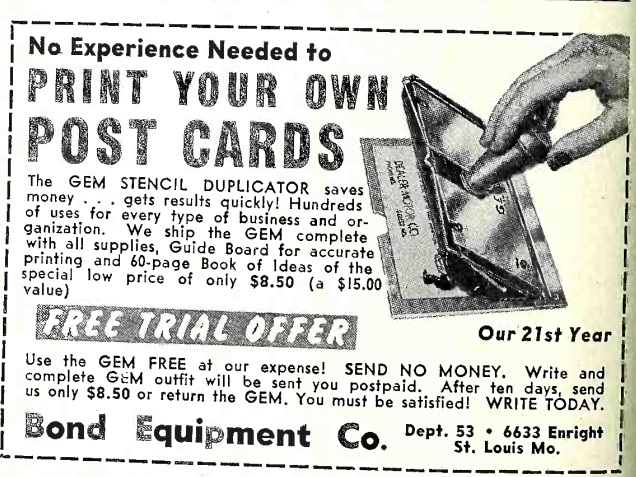
1941JanRadioRetailingA80 years ago, the small retailer, such as a radio dealer, would probably find this to be a very economical way to advertise. For $8.50, he would get everything necessary to print postcards himself, and then he could mail them out for one cent.

The device is a small mimeograph, or stencil duplicator.  The mimeograph should not be confused with the spirit duplicator, or ditto machine, although it often is.  The mimeograph used a stencil, a thin membrane which was physically cut by a typewriter without a ribbon.  The ink was forced through the resulting holes, making a very good image.

This inexpensive model was smaller than most, but could print a postcard in much the same way that one would use a rubber stamp.

If you’re looking for another antique method of printing, check out my hectograph page.

The ad appeared 70 years ago this month in Radio Retailing magazine, January 1951


1951 Arvin Model 4162 CM Console TV

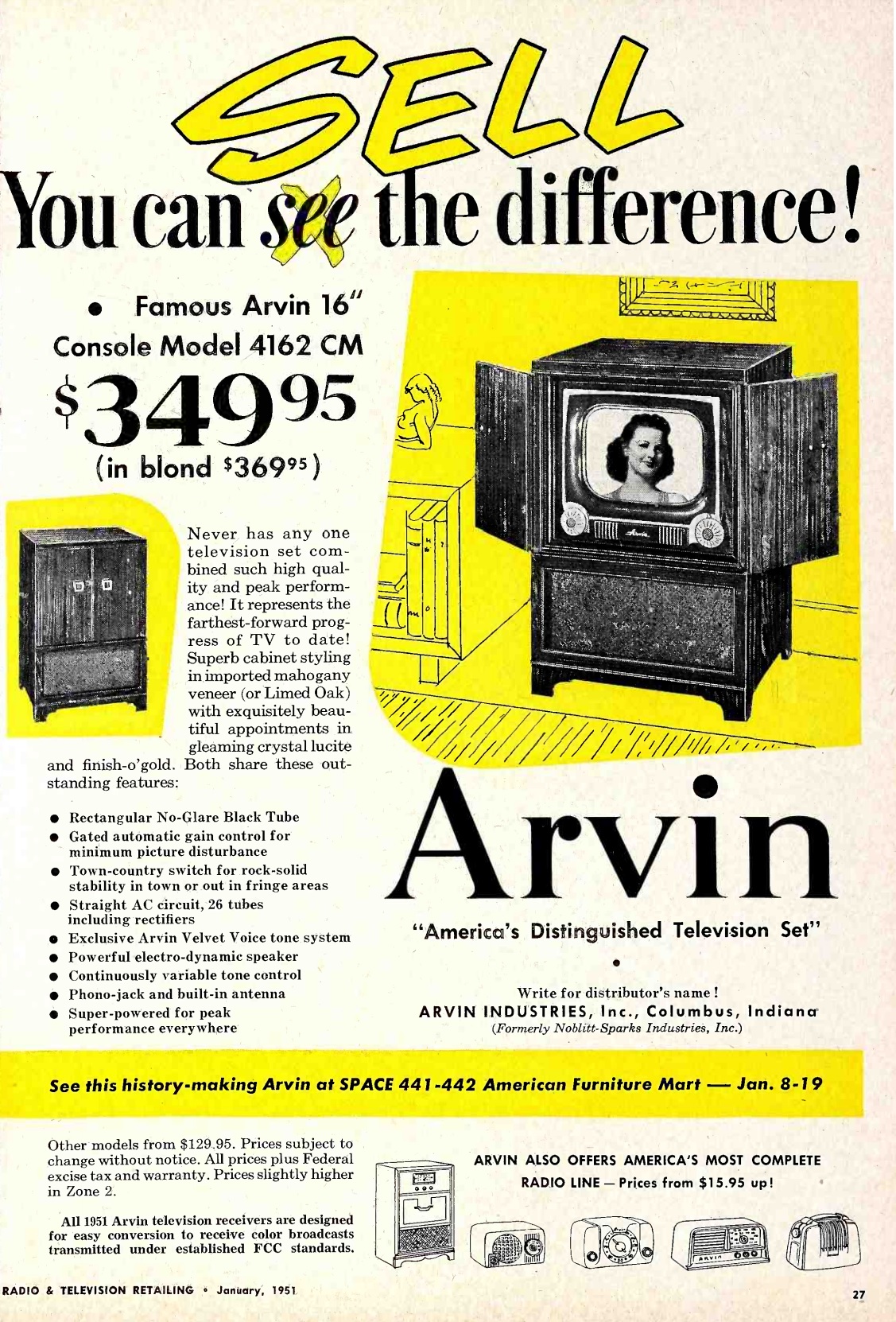
1951JanRadioTVRetailingThis ad for Arvin Television appeared seventy years ago this month in the January 1951 issue of Radio & Television Retailing.

It highlights their top-of-the-line console, the 16 inch model 4162 CM, which retailed for $349.95 (or an extra $20 for a blond cabinet), plus federal excise tax and warranty. Other sets started at $129.95, and the ad reminded dealers that the company had America’s most complete radio line, starting at $15.95, all of which rolled off the assembly line of Arvin Industries, Inc., of Columbus, Indiana.