Author Archives: clem.law@usa.net

Stringing the Dial Cord

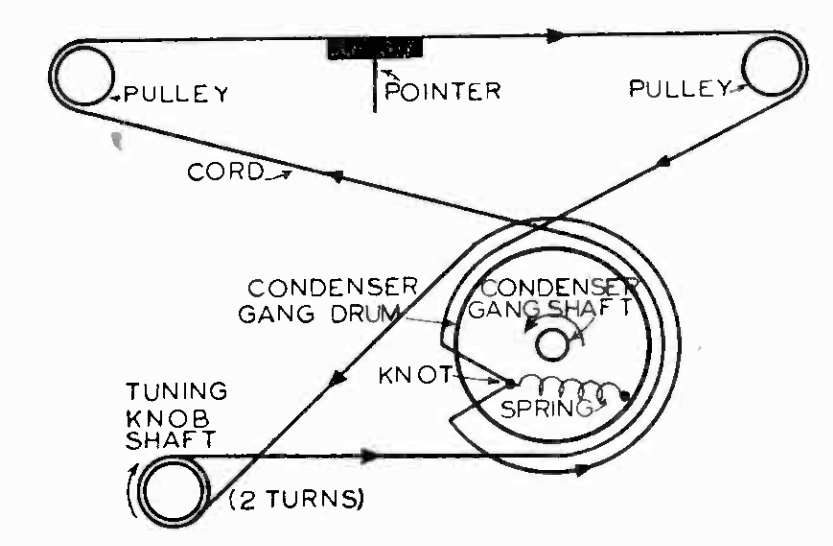
1946FebNatRadioNewsEven for the electronic genius who is repairing or restoring an old radio, stringing the dial cord is often a vexing problem. It’s a deceptively simple mechanism–you turn the tuning knob, and a string turns the tuning capacitor, and also moves a pointer along the dial. But the devil is in the details–it has to be set up so that a full 180 degree rotation of the variable capacitor results in the dial pointer moving the full length of the dial. Invariably, if you’re not careful, things don’t sync up.

An article in the February-March 1946 issue of National Radio News serves as a good primer on how to do it. The author notes that there are so many variations that even a much longer article wouldn’t cover them all. Fortunately, in most cases, the technician could write to the manufacturer and get a diagram. These days, the dial stringing diagram is often available at the same online sources that carry the schematic diagrams.

If the diagram was not available, the first step was to make a sketch. If the old cord was still in place, the first order of business would be to make an accurate diagram of exactly how it was hooked up.

If the dial cord was already broken or missing, then the first step was to try to figure it out and still draw a diagram. In this case, the diagram would serve two purposes. If the original guess was correct, then it would serve as a guide to do the job. But if it didn’t work, it would document one possibility that didn’t work, thus helping with the process of elimination.

The article cautioned that normal string could not be used for a replacement cord, since it tended to stretch. Instead, the magazine suggested silk or nylon fish cord as one possibility.

Overall, the article serves as a good introduction to the subject, and if you’re faced with this daunting task, I recommend giving it a read before trying to tackle the job.


1941 Four Tube TRF Tuner

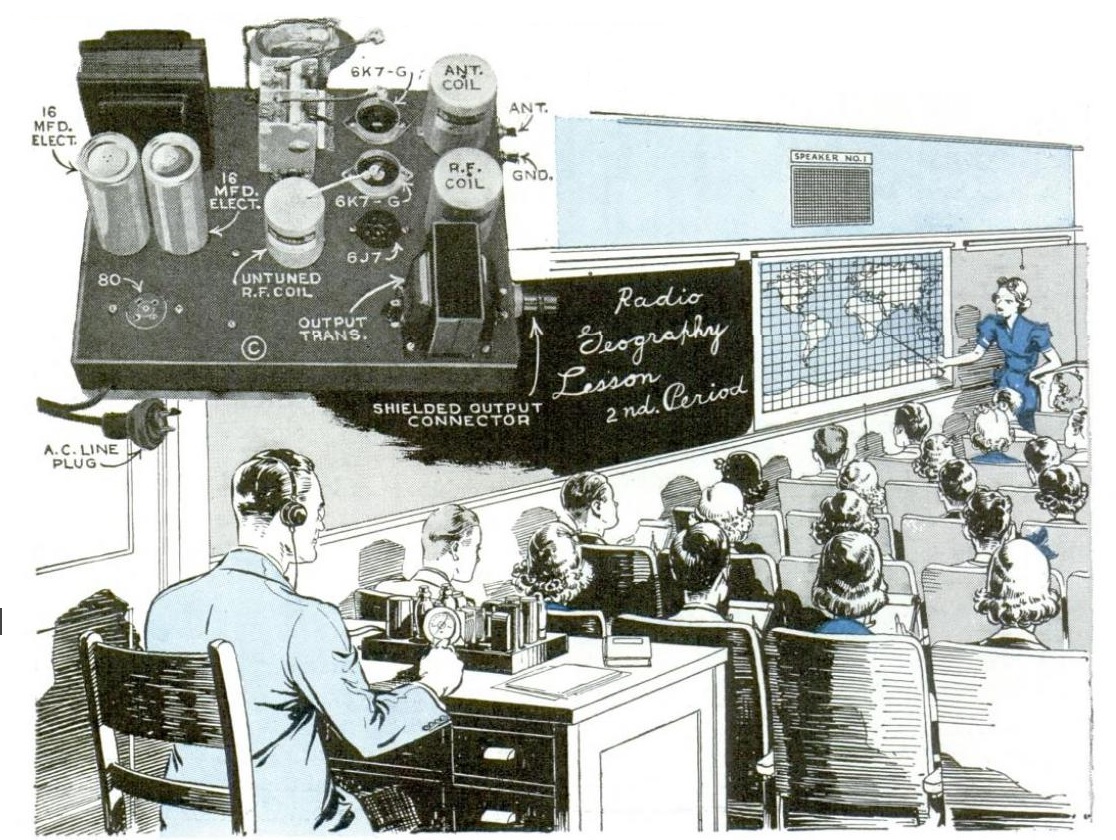
1941FebPMEighty years ago, this second period class somewhere in America was getting ready for its radio geography lesson. While the teacher points out western Africa on the map, the audio expert at the back of the room is preparing to cue in a radio lesson on the subject, which will presumably be piped in through speaker number 1 above the map.

He’s pulling in the program on the four-tube tuner described in the February 1941 issue of Popular Mechanics. It’s a TRF tuner which is selective enough to separate the local stations, but has sufficient bandwidth to provide good reception of musical selections. The set can be run through any audio amplifier. In this case, the school is progressive enough to have a public address system installed, and the students will hear the program through it.

1941FebPM2


T Coronae Borealis Goes Nova, 1946

Yerkes Observatory. Wikipedia image.

Yerkes Observatory. Wikipedia image.

1946Feb09PghPressOn this day 75 years ago, persons on Earth were able to witness a star going nova. In particular, the star T Coronae Borealis went from being a 10th magnitude star, barely visible with binoculars, to a magnitude 3.0. There were still 120 objects in the sky that were brighter, but for a few days, it was visible to the naked eye on February 9, 1946.

This news account appeared in the Pittsburgh Press, February 9, 1946. It reported that the “atomic explosion millions of times more powerful than the bombs which hit Japan” was first observed by Arman Deutch of the University of Chicago Department of Astronomy at the Yerkes Observatory in Williams Bay, Wisconsin.

The star is a recurring nova.  It’s actually a binary system containing a large cool component and a smaller hot component. The cool component, a red giant, is transferring material to the hot white dwarf component. During outbursts, the transfer of material increases, thus increasing the overall luminosity.

The star had a brightening in 2016, which is said to be similar to a 1938 brightening that preceded the 1946 outburst. It is said to remain at an unusually high level of activity.


Postwar Radio Retailing: 1946

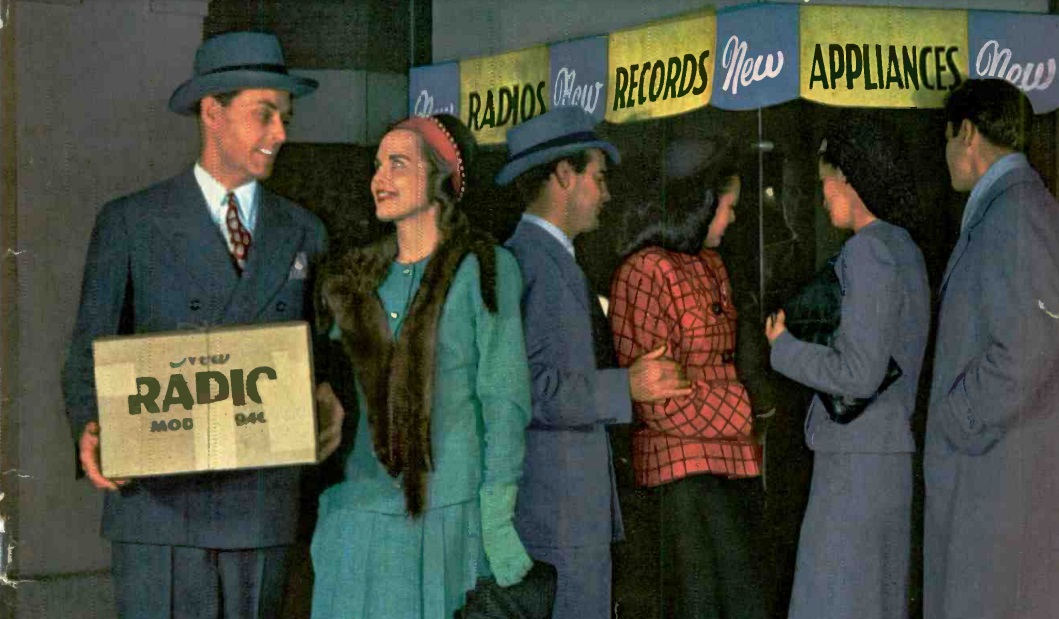
1946FebRadioRetailingShown here on the cover of Radio Retailing 75 years ago this month, February 1946, this couple are taking home their first postwar radio. New civilian radios were coming back on the market after a long absence, and there was probably still a shortage, as evidenced by the crowd clamoring behind them.

The magazine reminded dealers, however, that the time would soon come when customers would stop searching for radios. Instead, they would soon be going from store to store choosing. It warned against complacency. Even though it was currently no real task to sell anything, the dealer’s goal should be to make a customer of every shopper. In particular, customers would appreciate a little extra courtesy and consideration.

Selling a scarce item with the same degree of interest that would be called for in a competitive era would have the result of making friends and getting free advertising for his goodwill.

The day would soon come when the dealer would have to fight for every dollar, and attractive selling methods now would go a long way to bring in those dollars.


1951 Crystal Set

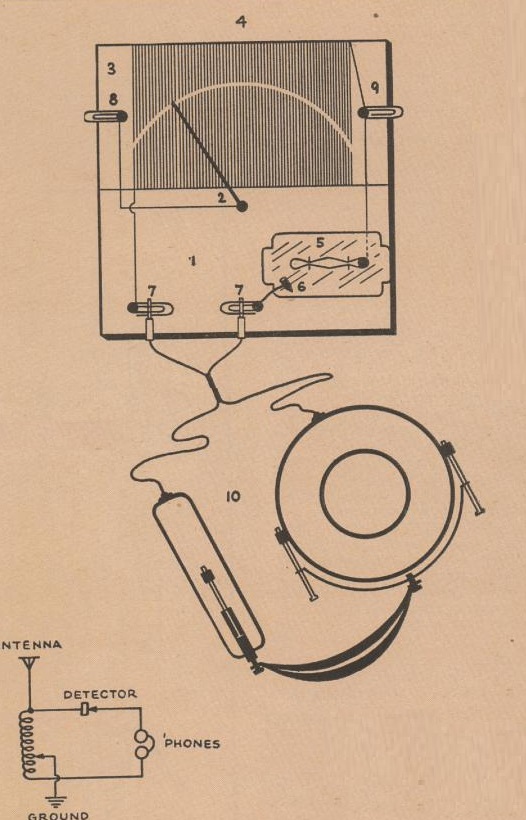
1951FebBLSeventy years ago this month, the February 1951 issue of Boys’ Life magazine showed how to put together this simple “non-crystal crystal set”. Regular readers will recognize it was the venerable “foxhole radio,” which used a razor blade and pencil lead for the detector.

The coil is wound on a flat piece of wood, measuring 4 by 2 inches and a quarter inch thick. Paper clips are used for many of the components, such as the slider and connectors.

For ideas on sourcing some of the parts, see our crystal set parts page.


Scouts Listening to the Radio, 1941

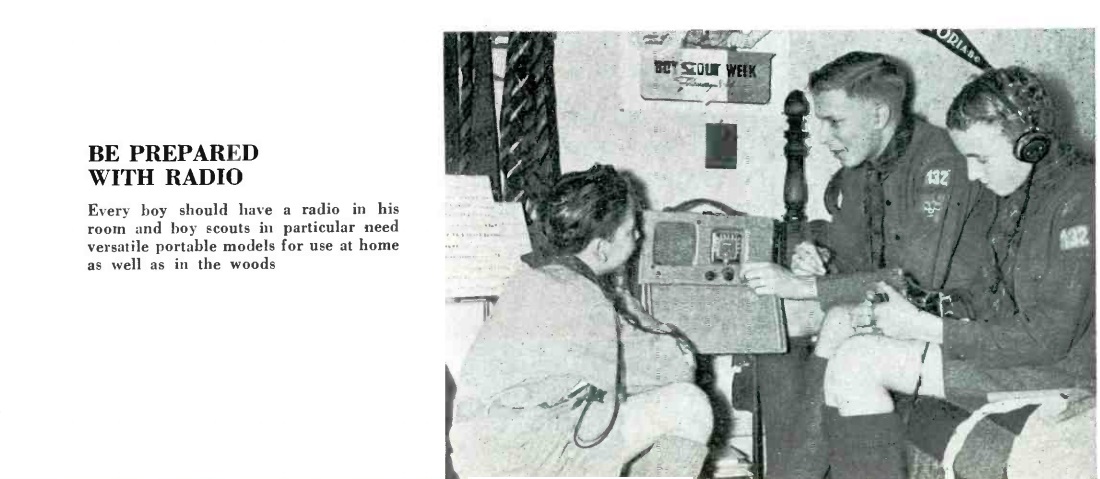
1941FebRadioRetailingEighty years ago this month, the February 1941 issue of Radio Retailing showed these Boy Scouts tuning in a program. The magazine reminded dealers that every boy should have a radio in his room, and that this was particularly true for scouts, who needed versatile portable sets for use at home or in the woods.

The Scouts are not identified, other than being from Troop 132 somewhere. The uniforms don’t look quite right for BSA uniforms, and the pennant in the background has the letters “ORIA BC” visible. I’m guessing that it reads “Victoria, BC,” and these are actually Canadian scouts.


Transformer Science Project


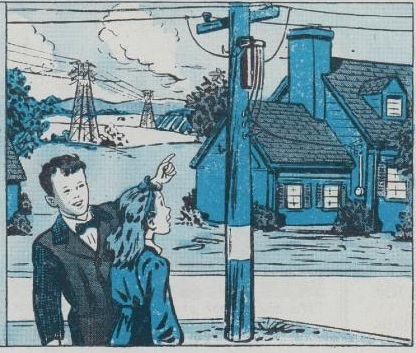
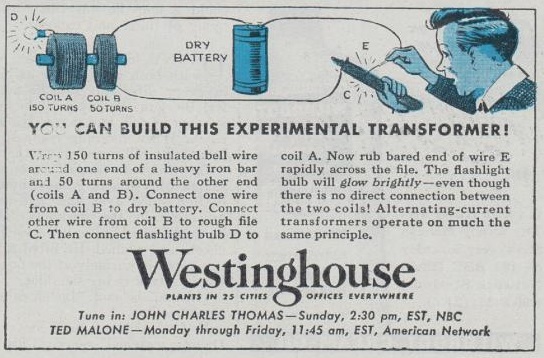
1946FebBL75 years ago, this young man discovered the secret for meeting girls. That, of course, was explaining to them how transformers worked. This young woman is obviously mesmerized by his explanation.

He gained this skill by conducting the experiment shown below. He constructed his own transformer with two coils of wire wound around an iron core. To provide the alternating current, he runs one wire along the file.

1946FebBL2

These items appeared as part of an for Westinghouse in the February, 1946, issue of Boys’ Life.  It reminded readers to tune in to programs sponsored by the company, John Charles Thomas and Ted Malone.

The science project is easily duplicated today.  While the old-style dry cell battery is no longer available, an alkaline D cell, with suitable holder, would work just fine.  The other items needed are wire, the bulb (with socket to make the connections easier), an iron bar, and file.


Science Fair Ideas: Measuring the Moon’s Diameter

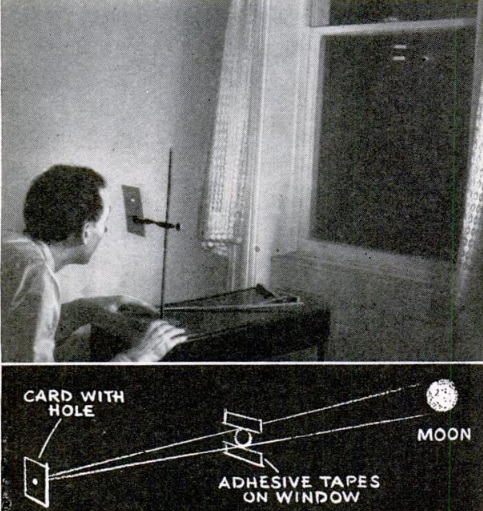
1941FebPSIf Junior is looking for a science project that can be completed in one evening, the teacher will be suitably impressed when Junior announces that he will measure the diameter of the Moon. All that’s required is a window through which the moon is visible and a couple of pieces of tape. Masking tape would probably work the best, but you could also use a couple of Post-It notes. You’ll also need a card through which you cut a hole.

Place the strips of tape on the window 1-1/4 inches apart. Then, you move the card away from the window, and keep looking through it until the moon appears to fill the space between the two pieces of tape. Measure the distance between the card and the window. At this point, the proportion of the two distances is the same as the proportion between the moon’s diameter and the distance between the moon and the earth.

Let’s say, for example, that Junior measures the distance between the card and the window as 137-1/2 inches. (Ahem, and if he does the experiment correctly, that’s the number he should get, assuming that the moon hasn’t changed size.)

According to NASA, who has been there, the moon is 238,855 miles from the earth. So we have a ratio:

1.25 / 137.5  =  X / 238,855

If Junior’s algebra is a little bit rusty, he can use this online calculator to get the answer of 2171.4 miles. According to space.com, the actual diameter is 2159.2 miles, so we would say that Junior’s method is pretty close.

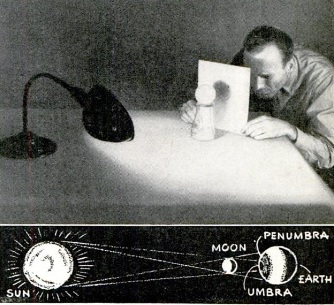
1941FebPS2The experiment appeared 80 years ago this month in the February 1941 issue of Popular Science, which also carried some other astronomy experiments and demonstrations. For example, shown here is a demonstration of a solar eclipse, using a lamp for the sun and a tennis ball for the moon. One of these would be an excellent project in preparation for the June 10, 2021 annular eclipse or the April 8, 2024, total solar eclipse, both of which will be visible in North America. The magazine even shows how to demonstrate the orbit of a comet using an electromagnet to simulate the sun’s gravitational pull on a steel ball simulating the comet.


Light Bulb Illusion

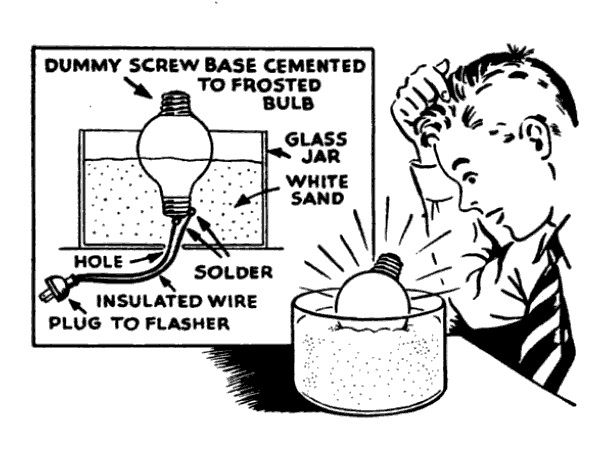
1946FebPSWe would be hard pressed to come up with any scientific principle that is established by this demonstration, but it’s a clever illusion, and if Junior’s teacher is the charitable sort, we’re sure that this project would be a most welcome diversion at the next science fair.

The light bulb seemingly glows without being hooked up to anything. As you can see from the diagram, this is accomplished by taking the base from a burnt out bulb and carefully attaching it to another bulb.

The idea appeared 75 years ago this month in the February, 1946, issue of Popular Science.


Happy Groundhog Day!

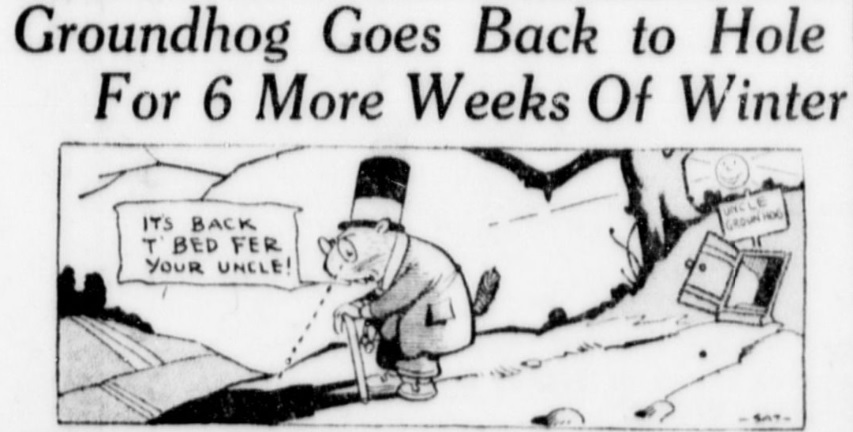
1921GroundhogDayHappy Groundhog Day from OneTubeRadio.com!

A hundred years ago today, at least in Albuquerque, the groundhog saw his shadow, meaning that there was to be six more months of winter. The paper quoted the full reasoning behind the forecast method: “If Candlemas is fair and clear, Ther’ll be two winters in the year.”  The picture appeared in the February 2, 1921, issue of the Albuquerque Evening Herald.

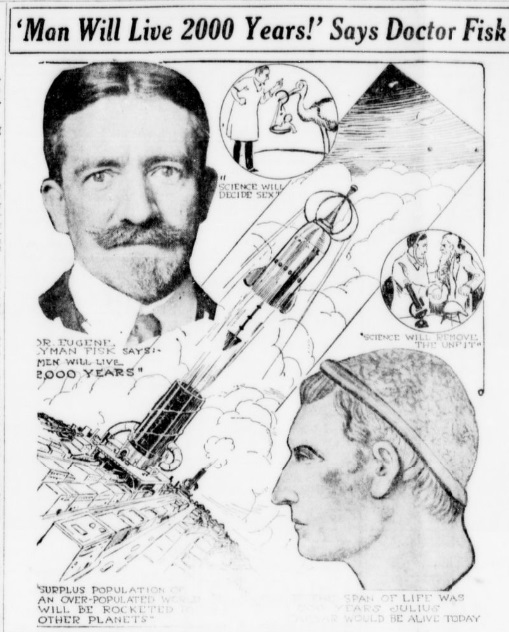
In other scientific predictions, the paper quoted eminent scientist Dr. Eugene Lyman Fisk, who predicted that within a comparatively short time, the average human life would be 2000 years. Recognizing the potential for overpopulation, the good doctor came up with three possible solutions:

Controlling the birthrate by determining sex.

“Selective euthanasia,” or putting people to death by lot.

Conveying selected persons in projectiles to other planets.

The cartoon shows a scientist talking to an elderly gentleman with the caption, “science will remove the unfit.”  Perhaps we’ll take the groundhog’s advice and just go back to bed for another six weeks.

1921GroundhogDay2