Author Archives: clem.law@usa.net

1951: Building the Family Foxhole

1951MarPS1951MarPS4Seventy years ago this month, the cover of the March 1951 issue of Popular Science featured this artwork by artist Denver Gillen (who made the first drawings of Rudolph the Red Nosed Reindeer, and later, numerous covers for Outdoor Life) showing “what an A-Bomb blast may do to your home,” but with an inset of a family safely hunkered down in their family foxhole.

The cover entreats the buyer to save the issue, since it contains a special section on emergency preparedness written by Michael Amrine, formerly of the Atomic Energy Commission.

The magazine’s editors noted that much of the literature regarding civil defense was “tragic nonsense–aspirin for cancer. Even the official booklets say mainly, ‘Keep calm, keep covered, and follow directions.” But it goes on to say that official directions might not be forthcoming, since there did not exist civil defense organizations comparable with the problem. Instead, the magazine advocated “planning and plain hard work” by individual homeowners, and the magazine contained advice on how to do that. “The hard truth is that the most you can expect from civil defense will be control and rescue work after a bombing. The most effective preparation for atomic attack will be family by family, house by house.”
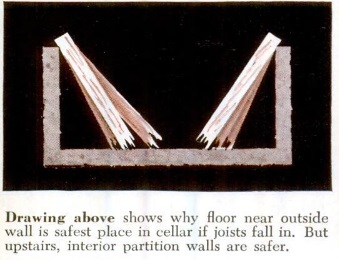
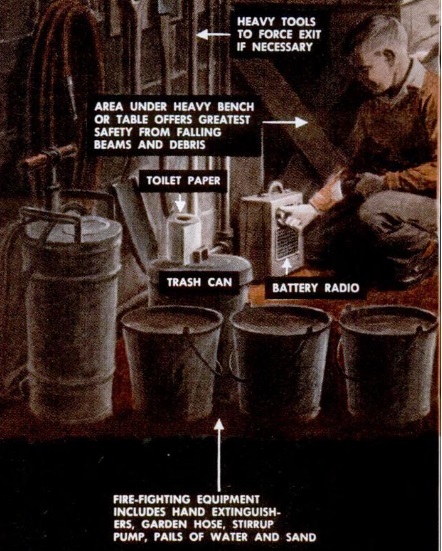
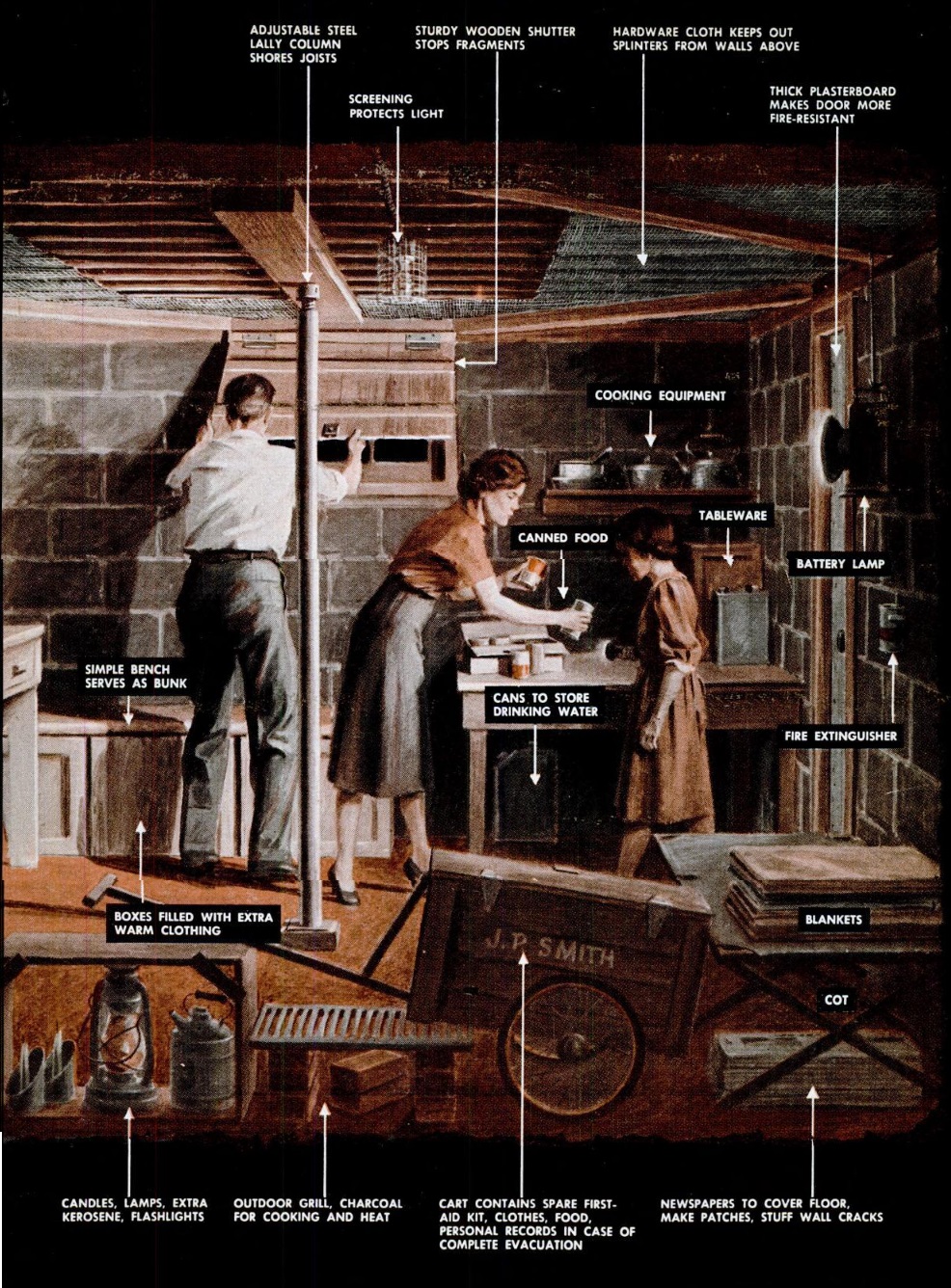
1951MarPS2The article first noted what not to do, and pointed out that steps such as blacking out the house, taping windows, or even buying a Geiger counter were of very minimal utility. It noted that, as in Hiroshima and Nagasaki, radiation was not going to be the big killer. Instead, it would be the familiar forces of heat and blast, and the article gave pointers on preparing a refuge room to protect against them. The author asked readers to “imagine that your house is in a cyclone or hurricane belt, and next door to a gas tank” and plan accordingly. The most important principles in planning a refuge room were making sure there were at least two exits, keeping out from under heavy furniture or appliances, and preferably being in a corner of the cellar with the least windows or exposure. The importance of using a corner is illustrated by the drawing at left.

After a spot was located, ideas such as shuttering windows and making use of a heavy table or workbench were outlined.

The article included a number of frequently asked questions, including “what should I tell the children?” The answer was simple: the truth. They should be instructed where to go in a raid and how to hit the deck. You shouldn’t scare them, but don’t make it a game, either.
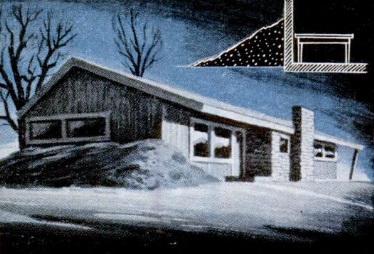
1951MarPS3For homes without a basement, the author suggested placing earth or logs against an outside wall, with a sturdy table inside.

The list of recommended supplies included the usual suspects such as canned food and battery operated lights. Under the category of “valuables,” the recommendation included an extra pair of glasses and a lockbox for valuable papers. Rounding out that category was money (in small bills), on the assumption that, as in the last war, the economy would be in full operation.

The list included a wind-up clock and maps of the city and county. The battery operated radio made its usual appearance on the list. The article noted that utilities would probably be out, although some, especially the gas lines, might continue to function for a time. Since battery operated radios were still quite rare (but not unheard of) in 1951, the article noted that a car radio would also work.

The article did note that it was dealing with just the Hiroshima-style A-bomb, and not the H-bomb. It notes that the H-bomb was then still just a theoretical possibility, but that if perfected, it would wreak the same level of damage over a still larger area.
1951MarPS5


1921 Recreational Vehicles

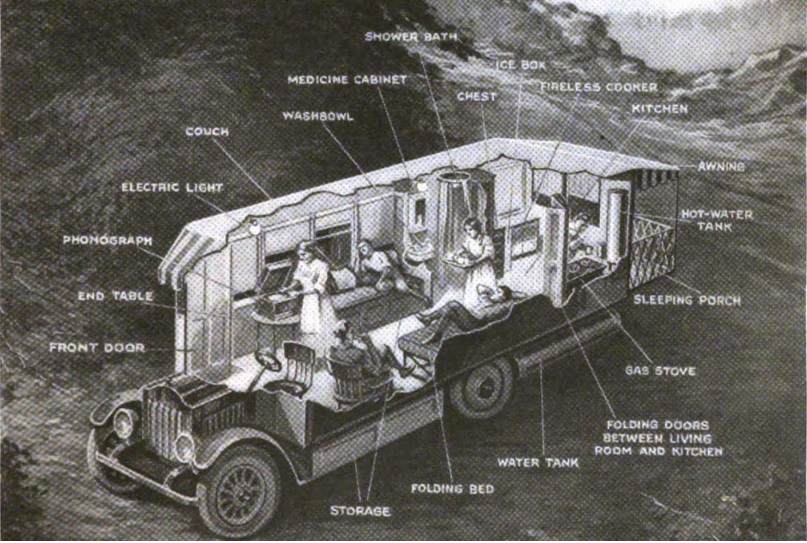
1921MarPM1This early proto-recreational vehicle was shown a hundred years ago in the March 1921 issue of Popular Mechanics. The magazine notes that this vehicle, called an “auto-bungalow” was “the culmination of a movement which had been growing ever since the motor car became a reliable means of transportation. It ancestor was the two-wheeled homemade camp trailer, designed to carry the tents, bedding, and other simple requisites of a two-weeks period of “roughing it” in the woods or at the shore.”

The early RV shown above was not cheap. According to the magazine, the total cost was $16,000. According to this inflation calculator, that would work out to almost a quarter million in today’s money, a figure that’s not surprising, since many top-end RV’s are available today in that price range. The vehicle, including the rear porch, had an overall length of 30 feet. As is apparent, it required an abnormally long overhang at the rear, but the magazine pointed out that this was an advantage, since it put most of the weight on the rear axle, providing better traction and making steering easier. The interior living quarters measured a respectable 8 by 20 feet, which included a kitchenette with ice box, stove, hot water tank, and fireless cooker. It included toilet facilities and 22 incandescent lights powered by battery and generator.

1921MarPM2


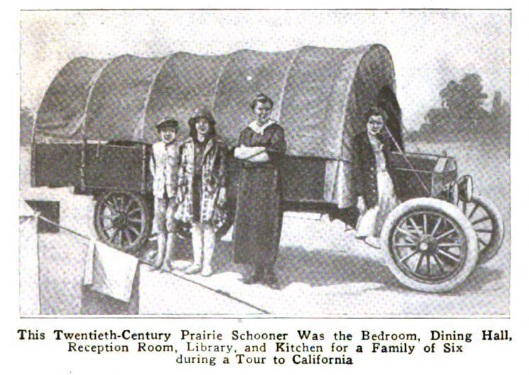
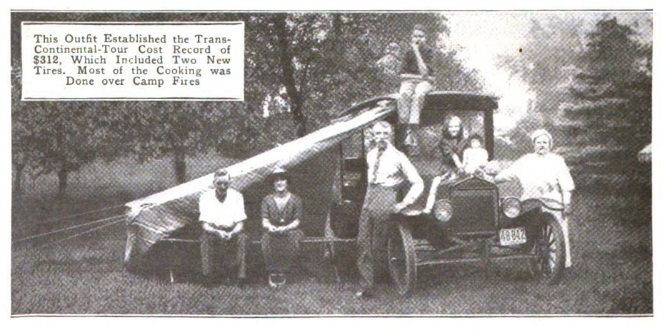
As is the case today, not everyone could afford such a top-of-the-line luxury RV, and the magazine pointed out a number of options for the more budget conscious. For example, the “20th century prairie schooner” shown at left was constructed at reasonable cost by a Kansas City resident. It was built on the chassis of a popular make of light car, with the wheelbase extended several inches. The even simpler equipment shown to the right 1921MarPM3was designed by a Maine resident at a total cost of $312, including two new tires. This family of six cooked most of their meals on campfires.


Modern tent trailer for motorcycle or small car. Amazon photo.

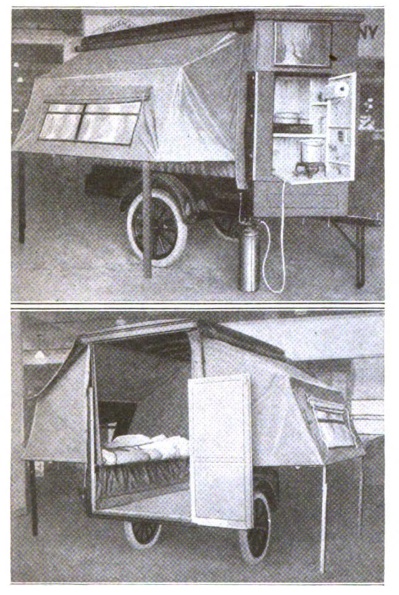
The tent trailer shown below is similar in concept to some modern motorcycle camping trailers. According to the magazine, a number of such trailers, with either two or four wheels, were readily available for purchase, for the benefit of those with “neither the leisure nor the ingenuity to originate and build outfits.”

1921MarPM4


1951: Friendly Fire Incident Averted!

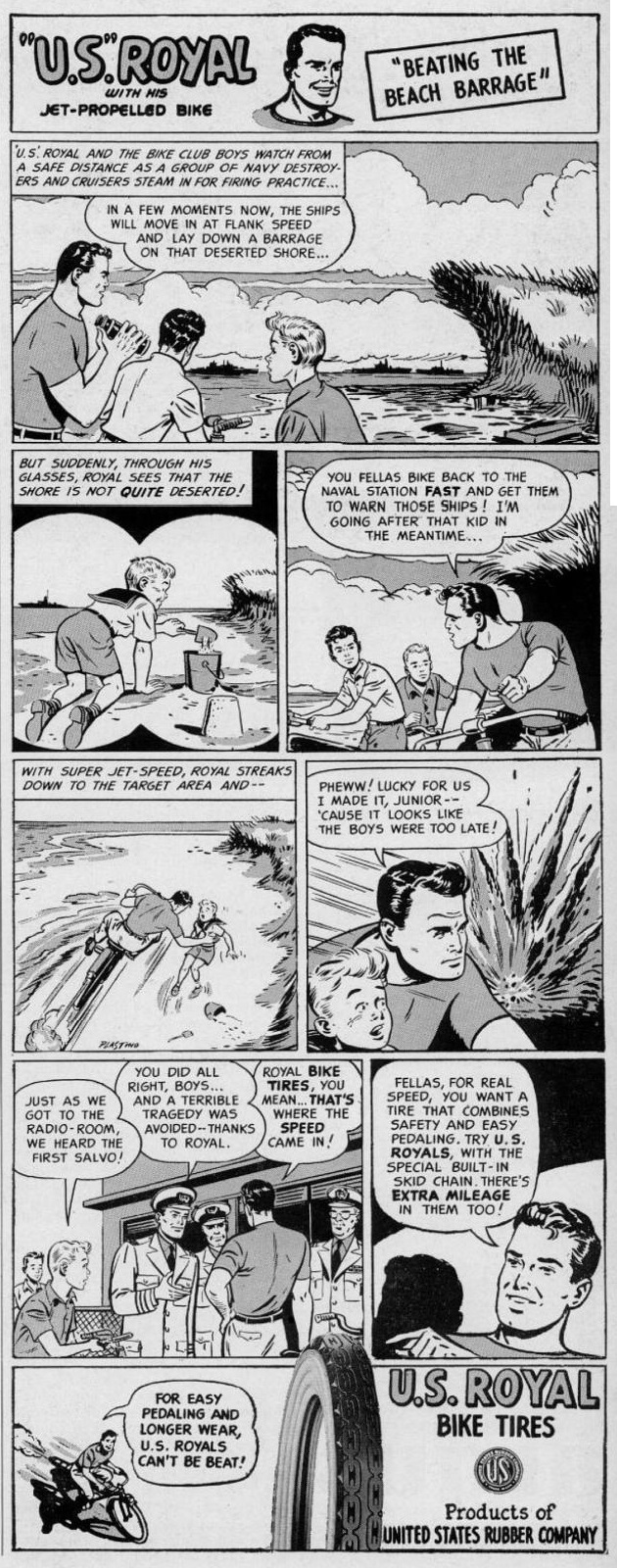
1951MarBL3You might not give much thought to the humble bicycle tire. But as shown in this cartoon, having good bicycle tires could mean the difference between life and death. A most unfortunate friendly fire incident was averted thanks to the hero’s bike being equipped with U.S. Royal tires, manufactured by the United States Rubber Co. This ad appeared 70 years ago this month in the March 1951 issue of Boys’ Life.


1941 “Little Giant” 5 Tube Superhet

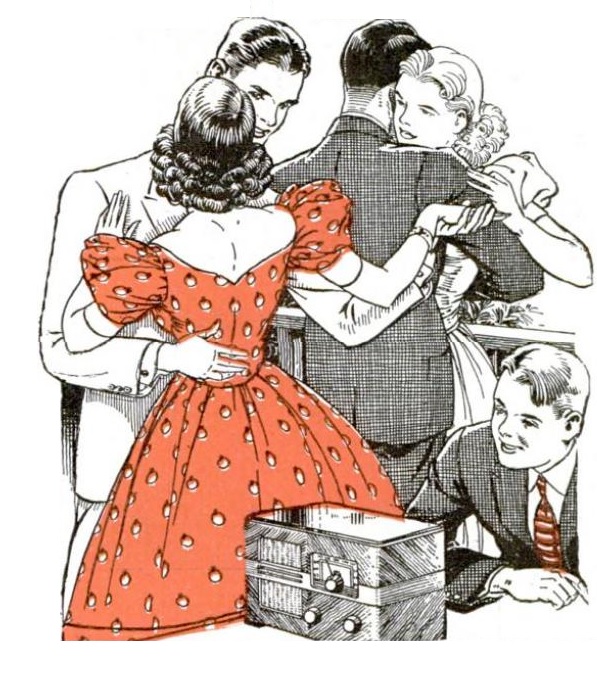
1941MarPM1AFor many years, the March issue of Popular Mechanics featured a radio receiver dubbed the “Little Giant,” and the couples here are enjoying the last months of the prewar era by dancing to the sounds of the magazine’s 1941 rendition.

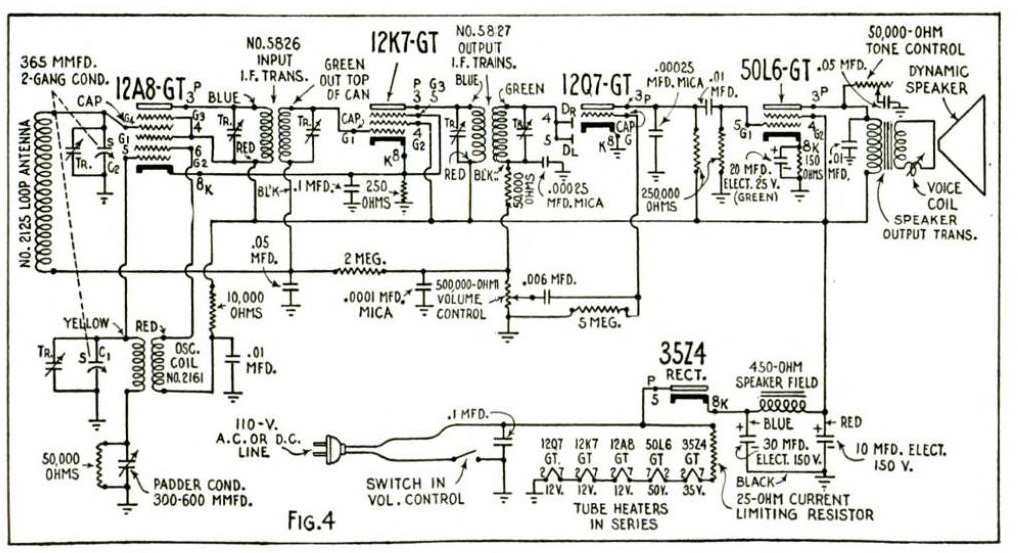
The set is a familiar “All American Five” AC-DC superheterodyne circuit, featuring a tube lineup of 12A8GT, 12K7GT, 12Q7GT, 50L6GT and 35Z4 rectifier.

The magazine noted that the set was easy to build, had unusually good tone, with full volume and distance-getting ability. The cabinet could be homemade, or purchased from a parts house.

1941MarPM1B


Science Fair Project: Tide Predicting Machine

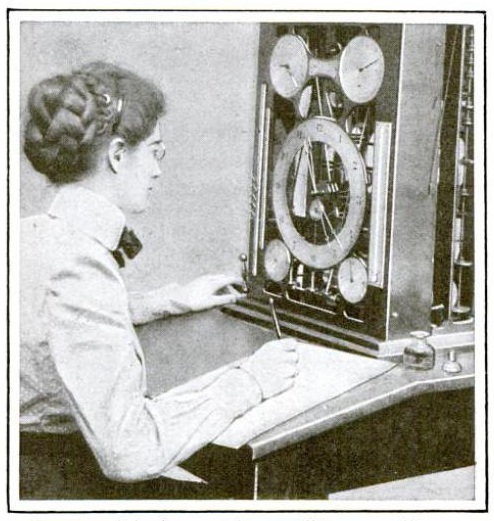
1921MarPSA hundred years ago, this scientist is predicting the tides with the help of this tide predicting machine, described in the March 1921 issue of Popular Science.

The machine is an analog computer, one version of which was fittingly dubbed Old Brass Brains.  The first such machine was designed by Lord Kelvin, who noted that the tide at any particular location was the sum of a number of sinusoidal functions in the form:

A_{1}\cos(\omega _{1}t+\phi _{1})+A_{2}\cos(\omega _{2}t+\phi _{2})+A_{3}\cos(\omega _{3}t+\phi _{3})+\ldots

Prior to the advent of the digital computer, such a computation would be laborious, especially if one needed to repeat it to calculate the tide minute by minute. But with the analog computer, once the various constants were set, it was simply a matter of turning a crank and seeing what the tide was at any given time.

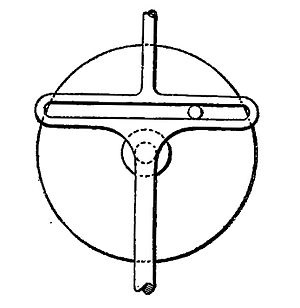
Each term of this equation is represented in the machine by a wheel similar to the one shown at the left.  As the wheel turns, the piece in the middle moves up and down, and the distance moved up or down is proportional to the cosine of the angle at which the wheel is turned.  By changing the position of the pin and the size of the wheel, the various constants in the equation are taken into account.  The output of this wheel is then linked by a pulley to the next wheel.

Replicating such a machine in its entirety would, of course, cost millions of dollars in precision machining.  However, the advanced student could create a very impressive science fair project by constructing a part of such a machine, namely one of these wheels, or perhaps even link two wheels together.  With information from the WIkipedia articles and Popular Science article linked here, a very impressive exhibit could be created.


Using Bad Tubes as Rectifiers

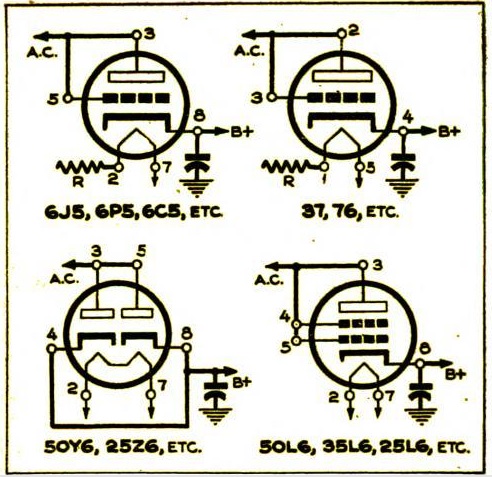
1946MarPS375 years ago this month, the March 1946 issue of Popular Science showed what you could do with bad tubes. If a tube tested bad for its particular circuit, it was a shame to just throw it away, and you didn’t have to. As pointed out here, unless a tube was completely burnt out, it would probably serve just fine as a rectifier. As shown here, the plate and grids were wired together to form the anode, and the tube could continue for many years serving as a rectifier.


1946 Grocery Prices

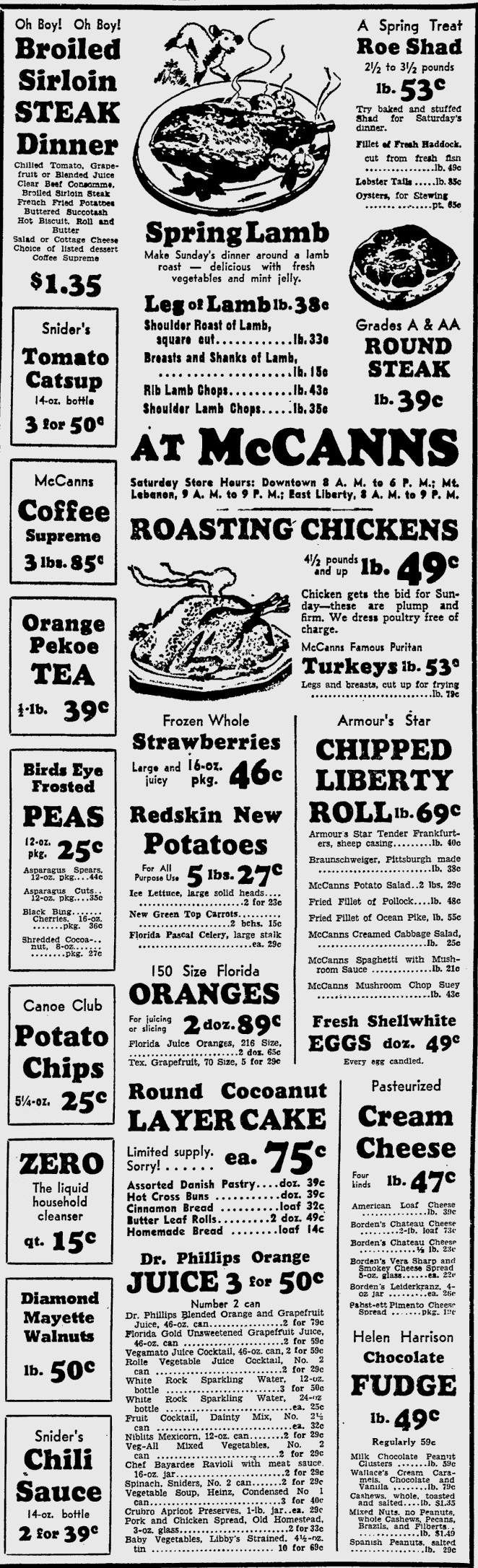
1946Mar15PghPressFor a snapshot of the cost of living 75 years ago, this ad appeared in the March 15, 1946, issue of the Pittsburgh Press, for McCanns Grocery Store. When comparing pre-1964 prices, one easy rule of thumb is to remember that one dollar equaled one silver dollar, four silver quarters, or ten silver dimes, each equal to about one once of silver. Today, that same ounce of silver is worth about $26, so in today’s money, the 85 cents for three pounds of coffee works out to about $22, or over $7 a pound. The complete sirloin steak dinner sounds like a bargain at $1.35, but that would be the equivalent of about $35 in today’s money.

The eggs sound like a bargain at 49 cents a dozen, but in today’s money, that works out to over a dollar for each individual egg. Of course, the eggs were candled, meaning that you didn’t need to worry about an unpleasant surprise when you cracked it open.


TV Comes to Lansford, PA, 1951

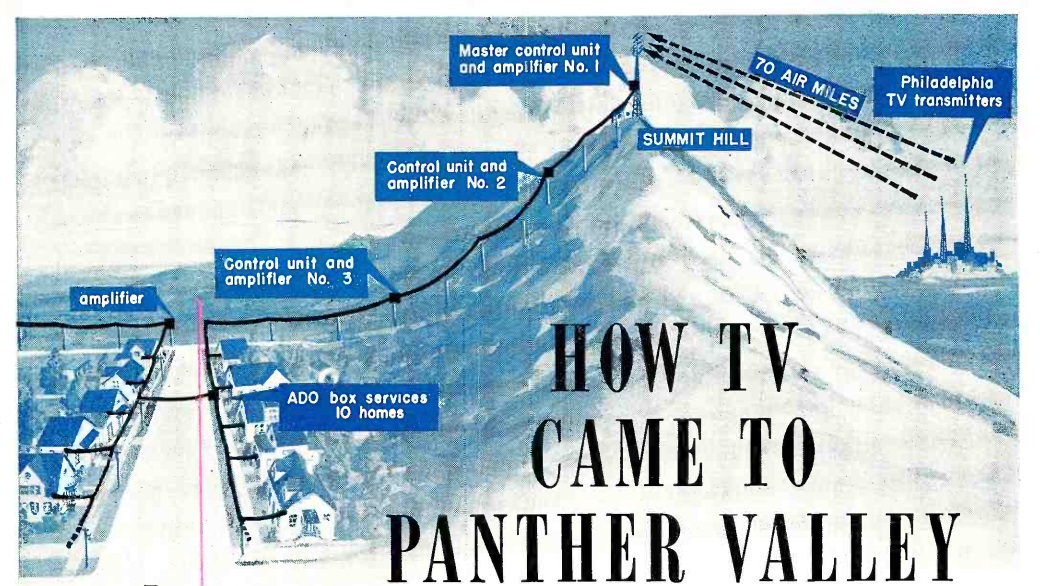
1951MarRadioNewsBy 1951, TV had become a way of life in major cities, but rural communities lagged. But rural areas were working hard to have the magic of television. We previously explained the herculean efforts which brought TV to Marathon, Ontario. The March 1951 issue of Radio & Television News showed the system put in place in the Panther Valley of Pennsylvania, starting with the town of Lansford, Pennsylvania. The town was 75 miles away from the Philadelphia stations, and had the added problem of having a mountain in the way. In fact, rural residents of Summit Hill, just a mile away from the town, had TV, but the residents of the larger town did not.

The radio dealers in town, eager to be able to start selling TV, decided to take action. A test was run by putting an antenna on the hill and running a coaxial cable into town. The test was successful, and the system was built, as described in the magazine. The system was able to pull in three Philadelphia stations, WPTZ, channel 3, WFIL, channel 6, and WCAU, channel 10.

Fortunately, the cable was allowed on utility poles, and a legal inquiry confirmed that the franchise would not need to be regulated as a public utility. Another legal opinion was obtained from the FCC that no licensing was required. The system was originally envisioned as a nonprofit, but the bankers balked and insisted that the system be operated on a for-profit basis before financing was forthcoming.


National Emergency Alarm Repeater: 1961

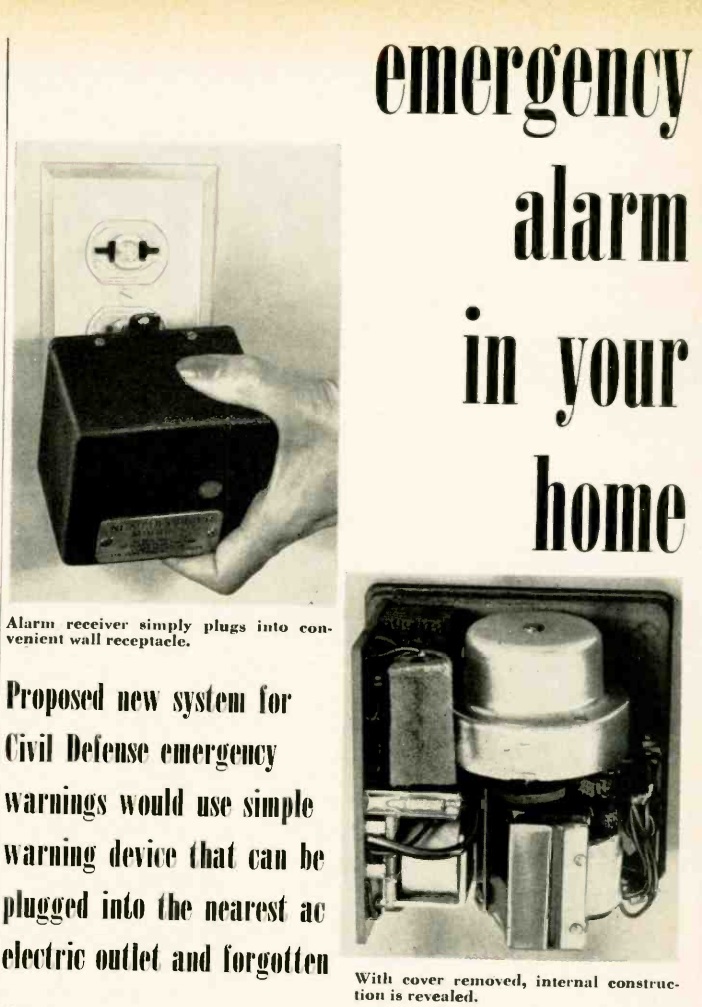
1961MarRadioElecOne of the great challenges of civil defense planners was alerting the public to an imminent nuclear attack. Sirens could be effective outdoors, but it was unlikely that people indoors would be able to hear them. One possible solution is discussed in the March 1961 issue of Radio-Electronics: NEAR, the National Emergency Alarm Repeater.

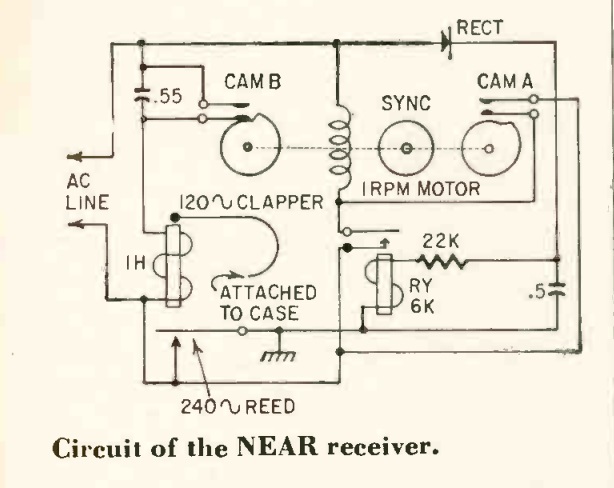
Three methods had been considered: telephone lines, power lines, and radio. The technical challenges for using the telephone network for simultaneously alerting the entire population were too difficult to overcome, and not everyone had a phone. Radio was a possibility, but radios were turned off many hours of the day, and especially at night. NEAR took advantage of the power grid. With only a few hundred repeater stations, a 240 Hz signal of about a volt could be superimposed on the line, and the receiver shown here was a clever electromechanical method of picking up that signal and sounding the alarm.

The home NEAR until shown here would be plugged in and forgotten by the homeowner until such time as there was an attack. It included a resonant circuit consisting of a 0.55 uF capacitor and 1 henry coil, with a tuned frequency of 240 Hz. To avoid false alarms, there was a time delay in the form of a 1 RPM motor. If the incoming signal were less than 10 seconds long, then the motor would simply reset and continue listening for a signal. But after 10 seconds, the motor would trip a clapper which used the outside of the device’s case as a sounder. The unit would emit a loud annoying noise which would alert the homeowner to the missiles that were incoming.

1961MarRadioElec2


1946 Automatic Hot Dog Machine

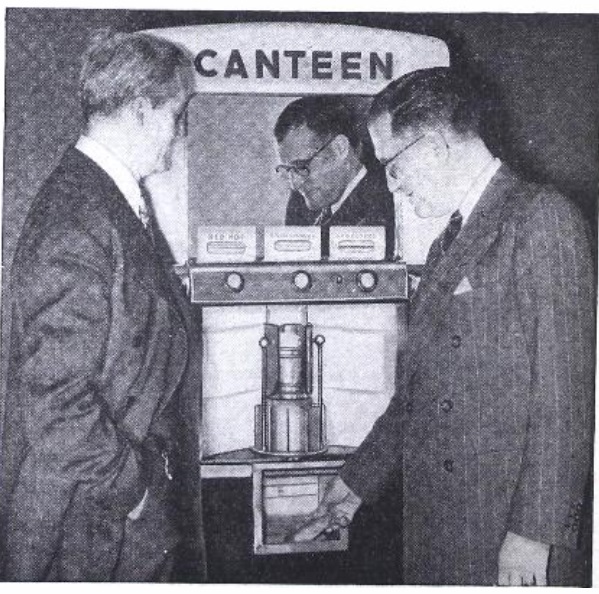
1946MarRadioCraftThese gentlemen 75 years ago were purchasing their power lunch from a coin-operated vending machine capable of dispensing hot dogs, hamburgers, or grilled cheese sandwiches. The picture appeared in the March 1946 issue of Radio Craft, which points out that the machine was only slightly larger than the usual soft drink or cigarette machine, and operated from a standard 117 volt outlet.

The food was heated by radio waves, from “two specially developed high-frequency power oscillator tubes.” In other words, the machine was an early version of the microwave oven. THe engineers toiled long and hard to develop the machine. In particular, the choice of frequency was problematic. Some frequencies would heat the roll but not the frankfurter. Other frequencies would heat the frankfurter but burn the bun. Finally, however, a frequency that was just right was found, and the machine was put into production.

While we recognize this dialectric high frequency heating to be the principle employed by the modern microwave oven, the magazine cautioned that home ovens were not just right around the corner:

It should not be construed from this development that the electronic stove is just around the corner, electronic engineers hasten to explain. The canteen grill and the electronic stove present two different kinds of problems and the accomplishments in the development of the former should not be interpreted as solving the problems yet to be overcome in the field of electronic cooking.

The two in the picture are identified by the magazine as Messrs. Baker and Leverone, first names not given. They are associated with General Electric and Automatic Canteen, the companies responsible for the new machine.  Leverone is probably Nathaniel Leverone, the founder of the vending machine company.