Author Archives: clem.law@usa.net

1961 Speed Mail

1961AprPESixty years ago, the U.S. Post Office tried something that Popular Electronics, in its April 1961 issue, called “Electronic Speed Mail.” The official name for the service was just “Speed Mail,” but it was an early hybrid of electronic mail (or more accurately, facsimile) and snail mail.

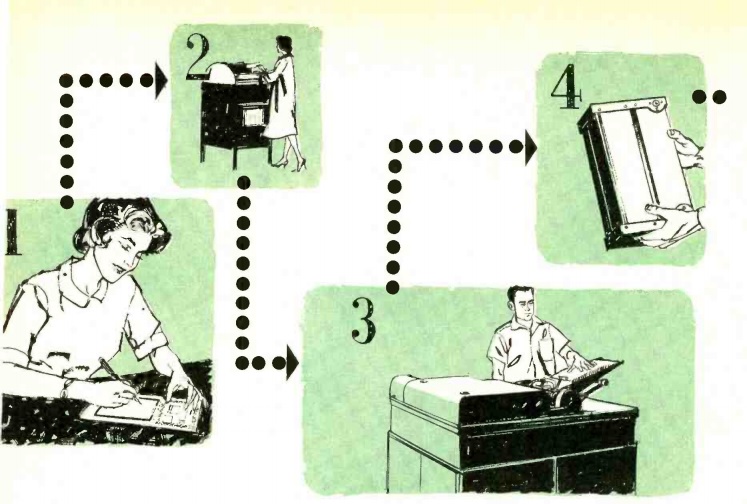
The Post Office Department envisioned having centers in 71 cities strategically located across the country. To write a letter that would be delivered the same day, a sender would write the letter on a special form provided by the post office, taking care to write only within the lines. The form was likened to the special “V-Mail” form of World War II, with which letters were microfilmed stateside and delivered to Army Post Offices where they were printed and delivered, or vice versa. In this case, the message form was sealed and deposited into the mails. At the local post office, it was fed in, still sealed, to a facsimile machine. The machine opened the mail, scanned it, and placed it into a sealed container. After the operator was sure that the message had been properly sent, the batch of message forms was destroyed.

The scanned message was then sent via the Echo 1 satellite to the closest post office to the recipient. There, the message was printed and sealed into a window envelope with only the recipient’s address and return address showing. Again, the entire process took place without human eyes seeing the message.

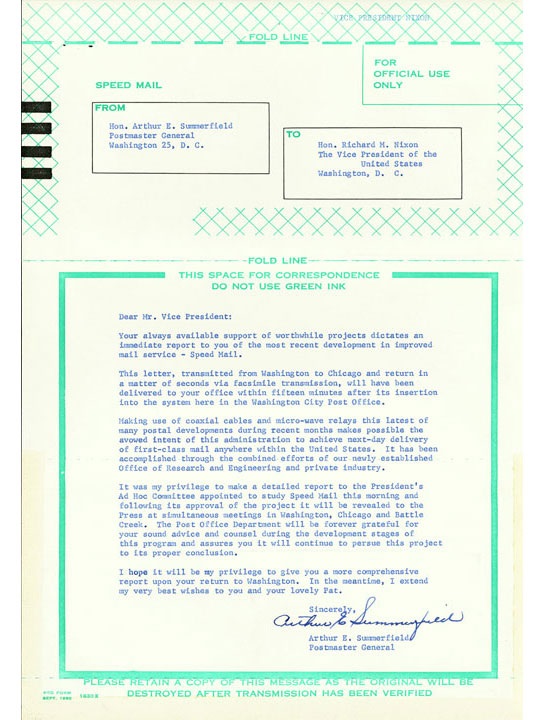
An example of the message blank is shown below. This one bears a message sent from Postmaster General Arthur Summerfield to Vice President Nixon, late in 1960. (Even though the message was sent crosstown in Washington, it was relayed via Chicago to demonstrate the service’s capabilities.)

When the Kennedy Administration took office, newly appointed Postmaster General J. Edward Day (best known for the creation of the ZIP code) was less enamored with the system, and no further efforts were made to promote it. The Western Union Mailgram service (“the impact of a telegram at a fraction of the cost”) was introduced nine years later in 1970, and allowed rapid mail service. Messages were sent by Western Union to the nearest post office, where they were printed and delivered the same day received.

1941 Portable Transmitter-Receiver

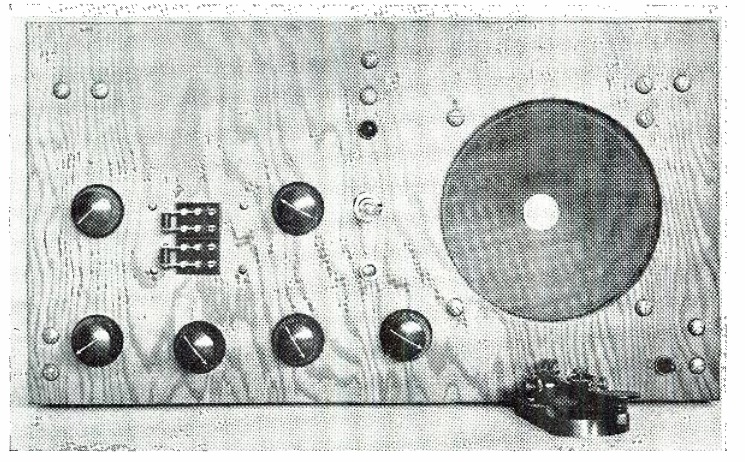
1941AprRadioNewsIn the April 1941 issue of Radio News, William D. Hayes, W6MNU, of Oakland, California, recounts that since he liked to build his own equipment and constantly improve as the state of the art progressed, he had amassed a large collection of perfectly good spare parts. To put them to use, he put together this transmitter-receiver. It was intended for portable use while vacationing, but could also be put to use as a backup rig from the home station.

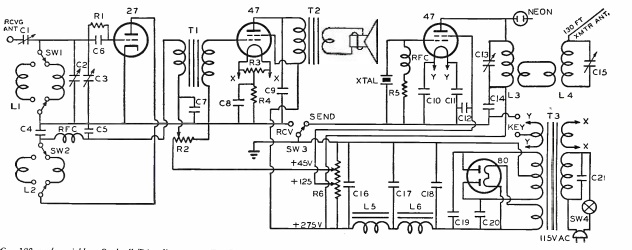
The receiver employed a 27 tube as regenerative detector, with a 47 used for audio output to drive a speaker, mounted on the wooden front panel with a piece of window screen for protection. The receiver covered 70 through 550 meters in two bands. The author noted that tuning the broadcast band was a useful feature, since the set would be used on vacation. He reported that the simple receiver provided very good reception on the broadcast band.

A bandspread capacitor covered the 80 meter ham band perfectly.

The 80 meter transmitter was a crystal oscillator also using a 47 tube. The use of the same tube as used in the receiver was intentional, to minimize the number of spare tubes that had to be carried. With the type 80 rectifier tube, only three spare tubes had to be brought along.

The author reported that from his cabin in the Santa Cruz mountains of California, and with a 130 foot antenna only 10 feet off the ground, he made numerous contacts with California, Washington, Oregon, Idaho and Nevada.

1941AprRadioNews2


Aleutian Islands Earthquake and Tsunami: 1946


Hilo residents fleeing tsunami. Wikipedia photo.

Hilo residents fleeing tsunami. Wikipedia photo.

Today marks the 75th anniversary of the April 1, 1946, Aleutian Islands earthquake and tsunami.  The quake had a magnitude of 8.6 and resulted in hundreds of casualties, including all five lighthouse keepers at the Scotch Cap Lighthouse on Unimak Island. 55 foot waves raced across the Pacific at 500 miles per hour and hit Hawaii 4.9 hours later. In Hilo, 173 were killed, including some who were swept out to sea by the receding waters. The destruction prompted the creation of the Seismic Sea Wave Warning System, the forerunner of the Pacific Tsunami Warning Center.

As detailed in the August 1946 issue of QST, at Ikatan, Alaska, the quake was felt by amateur radio operator Henry W. Peterson, K7FFG, who reported four earthquakes followed by a tidal wave cresting at 60 feet. His home was washed into the bay and many other buildings were damaged. He reported families having to head for the hills until daybreak when they could see what was going on.

At 6:00 AM, he put out a call of QRR, but was unable to make contact until 10:00 AM, when he got in touch with government station KNLL. He also raised Signal Corps station WXFP, which requested that he keep a constant radio watch and report every 15 minutes for 24 hours. He then reported all shocks twice a day. There were a total of about 70 shocks up through April 7.

Local residents were very relieved to know that he was in contact with the Signal Corps and could get help at any time if needed.


1961 British “Ranger 3” 3-Transistor Regen

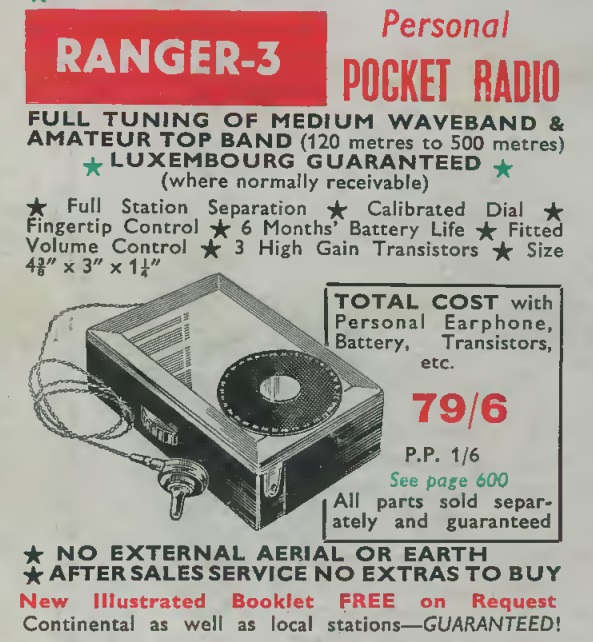
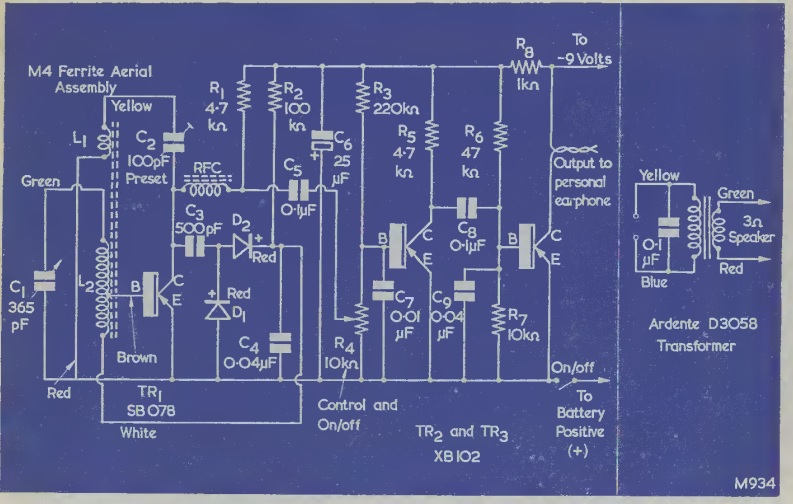
1961MarRadioConstructor2Shown here from the March 1961 issue of the British magazine Radio Constructor is a set dubbed the “Ranger 3,” a pocket sized three-transistor receiver for the medium waves, including the 160 meter ham band and marine frequencies. The set employed a regenerative detector and had a built-in ferrite antenna. The basic set used an earphone, but as shown in the schematic, it could drive a speaker with a few additional parts.

As was often the case with this magazine, there was a construction article, and the ad for a parts supplier conveniently appeared in the same issue with all of the parts. In this case, Henry’s Radio Ltd. of London could supply all the required parts for just over 79 shillings.

The ad points out that the set should be able to pull in Radio Luxembourg in most areas, and the ad turns this into “Luxembourg Guaranteed (where normally receivable).” The BBC had a monopoly on broadcasting in Britain, and the English commercial program from Luxembourg was a popular alternative.

This simple set did a good job of pulling in the distant station because it was optimized for the station’s wavelength of 208 meters (1439 kHz). Since this was close to the top of the dial on most sets, the reception might be marginal, since they were probably optimized for the middle of the broadcast band. The Ranger 3, however, covered 600 kHz to 2.5 MHz, meaning that the Luxembourg station was right in the middle of the dial. In fact, the article suggested waiting until late at night to tweak the receiver, using Radio Luxembourg as the test signal.

According to the article, the set was a very good performer, pulling in numerous continental stations, especially at night.

1961MarRadioConstructor


Vinegar and Baking Soda Experiments: Beyond the Volcano

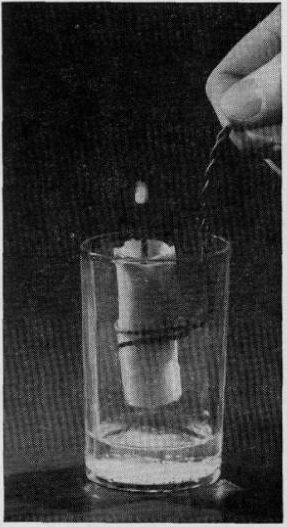
1951MarBLEvery self-respecting young mad scientist probably discovered as a toddler that many hours of fun could be had by mixing vinegar and baking soda. When the time comes for their first science fair in elementary school, many of them harken back to this early experiment and decide to make a vinegar and baking soda volcano. In fact, if you Google the words “science fair vinegar and baking soda volcano“, you will get over a million results, many of which we are sure are fine educational projects. But we also know that our readers, even the youngest ones, strive for a bit more. So if your young mad scientist is thinking of a science fair project involving these venerable home chemicals, here are a couple of more advanced projects, which appeared in Boys’ Life magazine 70 years ago this month, March 1951. They are just as easy (or even easier) than the stereotypical volcano that other kids will be bringing, but they demonstrate some additional scientific principles.

To do the experiment shown above, you start with a tall glass of water and add a tablespoon of vinegar. You then slowly stir in a half teaspoon of baking soda. Finally, you put four or five mothballs in the glass. They’re heavier than water and will sink to the bottom, but after about a minute, they will rise to the surface. They’ll sink again and continue rising and falling for hours.

What’s happening is that the mothballs are only slightly heavier than water. Little carbon dioxide bubbles affix themselves to the surface, which gives just enough buoyancy for them to rise. At the surface, the bubbles pop, and the mothball sinks again. If you don’t have any mothballs around the house, I’m told that raisins will work just as well.

1951MarBL2If Junior likes playing with fire (and what kid doesn’t?), they will enjoy the experiment shown at the left. You start with a teaspoon of baking soda at the bottom of an empty glass. To this, you add a tablespoon of vinegar diluted with a tablespoon of water. When the mixture begins to fizz, you lower a lighted candle into the glass. Since carbon dioxide is heavier than air, it fills the glass. And since carbon dioxide doesn’t support a flame (which is why fire extinguishers use it), the flame extinguishes itself.

But there’s more! If you act quickly enough, you can lift the candle back out as soon as it goes out, and the flame will miraculously come back to life. This is because there is still vaporized wax, and the wick is still hot enough to ignite as soon as it gets back into sufficient oxygen.

The kid who made the volcano will undoubtedly go home with a nice participation ribbon. But armed with these simple experiments proving scientific principles, Junior will undoubtedly take home the blue ribbon.


1941 Grocery Prices

19410328PghHere’s a snapshot of the cost of groceries just before World War II, from the Pittsburgh Press, March 28, 1941.

These prices look low, but there’s been a lot of inflation in the last 80 years. According to this inflation calculator, one dollar in 1941 was the equivalent of $17.89 in 2021 dollars.  When you multiply all of these prices by 17.89, most of them stop looking like bargains.


1961 Two Transistor “Little Cub” Broadcast Set

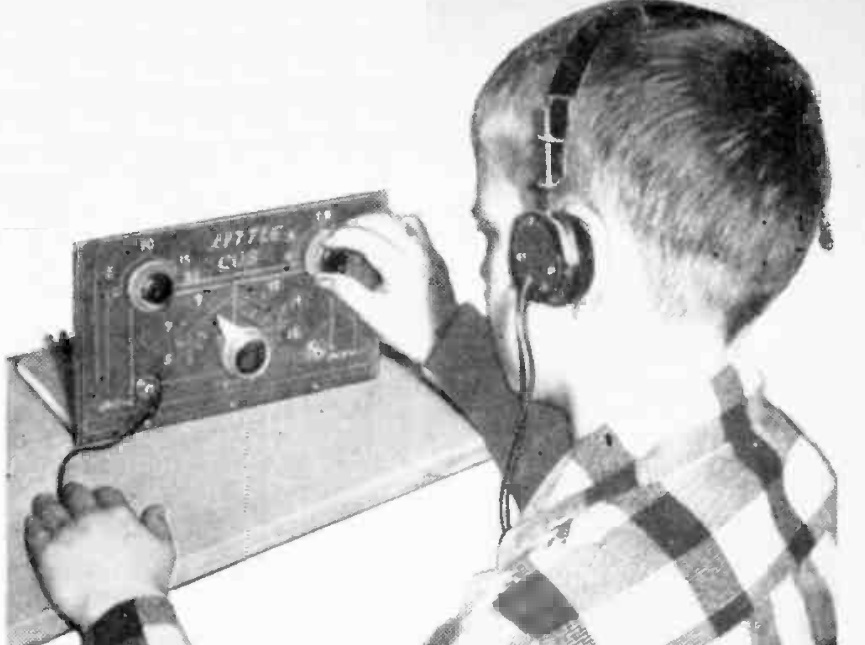
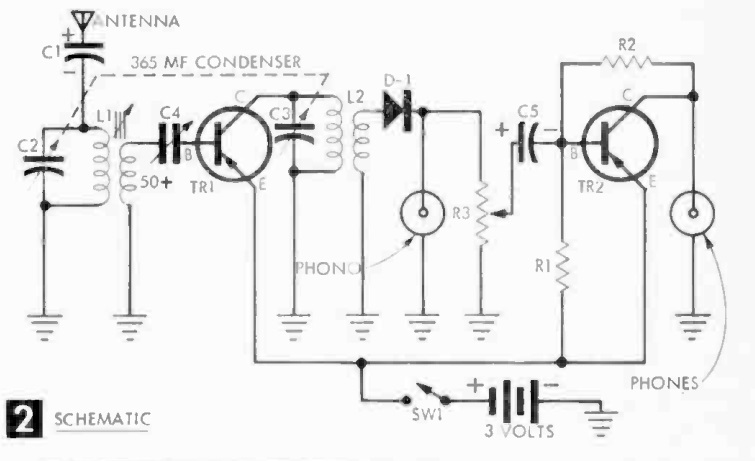
1961SprRadioTVExpThe young man shown here has been drawing Social Security for a few years now, but in 1960, he was pulling in a broadcast station thanks to the two transistor receiver described in the Spring 1961 issue of Radio TV Experimenter.

The set was dubbed by the magazine as the “Little Cub,” and was described as an ideal project for boys, individually or in groups. The circuitry was mounted on the front panel, which was a printed circuit board. Half the fun of building the set was etching the circuit board using etchant liquid. According to the magazine, contact with clothing would cause it to be soiled with a brownish color, “but this solution is not dangerous in any form.”

The circuit board traces actually went on the front of the board, and additional decorations and dial markings were added, meaning that the lettering was all in copper.

After the circuit board was etched and rinsed, the glass baking pan in which it did its work was washed with soap and water and put away, and Mom was presumably none the wiser. Then, the two transistors and one diode and other components were soldered in place. The first stage, a 2N414A transistor, served as RF amplifier and used feedback to boost the signal. A 2N107 transistor was used as audio amplifier. The set also featured a phono input which could be hooked to a record player.

1961SprRadioTVExp2


1911 Aerial Searchlight

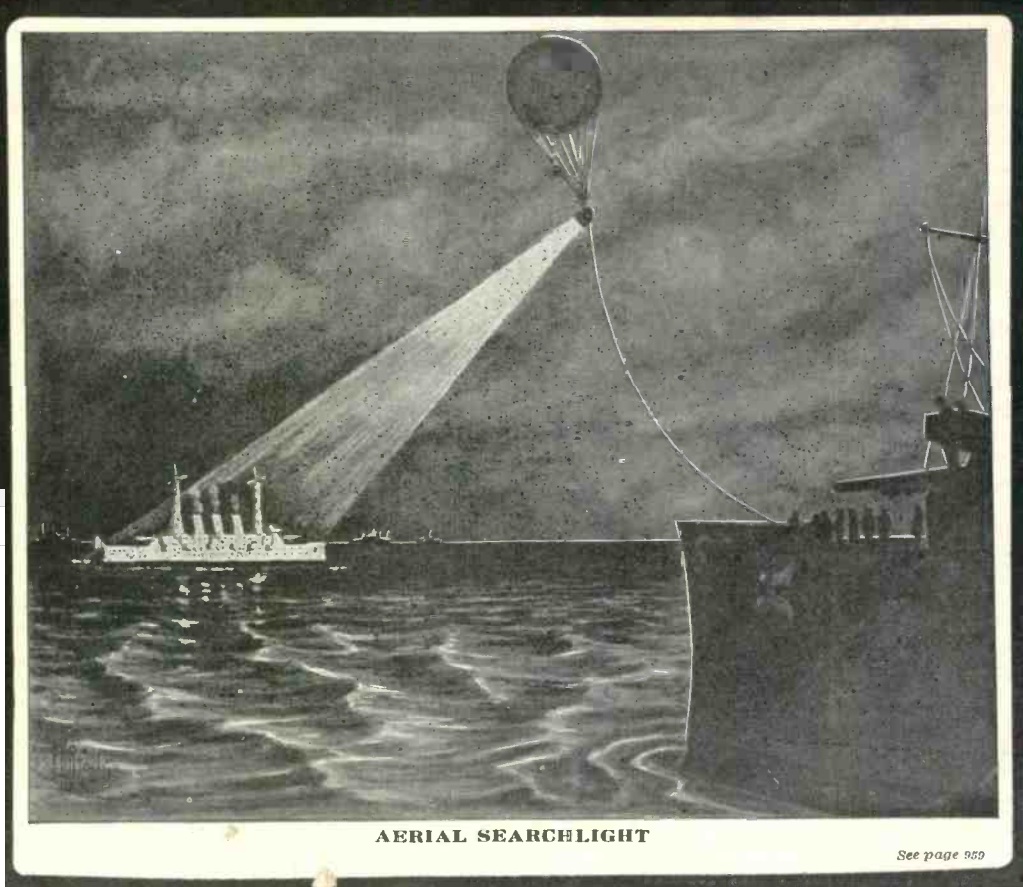
1911MarPopularElectricityShown here 110 years ago this month in the March 1911 issue of Popular Electricity is an aerial searchlight system. According to the magazine, one of the most serious problems of naval warfare was lighting the enemy’s vessels sufficiently to make them good targets. A spotlight directly from the ship would be counter-productive, since it would provide a target for the enemy. One possibility was to mount the lights on smaller boats which were “harder to hit and not so costly if sunk,” but the problem was communicating with them, which would require either signal lights or wireless which could be detected by the enemy.

The solution was to mount the searchlight in a balloon powered by cables from the ship. The balloon would be carried by the wind and not switched on until it was sufficiently far away to avoid revealing the ship’s location. It could be controlled by magnets run from the ground.

The invention was actually the subject of a German patent by one L.J. Mayer. The magazine notes that the inventor was from “Metz, the warlike frontier town which Germany wrested from France in 1871.”


1971 Italian One Tube Reflex Radio

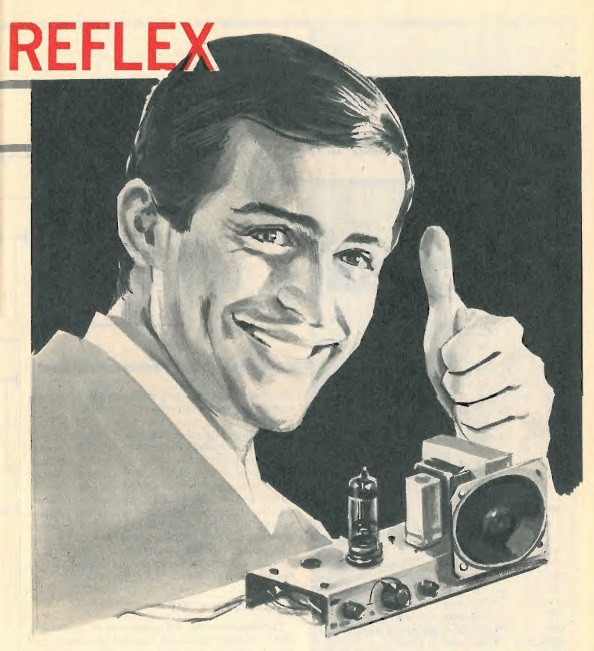
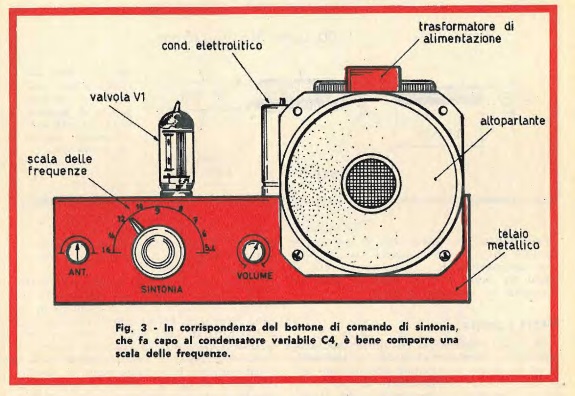
1971MarRadiopraticaFifty years ago, this Italian gentleman is expressing his approval at the loudspeaker volume coming from this one-tube medium wave set, described in the March 1961 issue of Radiopratica magazine.

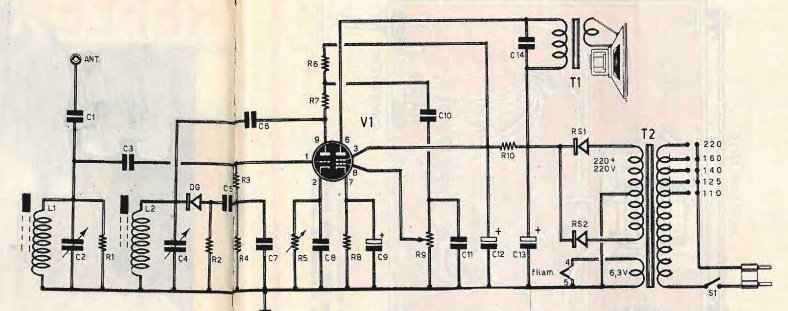
The set used a single dual tube, an ECL86, known in America as a 6GW8. The tube was reflexed to get double duty out of the tube, allowing the use of a speaker with a relatively simple circuit. The set ran off line current, thanks to solid state rectifiers, and the detector is also a solid state diode.

1971MarRadiopratica2

1971MarRadiopratica3


Parabolic Reflector Science Fair Project

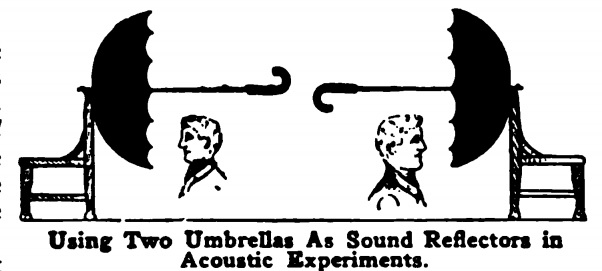
1921MarSciInvIf Junior is looking for a science fair project involving acoustics, then this one from a hundred years ago will fit the bill. It’s simple to create but has a spectacular result. And as an added bonus, it promotes communication despite social distancing, since it is possible to whisper to someone about 20 feet away.

The diagram above is more or less self-explanatory. Two umbrellas are carefully placed on chairs as shown, and they serve as parabolic reflectors. The alignment is very critical, and it is recommended that a piece of string be used to keep the umbrellas exactly in line. In addition, each umbrella is thoroughly soaked in water, as this ensures that sound is completely reflected. While Junior whispers into one umbrella, the sound is heard by someone with their ear at the focus of the other umbrella. The sound seems to come from the closest umbrella.

The diagram and explanation appeared a hundred years ago this month in the March 1921 issue of Science and Invention.  The idea had been sent to the magazine by S. Leonard Bastin.

Some links are affiliate links, meaning that this site earns a small commission if you make a purchase after clicking on the link.