Author Archives: clem.law@usa.net

Selling Clock Radios: 1951

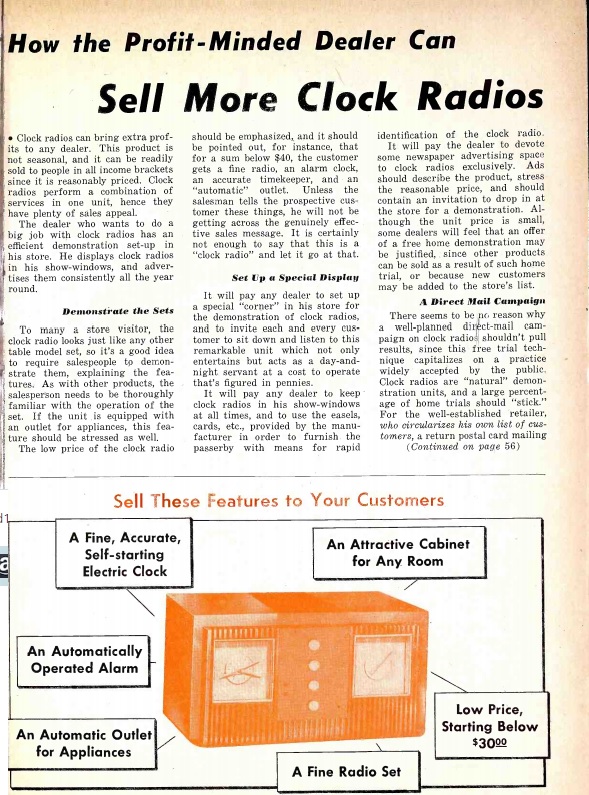
1951AugRadioRetailSeventy years ago this month, the August 1951 issue of Radio Television Retailing reminded dealers that there was money to be made by selling clock radios, an item that readily sold to people in all income brackets.

The clock radio “looks just like any other table model set” to the customer, so some salesmanship was required. The salesman needed to be thoroughly familiar with the product, and emphasize the low price for something that could serve as a fine radio, an alarm clock, a timekeeper, and in many cases, an automatic outlet.

The magazine suggested that direct mail might be a profitable way to sell. Select customers could be sent a mailing offering a set on approval, and once in the home, the customer was very likely to keep the set.


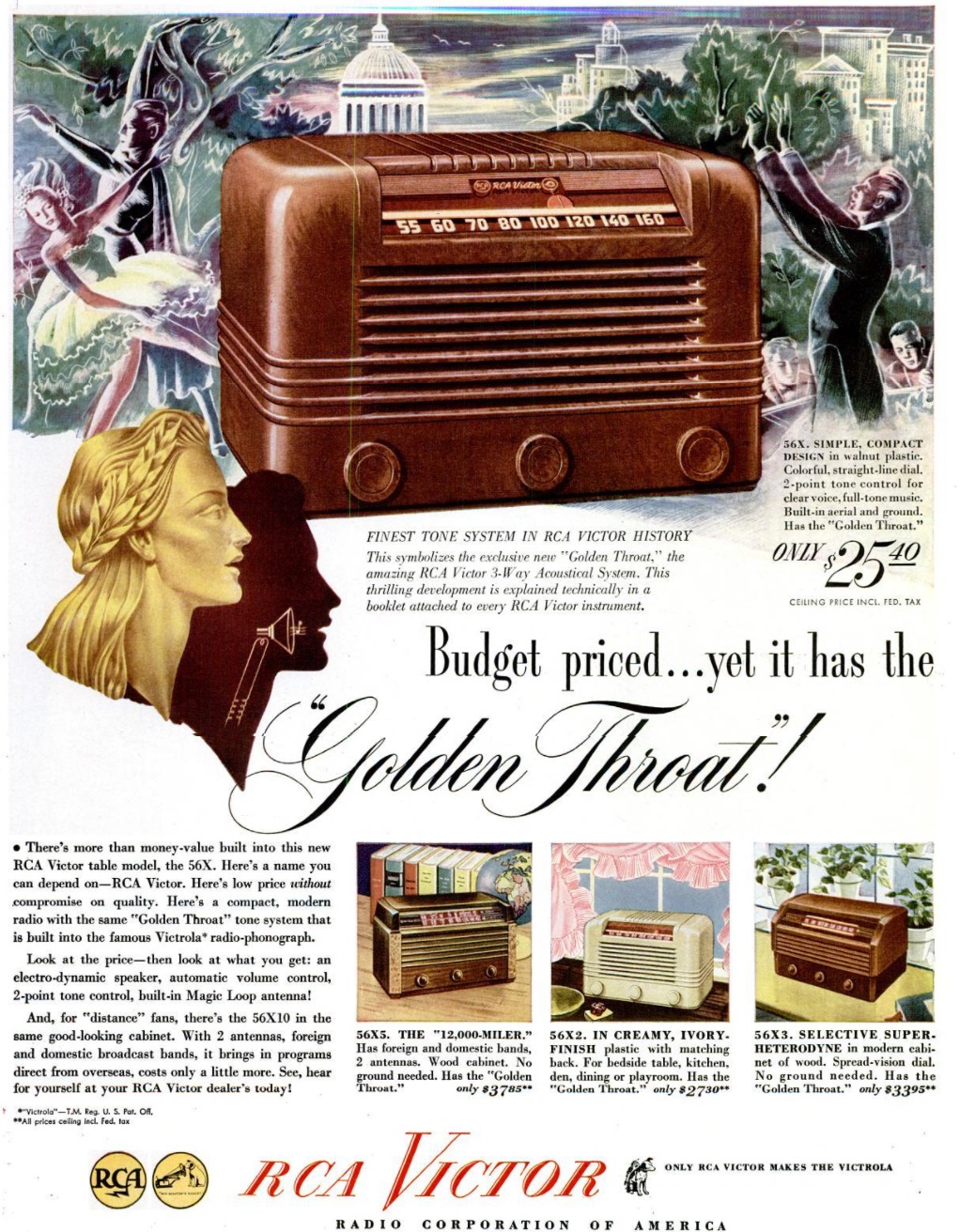
RCA Model 56X: 1946

1946Aug12LifeSeventy five years ago today, the August 12, 1946 issue of Life magazine carried this ad for the RCA model 56X and some variations. The set is a six-tube superhet covering the broadcast band, and retailed for $25.40 in its walnut plastic cabinet.  The same radio with the creamy ivory finish, model 56X2 sold for $27.50, and the 56X3 in a wooden cabinet had a list price of $33.95.

We’ve previously featured the 56X5, which added one shortwave band and earned the set the “12,000 Miler” moniker.  The shortwave set sold for $37.95.


1936 Grocery Prices

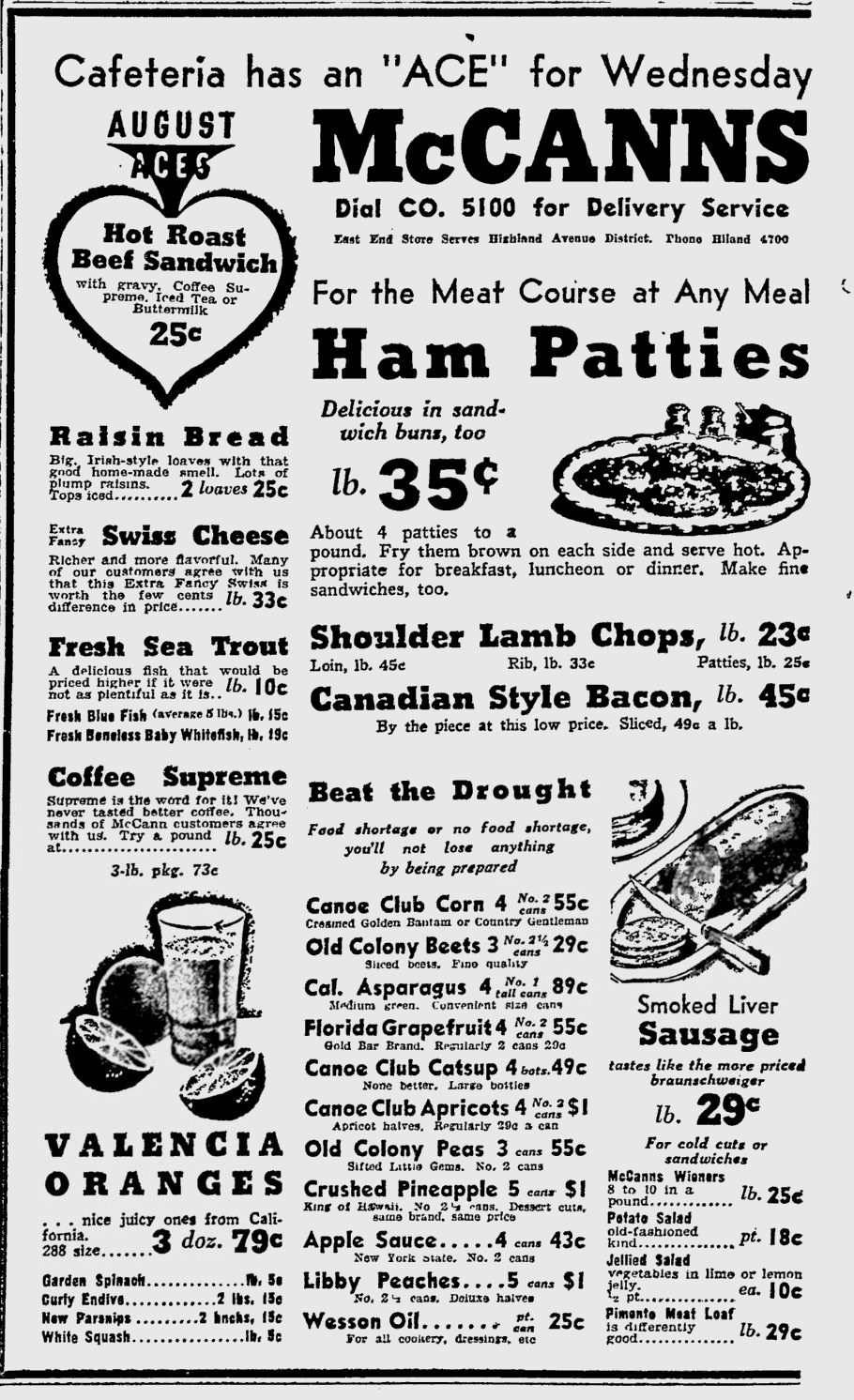
1936Aug11PghPressFor an idea of how much groceries cost during the Depression, this ad appeared 85 years ago today in the August 11, 1936, issue of the Pittsburgh Press.

The prices look like bargains, but for many, cash was scarce, and there’s been a lot of inflation since then. According to this inflation calculator, a dollar in 1936 is the equivalent of $19.55 today. So a pound of coffee or a pound of wieners sounds like a bargain for a quarter, but that’s almost $5 per pound in today’s money.

The ham patties sound good, and I’d probably be convinced to hand over a silver quarter and a silver dime to get a pound. And they were appropriate for breakfast, luncheon, or dinner, so you can’t really go wrong. But if that was too expensive, the fresh sea trout was only a dime a pound. As with anything, it “would be priced higher if it were not as plentiful as it is.”


Science Fair Ideas: Center of Mass & Sound Waves

1936AugPSIf Junior just announced that the science fair project is due tomorrow, but the project hasn’t even been started, there’s no need to panic. Thanks to these simple projects from 85 years ago, it’s still possible to get an A on the assignment, and the teacher will assume that many weeks of planning went into the project.

Shown above is a simple method of determining the center of gravity (or, since the teacher will prefer the more scientifically accurate term, the center of mass) of an object. Cardboard is used, but any similar substance of uniform thickness will work fine. After the pattern is cut out, the design is hung by one edge. A plum line (which is just a piece of string, with a weight on one end) is hung from the same point, and it is traced on the item. Then, it’s hung from another edge. Where the two lines intersect, that is the center of mass.

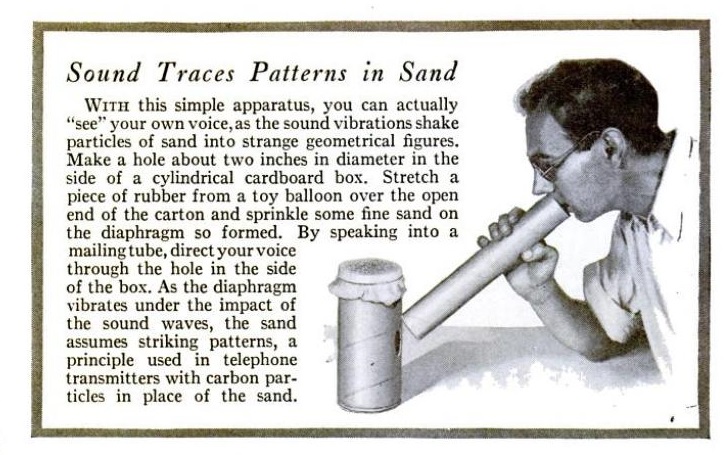
The other project, shown below, gives a visual indication of sound waves. All that’s needed is a couple of cardboard tubes, a balloon, and some sand. Both projects appeared in the August 1936 issue of Popular Science.

1936AugP2S


1941 Optical Communicator

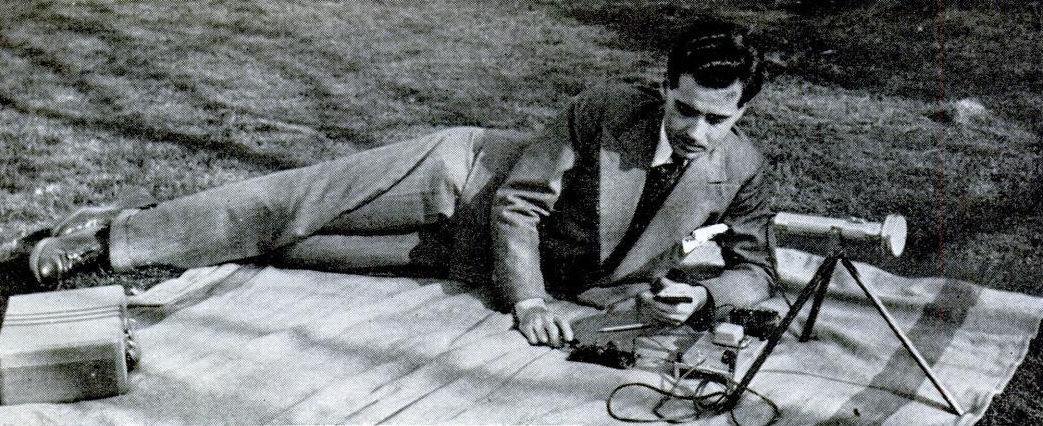
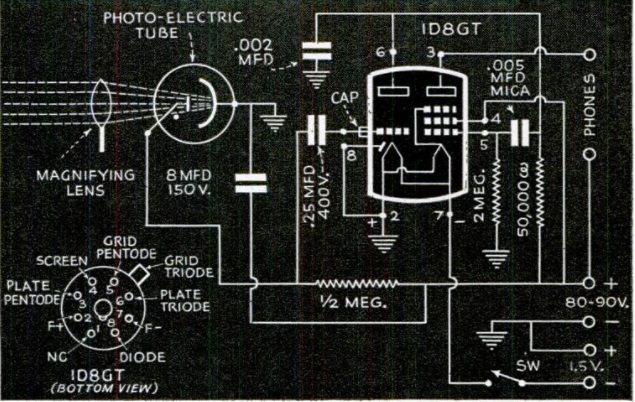
1941AugPS1Eighty years ago, this well dressed gentleman was sending a message through this light beam transmitter, as described in the August 1941 issue of Popular Science.

The magazine was a bit prophetic, since there was more experimentation with the idea after Pearl Harbor. When hams were ordered off the air for the duration of the war, optical communications was one of the ways they continued to practice their hobby (along with carrier current communications.)

The idea is simplicity itself, and it’s an idea that I independently invented as a youngster 30 years later, and I know others did as well. The light beam of a flashlight is modulated with an audio signal by wiring the light in series with the secondary of a transformer. The primary of the transformer is wired with a buzzer and key to send Morse code. When I did the same thing, I hooked the transformer primary to the output of a transistor radio or other audio amplifier, allowing voice signals to be sent.

The receiver is an audio amplifier, with a photoelectric tube hooked to the input. In my later experiments, I used a solar cell hooked directly to the input of an amplifier, which didn’t seem to mind the small DC voltage.

The student looking for an interesting project for a science fair could easily duplicate this experiment with modern equipment, at very low cost.  It’s an easy demonstration of a communications device dependent only upon light.

1941AugPSRx1941AugPSTx


1936 Deroyla Radio

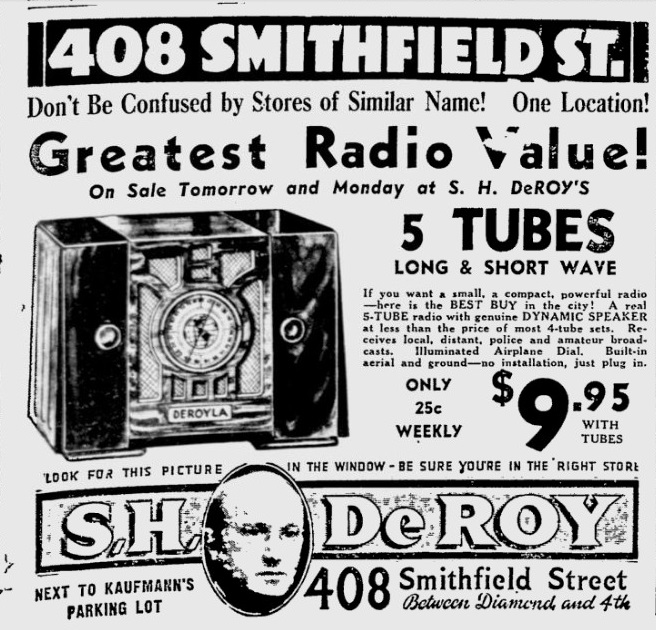
7PghPressThis ad appeared in the Pittsburgh Press 85 years ago today, August 7, 1936, and it raises some interesting questions. It’s for the store of one S.H. DeRoy, 408 Smithfield Street, Pittsburgh.
It implores customers not to be confused by stores of a similar name, and points out that there is but one location for the S.H. DeRoy store. There was a picture of S.H. DeRoy in the window, and you were supposed to look for that before going in.

It appears that other relatives of S.H. DeRoy might have been operating their own competing stores, hence the warnings. This case from the U.S. Tax Court reveals that S.H. had been in partnership with his brother and father running a jewelry business, but the partnership went bankrupt in 1930. Another brother acquired the assets, formed a new corporation, and attempted to continue the business. But by 1937, it too had become insolvent. While it’s hard to tell for sure, it’s likely that other family members were in competition, hence the warnings.

According to the court decision, the company was primarily in the retail jewelry business, and it appears that much of their business was frames for eyeglasses.  In 1936, S.H. apparently branched out into radio, with the model shown here.  The court opinion notes that the jewelry was sold on credit, and the radio was as well, since you could take it home for only 25 cents per week, or buy it for $9.95 cash.

Despite the insistence on not being misled by similar names, it’s interesting to see the brand name of the radio being sold. This set, described only as receiving both longwave and shortwave, bears the brand name of Deroyla. That makes perfect sense, since it’s being sold by DeRoy. But it’s also suspiciously similar to Detrola, which was a major brand name at the time. The only other Deroyla radio I’ve been able to find is this ebay listing, which is for a model with a similar description by somewhat different front panel layout.


1941 Soviet Crystal Set

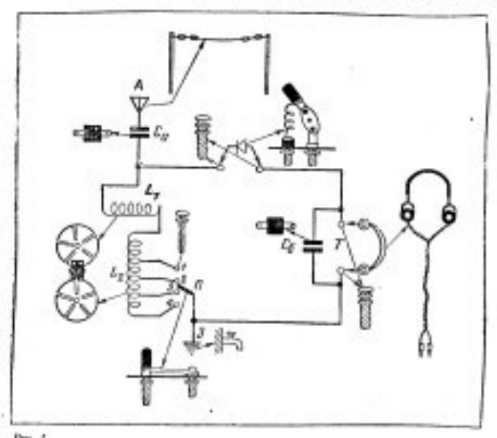
1941AugRadioFrontIn August 1941, the Germans were busy invading the Soviet Union, but they would have realize the futility if they had known that the Soviets were quite undaunted, and were busy putting together crystal sets. As you can see from the August 1941 issue of Радиофронт (Radio Front) magazine, that is exactly what they were doing. The diagram shown above is clearly a crystal set, and most of the parts appear to be homemade. Despite what the Germans could throw at them, the Soviets were still able to pull in the stronger stations thanks to simple receivers such as this one.

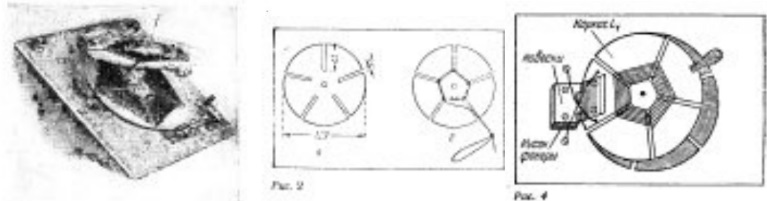
As you can see from the diagrams below, the tuning was accomplished with a variometer, using two spiderweb-style coils hinged together. And as long as they could find a suitable mineral, the Soviets could easily put together the detector shown below.

1941AugRadioFront21941AugRadioFront3


5 August 1921: First Baseball Broadcast

Forbes Field exterior.jpg

Forbes Field. Wikipedia image.

One hundred years ago today, August 5, 1921, the Pittsburgh Pirates beat the Philadelphia Phillies 8-5 at Pittsburgh, as duly recorded by the next morning’s newspapers. While nothing remarkable happened during the game, it was a landmark event, since it was the first time that a baseball game was broadcast by radio.

Harold Arlin provided the play by play over KDKA, which had just received its commercial license. He sat in a converted box seat at Forbes Field and spoke into a microphone that he described as looking like a tomato can lined with felt.

Hams:  To commemorate the event, KD3KA will be operating a special event station on August 7 and offering a commemorative QSL card.  Details are available at the ARRL website.


1960 NEAR Test, Charlotte, MI

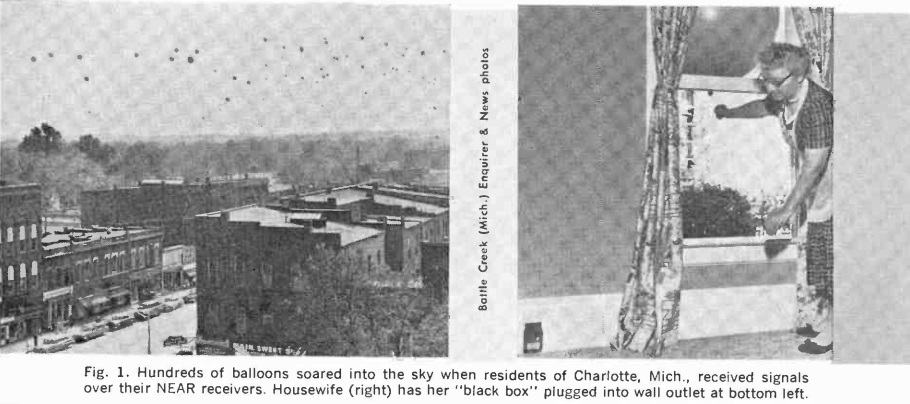
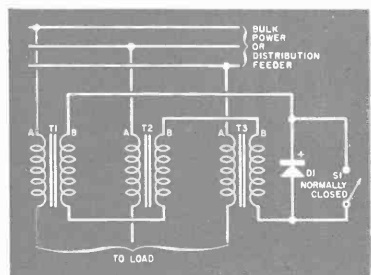
1961AugPE1We’ve previously written about the NEAR system, which was a system envisioned to alert the American public to a nuclear attack. It relied upon a 240 Hz signal superimposed upon the power lines. This signal was picked up by an ingenious electromechanical receiver in the home, and sounded a loud buzzer in the event of an alert. We previously described how the receiver worked, and the August 1960 issue of Popular Electronics, from which the pictures above were taken, explains the equally simple method used to transmit the signal. In the schematic at right, at the utility substation, to send the alert, switch S1 is opened. The rectifier sends a flow of DC1961AugPE2 pulses through the transformer secondaries, generating a signal at the fourth harmonic of the power line frequency. This signal averaged about 2-3 volts, meaning it would not interfere with regular power transmission.

On that October day, the alarm originated at a radar station in the Arctic, from which it was relayed to NORAD headquarters in Colorado Springs, CO. An officer there pushed the button to activate the NEAR system, resulting in the alarm being sounded almost immediately in Charlotte, MI.

That morning, seniors at the high school, the Charlotte Class of 1961, had inflated weather balloons and distributed them around town. When the devices buzzed in each home, homeowners were to release the balloon on a tether. Back at the courthouse, the students were in the tower of the courthouse counting balloons.

References


1931 Grocery Prices

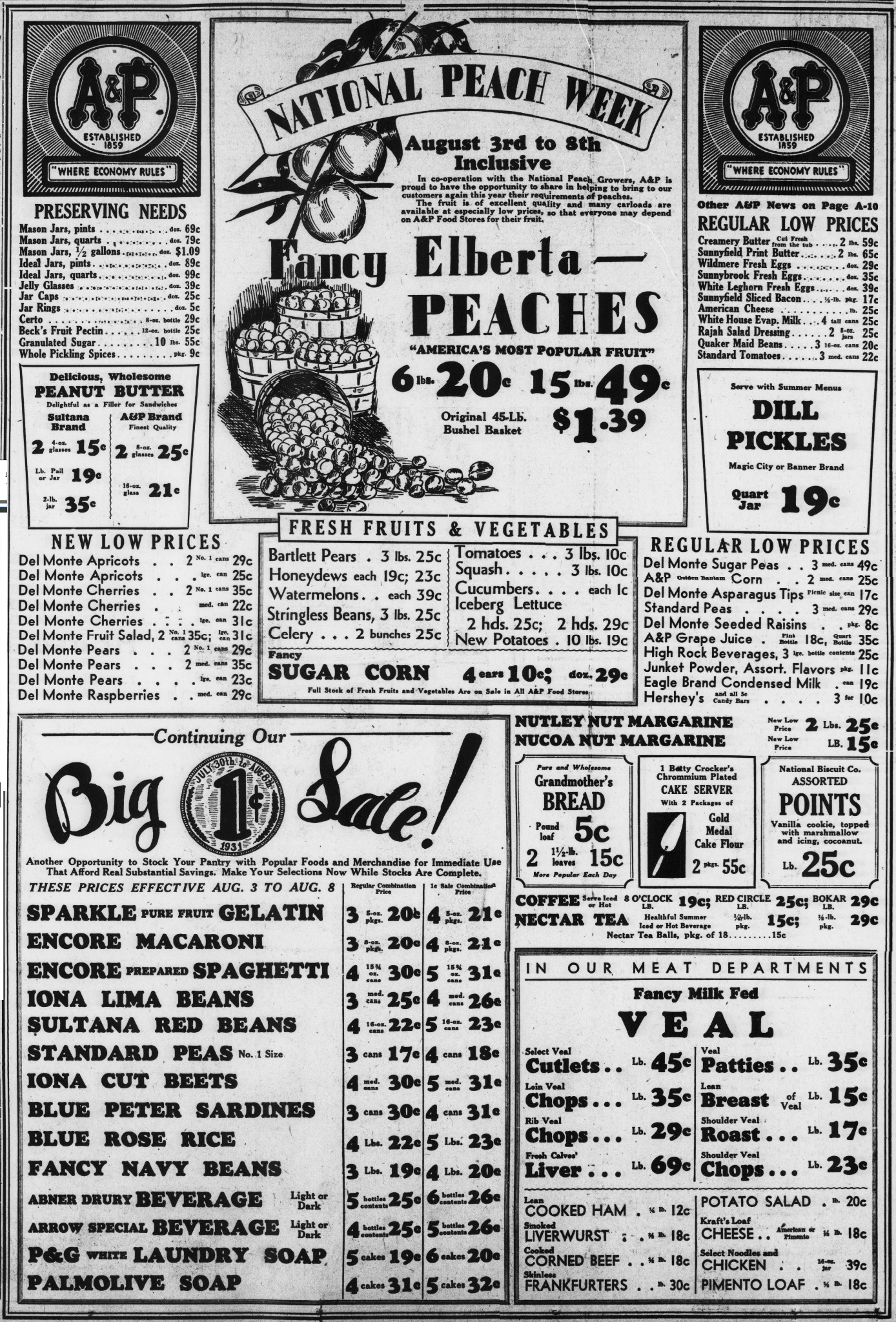
1931Aug3WashStarFor a snapshot of what groceries cost in the 1930s, here the ad for A&P stores that appeared 90 years ago today, August 3, 1931 in the Washington Evening Star.  (You can click on the image to see the full size version.)  The prices look like bargains, but there has been a lot of inflation in 90 years. According to this inflation calculator, one dollar in 1931 is the equivalent of $17.87 in 2021 dollars.

So the one pound loaf of bread for a nickel is the equivalent of 89 cents today, which is about what one would expect to pay. But if you want to butter your bread, it’s two pounds for 59 cents, which works out to about $5.28 per pound. And eggs start at 29 cents a dozen, but that’s over $5 in today’s money.

Frankfurters are 30 cents a pound, but that is over $5 today. Depending on the brand, coffee ranged from 19 cents to 29 cents per pound. That’s relatively inexpensive, since it’s the equivalent of $3.33 to $5.09.

What item do you think is the best bargain? Feel free to leave a comment below.