Author Archives: clem.law@usa.net

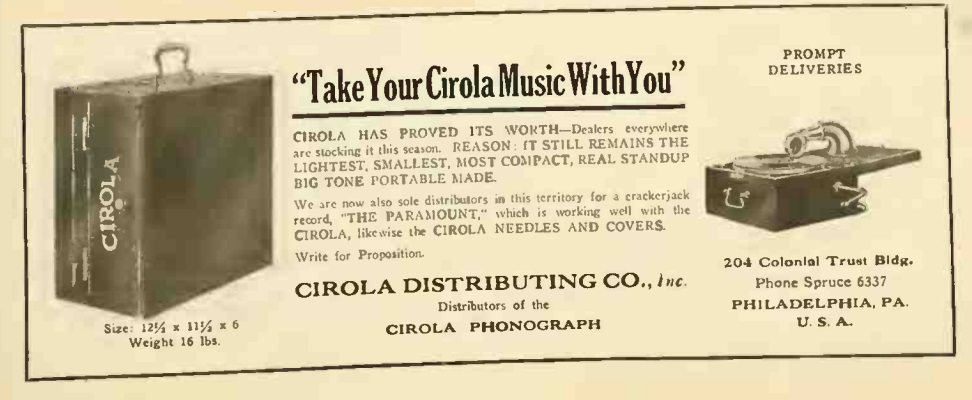
Cirola Portable Phonograph, 1921

1921AugTalkMachWorldA hundred years ago this month, the August 1921 issue of Talking Machine World carried this ad for the Cirola portable phonograph, from the Cirola Distributing Company, Inc., 204 Colonial Trust Bldg., Philadelphia.  The set is quite portable, and weighed in at only 16 pounds.  You can see one in action at this video:


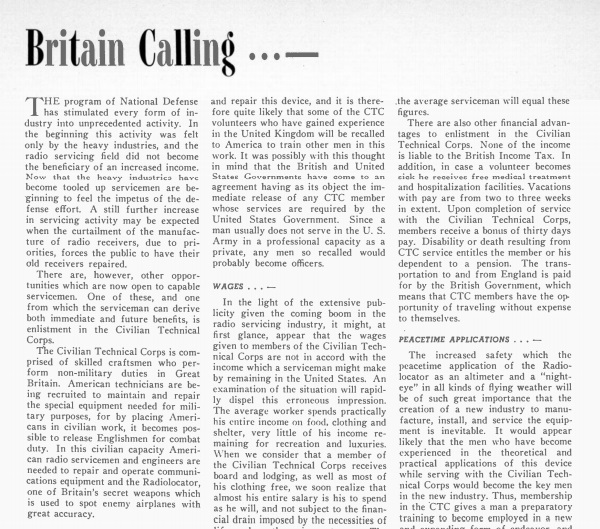
Civilian Technical Corps, 1941

1941AugRadioServiceDealer

CivilianTechnicalCorps

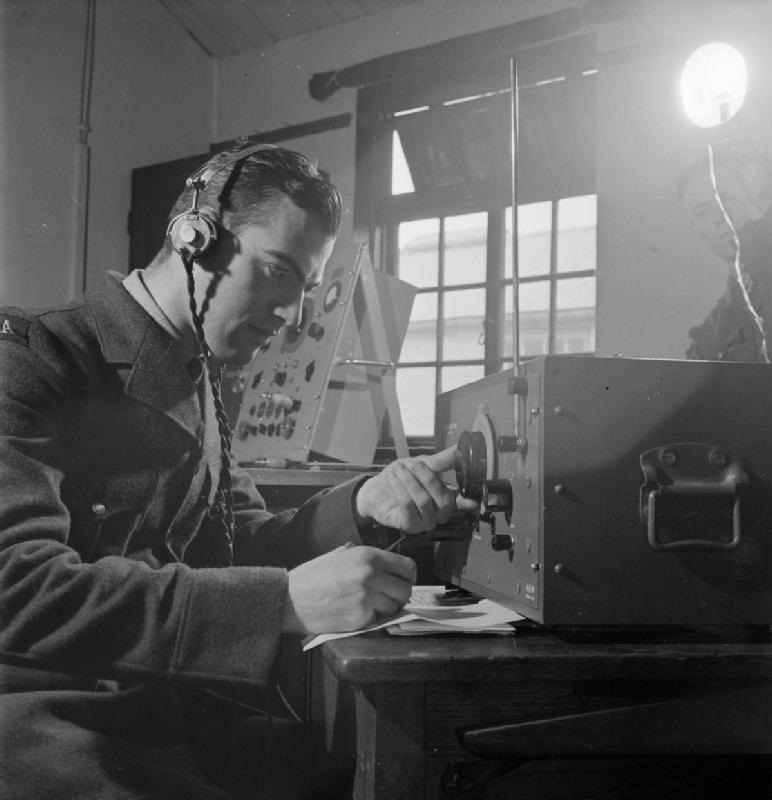
Civilian Technical Corps member training, 1941. Wikipedia photo.


The August 1941 issue of Radio Service Dealer carried this article describing something I had never knew existed, the Civilian Technical Corps, an Anglo-American quasi-military organization. It was essentially a branch of the British military manned by American civilians, primarily working in radio. Members wore a uniform identical to the Royal Air Force.

The magazine described the Corps as being comprised of skilled craftsmen who performed non-military duties in Britain. American technicians were being recruited to maintain and repair radio equipment. By placing Americans in these slots, Englishmen were freed up for combat duty.

“There are a number of men, who, although perfectly loyal American citizens and willing to die in the defense of their country, would prefer to retain their civilian status. Enlistment with the Civilian Technical Corps qualifies a man for deferment from the draft, and does so with the full consent and approval of President Roosevelt. All local draft boards have been authorized to put CTC volunteers in Class II-B, for it is felt that this civilian occupation is of notable importance to our own National Defense. Enlistment in the CTC thus enables a man to satisfy his patriotic urge even though his is not serving in the armed forces.”

Pay ranged from $24.12 to $38.65 per week, but the magazine noted that this was actually quite generous, since food, clothing, and shelter were all provided. It was thus the equivalent of a salary of $50 to $75 per week, and also offered free passage to England.

Interested men were directed to apply to the British Consulate General in New York.  From this site, it appears that 21 members of the Civilian Technical Corps died in the line of duty, 19 of whom were lost in the Atlantic on October 15, 1941.  Perhaps some of those men were going off to England in response to this article,  and were indeed perfectly loyal American citizens and willing to die in the defense of their country, albeit in a civilian status.


Science Fair Idea: Clothing to Keep You Cool

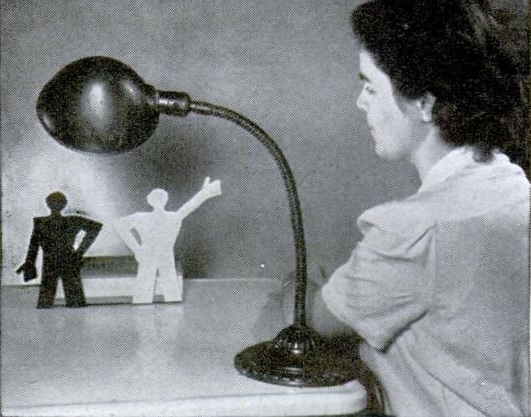
1941AugPSsciencefairIf Junior just remembered that the science fair project is due tomorrow, and it hasn’t even been started, you’ve come to the right place. This last-minute experiment from 80 years ago will prove an important scientific principle, you have everything you need around the house, and the teacher will be suitably impressed at Junior’s ingenuity. The teacher needn’t suspect that the project was put off until the last minute.

This project answers the simple question, “what kind of clothing keeps you cooler?” It turns out that it’s light colored clothing. All you need is a couple of pieces of cardboard, a table lamp, and a little bit of wax. If you can’t find any wax around the house, you can always go to the closest all-night supermarket and buy a package of birthday candles.

While you are out buying the wax, Junior should cut out the two small human figures, one from a piece of white cardboard, and one from a piece of black cardboard. If you can’t find any black cardboard, just make the both out of white cardboard and color one with a black magic marker. The arms should be made separately, and the arm is attached with a small drop of wax. If Junior is not old enough to play with matches, then an adult should light the candle and place a drop of wax in the correct spot.

Then, you stand up both of the figures and shine a lamp on them. You want the hottest lamp you can find, so don’t mess around with energy-efficient bulbs.

Eventually, one of the figures will get hot enough that its arm will fall off. Unless the laws of physics have changed in the last 80 years (hint: they haven’t), it will be the one in dark clothing. Junior has proven that you will be cooler if you wear light clothing on a hot day.

The experiment appeared in the August 1941 issue of Popular Science.



1946 Grocery Prices

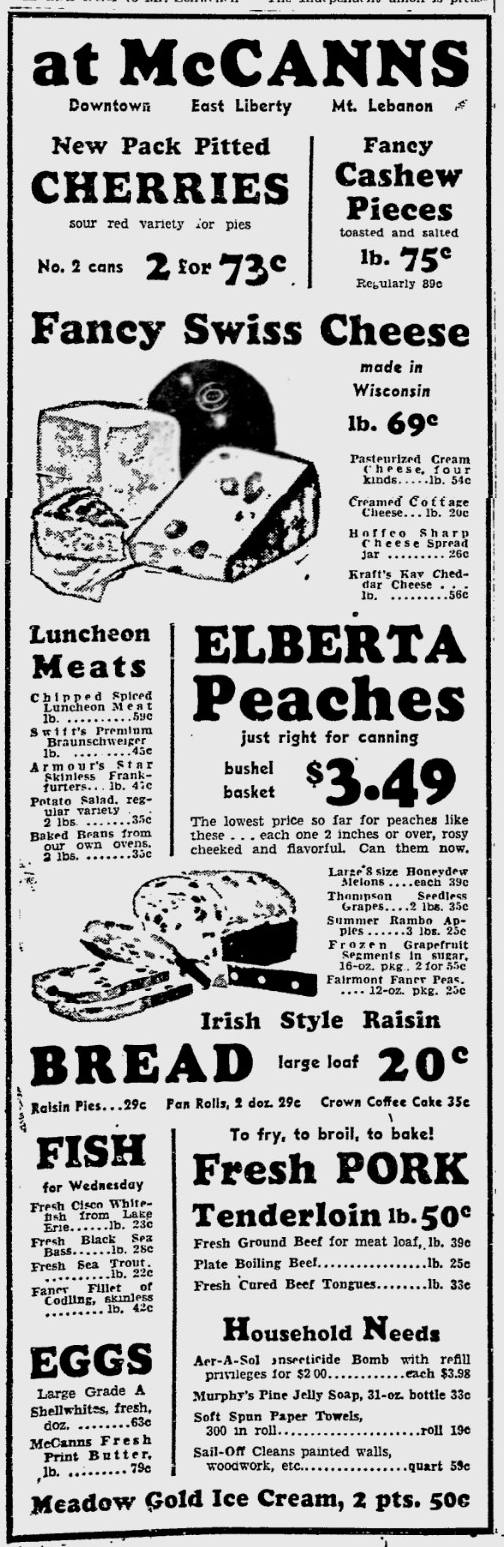
1946Aug20Pgh21946Aug20PghHere’s a snapshot of what grocery prices looked like right after World War II, from two different ads in the August 20, 1946, issue of the Pittsburgh Press. While these prices look like a bargain, there has been a lot of inflation in the last 75 years. According to this inflation calculator, one dollar in 1946 was the equivalent of $14 today, so you need to multiply all of these prices by 14.

A dozen eggs for 63 cents sounds cheap, but that works out to $8.82 today.  A loaf of raisin bread for 20 cents isn’t so bad, but it is $2.80 today.  The best bet for dinner might be a pound of chop suey for 39 cents, but that’s still $5.46.

What would you make for dinner 75 years ago?  Feel free to leave your thoughts in the comment section.


1961 Electronics Quiz

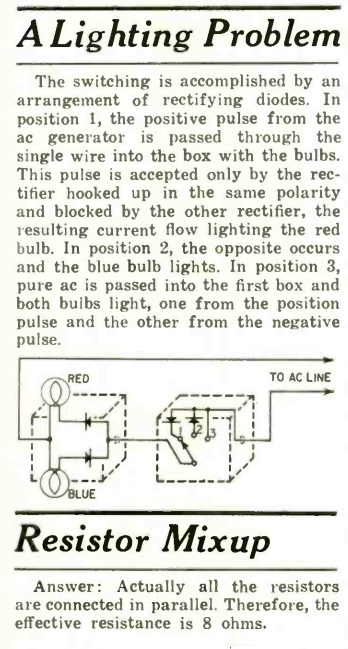
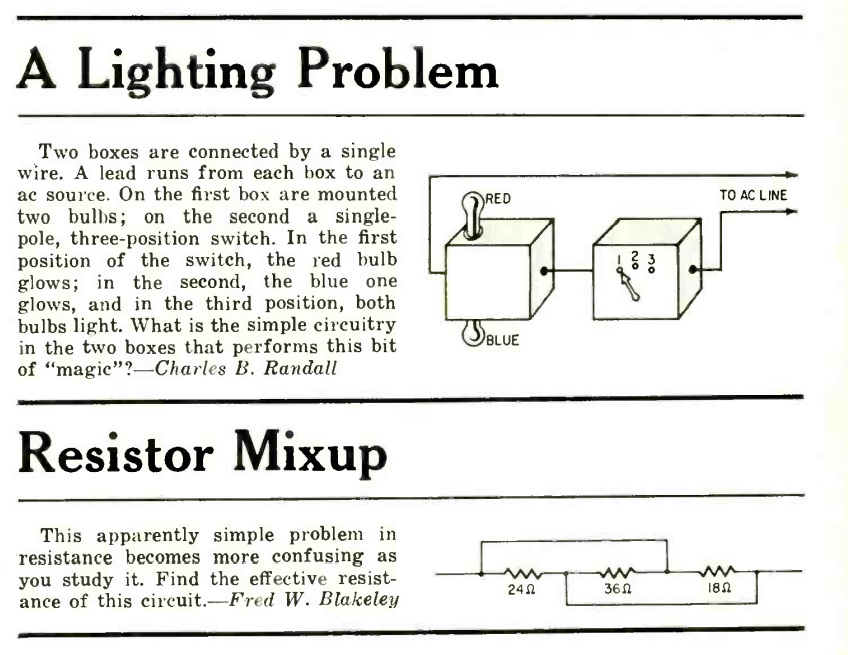
1961AugRadioElectronicsThese two quizzes appeared 60 years ago in the August 1961 issue of Radio Electronics.

We’re confident that most of our readers can figure them out. If not, we’ll post the answers tomorrow. If these look vaguely familiar, it’s probably because you’ve seen them here before. The first “black box” quiz is very similar to a circuit we showed previously from October 1956 QST. And the second one with resistors is almost identical (only the values have changed) to the one we previously showed from the January 1957 issue of QST.

The 1961 answers (which are similar to the 1956-57 answers) will appear here tomorrow.


FM Stereo: 1961

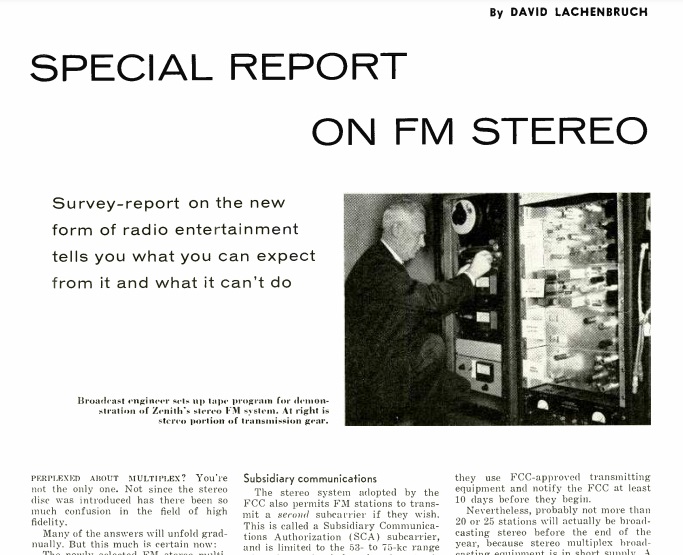
1961AugRadioElecFM stereo is 60 years old this year, and 60 years ago this month, the August 1961 issue of Radio Electronics carried an update on the status of FM stereo broadcasting. The format had been approved by the FCC on April 19, 1961, and the first station to start stereophonic broadcasting was GE-owned WGFM in Schenectady, NY, followed soon by Zenith’s WEFM in Chicago.

FM stations were free to start stereo service whenever they wanted, as long as they used approved equipment and gave the FCC 10 days’ notice. But the magazine noted that due to shortages of equipment, there would only be 20-25 stations on the air before the end of the year.

The magazine was advertising a few stereo receivers, and the article noted that there were two ways to get stereo. Some receivers had been constructed with multiplex inputs, and the manufacturers were tooling up to produce adapters. However, in most cases, it would be necessary to use an adapter from the same manufacturer.

Table model receivers were also soon available. The magazine predicted that FM stereo would not mean the end of monophonic FM. In fact, the additional demand for FM stereo would probably add interest to FM in general, to the benefit of stations broadcasting in mono.


1946 Portable Radio Batteries

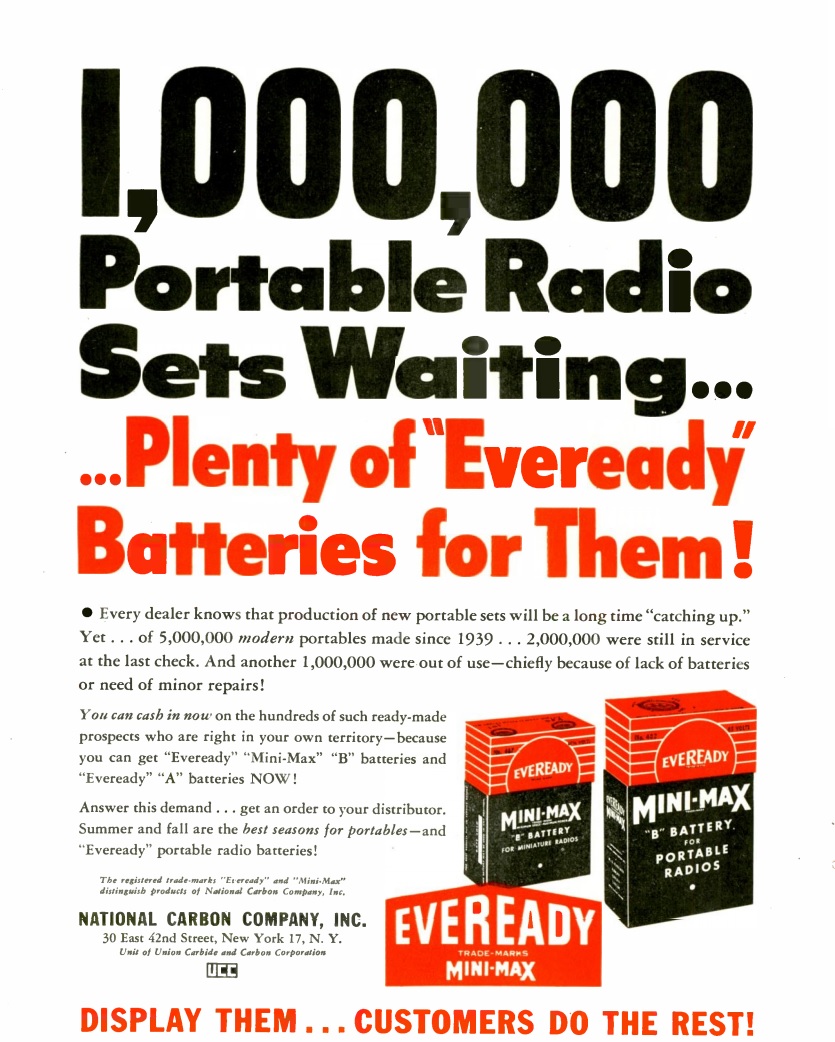
1946AugRadioRetailerSeventy five years ago this month, the August 1946 issue of Radio Retailing carried this ad for Eveready batteries.  The wartime years were ones of shortages of many consumer products, and radio batteries were difficult or impossible to find.

Millions of portable radios had been manufactured since 1939, but a million of them were out of service, mostly because no batteries were available.  Summer was prime time for portables, and Eveready reminded dealers that if they put the batteries on display, they would sell themselves.


1946 One Tube Regen

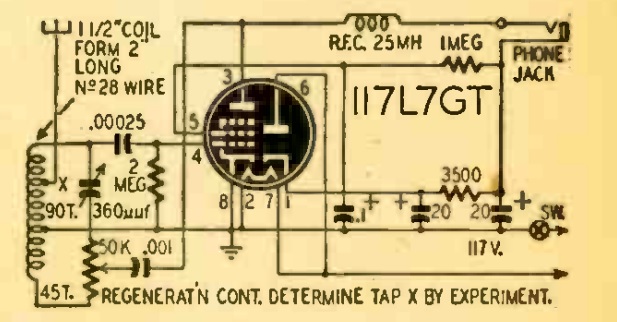
1946AugRadioCraftSeventy-five years ago this month, the August 1946 issue of Radio Craft carried this simple circuit for a one-tube receiver. The circuit had been sent in to the magazine by one Robert Sherrington of High Prairie, Alberta, who noted that the circuit was very selective and would pull in locals with good volume on a loudspeaker. It employed a 117L7GT, half of which served as a rectifier, with the other half serving as a regenerative detector.

The designer of the circuit was almost certainly the same Robert Sherrington, who was 16 at the time he sent the circuit into the magazine. According to his 2015 obituary, he attended the Radio College of Canada in Toronto in 1949, and then owned a radio repair shop in High Prairie. He later moved to British Columbia, where was licensed as VE7DLX.

The magazine’s editor noted that the circuit, while unusual for the time, was not new, having been used in earlier receivers, including the Reinartz.


Hammarlund HQ-105-TR General Coverage Receiver/CB Transmitter

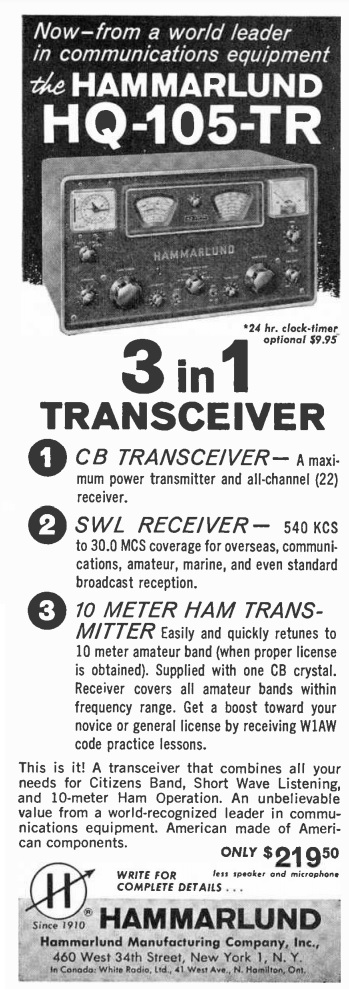
1961AugPESixty years ago this month, the August 1961 issue of Popular Electronics included this ad for an unusual combination from Hammarlund–the model HQ-105-TR.

The set was basically an HQ-100 receiver with one added feature: It included one additional tube for the CB transmitter. One CB crystal was included, and the receiver’s audio amplifier was used as the modulator.

The receiver covered the broadcast band up to 30 MHz, and had a bandspread calibrated for the ham bands. The ad noted that when the owner got the general class ham license, the transmitter could be easily retuned to the 10 meter band. In the meantime, the receiver could be used to copy W1AW code practice toward getting that license.

You can view the receiver in action in this video:

Interestingly, the mike connection is in the back, and there is no indication on the front panel that the unit also contains a transmitter.