Eighty years ago today, the December 29, 1941, issue of Broadcasting showed Private Milton Shaw of Cleveland, Georgia, standing guard over the 50,000 watt transmitter of KIRO, Seattle, sited on Vashon Island. The soldier was one from the 41st Division. The magazine claimed that the station was “located in the center of a large colony of Japanese nationalists.” The magazine noted that the station was the only 50,000 watt station north of San Francisco and Salt Lake City.
Yesterday, we featured some fallout shelter designs from the December 1961 issue of Popular Mechanics. The public relations department at the Office of Civil Defense must have been working overtime, because that month’s issue of Popular Science also carried a feature entitled “Plain Facts About Fallout Shelters.” The Popular Science article was written mostly in Question and Answer format. It started by noting that those who build fallout shelters in the past kept it secret for fear they would be considered crazy. But according to the magazine, “safety precautions against the ravages of atomic war no longer reveal old-maidish nervousness but admirable prudence.”
Unfortunately, the magazine lamented that many buyers, as well as builders, of shelters didn’t know what they were doing. So the article is devoted to dispelling some misconceptions and providing good information.
The chart above illustrates that radiation is not necessarily fatal, but the dose is the key factor. The stress on fallout shelters was because much of the country would be free from the immediate effects of the blast, but would be subject to deadly fallout. The general idea was that if you were in the “probably die” category, you would want to move yourself up to “sick,” or even better yet, to “safe.” And a fallout shelter would do that for millions of Americans.
After explaining the basics, the magazine urged readers to write to the Office of Civil Defense for further information. It also made the reminder to check local building codes before starting work.
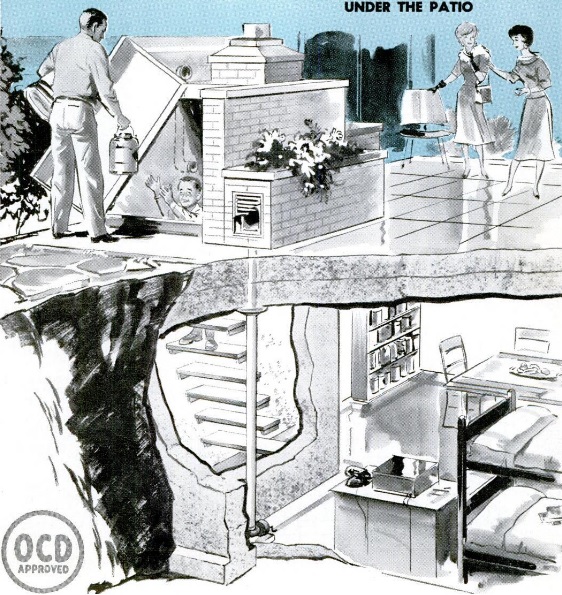
Sixty years ago this month, the Cuban Missile Crisis was still almost a year off, but protection from nuclear weapons was already on the minds of many Americans, and the December 1961 issue of Popular Mechanics carried construction details for four fallout shelters. The deluxe model shown above, with an estimated cost of $1841 (about $17,000 in 2021 dollars) was typical of that offered by commercial builders. It was an underground room that could be used in peacetime for some other use, with an attractive patio on top, complete with a built-in grill.
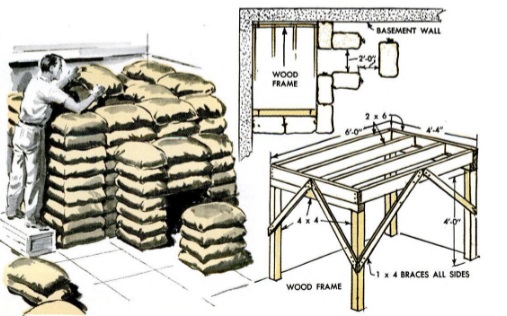
The other end of the cost spectrum was represented by the design shown at left courtesy of Prof. R.M. Stephenson of the University of Connecticut’s nuclear engineering program. He estimated that the design would reduce radiation levels by a factor of 200-1000, meaning that it would save lives even in areas of high fallout. The material consisted of 100 sandbags, 10,000 pounds of dry sand, and some miscellaneous lumber, with a cost of only $30 ($279 in 2021 dollars).
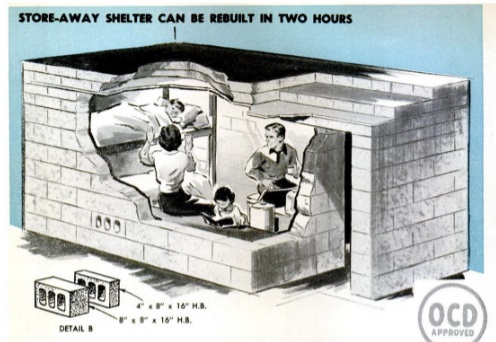
The next least expensive was the design shown at right, with an estimated cost of $97 (about $900 in 2021). The initial construction of this design was done prior to the emergency, requiring about 33 hours of labor. A wooden frame was mounted to the wall with a hinge for the ceiling, with the concrete blocks stored nearby. In time of emergency, the construction could be completed in about two hours, assuming you were in a hurry, which you probably would be. To save space in this shelter, food and water was to be stored outside, with the occupants brining in a one or two day supply.
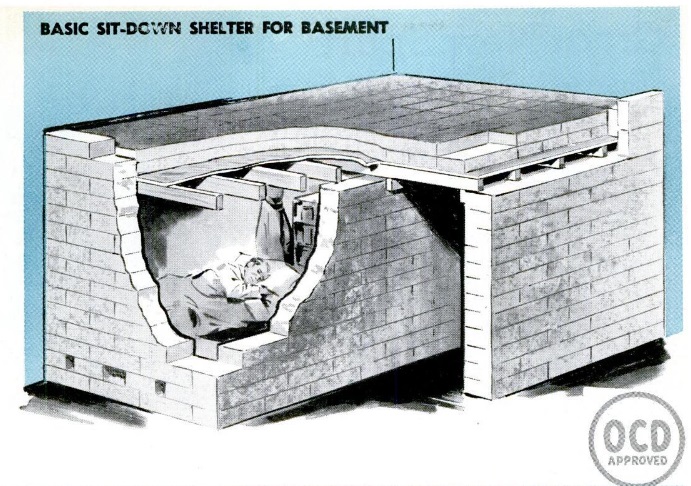
The final design, shown below, could shelter four persons at a cost of $280 ($2600 in 2021 dollars). This design was made mostly of concrete block. Some lumber was used, and the designers recommended that any lumber in contact with existing basement floor or walls be coated with tar or white lead paste to prevent rot.
The magazine offered a booklet with more details about the designs, and also directed readers to the Office of Civil Defense for more free information.
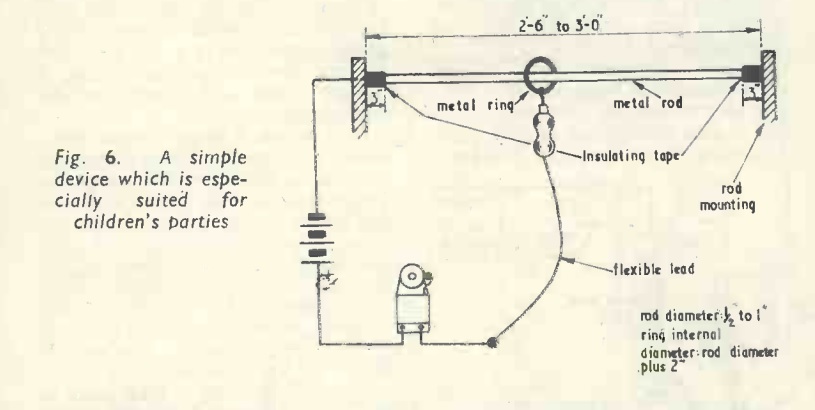
Sixty years ago this month, the December 1961 issue of the British publication Radio Constructor gave some ideas for devices to liven up a Christmas party or, for that matter, any party. According to the author, the self-explanatory design here was an “oldie,” but was largely forgotten. To play the game, one needed to move the ring from one side to the other without touching the metal rod. According to the magazine, this feat required a remarkably steady hand, and was no doubt good for many hours of fun as the guests made an attempt.
The magazine noted that if the party was one for charity, then the guests could be charged a fee to play, earning a refund if they were able to successfully move the ring from one side to the other without sounding the bell.
Perhaps if Junior is looking for a science fair project, this one could be used as a basis for determining which of their classmates had the steadiest hand.
It’s sung in French at the video above, but here are the lyrics in English:
Bring a torch, Jeanette, Isabella!
Bring a torch, to the stable call
Christ is born, tell the folk of the village
Jesus is born and Mary’s calling.
Ah! Ah! Beautiful is the Mother!
Ah! Ah! Beautiful is her Child
Who is that, knocking on the door?
Who is it, knocking like that?
Open up, we’ve arranged on a platter
Lovely cakes that we have brought here
Knock! Knock! Open the door for us!
Knock! Knock! Let’s celebrate!
It is wrong when the Child is sleeping,
It is wrong to talk so loud.
Silence, now as you gather around,
Lest your noise should waken Jesus.
Hush! Hush! See how He slumbers;
Hush! Hush! See how fast He sleeps!
Softly now unto the stable,
Softly for a moment come!
Look and see how charming is Jesus,
Look at Him there, His cheeks are rosy!
Hush! Hush! See how the Child is sleeping;
Hush! Hush! See how He smiles in His dreams!
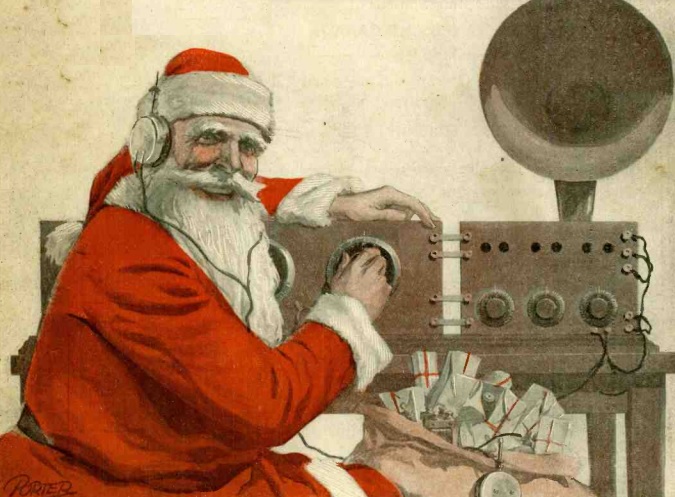
Once again this year, to assist him with precision navigation, Santa Claus has asked OneTubeRadio.com to activate its non-directional beacon (NDB). We will, of course, be complying with this request, and we have activated a beacon on 1610 kHz. Santa will use the automatic direction finding equipment (ADF) installed in his sleigh to home in on the beacon. (He is currently employing equipment more modern than shown above in a picture from the December 9, 1922, issue of Radio World.) We expect that while aloft, Santa will be able to pull in the signal from the North Pole.
Even though COVID-related travel restrictions have eased, Santa Claus is still required to adhere to a flight plan, and this beacon will allow him to navigate very precisely. To view his progress, we recommend visiting the official NORAD Santa Tracking website. (We previously wrote about the history of this project here.)
At ground level, the signal will have a range of about one mile. If you are located close to the OneTubeRadio.com world headquarters, you can tune in to this special broadcast. If you are further away, you can listen online:
We are transmitting with our InfOspot Talking House transmitter, which I previously reviewed at this link. It is an FCC-certified transmitter for the AM band and operates with 100 milliwatts to a 3-meter antenna. It has fairly solid coverage for about two blocks, and in a few spots, can be heard over a mile away. During COVID-19, I have used this transmitter for drive-in educational programs for my continuing legal education business. It is also suitable for other socially distanced activities, such as church services and meetings of community organizations. It could potentially be an important community resource in emergencies. And tonight, it is assisting Santa Claus in performing his duties.
Reception reports are welcome. You can contact us at como-radio@usa.net.
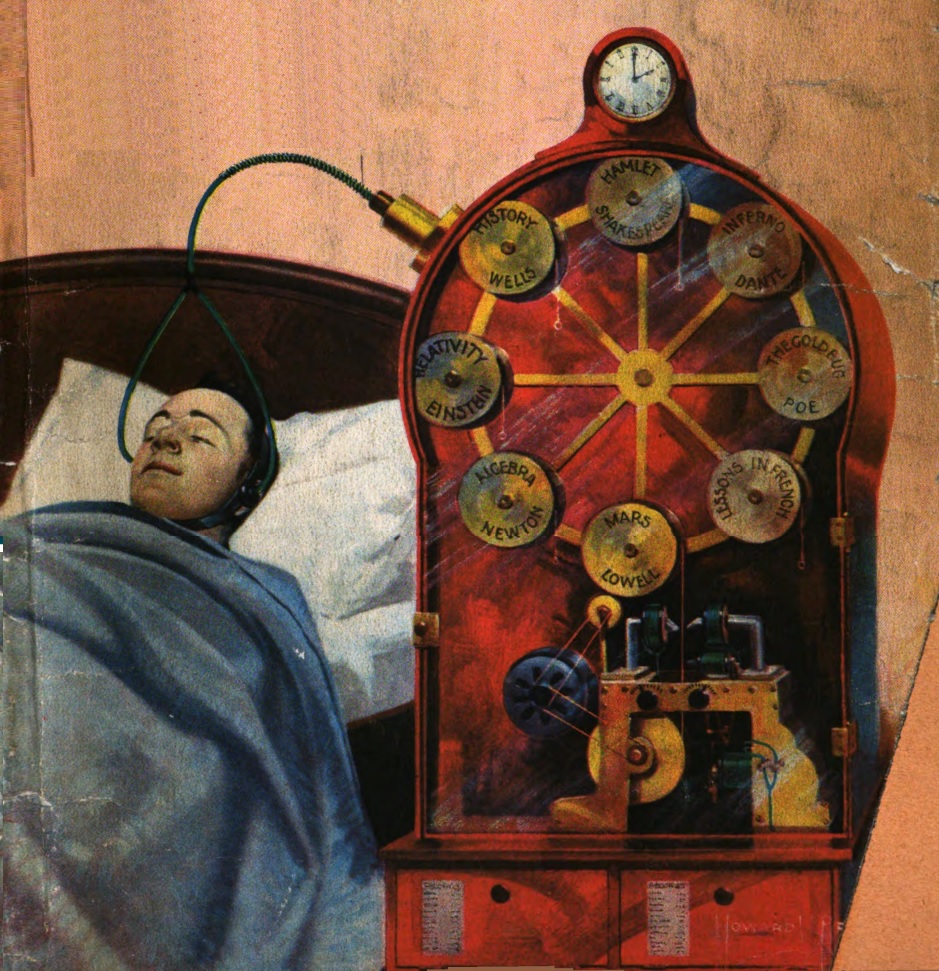
A hundred years ago this month, the cover of the December 1921 issue of Science and Invention magazine covered a topic that seemed reasonable to me as a youth. Rather than spend waking hours with the burdensome task of learning, it would be easier to just play the material while sleeping, and let the subconscious mind soak it in. This gentleman is doing exactly that, and the whole system is explained in an article by Hugo Gernsback, who also included the technology in his novel Ralph 123C 41+, first published in serial form in 1911.
It never worked for me as a kid, mostly because I never figured out how to keep something playing all night. The record player could keep playing the same record over and over, but I didn’t have any records containing material I needed to learn. I had a tape recorder, but I never figured out how to make an endless loop long enough to contain useful information. Unfortunately, I didn’t have the machine shown here available.
According to Wikipedia, it doesn’t work anyway. But if you want to give it a try, you can find the materials at Amazon.
Some links on this site are affiliate links, meaning that this site earns a small commission if you make a purchase after clicking the link.
Seventy years ago this month, the December 1951 issue of Popular Mechanics carried a feature with the byline of RCA Chairman of the Board David Sarnoff discussing the prospects of international television. He predicted that before long, viewers would be able to bring exciting events from distant lands to their armchairs with a flick of the dial, all at the instant they’re taking place.
He outlined the ways this might happen, but interestingly, he fails to mention the technology that did make it happen, namely orbiting satellites.
His most promising idea is shown above, namely a network of microwave relays about 20-50 miles apart. This network was already taking shape in the US, and Sarnoff pointed out that it could easily be expanded from Patagonia to Alaska. And since it was only 40 miles acroos the Bering Strait, there was no technological reason why the network couldn’t be thus extended into Eurasia, and from there to Africa. He notes that there were plans for a telegraph land line along the same route 90 years earlier, which was abandoned only after the success of the transatlantic telegraph cable.
Another idea for connecting America and Europe was a string of artificial islands in the Atlantic, 200 miles apart, each with a 1000 foot tower.
We’ve previously mentioned the idea of stratovision, namely, using aircraft both to broadcast and relay programs. Sarnoff hinted at a possible expansion of this system to link America and Europe. He noted that there were already enough commercial flights flying the route, and that if these planes were fitted with television relays, they could provide a permanent microwave link across the Atlantic.
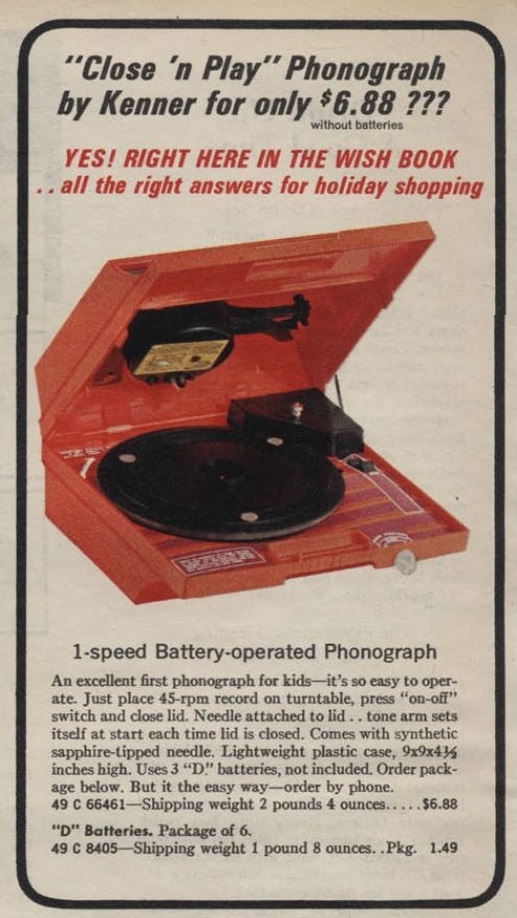
It was probably 1971, plus or minus a year or so, that Santa Claus brought me my very own record player. We had at least two phonographs around the house, and at least one of them was used mostly by me. But it wasn’t mine, and thanks to the Kenner Close ‘n Play phonograph, any kid could own one. And the parents’ (and/or Santa Claus) would only be out $6.88, plus the cost of three D cell batteries (According to this inflation calculator, that works out to about $47 in 2021 dollars.
The Close ‘N Play was a rather ingenious design. It played only 45 RPM records and it was more or less automatic. The young audiophile would place the record on the platter and turn on the motor. When the lid was closed, the record would automatically start to play.
The Close ‘N Play was probably one of the last acoustic phonographs to be mass produced. There were no electronics inside. The acoustic tone arm was built into the lid, and when the lid was opened, the arm would drop into position, ready to play from the start of the record. With the Close ‘N Play, there was no way to start in the middle of a record. If you lifted the lid, it automatically went back to the start. When you closed the lid, the needle would land on the record, and play through the acoustic horn, which was about 4 inches in diameter. Of course, there was no volume control, but the horn was relatively efficient and could be heard with no difficulty.
Of course, young owners such as me (and especially their parents and older siblings) quickly discovered that the steel needle, even if “synthetic sapphire tipped,” wasn’t particularly good for the records, especially since the acoustic tone arm had a pretty hefty tracking weight.
Despite being made by a toy company, the Close ‘N Play was decidedly more than a toy. But it didn’t quite qualify as a “real” phonograph. Once the novelty wore off (and the batteries went dead), most of my youthful record listening took place on a normal record player. The only real advantage of the Close ‘N Play was its portability. But I could proudly say that I owned my very own record player, even if perhaps I destroyed a few 45’s in the process of using it. The clipping above is from the 1971 Sears Christmas Catalog.
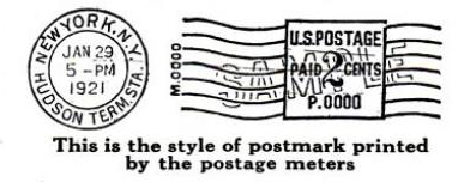
Arthur Pitney filed a patent application for the first postage meter in 1901, but it wasn’t until he teamed up with Walter Bowes in 1920 that the concept caught on.
The December 1921 issue of Popular Science, featured this image of a postage meter imprint, and the accompanying article starts by asking readers, “have you received a piece of ‘metered mail’ yet?” Apparently, many had not yet received one, but the magazine successfully predicted that they would before long, since “the newly invented postage meter is being adopted by many large companies to speed up their outgoing mail.”
The magazine shows a Pitney-Bowes Model M postage meter, which had received the seal of approval from the U.S. Post Office on September 1, 1920, and which was named in 1986 an “International Historic Mechanical Engineering Landmark” by the American Society of Mechanical Engineers.
If you’re like me, you now have this song running through your head. Unfortunately, we couldn’t find the 1983 commercial version, but here’s the original from 1922:

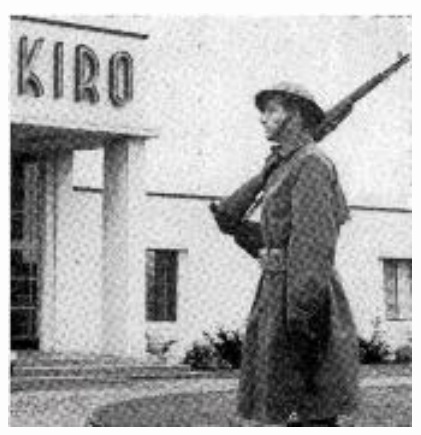 Eighty years ago today, the December 29, 1941, issue of Broadcasting showed Private Milton Shaw of Cleveland, Georgia, standing guard over the 50,000 watt transmitter of KIRO, Seattle, sited on Vashon Island. The soldier was one from the 41st Division. The magazine claimed that the station was “located in the center of a large colony of Japanese nationalists.” The magazine noted that the station was the only 50,000 watt station north of San Francisco and Salt Lake City.
 According to this source, Shaw was killed in Action in New Guinea on June 17, 1944, and his remains are buried at Oakwood Cemetery, Oakwood, Georgia.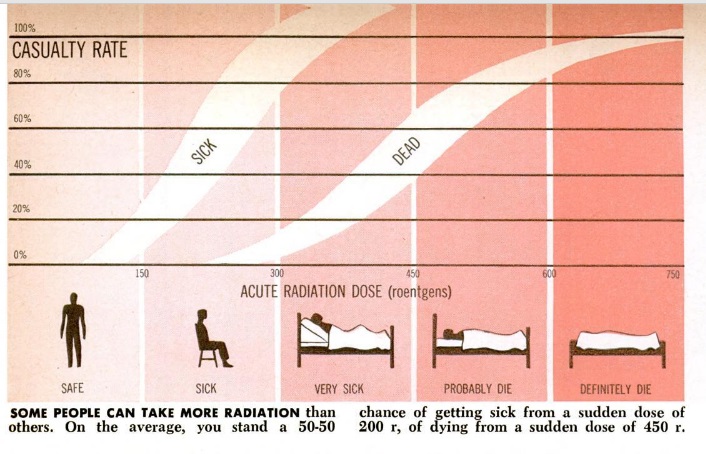

 We are transmitting with our