Author Archives: clem.law@usa.net

1961 Distance Learning

1961NovRadioElecAs we’ve seen earlier, distance learning is nothing new, and sixty years ago this month, the November 1961 issue of Radio-Electronics carried a summary of the state of the art. It noted that television, either broadcast or closed-circuit, was the leading method in use at that time. The most famous was the NBC “Continental Classroom” program, which ran from 1958 to 1963, which offered college credit. While not mentioned in the article, a similar program, Sunrise Semester ran from 1957 to 1982.

And as we’ve previously covered, the article mentioned the Midwest Program on Airborne Television Instruction (MPATI), which broadcast from an airborne transmitter over much of the Midwest.

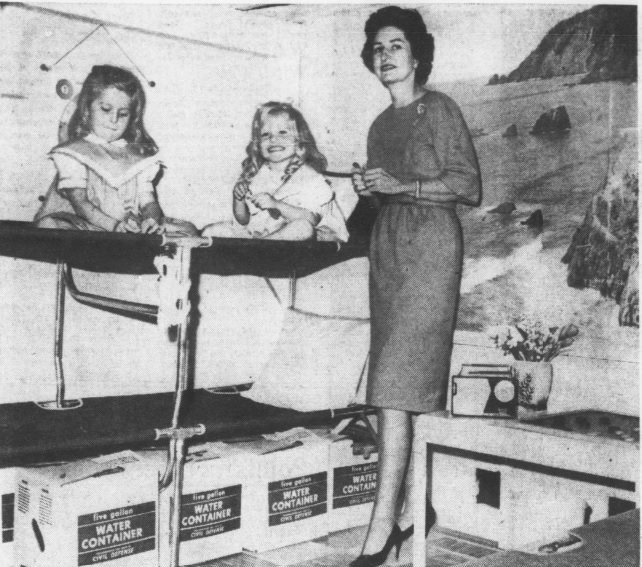
The most elaborate system in use, what we would call interactive, was that used by the New York Institute of Technology, shown above. The student listened to a recorded lesson, and then answered multiple-choice questions which were reviewed by the instructor. There was an intercom through which the student could ask questions of the instructor, and any visuals were shown to the student on a nearby TV monitor.

The magazine concluded by noting:

The exact methods that electronic instruction will follow in the future are not clear, but the question “Will it be a factor in future education?” has been answered. Make no mistake about it- electronic education is with us, and extending fast.

WW2 “Ivan The Terrible” Broadcasts

1971NovEIFifty years ago this month, the November 1971 issue of Electronics Illustrated carried the story of Ivan The Terrible, the Soviet interloper who interfered with Nazi broadcasts during the war.

Deutschlandsender broadcast its German home service on 191 kHz, with broadcasts including the news. One day in 1941, listeners were able to hear additions to the news broadcast. For example, if the announcer said, “new victories have been won by the Wehrmacht,” another voice completed the sentence with “in the grave.”

The voices were coming from Soviet Station RW-1 at Noginsk, near Moscow. The engineers at that station were able to tune the 500 kW transmitter from its original frequency of 172 kHz and synchronize it with the German station to avoid any heterodyne. Eventually, the Germans were forced to put their news broadcasts on mediumwave, and use their powerful longwave transmitter for entertainment programs.

When the Russian source of the broadcasts was known, it was dubbed Ivan The Terrible, and that name is used in this 1941 Time magazine article from September 15, 1941.

According to the 1971 Electronics Illustrated article, British and American intelligence issued a report disclosing the identity of Ivan the Terrible. Unfortunately, however, the American copy of the report was misfiled and was lost somewhere in the Washington catacombs. The British copy was still covered by the Official Secrets Act and couldn’t be made public until 1991.

But the author of the article did enough digging to give “a pretty good idea” as to the identity. According to the 1971 article, the instigator was Sololmon Abraham Lozovsy.
Despite his service to the Soviet Union, Lozovsky became the victim of one of Stalin’s purges. Even though Krushchev later issued a pardon, it came a bit too late, since Lozovsky was shot in 1952.

The actual voice of Ivan The Terrible was that of Bohemian Ernst Fischer.  After winding up on the wrong side of the Austrian civil war, he found his way to Moscow where his fluency in German was put to good use. After the war, Fischer brought his communism back to Austria, where he remained a figure in the Austrian Communist Party until 1969, serving as the Communist Minister of Information immediately after the war.

For a similar use of radio during the war, see our earlier post on Soldatensender Calais.

1921 Vacuum Airship

1921NovSciInv2The November 1921 issue of Science & Invention contains an idea that I thought of independently. A lighter-than-aircraft relies upon the fact that a gas such as hydrogen or helium is lighter than air. But instead of filling the balloon with hydrogen or helium, you’ll get even more lift if you fill it with vacuum!

The idea had been proposed, and the article, penned by H. Winfield Secor was entitled, “Is the vacuum airship practical?” There was reportedly one under construction in Italy. Despite my having the idea, and despite the Italians trying to make one, I’ve never heard of such a thing, and Secor explains the probable reason:

Stop to think for a moment just what kind of construction will have to be employed in building compartments capable of being exhausted to almost a perfect vacuum. You will remember that our physics books taught us that unless a chamber is very strong, it would collapse, due to atmospheric pressure, when a perfect vacuum was produced. It would thus seem that after we have built an airship with compartments strong enough to withstand the outside atmospheric pressure when the air is pumped out of them, we can hardly expect the airship to rise, even if it only has to carry up its own frame.

Lo and behold, Wikipedia has an entry for vacuum airship, and the idea has been around since at least 1670.  But undoubtedly for the reasons stated a century ago, the idea literally never got off the ground.

1N34 Diode: 1946

1946NovQSTSeventy-five years ago this month, the November 1946 issue of QST carried this ad from Sylvania for the venerable 1N34 diode, which had only recently hit the market. Because of the low cost of the device, practically all postwar crystal sets relied upon one of these, rather than the old-fashioned cat’s whisker and chunk of galena. (The latter, however, has the advantage of being able to make at home.)

The ad also contained something called the 1N35, which was simply two matched diodes (probably 1N34’s) mounted together on a metal bracket.

For those wishing to source this part today, they are readily available, as shown by our crystal set parts page.

1948 Grocery Prices

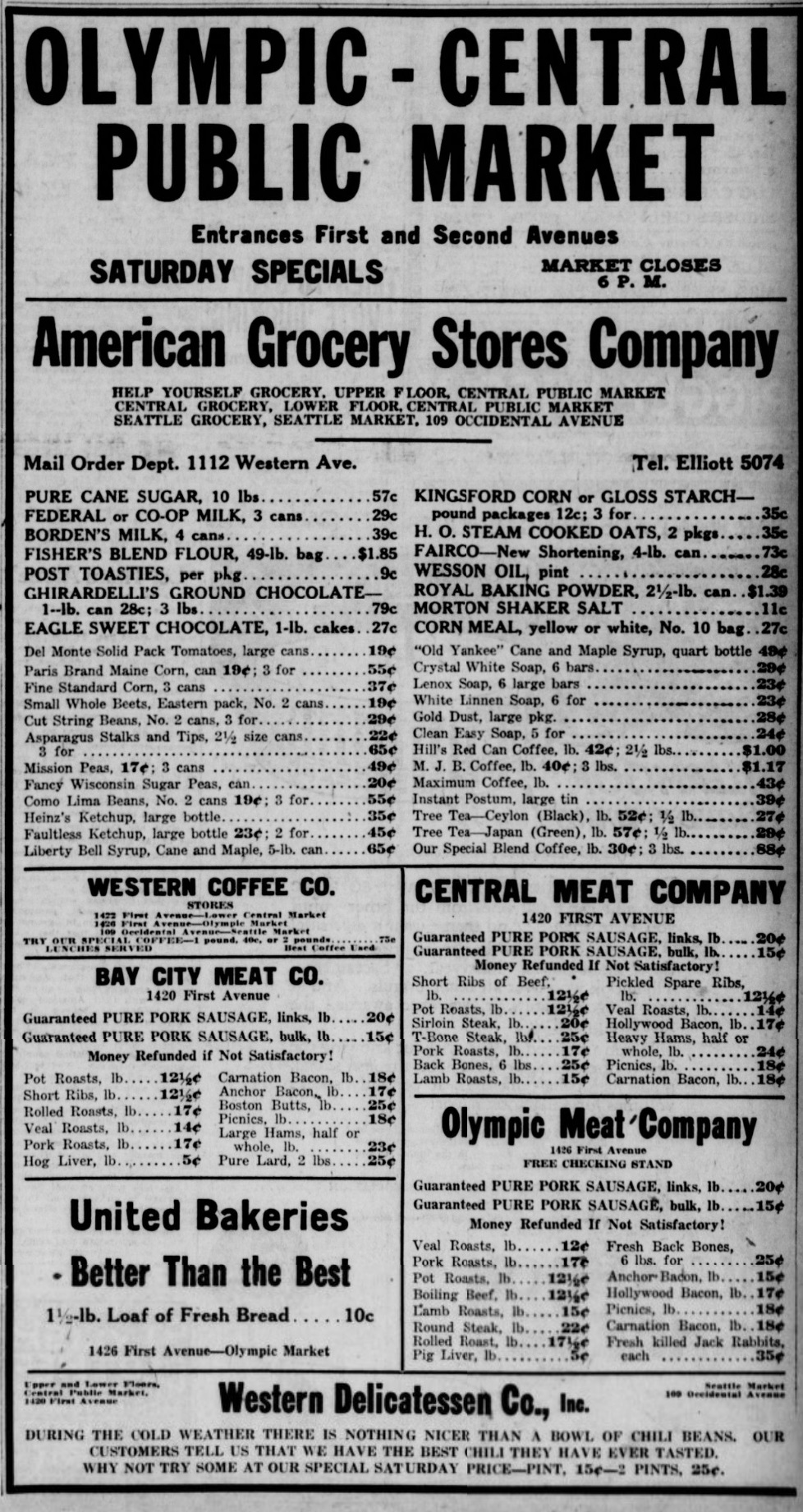
1948Nov15PghPressGroceryFor a snapshot of grocery prices in 1948, this add for McCanns supermarket appeared in the November 15, 1948, issue of the Pittsburgh Press.  (You can click on the ad to view a larger version.)

Prices were high after the war, but there’s also been a lot of inflation since then. According to this online inflation calculator, one dollar in 1948 was the equivalent of $11.48 in 2021 dollars. So to get a true picture of what things cost, you need to multiply these prices by 11.48. Therefore, the dozen eggs sound pretty reasonable at 99 cents, but that’s really $11.36 in today’s money. In other words, it’s almost a dollar per egg! And the bacon at 75 cents per pound works out to $8.61 per pound.

To my taste, the smoked beef tongue doesn’t sound very appetizing. But at the equivalent of $4.48 per pound, it’s the cheapest meat they have. On the other hand, I could probably afford the apple pie for 49 cents ($5.62 in today’s money), so maybe I’ll just have that for supper. The minimum wage at the time was 40 cents per hour, so I could get that for working just over one hour.


1971 75 Meter Beam

1971Nov73Fifty years ago this month, the November 1971 issue of 73 magazine carried an article by Doug Gaines, W4AXE, detailing these plans for a three-element beam for 75 meters (3800 kHz). From his Florida QTH, he was tired of being outdone by stations in the Northeast, and decided to do a single-band entry into a DX contest on 75 meters. After various experiments, he decided to build a temporary 3-element Yagi, using his 125 foot tower, which at the time contained a 20 meter beam.

To manage this, he used the tower itself as the driven element, feeding it as shown with a gamma match, and with six quarter wave radials. The director and reflector consisted of vertical wires hanging from outriggers on the ends of the 20 meter beam, weighted down with bricks.

One incident involving the parisitic elements being tangled with the tower convinced him that the antenna should be turned slowly and only when necessary, but the system did work, and he reported 9 dB gain into Europe. The front-to-side ratio was 30 dB, and the front-to-back was 16 dB.


We Own the World’s Most Valuable Stamp

OneCentMagentaWe are proud to announce that we are now the owner* of the most valuable stamp in the world, the 1856 British Guiana One Cent Magenta. Prior to our purchase, the most recent sale was for $8.3 million. We, of course, paid a slight premium when we made our purchase this week.

The unassuming scrap of paper rolled off the presses of a newspaper printer in Guiana in 1856, along with a set of four cent stamps. The postmaster had been expecting a delivery of engraved stamps from England, but the shipment was much smaller than expected. Faced with a need for stamps, he contracted the job to a local printer. The one cent stamp was used for only newspapers, and apparently only one example has survived. A Scottish schoolboy found it in his uncle’s papers in 1873, and sold it for six shillings to a collector. Five years later, that collector sold his collection for £120. That collection found its way into a Berlin museum, and was taken by France as war reparations at the end of World War I.

The stamp was sold in 1922 for $32,000. At that sale, the buyer reportedly outbid three kings, including George V. It changed hands a few more times before being purchased by John E. du Pont in 1980 for $935,000. The stamp remained locked in a vault while Du Pont went to prison for murder. When he died in prison, the stamp was sold by the estate for $9.4 million in 2014. In June 2021, it was sold again to British stamp dealer Stanley Gibbons for $8.3 million. It is the most valuable stamp in the world, and by weight, it is the most valuable object in the world. This week, Stanley Gibbons made the sale to me.

*- I should clarify that we do not own the entire stamp. Instead, the dealer Stanley Gibbons sold 80,000 shares of the stamp. The stamp is held in trust, and each share owner owns a 1/80,000 undivided interest. It’s essentially the same as owning one share of a company such as Consolidated Widget.  In the future, if I desire, I can sell my share to someone else.  Under the terms of the trust, if there is an offer to buy the stamp, the offer must be accepted by 60% of the shareholders.

If you wish to buy a share of the stamp, it is currently in what might be called the Initial Public Offering period.  You can purchase a share from Stanley Gibbons at the Showpiece.com platform.  If you want to see the stamp before buying, it is on currently on public display until December 18 at 399 Strand, London.


Radio History in 1946

1946NovPMSeventy-five years ago this month, the November 1946 issue of Popular Mechanics carried this article about one of our favorit topics, namely, the history of radio. And the article highlights just how much had happened in the medium’s first quarter century or so. The first commercial radio broadcasts had taken place in 1920, and the first permanent nationwide network, NBC, was formed in 1926.

The magazine noted that when KDKA carried the first scheduled broadcast, the 1920 Harding-Cox election returns, there were only a handful of receivers in the nation. But when FDR addressed the nation less than 20 years later, there were more than a hundred million Americans listening.

Obviously, there have been many changes in the last 75 years, but by 1946, postwar broadcasting, of AM, FM, and television, is still recognizable to us today.


1946 PA Amplifier

1946NovPM1946NovPM2The accompanying article doesn’t say for sure, but I’m guessing the gentleman shown at the left made some serious extra income 75 years ago, thanks to the audio amplifier he built, based on plans in the November 1946 issue of Popular Mechanics.

The general-purpose amplifier put out 32 watts, and had enough power to drive four large speakers. It could be used in emergencies, or to provide music and public address for school groups or outdoor activities. It had two 6L6 tubes in push-pull configuration running class AB-1, and weighed in at only 22 pounds, with a plywood chassis.


1921 ABC Units Crystal Set

1921NovBLA hundred years ago this month, this savvy advertiser realized that scouts would be a huge market for the magic of radio. Wireless merit badge had been introduced in 1918, and radio was a young man’s game. This ad from the Wireless Equipment Co., Inc., of Newark, NJ touted the company’s ABC Unit detector.

The unit was a complete crystal set, but the name referred to the fact that it could be added to other units in a modular fashion. After starting with the crystal detector, a two-step amplifier could be added, or a vacuum tube detector could replace the crystal.

The booklet describing the set was only a dime, but the price of the set would have been out of reach of the impecunious scout. It sold for $24.50 which, according to this inflation calculator, works out to $375 in 2021 dollars.  The ad appeared in the November 1921 issue of Boys’ Life.