Quick Links:
One year from today, there will be another total eclipse in North America! As we did in 2017, we will provide full coverage of the April 8, 2024, total solar eclipse.
You might have remembered news stories about two big shortages in 2017: Hotel rooms and eclipse glasses.
Hotel Rooms
Many of the stories about hotels were exaggerated, with reports of alleged “gouging.” While a few run-down motels advertised astronomical prices, the reality was not quite that dramatic. In general, you were able to get a hotel room at the normal price, but if you didn’t make your reservations at least a few months in advance, most rooms were unavailable. We booked our room in Hastings, Nebraska, about 11 months in advance. So if you are planning to travel to the path of totality, whether it’s in Mexico, the United States, or Canada, it behooves you to make your plans now.
We haven’t made our final plans, but the official OneTubeRadio.com eclipse headquarters for the 2024 eclipse will probably be in Dallas.
For the 2017 eclipse, hotel rooms and other accommodations started becoming scarce a few months prior to the eclipse. A few rooms remained available up until two weeks prior to the eclipse.
In general, most hotels allow you to make reservations one year in advance, so if you want, you can make your reservations now.
Eclipse Glasses
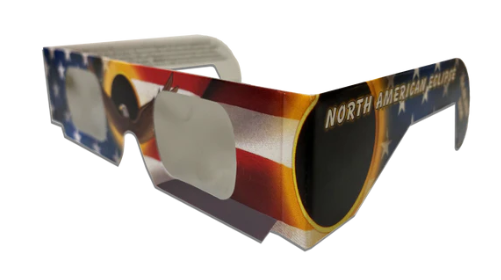 The other item that will be in short supply will be eclipse glasses. You have plenty of time to order them online, so that you can safely view the eclipse. If 2017 (and other eclipses) is a guide, these will become totally unavailable in the weeks before the eclipse. People will be paying grossly inflated prices, and there will be rumors of counterfeit glasses. This time, we decided to get in on the fun, and we will be selling eclipse glasses. We have started a website, MyEclipseGlasses.com, where you can order safe American-made eclipse glasses at a reasonable price. Our glasses are made in the USA by American Paper Optics. Their website contains an excellent resource explaining eclipses, and includes a one-hour on-demand video presentation.
Schools and the Eclipse
If you have kids who will be in school, plan on taking them out of school that day. Unfortunately, the 2017 eclipse showed that some American schools had an irrational fear of the eclipse and actively prevented children from witnessing it. If you believe that your child’s school is more enlightened, then on the first day of the 2023-24 school year, or maybe now, you should have your children ask the science teacher if the school is planning a field trip to see it. If the teacher balks, then your children should let him or her know that they will be absent the day of the eclipse. At the very least, you should ask whether your children’s school has purchased eclipse glasses for the event. If they buy in bulk before the eclipse, they can be had for pennies. But if they fail to plan and wait until the last minute, they will be unavailable, or selling for outrageous prices.
A field trip to see the eclipse is an entirely reasonable request for most schools. For example, students in Chicago could be placed on a school bus and taken to see the eclipse only a couple of hours’ drive away in Indiana. The expense will be less than other field trips taken to amusement parks, movies, etc. This is true for schools in many cities. They have the opportunity to let the kids witness an amazing scientific event, but only if they do some basic planning.
But I predict that this won’t happen, since most schools won’t think of the possibility until after it’s too late to make the necessary plans, or they’ll have the same irrational fears that showed up in 2017. It’s the duty of the students to pester the administration so that the necessary plans are made sufficiently in advance. And as I explained in 2017, if the school fails to act, then it’s reasonable for children to skip school on April 8, 2024.
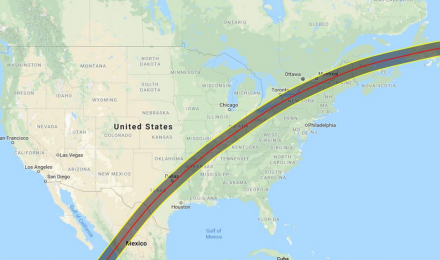
October 14, 2023 Annular Eclipse
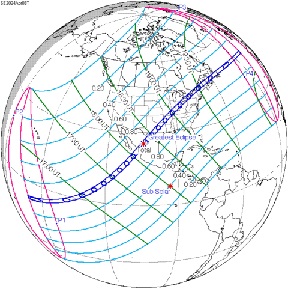
Path of October 14, 2023 Annular Eclipse.
There is another eclipse, an annular eclipse, on October 14, 2023. That event, while interesting, is nowhere near as breathtaking as a total eclipse. So if you happen to be close, you should take in the 2023 event. But the 2024 total eclipse is in an entirely different league.
The 2024 total eclipse will be visible in parts of Texas, Oklahoma, Arkansas, Missouri, Illinois, Indiana, Ohio, a tiny slpeck of Michigan, Pennsylvania, New York, Vermont, New Hampshire, and Maine. The path of totality also passes through Mexico and Canada. Major cities in the path of totality include Dallas, Little Rock, Indianapolis, Buffalo, Cleveland, and Montreal.
Please don’t be confused when you hear about “percentages” of eclipse. Some people are lulled into believing that since they will experience a “90% eclipse” at their home, or even a “99% eclipse,” that there is no need to travel. This is a big mistake. Even with a 99% eclipse, the experience is completely different from a total eclipse. Unless you are paying attention, you might not even notice the 99% eclipse. But you’ll definitely notice the total eclipse just a few miles away, since it will become noticeably dark outside.

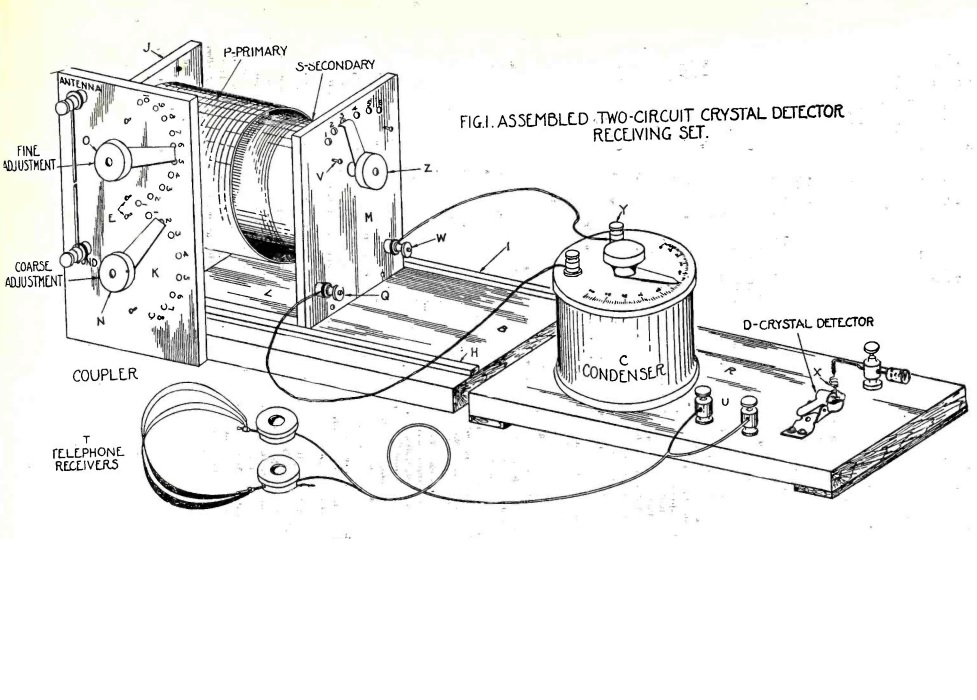 A hundred years ago this month, the April 1923 issue of Radio Age showed how to put together this handsome crystal set. The plans were actually courtesy of the U.S. Bureau of Standards, and the construction article was a reprint of a government pamphlet. The set was an upgrade from an earlier Bureau of Standards model, and featured greater selectivity. The total cost was said to be about $15.00. If the earlier set had already been built, the additional components would cost about $5.00.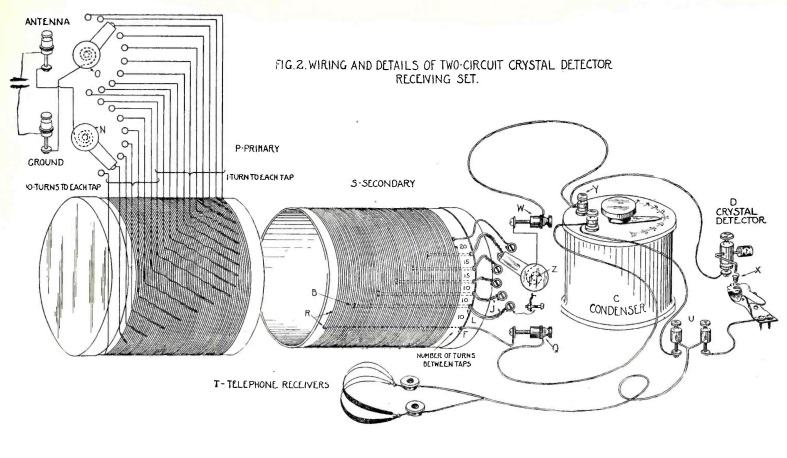





 Today, if you buy a