First National Presidential Radio Address: 1923

Screenshot 2023-06-06 12.26.41 PMToday marks the 100th anniversary of the first time an American president addressed the nation through a hookup of multiple radio stations.

President Warren Harding was on a tour of much of the continental United States, as well as the Territory of Alaska. While in Kansas City, he gave the speech over WDAF in that city. It was also picked up by WGY in Schenectady, NY, WEAF in New York City, and KDKA in Pittsburgh. The wire service story above appeared in the Casper (WY) Daily Tribune, June 22, 2023. It was estimated that about a million Americans heard the speech.


Summer Radio 1923

Screenshot 2023-06-06 12.52.14 PMThe summer of 1923 was to be a big one for radio, as predicted by the June 1923 issue of Wireless Age. The magazine editorialized that radio would be a major feature of summer camp experiences, and many farm families would be introduced to radio by their city visitors.

The cover featured this illustration by Charles S. Jaeger. But somehow, play-by-play broadcasts of rowing crew competitions never quite caught on.


General Instrument Model 60 UHF Tuner, 1953

Screenshot 2023-06-05 12.00.59 PMShown here, on the cover of the June 1953 issue of Radio-Electronics, is Barbara Reid, a worker at General Instrument in Elizabeth, NJ.  She is making adjustments on the company’s Model 60 UHF tuner, which was in turn used in a number of manufacturers’ sets to tune channels 14-83, 470-890 MHz, which had been allocated to television in 1952.

According to the magazine, this band was an awkward one. The frequencies were too low for microwave and radar techniques, but too high for lumped-constant circuitry.  Accordingly, this tuner, which found its way into sets made by companies such as Dumont, used a combination of both techniques.

Screenshot 2023-06-05 12.13.39 PM


1975 Grocery Prices

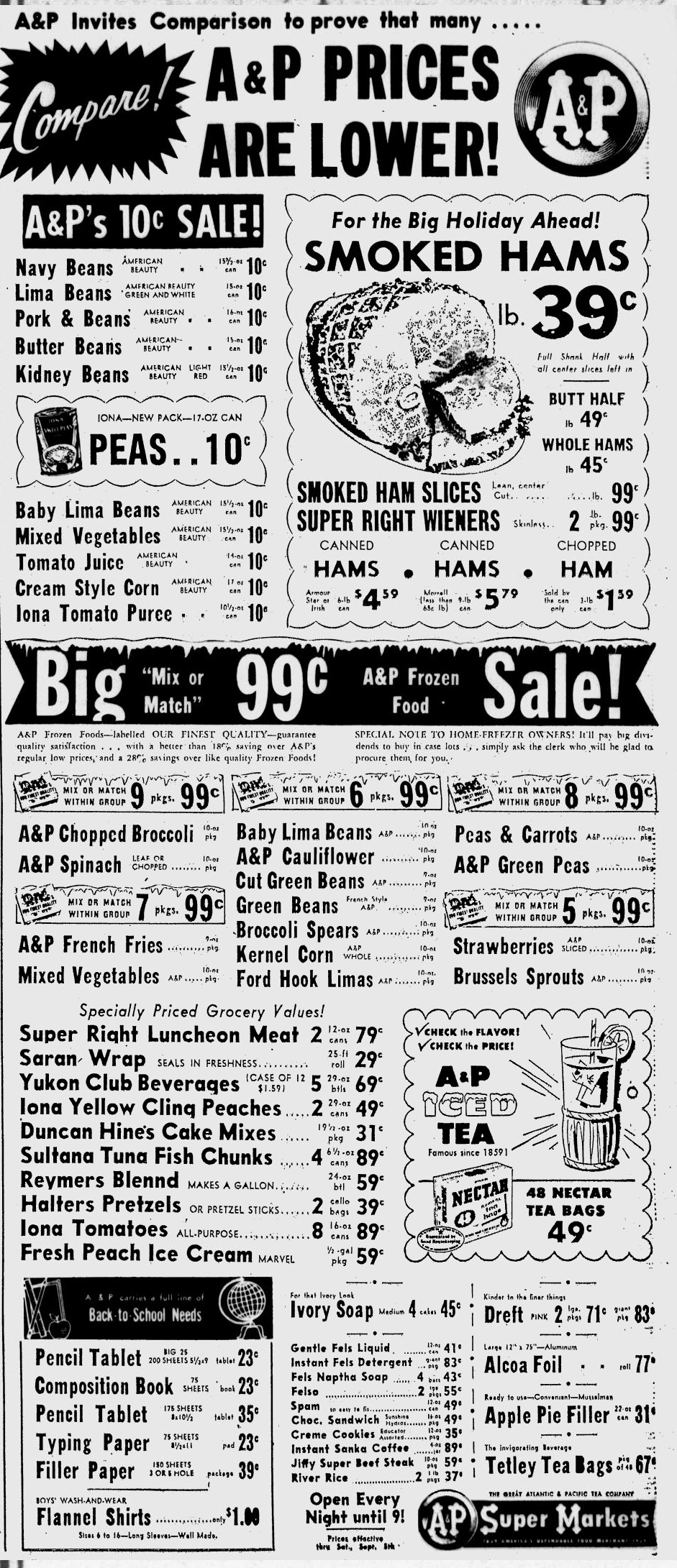
1975June16PghPressFor a snapshot of grocery prices in 1975, this ad for A&P appeared in the Pittsburgh Press, June 18, 1975.  (You can click on the image above for a larger version.)

According to this online inflation calculator, one dollar in 1975 was the equivalent of $5.65 in 2023 dollars. So you need to multiply all of these prices by 5.65. The pound of coffee for $1.02 sounds like a bargain, but it works out to $5.77 in today’s money. And five pounds of flour was only 69 cents, but that’s the same as $3.90 today.

The federal minimum wage was $2.10 per hour, so you would earn $16.80 for a day’s work. How would you spend your grocery budget if you were buying?


Solar Cooking, 1923

Screenshot 2023-06-05 12.28.16 PMHarnessing the power of the sun to cook your food is nothing new, as shown by this hundred-year-old illustration on the cover of Science and Invention, June 1923.

The accompanying article, penned by Dr. C.G. Abbott, the assistant secretary of the Smithsonian Institution, isn’t quite a construction article, but it does provide some basic ideas. The model shown above was suitable for camping, or other situations where fuel and power were unavailable. The two concave mirrors, made of tin, reflected the sun onto the cooking surface, the bottom of which was blackened with soot.  The complicating factor, possibly unnecessary, is the use of an alarm clock to keep the mirrors aimed.

For situations where it was necessary to cook at night or when there was no sun, the author also described a more complicated system, where the sun heated a reservoir of oil, which was in turn used to provide the cooking heat.

For a simple solar cooker, you can see our earlier post, where we provide plans for construction of a solar oven.  If you want to save the work, the solar cooker shown below uses the same principle as the 1923 design, but it somewhat more efficient with the parabolic mirror.  If you don’t feel like making your own, solar ovens are surprisingly inexpensive on Amazon.

While these can’t be used in the dark or on cloudy days, having the ability to cook using only the sun’s energy adds flexibility for camping or emergency preparedness.


Some links on this site are affiliate links, meaning that this site earns a small commission if you make a purchase after using the link.

1948 One Tube “Reflex” Receiver

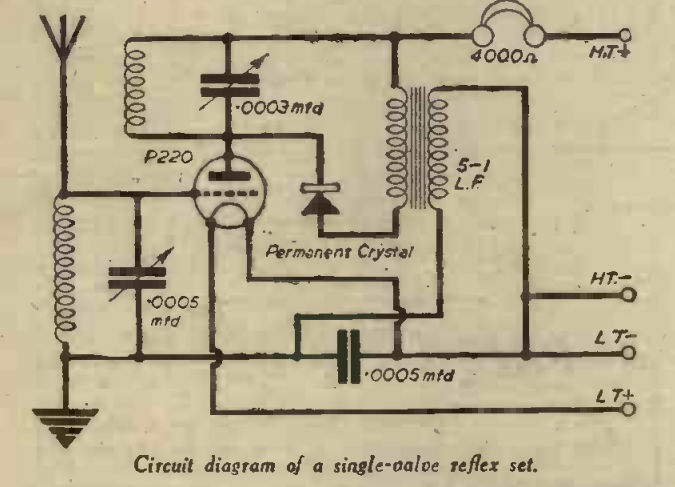
1948JuneRadioCraftThe June 1948 issue of Radio Craft showed this circuit for a one-tube “reflex” receiver, so named because the tube served double duty.  The input was connected to the antenna circuit, and the tube served as an RF amplifier, with the output going to a then relatively new 1N34 diode.  The audio then went through a transformer and volume control, where it was fed back to the tube, which then amplified the audio.  The audio then passed through an RF choke on its way to the speaker.

The circuit had been sent to the magazine by one Arthur S. Bean of Baltimore.  The magazine noted that his design provided good volume and moderate selectivity.


1948 RCA Portables

Screenshot 2023-06-06 9.02.39 AMScreenshot 2023-06-06 9.03.21 AMSeventy-five years ago, the June 14, 1948, issue of Life magazine carried this ad from RCA, showing the company’s lineup of portables, and suggesting that your sainted dad might enjoy one of them for Fathers Day.

The lowest cost option was the model 54B at $29.95, which was battery only.  The four-tube set measured about 6 by 4 by 3 inches.    The model 8BX5 at $34.95 could run on AC or DC power or battery.  It featured five tubes, since it also included a rectifier.

The top of the line was the 8BX6, dubbed the Globe-Trotter, for $49.95, which also had three-way power.  This set had six tubes and a four-inch speaker.


Flag Day 1923

1923Jun14WashTimesToday is Flag Day in the United States, the anniversary of the adoption of the U.S. flag by the Continental Congress on June 14, 1777. A hundred years ago today, Flag Day 1923 saw the convening in Washington of the National Flag Conference, an assembly of a number of patriotic organizations, such as the American Legion and the Boy Scouts of America.

As shown by this clipping from that day’s Washington Times, President Warren G. Harding addressed the assembled delegates. The main order of business was the adoption of a code of etiquette surrounding the display of the flag.  That code was ultimately enacted by Congress in 1942 as the U.S. Flag Code.


DeWald BT-100 Television, 1948

Screenshot 2023-06-02 12.03.16 PMIf you were going to be an early adopter of television 75 years ago, it might be a fairly expensive proposition for you. This ad for the DeWald BT-100 appeared in the June 1948 issue of Radio News. The ad, for Warren Distributors, 3145 Washington St., Jamaica Plain, Mass., listed the set as selling for $372.10, which is the equivalent of over $4600 in 2023 dollars.

The set tuned 13 channels, meaning that it was all set to go for Channel 1, 44-50 MHz, even though that channel was soon to be abandoned in North America.


GE Model F-96, 1938

Screenshot 2023-05-30 11.53.16 AMThere was a time when people dressed up to listen to the radio, and 85 years ago was one of those times, as demonstrated by this young woman on the cover of the June-July 1938 issue of National Radio News.

You would dress up, too, if the receiver you were listening to was the General Electric model F-96 Electric Touch Button Tuning Radio.  The handsome nine tube set retailed for $110 (over $2300 in 2023 dollars).  It featured sixteen pushbuttons, and tuned both broadcast and short wave, as well as pulling in police calls.