Herbert Hoover Ponders Deputizing Hams


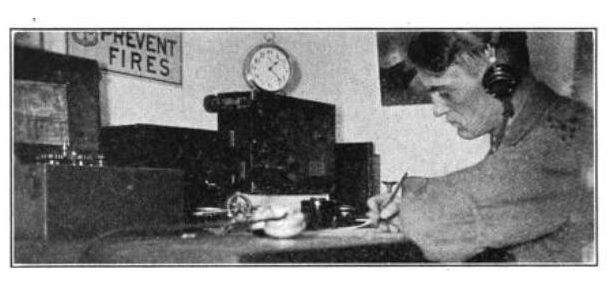
Radio Fan Getting the Time and Weather Observations Over the Wireless.  It Will Not Be Long Before the Radiophone Will be One of the Necessities of the Home.  Richmond Times-Dispatch, April 23, 1922, page 3.

Radio Fan Getting the Time and Weather Observations Over the Wireless. It Will Not Be Long Before the Radiophone Will be One of the Necessities of the Home. Richmond Times-Dispatch, April 23, 1922, page 3.

92 years ago today, the Richmond Times-Dispatch of April 23, 1922, reported the possibility that amateur radio operators would serve as deputies of the Commerce Department in policing the airwaves. The paper reports that Commerce Secretary Herbert Hoover was favorably disposed to a recommendation that deputy radio inspectors be elected from the ranks of hams.  Once deputized, these inspectors would endeavor to secure strict observance of the radio communications laws.  If the law required compensation, then these deputies would serve for a payment of one dollar per year.

The paper pointed out that hams in the Richmond area had already voluntarily observed for a number of years rules of etiquette. For example, in Richmond, local stations had been observing a schedule described thus:

the hours from 6 A.M. to 6 P.M. as “free air,” that is, communications of any kind; 6 P.M. to 7:30 P.M., local communication; 7:30 to 11 P.M., standby for broadcast; 11 P.M. and on, long-distance amateur communication.

The article went on to include the following praise: “The average amateur works in a highly technical manner, particularly if he is a member of the American Radio Relay League, an organization of amateurs stretching all over the United States and permitting of constant communication at all times and places.” It concludes by stating that the “amateur promises to be the backbone of our national system of popular radio, now springing into being.”


The Flame Audion

One interesting footnote in Radio History can be found in Alfred Powell Morgan’s 1914 book Wireless Telegraph Construction for Amateurs. This is the Flame Audion detector, shown below:

FlameAudion

Morgan describes it thus:

The simple but sensitive form of detector illustrated in Fig. 119 is not of practical value for commercial work, but is very interesting as the progenitor of the audion, and provides a good field for amateur investigation. Its only drawback is that the gas flame is very difficult to keep steady and every flicker registers as a sound in the telephone receivers.

A Bunsen burner using coal gas furnishes the flame, and a salt of an alkaline metal heated in the flame, the ions. The hydroxides of csesium, potassium and sodium give the best results in the order named.

The salt is contained in a piece of trough-shaped platinum foil, about 3/8 inch long and 1/16 inch wide. This trough is made the cathode or negative of the telephone circuit and placed in the outer oxidizing flame just above its juncture with the interior reducing flame and must be kept incandescent. The upper electrode .or anode is a piece of platinum wire about  1/16 inch above the trough.

The arrangement and construction of the detector is clearly indicated by the drawing so that it is unnecessary to go into details. The block, E which fits on the tube of the Bunsen burner, is made of fiber. Two double binding posts, D, are fastened to E to support the rods, R, which are fitted at the tops with binding posts, B, into which the electrodes may be clamped.

Twelve dry cells are connected with a multiple point switch so that an electromotive force of 6-18 volts, varying in steps of one cell at a time, may be secured. The flame is best provided with a mica chimney to protect it from drafts. By keeping plenty of salt in the trough and carefully adjusting the voltage, this detector may be made marvelously sensitive.

This type of detector was the inspiration for the Audion tube. The effect was discovered by the Audion’s inventor, Dr. Lee DeForest, in 1903. DeForest writes in 1947 about this discovery:

I used a Bunsen burner, locating within the flame two platinum electrodes, one of which was connected through the telephone receiver to a dry battery, and thence to the other platinum electode. I enriched the flame with sodium, or common salt.

I then found that when the electrodes were properly located in the gas flame the signals from my spark transmitter were distinctly audible in the telephone receiver. I made countless experiments with this phenomenon; and to prove definitely that the effect was not acoustic but electrical, I connected one of the flame electrodes to my antenna, the other to the ground, and actually obtained wireless signals from ships in New York Harbor.

Radio-Craft, January, 1947

deforestdiagram

DeForest’s Diagram of the Flame Audion Circuit

DeForest applied for a patent in 1905, and was issued U.S. Patent 979275 for the flame detector in 1910.

DeForest wrote about the flame audion himself a number of times. For example, see his articles in Western Electrician, November 3, 1906; the February, 1916, edition of Popular Mechanics; the January, 1947, issue of Radio-Craft.

He wrote a more complete scientific paper which was published in the Transactions of the American Institute of Electrical Engineers in 1906.

DeForest is occasionally criticized for not really understanding what was going on inside the triode. This criticism isn’t really fair. It was later discoverd that the Audion acted as an amplifier. It was quite imperfect as an amplifying tube, because it did not have a complete vacuum. But from reading DeForest’s writings, it is clear that he never intended to invent an amplifying tube. He was working on a detector, and the ionized gas within the tube (which wouldn’t have been there if it had been a true vacuum tube) was responsible for this capability. The amplifying ability was, indeed, a lucky accidental discovery. But particularly looking over the 1906 paper, it’s clear that DeForest was an extremely gifted engineer, and he is worthy of the credit he has received for his advancement of radio in the early years.

It seems to me that students looking for an interesting science fair project might be inspired by DeForest’s work. It combines both fire and electricity. Since it had no reasonable commercial use in the early 1900’s, there was no good reason for scientists to pursue it. But it seems to me that interesting things might be going on inside that flame.

DeForest used platinum wire, which is rather expensive. On the other hand, the cost isn’t entirely out of line. For about $20, you can buy enough Platinum Wire to construct the detector. Platinum foil would be prohibitively expensive, but there doesn’t seem to be any reason why the salt needs to be contained by the platinum. It seems to me that two platinum wire electrodes could be used. And while DeForest used platinum, there doesn’t seem to be any evidence that he experimented with other metals. Would copper perform the same function?

The flame audion was used as a radio detector by DeForest. But earlier scientists had shown that the flame would conduct electricity, a fact that is obvious from the flow of current through the gap. What flames provide better conductivity? Salt is added presumably because it ionizes better than just the fuel and air alone. It would be a relatively simple matter to measure the conductivity of different ionized materials.  Variations in the flame can be heard in the headphones, so for the purpose of making a sensitive radio detector, it’s probably necessary to have a very constant flame.  But for many applications, it seems to me that an ordinary candle would suffice.

(For more science project ideas, see my review of the book Radio Science for the Radio Amateur.)


More Century Old Radio

April1914PMwirelessThe  April 1914 edition of Popular Mechanics includes this Complete Wireless Station for $9.85 from the Nichols Electric Company of 35 Frankfort Street, New York.  That address had housed the “Clean and Ready Company” in 1893.  It now appears to be part of the campus of Pace University, next to the Manhattan entrance to the Brooklyn Bridge.

According to this inflation calculator, the $9.85 cost would be $232.75 in today’s dollars. To look at it another way, that would cost ten silver dollars, or about ten ounces of silver, which would be worth about $200 today. This apparatus seems very similar to one described by Alfred Powell Morgan in his book published in the same year, Wireless Telegraph Construction for Amateurs,  with two exceptions: This set doesn’t appear to have the variable condenser shown in Morgan’s schematic, below.  On the other hand, this set includes a knife switch in order to use the same antenna for both transmitting and receiving.

1914 Morgan Schematic

1914 Morgan Schematic

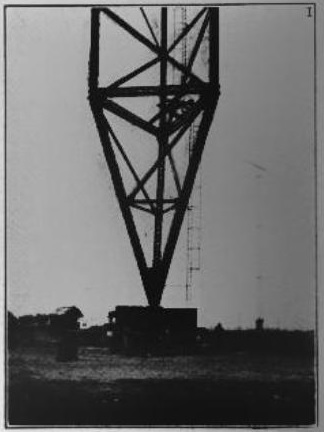
The receiver is a simple crystal set, billed as being able to receive 1200 miles. I suspect this figure involves a bit of hyperbole, but I suppose with a good antenna and good conditions, it might be possible to occasionally log stations such as NAA, transmitting time and weather from massive towers overlooking Arlington National Cemetery, shown here in 1922.

NAA Towers 1922

NAA Radio Towers, Overlooking Arlington Cemetery. Radio World, November 25, 1922.


The transmitter is billed as being capable of transmitting 12-15 miles. The ad doesn’t mention anything about a license. Licenses had been required since 1912, but it’s quite likely that the owner of this set wouldn’t have bothered. In fact, it’s unlikely that he would have been able to receive a license after explaining to the radio inspector what kind of equipment he was using.

The license requirements are explained in Morgan’s book.  Morgan explains:

An amateur may not use transmitting apparatus which is sufficiently powerful to send radio signals across any of the boundaries of the state in which he is located and which can be detected by a sensitive receiving set located just beyond the state boundary, nor can he use apparatus which is powerful enough to interfere with the reception of signals by others from beyond the state boundaries unless he has a license….

In other words if the amateur possesses a receiving outfit only which is in working order or if he has both transmitter and receptor and the.former is not powerful enough to send signals out of the state in which he fives, or to interfere with the reception of messages by another when the messages come from beyond the state boundary a license is unnecessary.
This is of course somewhat unfair for those living near the center of large states for they may operate almost as they please with ordinary instruments with no fear of the signals going beyond the border, while those living within a few miles of another state must secure a license.

Morgan goes on to explain why this set probably wouldn’t qualify for a license:

The law also says that the transmitting wave must be pure, and must be sharply tuned, which means that the wave must be of one length and not, as is very often the case, composed of two or more waves of different lengths.

In order to comply with this restriction, the use of an oscillation helix or loosely coupled helix is necessary. A rotary or quenched gap is also necessary in place of the ordinary spark gap.

The transmitter shown here fails in two regards. First of all, there’s no way of quenching the spark, although I suspect if it was run on batteries, that wouldn’t be much of a problem. The main problem is that the “helix” is basically a tapped autotransformer, and it will probably radiate quite well on at least two wavelengths. In addition, the signal from a transmitter like this is going to have a very wide signal.

I suppose, with a good antenna, this transmitter might be heard 12-15 miles away. But if the owner was more than 15 miles from the state line, it would appear that he could use this without fear of the radio inspector, as long as a licensed station didn’t complain of interference.

By the way, if the name Alfred Powell Morgan rings a bell, you’ll recall why when you visit my Alfred Powell Morgan page.


Minnesota Court of Appeals Throws Out Commercial Vehicle Case

A decision released today by the Minnesota Court of Appeals might put a lot of commercial vehicle equipment tickets in doubt.  The Court held that the commercial vehicle inspector, a civilian employee of the Minnesota State Patrol, had no authority to stop a truck.  Therefore, everything discovered as a result of the stop (namely, that the driver didn’t have a valid license) couldn’t be used in court, and the conviction was reversed.

The case, State of Minnesota v. Kevin Ervin Stall, is discussed in more detail on my website.


Amazon Author Page

This post is a bit of a test.  I did some updates to my author page at Amazon, amazon.com/author/clem.  Among other things, I added a blog feed, and this post is testing whether it shows up there.

Among other things, I’m testing whether this allows me to place live links on the Amazon page, such as links to my other sites:


Radio and Timekeeping a Century Ago

1914PortableRxThe April 1914 issue of Popular Mechanics includes this interesting portable zero-tube radio.  It appears to be a crystal set consisting of a detector mounted directly to the headphone, with two wires for clipping to a convenient antenna and ground connection.

This particular receiver is billed as being for receiving time signals from the Eiffel Tower, which had begun on May 23, 1910.  The station, FL, was operated by the French
Bureau des Longitudes, and transmitted time signals from the Paris Observatory. It operated on 2000 Meters (150 kHz) with a spark transmitter of about 40-50 kW. Service even continued during the war, which began for France about three months after this magazine was published.

Despite the apparent lack of any tuner, a crystal set such as this ought to have been able to receive the signal for quite a distance from Paris. As you can see, the two wires had clips for attaching to any suitable antenna and ground. The signal from the powerful station was so reliable that a guide to receiving the signals, published by the Bureau of Longitude in 1913, was translated and published in English in 1915. The translation is available to read at Google Books.

The original 1913 edition, Réception des signaux radiotélégraphiques transmis par la Tour Eiffel, is also available online.

Any doubts about whether a crystal set would be able to receive the powerful signal should be put to rest by the mere fact that this guide book was published in England. The guide states that the “energy radiated by the Eiffel Tower Station in transmitting signals is great enough to permit the use of receiving aerials of reduced height and dimensions throughout the whole of France and in the French possessions in North Africa.”

Station FL transmitted the exact time nightly at 11:45, 11:47, and 11:49 PM.  And it seems quite likely that the little pocket receiver shown here would have been suitable for receiving it throughout much of France.

The Eiffel Tower time signals had the very practical purpose of an indispensable aid to navigation. There are many ways by which one can determine latitude. But longitude depends on knowing the exact time at a fixed location on Earth, and then comparing that to the local time. One early method of determining the exact time was by observing the moons of Juipter.  Good chronometers largely solved the problem of having to go to these lengths, but there was still the matter of having to periodically set the chronometer. And time signals such as those provided by the Eiffel Tower greatly simplified the process.  A pocket sized receiver such as the one shown here would have been a most useful accessory.


Why Judicial Retention Elections are a Bad Idea: Part 2

Another Overlooked Effect of Judicial Retention Elections

In an earlier post, I stated my main objections to amending the Minnesota Constitution to provide for retention elections in  judicial races. In summary, I believe this change will make the process more politicized. Since the stated reason for the amendment seems to be making judicial selection less political, this means that the amendment will make the problem worse rather than better.

An Iowa attorney who took one of my CLE programs identified another issue, that I probably wouldn’t have noticed. Lawyers in Minnesota are governed by the Minnesota Rules of Professional Conduct. These are essentially identical to the rules adopted in most other states, including Iowa. Rule 8.2 quite reasonably states that a lawyer must not knowingly or recklessly make a false statement concerning the qualifications or integrity of a judge or candidate for judicial office.

Again, this rule is quite reasonable.  We don’t want the lawyers of the state running around falsely stating that Judge _____ is a crook.  If he or she is really a crook, then I think that most would agree that we ought to make that fact known. And both this rule and the First Amendment make clear that we are allowed to say so. We are only prohibited from making false statements that the judge is a crook. Since we have very few crooks serving as judges, I have never been called upon to say that one of them was a crook. But if one of them actually were a crook, then it is both my right and my duty to point this out.

But I also need to be careful as to what I say, because if I provide false information, I will suffer the consequences under this rule.

This is how it should be. But there is indeed a restriction on my free speech, and under the First Amendment, we need to be careful about imposing restrictions on speech. As we lawyers like to say, these kinds of restrictions can have a “chilling effect” on free speech: Even though I might have proof that Judge _____ is a crook, I might decide to keep my mouth shut, because it’s just not worth the risk of getting in trouble.

In Minnesota, this chilling effect isn’t really a problem, though, because  we have a level playing field. Yes, there might be a chilling effect on my speech. But the other side (the people who think the hypothetical crooked judge should be re-elected) have an identical chilling effect upon their speech. They also have to be careful about what they say, because they run the risk of getting into the same trouble as me: If they say something false about the opposing candidate, they can also face discipline.

So in Minnesota, there probably is some chilling effect on speech. But at least everyone is operating under the same rules, and everyone’s speech is chilled by the same amount. In other words, it’s a level playing field.


This is not the case in Iowa, as an Iowa attorney pointed out to me. In Iowa, or any state with retention elections, the opponents of an incumbent judge have the same chilling effect on their speech that I have. If they make a statement that some judge should be removed from office, there’s the possibility that they will get in trouble, if their comments are construed as false claims about the judge’s qualifications or integrity.

But in Iowa, those in favor of retaining the judge face absolutely no risk: They are not telling you to vote against the challenger. Their only opponent is the word “no” on the ballot.  It’s impossible to make a false statement about the integrity or qualifications of the word “no.”  So in Iowa, if there are two sides of the debate, one side has one set of rules, but the other side has a different set of rules. The chilling effect applies only to one side. We lawyers would say that the rule is not “content neutral.” To put it in simpler terms, this is another way of saying “it ain’t fair.”

But What About Texas?

Inevitably, the proponents of retention elections will say something along the lines that if we keep our current system of contested elections, we’ll eventually “turn into Texas.” Texas judicial races are, indeed, much more politicized than they are in Minnesota. And I would probably agree that it would be a good thing if we don’t “turn into Texas” in this regard.

The problem, once again, is that the proposed amendment will make matters worse, not better. In short, we’ll turn into Texas faster if we adopt the amendment. For the reasons stated in my original post, we have a better chance of keeping the system non-politicized if we stay with the current system. The 2010 Iowa judicial elections were, in my opinion, much more political than just about any Texas race. The defeated judges called it “an unprecedented attack by out-of-state special interest groups.” They were probably right.  There was an angry mob of Iowa voters running around with signs that said “NO,” presumably financed by those evil out-of-state special interest groups.

But how is an angry mob of Iowa voters carrying “NO” signs any different from an angry mob of Texas voters carrying signs with the name of an opponent?

But Minnesota won’t go the way of Texas for a completely different reason. As the former Texas Chief Justice points out, the main problem with Texas judicial elections is that the party designation is listed on the ballot. This means that voters can vote a straight ticket.  Texas judicial candidates tend to ride the coattails of the presidential or gubernatorial race. In practice, this means that Republican judges are swept out of office when a Democrat carries the state, and vice versa. In Minnesota, even though judicial candidates may now seek party endorsement, the party designation, unlike in Texas, is not shown on the ballot. In other words, the voter cannot vote a straight party ticket without at least a little bit of education prior to the race.

I would oppose putting party designation on the ballot in judicial races. But as far as I know, nobody has proposed that. Keeping party designation off the ballot is what keeps us from “becoming like Texas.” The 2010 Iowa experience shows that retention elections are exactly the thing that will give us Texas-style judicial races.

Finally, I should point out one common misconception about Texas. It is true that judicial races in that state are sometimes hotly contested. You will occasionally see lawn signs supporting particular candidates, and I agree that these are a bit unseemly. But many (but not all) of these signs are actually supporting candidates for “County Judge.” Despite the name of the office, the County Judge is actually the chief executive of the Texas
county government. A more descriptive name of the position would be “chair of the county commissioners.” Other than some minor judicial functions in some rural counties, the County Judge is not a judicial officer. He or she holds a political office. Again, many (but not all) of the unseemly lawn signs are actually supporting candidates for this political office.

The retention amendment is a knee-jerk reaction to a problem that doesn’t exist. And unfortunately, it will be the very thing that brings the problem about.

Eating Without Money Part 4: The Big Day Comes

As I’ve mentioned in earlier posts, I recently conducted an experiment to see how well I could feed myself for a day without expending any money whatsoever.  To accomplish this, I ordered about $45 worth of food on Amazon. Rather than purchase it using money, I used earnings from Amazon Mechanical Turk.  The food arrived last week, and I chose yesterday to perform the experiment.

Even though I had more dollars to work with this time ($45, vs. $26.01), this experiment was more challenging than my experiences during the SNAP Challenge, when I had to feed myself for an entire week with a budget of $31.50.  This is because at local stores, I was able to find lower prices and, more importantly, smaller quantities of items I needed.  Fresh food was also available.

Despite these hindrances, I ate quite well yesterday.  Here’s what I had:

Breakfast

DSC01143


Since a box of pancake mix was part of my purchase, it’s only logical that I had pancakes for breakfast. I actually made them the night before, froze them, and heated them up in the toaster. I made plenty, and unlike during the SNAP Challenge, I had plenty to share. Therefore, my kids also had pancakes for breakfast. They had theirs with normal syrup and butter. In my case, I had neither. The least expensive sweetener I could find was the Agave Nectar, which was excellent, and much better than normal syrup. I had ordered this to use as a sweetener for other recipes, but for my one-day experiment, the only thing I used it for was the pancake syrup.


I had fried the pancakes in the Butter Flavor Crisco, which turned out to be the biggest surprise of this experiment. I had assumed that I could use this shortening for cooking, but it never occurred to me that it could actually be used as a butter substitute. As you can see, I decided to use a small amount in place of butter. Obviously, it wasn’t as good as real butter, but it actually passed as margarine. This is a good thing to keep in mind for emergency food storage.  The Crisco has an essentially infinite shelf life, and could be used as a substitute for butter in an emergency.  As you can see, I (and the kids) also had some of the summer sausage for breakfast.

Yes, it’s kind of weird to have lemonade for breakfast, but that was the only drink I had available. When I purchased it, it was the least expensive beverage to be found on Amazon. When I checked again today, it was still available on Amazon, but at an insanely high price for such a small package. The Cafe La Llave Espresso coffee was excellent, and only slightly more expensive than regular coffee.

Lunch

DSC01144For lunch, I could have gotten by simply be eating crackers and sausage from my sausage sampler.  But I decided to try my hand at actually cooking something with my limited supply of ingredients, and made some biscuits.  Despite their odd shape, they were actually very good.  I simply mixed a cup of the  pancake mix with about a half cup of Crisco (melted in the microwave for about 45 seconds) and a small amount of water,  I baked them at 450 degrees for about 10 minutes.

That sounds like a cookie recipe, and they wound up looking like cookies.   But they tasted great and were very filling.  They turned out extremely crumbly, and I think I would have done better to use a little less shortening and a bit more water.  As you can see, I turned them into a sandwich with the sausage.

All of this, of course, I washed down with lemonade and coffee.

Supper

I ate lunch rather late, and the biscuit sandwiches were extremely filling.  For supper, I only had half of one of the Hormel Compleat dinners. (My son eagerly ate the other half.)

During the day, I also had some snacks of pancakes, sausage, and crackers from the  sausage sampler.

Observations

From what’s left over, I could repeat an identical diet for about two more days.  Some of the items (such as the Crisco) would be left over.

Was this a practical way to feed myself?  No.  I didn’t spend any actual money, but I could have used that $45 for other things.  I could have had an almost identical diet for a day for about $5 and still have leftovers.  So this is definitely not the most practical way of doing things.  But what I wanted to demonstrate was that even without any actual money changing hands, it is possible to subsist by using whatever resources are available.  In this case, the resource at hand was Amazon.

From a more practical point of view, the better course of action would have been to supplement normal groceries with staples from Amazon.  The pancake mix I bought was very expensive for a single box, but by buying larger quantities, such as this 4 pack, the price becomes much more reasonable. I’ll be making use of the remaining five  Hormel Compleat dinners, which were reasonably priced and are very convenient for a microwave lunch away from home.  By shopping around  Amazon, it would be quite possible to stretch a grocery budget by buying items with “free” money such as I was using.  It’s also possible to purchase luxury items such as the  Agave Nectar and the  premium coffee at no cost.


Eating Without Money Part 3: The Free Food Arrives

My free food, courtesy of Amazon.

My free food, courtesy of Amazon.

I’ve been rather busy the last week, and didn’t get a chance to really open it until today, but my free food arrived last week.  Tomorrow will be my day to subsist on this food and nothing else.

Mornings can be hectic, so tonight, I made a batch of pancakes and put them in the freezer.  In the morning, I can simply put them in the toaster.  I’ll also make some sausage for breakfast.


The brick of Cafe La Llave espresso coffee smells good, and I loaded the coffee maker and set the timer. I tasted the Agave Nectar, and it should work very well as pancake syrup. The taste was quite similar to honey.


The sausage sampler proved to be a good deal. The description wasn’t clear on the exact portion size, but each sausage is eight ounces, for a full pound of meat, in addition to the crackers and mustard. So I should be well set for both breakfast and lunch.

The lemonade mix proved to be quite expensive, since this package makes only two quarts. But it will easily last me the day, and was the least expensive beverage I could find. Interestingly, it did include the whisk shown on the Amazon picture.

Unlike my experience during the SNAP challenge, when my $26.01 worth of food lasted me a whole week, this experiment will last only one day.  Since I have much more than I’ll need for that time, I won’t have to jealously hoard my food as I did during the SNAP challenge, and my family will also get to experience eating without spending money.  They will be able to eat other things as well, but they’ll be able to know what my free food tastes like.  And it looks like I have plenty of free food to go around.


Retention Elections Will Make Judicial Selection More Political, Not Less. And Iowa Proves It.

A bill currently before the legislature seeks to amend the Minnesota Constitution to end constested elections for judges in the state.

Contrary to popular perception, judges in Minnesota are not appointed. They are elected. This comes as a surprise to most Minnesotans. When asked, they will typically opine that judges are initially appointed by the governor, but then must run for re-election. But that’s not exactly right. Article 6, Section 7 of the Constitution states:

The term of office of all judges shall be six years and until their successors are qualified. They shall be elected by the voters from the area which they are to serve in the manner provided by law.

Section 8 does, indeed, give the Governor the power of appointment, but only in the case of a vacancy:

Whenever there is a vacancy in the office of judge the governor shall appoint in the manner provided by law a qualified person to fill the vacancy until a successor is elected and qualified. The successor shall be elected for a six year term at the next general election occurring more than one year after the appointment.

While there are some differences (the length of the initial term) this system is essentially identical to how U.S. Senators are chosen. U.S. Senators are elected by the voters, but mid-term vacancies are filled by the governor. Yet nobody ever says that senators are initially appointed by the governor, but then must run for re-election, as they invariably say about judges.


The confusion comes largely because most judges retire prior to the expiration of their term. Section 9 gives the Legislature the power to provide for retirement, and Minnesota Statute 490.125 sets a mandatory retirement age of 70. Upon a judge’s retirement, a vacancy is created, and the vacancy is filled by the Governor.

As a practical matter, most Judges retire in the middle of their terms, either by choice, or because they are faced with mandatory retirement. Therefore, the Governor initially appoints most judges.  Senators rarely retire mid term, and there is no mandatory retirement age for senators. This is why people rarely explain the senatorial election process the same way they explain the judicial election process. But the two processes are essentially the same: Both senators and judges are elected officials.

Interestingly, in the reports of the Minnesota Supreme Court and the Minnesota Court of Appeals, newly-appointed judges have a footnote next to their name which indicates that they are acting as judges pursuant to appointment. So even the Courts themselves seem to recognize that judges appointed by the governor are somehow not quite fully tenured judges.

The proposed amendment seeks to change the status of judges as elected officials. Under the amendment, they would really become what most people think they are already: They would be appointed by the governor. The amendment would make two changes. First of all, the governor would be limited to nominees presented by a judicial selection commission. The governor would not be able to nominate persons unless they received the un-elected commission’s approval.

The other big change would be in how judicial elections are carried out. Currently, any lawyer in the state can run for judge. If I want to, I can go pay the filing fee and run against any sitting judge. Or, in the rare cases where there’s a vacancy, I can seek employment for the next six years by running for the open seat. Most frequently, however, there is no challenger, and there is no open seat. On the back of the ballot, there’s a dizzying long list of incumbent judges. Each one has a bubble next to his or her name. And below the name, there’s another bubble next to a blank line for write-in candidates. If people look at the back of the ballot at all, they fill in the bubbles next to the names of the incumbents, even though those names are rarely familiar. On rare occasions, there’s another name, that of some brave lawyer who decided to pay the filing fee to get his or her name on the ballot. And that lawyer undoubtedly realizes that if he or she loses, it probably won’t be a good idea to appear before that judge for the rest of his or her legal career.

In the last few years, the U.S. Supreme Court has held that these brave challengers (as well as the incumbents) are, indeed, covered by the First Amendment. In other words, they are, indeed, allowed to say, “please vote for me.” They are even allowed to state their beliefs on matters of public concern.

The fact that the First Amendment still applies has caused a great deal of consternation in some quarters, and there are those who believe that the judicial election process will become “politicized.” There is undoubtedly some truth to this belief. As I have shown, judges are indeed elected officials. And an election is, by definition, a politicized process.

The amendment seeks to end this “politicization” by switching to retention elections. Instead of the back of the ballot having the names of judges and blank lines for write-ins, it will have the judge’s name and a question. The question will ask: “Shall Judge ____ be retained?” The voter will have the choice of two bubbles to fill in: Yes or No.

I think this is a bad system for a number of reasons. A good example of the most commonly cited reasons in opposition are stated by the Republican Liberty Caucus Minnesota statement. In general, I subscribe to the arguments made on that page.

But there’s another argument that is largely overlooked. Moving to retention elections would not do anything to de-politicize the process. If anything, retention elections will make the problem worse! And for proof, we need look no further than the Hawkeye State. Iowa’s experience proves that retention elections do not insulate judges from the whims of the voters. Instead, the retention election process makes judges more vulnerable to voters acting for weak and transient causes. Like Minnesota, the Iowa Constitution originally called for the election of judges. This was amended in 1962 to a retention system similar to what is now being proposed for Minnesota.

In 2009, the Iowa Supreme Court decided Varnum v. Brien. In that case, the court unanimously held that Iowa’s ban on gay marriage was unconstitutional. This decision was unpopular in some quarters.  Three of the judges of the supreme court were up for retention in 2010: Chief Justice Marsha Ternus, Justice David Baker, and Justice Michael Streit. All three of them were defeated. In other words, it’s safe to say that Iowa’s 1962 retention amendment didn’t do much to insulate them from the whims of an electorate responding to what many would consider a weak and transient cause.  In 2012, Justice David Wiggins, who also participated in the Varnum decision, was retained.  This was partly because the Iowa bar was more successful in rallying behind him, but also because three years had passed.  That’s the nature of weak and transient causes.  They’re easily forgotten.

For those who believe that judges should be insulated from the whims of the voters, did the retention system work? I would say that it did not. And it is obvious to me why it didn’t work. A mob of angry Iowa voters doesn’t have to invest very much effort in voting the perceived bums out of office. The work has been done by the people who printed the ballot. All the angry voter has to do is fill in the box marked “no”. If enough people fill in the bubble, then the judge is removed from office.

In Minnesota and other states with contested judicial elections, it’s not so easy to remove a sitting judge. The action being protested must be sufficiently egregious for two things to happen. First of all, as in Iowa, a majority of the electorate has to agree that the judge must go. But before this can happen, some lawyer must place his or her name on the ballot. I have no intention of running against some judge before whom I might appear someday. And most other lawyers in the state would have similar trepidation.

In short, yes, there is the distinct possibility that in our imperfect system, judicial elections might become “politicized.” But the Iowa experience proves that our current system is the least worst. The framers of the state constitution (both parties, since Minnesota really has two constitutions, as I explain on page 3 of this paper) picked our current system for a reason, and I believe that we should keep it the way it is.

In a future post, I’ll explain another unintended consequence of retention elections, as explained to me by an Iowa attorney.

Are you an attorney looking for a free CLE credit?  If so, please attend my free conference call CLE on March 24.