More Radio Scouting, 1922

1922RadioScouting


This photo, form the New York Tribune, July 9, 1922, shows William Hodson, a Boy Scout from Troop 108, Brooklyn, along with two other scouts, operating a receiver. But it’s not just any receiver. It’s a “three-coil duo lateral regenerative set with loud speaker attachment.”


The Shortwave Broadcast Bands During WW2

AdmiralConsole

I’ve always been curious about what the short wave bands sounded like in the United States during World War II. Short wave was available on many, but by no means all, pre-war consumer radios. The radio shown here, Admiral model 71-M6 covers the standard broadcast band, has a phonograph, and also covers the 31 meter shortwave band, which it calls the “European” band. The ad is from the February, 1941, issue of Radio Today.

I own an Admiral console very similar in appearance to this one, but mine is a bit more upscale. Mine also includes the 25 meter band and has push button tuning for the standard broadcast band. (Most of the buttons on mine are labeled with Chicago stations, so it must have originated in the Chicago area.)  I forget the exact tube count of mine, but I believe it’s more than six. It has push-pull audio, meaning that it has two tubes in the final audio stage. Mine also has an RF preamplifier stage, which this one is probably lacking.

But the styling of mine is so close to the one shown here that it’s very likely that mine also predates the war, and the sounds of wartime shortwave broadcasts probably came out of its old speaker. Its actually a very good receiver on both the AM and shortwave bands. And since it’s set up for only the two shortwave broadcast bands, it’s quite easy to tune to a particular frequency, a feature lacking in most commercial shortwave receivers.

The ability to make sound recordings was virtually unknown in consumer equipment, so the chance of finding a recording of someone’s SWL’ing from that era is very unlikely. But the site americanradiohistory.com has a treasure trove of old radio publications, and I found one that sheds some light on what the casual listener with a radio such as my Admiral would have been able to hear. The predecessor of TV Guide magazine was  Radio Guide, and during the war years, it seems to have gone by the name Movie-Radio Guide. It did include a couple of pages of short wave listings in each issue, and provides a good look at short wave during the war years. The issue for December 20-26, 1941 appears to have been mostly ready for press prior to Pearl Harbor, but it does include a notice: “War conditions permitting, complete information as to how wartime conditions will affect your radio listening will be revealed by Curtis Mitchell, U.S. Army” in the next issue.

That issue, dated December 27, 1941, announces that the Guide will have “new, enlarged short-wave information and program section” where “short-wave dialers will find a large, carefully compiled list of the world’s short-wave stations, carrying war news in English.”

The promised listing of war news shows the scheduled times and of English-language war news broadcasts:

WarNews122741

Berlin, Rome, and Tokyo are all represented on the list.  Later issues also show a listing for the Vichy, France, station.  These stations also have programs listed in the accompanying program schedule. For example, the “Lord Haw Haw” show is shown as being broadcast at 5:30 PM U.S. Pacific Time on Saturday from DXZ (9.57 MC) and DXJ (7.24 MC) and Y (the Paris station on 9.52 MC). At 6:30 PM, Berlin carried “Greetings from British prisoners in Germany to their families in the U.S. and Canada.” The text refers to this program as a “sadistic touch.”

Most usefully, this magazine also has what appears to be a rather comprehensive list of “Transmissions Beamed on North America”. The December 27 issue covers from 17.87 MC (GSV, London) down to 5.95 MC (XGDY, Chungking).  One article notes that Radio Saigon, while Axis controlled, signed off with the Marseilles.

The January 3, 1942, issue discusses the possibility of blackouts of U.S. standard broadcast stations during air raids. It also reminds listeners that the Post Office Department suspended mail service to Germany, Italy, and other lands under their control, and that listeners shouldn’t “waste postage on reports to Axis stations.” It also notes that “with most of the interference now absent [presumably since amateurs sharing the 40 meter ham band were now silent], reception ranging from fair to excellent is being afforded by the stations broadcasting on [the 41 meter] band. DXJ (7.24), Berlin, for example, is being heard daily from 4:50 p.m. to 1:00 a.m. EST with louder signals than any of the seven other Berlin outlets for the North American service.”

This issue also presents the beginning of a list, in serial form, of all short-wave stations by frequency. This issue caries listings for the 19 meter band (15 MC). The issues for January 10, 1942 and January 17, 1942 list all of the stations transmitting on the 25 meter band (11 MC). The January 24 and January 31, 1942 issues contain the listings for the 31 meter band (9 MC). The listings for the 41 meter band (7 MC) are in the February 7, 1942, issue.

This issue also reports that Tokyo is now carrying messages from American prisoners of war, and notes that these messages are probably recorded under duress. The 49-meter band (6 MC) and a few stations below are covered in the February 14, February 21, and February 28 issues.

The February 28 issue also notes that Berlin has revamped its English service, to consist of a news broadcast followed by “a fifteen-minute talk or commentary in English by one of Goebbels’ gabblers.” This issue also notes that Moscow has expanded its shortwave service, and that “reports from all parts of the country indicate that these new transmissions are being received with very good signal strength.” These programs apparently originated from Moscow studios, but were put on the air from a transmitter at Komsomolsk, Amur.

In addition to these comprehensive listings, the magazine also contained in each issue a list of “important stations” shown here, this one from the February 28, 1942, issue:

ImportantStations022842

In short, if there was any doubt, it appears that the shortwave bands were lively during the war, and that American listeners with a shortwave receiver had many opportunities to hear first hand the propaganda being broadcast by the axis powers.


Panama Canal Radio Station

CanalFinishingTouchesWhile the final seeds of war were being sown in Europe, in this hemisphere, the Panama Canal was quickly coming to completion, and opened on August 15, 1914. This feature in the Burlington (Vt.) Weekly Free Press for July 30, 1914, shows some of those finishing touches. These included the powerful radio station, which was still under construction:

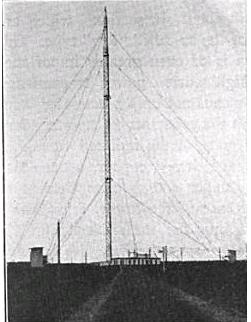
Work on the three 600-foot steel towers of the proposed Darien radio station at Caimito has begun and will be completed before opening day. Each tower is built in the form of an equilateral triangle, 150 feet on the side. At each corner of the triangle will be a footing of concrete. The depth of the excavation for the footing has varied from twelve to twenty-eight feet below the surface of the ground, the greater depth being necessitated by the irregular surface elevations, The concrete base will be rectangular in plan, sixteen by twenty, and ten feet deep. The building to serve as quarters for operators has been practically completed and will be provided with furniture by the Navy. New radio stations for relatively local use as compared with long distance stations are to be erected at Colon and Balboa and will supplant the ones now in service at these points. The towers resemble the ones at Arlington, Virginia, and each station will have two three hundred feet towers six hundred feet apart. The present wooden masts at Colon, about two hundred feet high, and the antennae of the present Balboa station are suspended at an elevation of about one hundred and ten feet above the ground between the steel tower and the power plant.

When the station, whose callsign was NBA, became operational, it was able to make regular contact with the powerful navy station at Arlington, Virginia. The transmitter is shown here:

This is a 100 kilowatt Poulsen arc transmitter, manufactured by the Federal Telegraph Company. It is described as being very sturdily designed, with an “unusually rugged and elaborate water-cooling system.” The arc transmitter produced a continuous wave signal, and could even be modulated for voice transmissions (although this one was used strictly for radio telegraph work).


Another Aeronautical/Radio Wedding

MNAeroWedding


In an earlier post, I reported on the April 1922 wedding of Sarah Cockefair and Albert Schlafke, who were married in the skies above New York before thousands of radio witnesses.  Perhaps inspired by the New York couple, it seems that a Minnesota couple decided to tie the know in a similar fashion just a few months later.  This wedding took place in June, 1922, during an airshow at the Minnesota State Fairgrounds.  It is reported in the article shown above, a wire story appearing in various papers including the Albuquerque Evening Herald on July 2, 1922.

According to the article, Zelma Olson of Minneapolis desired to be married in an airplane, and desired that the ceremony be officiated by one Rev. E.A. Jordan, who weighed 220 pounds.  Unfortunately, the aircraft could accommodate only an additional 75 pounds.

It’s not until the third paragraph of the story that we learn that the groom was one Edwin Moline, who was presumably going to be present in the aircraft as well.  His weight is not stated.

The site of the wedding, about five years earlier. (Photo from Google Books)

The site of the wedding, about five years earlier. (Photo from Google Books)

The problem was solved, at Moline’s suggestion, by placing a radiotelephone set in the plane (presumably one weighing less than 75 pounds), and having Rev. Jordan officiate by wireless.

This he did, and Rev. Jordan conducted the ceremony from a pagoda overlooking the State Fair Grandstand.

There doesn’t seem to be a great deal of historical record surrounding this novel ceremony.  I was able to find this post by one Jennifer Moline, presumably a relative of the 1922 newlyweds, indicating that the wedding actually took place on June 4, 1922, a fact not reported in the wire story.

Also, the original 1922 press photo is available for purchase on eBay, and a better copy of the photo can be found at that listing.  The back of the image notes that the photo originated from the St. Paul Daily News, and that the photographer was Earl L. Vogt.  There’s a date stamp on the back of June 8, 1922, which seems consistent with a wedding date of Sunday, June 4, 1922.

If anyone has any additional details about this wedding, I would enjoy hearing from you.


More 1914 Mobile Wireless

1914mobilewirelessThis mobile wireless setup appears in the July 1914 issue of Popular Mechanics.   Used by the U.S. Army, the set was reported to have a range of 30-40 miles when used with an inverted-L antenna. It was reported to send a pure musical note of 500-750 sparks per second. It could be operated from either a storage battery or a hand-operated dynamo.


Assassination of Archduke Franz Ferdinand, 1914

FranzFerdinand

A hundred years ago, on June 28, 1914, Archduke Franz Ferdinand and his consort were assasinated in Sarajevo, Bosnia, as reported here in the next day’s edition of the New York Tribune.

That morning, as the heir to the Austro-Hungarian throne made his way to city hall, a bomb had been thrown at his entourage. The papers reported that he was indignant upon his arrival at city hall, and snapped, “Herr burgemaster, we come to pay you a visit and bombs are thrown at us. It is an insult!”

After the ceremonies had been concluded at city hall, the Archduke and Duchess announced that they would go to the hospital to visit the wounded members of their party. Despite being under the protection of a cordon of police, they made a wrong turn down a street where the young Gavrilo Princip seized the opportunity and fired the fatal shots upon the Archduke and Duchess.

Later reports, such as the Washington Times for July 1, 1914, revealed that scores of bombs had been awaiting the royals, and that the Archduke “had not one chance in a hundred to escape the Bosnian conspirators.” The Times also correctly reported that “war is near.”

The assassination did indeed serve as the spark that ignited the First World War. Austria-Hungary had annexed Bosnia in 1908. While residents of Vienna paid surprisingly little attention to the assassination, it did spark a massive crackdown against Serbs in Sarajevo, as well as massive riots. The evening of the assassination, the mayor of Sarajevo issued a proclamation denouncing the crime, and announcing that there was no doubt that the bomb came from Belgrade. Anti-Serbian protests, as well as a virtual pogrom against the Serbs, followed.

Austria-Hungary also assumed (correctly, it turns out) that Serbia had been responsible for the assassination, and delivered an ultimatum to Serbia. When Serbia failed to comply, Austria-Hungary declared war on July 28. Russia and Germany quickly mobilized their forces, and in response, Germany delivered an ultimatum to Russia to demobilize. When this ultimatum went unheeded, Germany then declared war against Russia on August 1. When France did not adequately comply with German demands for neutrality, Germany declared war on France on August 3, followed by a declaration of war against Belgium on August 4. In response, Britain declared war against Germany on August 4.

Wireless and other technologies were to play an important role in the course of that war, and we’ll be seeing many such examples here as we look back at the centennial of the Great War. The various ultimata and declarations seem to have been delivered successfully using normal diplomatic channels, and wireless seems to have played little role in the start of the war.

It is interesting to note, however, how Austria-Hungary had used technology as part of its unsuccessful attempt to incorporate Bosnia into its empire. The journal Electrical Engineering, January, 1914, reports the successful completion of the Vienna-Sarajevo telephone circuit: “Satisfactory telephonic communication has recently been established between Vienna and Sarajevo, a distance of 875 miles.” Presumably, that line was cut in the coming months, and one press account notes that in reaction to the assassination, all telephone and telegraph facilities in Sarajevo were shut off to all but official communications.

The world would soon be at war, and wireless was to play a role.


The (non) Sinking of the Siberia

SiberiaLostOn May 1, 1914, the New York World Herald, along with most other U.S. papers, carried the tragic news of the apparent loss of the 11,000 ton steamer Siberia off the coast of Formosa. The paper reported that the gravest anxiety prevailed over the fate of the 821 souls aboard, including that of Mrs. Francis Burton Harrison, the wife of the Governor General of the Phillipine Islands. Ships from Britain, Japan, and the United States were racing to the scene of the wreck. The ship’s owners, the Pacific Mail Company of San Francisco, spared no expense in dispatching aid.

The headline of the Seattle Star reported that the ship was “wrecked by Chinese pirates” and helplessly ashore on the coast of Formosa.

On May 2, only an hour behind schedule, and much to everyone’s surprise, the Siberia sailed into Manila harbor none the worse for wear. She hadn’t sunk, nor had she been captured by Chinese pirates. She had been sailing in fair weather the entire time, and her reported demise had been greatly exaggerated.

Apparently the confusion arose when the Siberia made wireless contact and reported her position to the nearby steamer Persia. The Siberia’s call sign was WWU, and the Persia’s call sign was MBS. At some point, the Siberia’s operator was calling the Persia and sent, in International Morse, MBS DE WWU.

This was mistaken for a distress call. In Morse, the Persia’s call MBS is:

_ _      _ . . .    . . .

The distress call SOS is:

. . .     _ _ _    . . .

The confusion probably arose when the call sign was repeated multiple times:

_ _      _ . . .    . . .  _ _      _ . . .    . . .  _ _      _ . . .    . . .

The call was overheard by at least one Japanese steamer as well as by the operator of the shore station at Ozesaki, Japan. The Japanese operators mistook it for an SOS. The Siberia probably had a more powerful transmitter than the Japanese stations, and the Japanese operators’ frantic acknowledgements of the distress call were never heard by the Siberia. Instead, the massive rescue effort was dispatched.

In a later report of the incident, the Pacific Mail Company, which was also the owner of the Persia, was quoted as saying that it will probably change the call sign of the Persia.

The Siberia was sold in 1916 to a Japanese line and was renamed the Siberia Maru.  She remained in service until 1930 and was scrapped in 1934.

References:

“Wireless Mistake Causes Report of Shipwreck,” Popular Mechanics, July 1914, p. 80

“Marine Insurance Notes”, Pacific Marine Review, June 1914, p. 58.

http://www.atlantictransportline.us/content/48Siberia.htm


ARRL 100th Anniversary

ARRLnewsitemA hundred years ago, the New York Sun for June 14, 1914 reported on the beginnings of the ARRL.

The article announces that “H.P. Maxim, who invented a silencer, hopes he has invented a communicator.” It outlines Maxim’s plan, which is generally what the ARRL accomplished soon thereafter. “The scheme is to get all the amateur wireless operators of the country, and they exist by the hundreds of thousands, interested in transmitting messages from coast to coast.” Maxim is quoted that the proposal is to “select those stations which are able to transmit from fifty to 100 miles and which are kept in perfect running order. And then all stations in the league which we are forming, to be known as the American Radio Relay League, will at a predetermined hour ‘listen in.’ That hour will probably be 7:30 each evening.”

Maxim points out that the intention is “to make this thing strictly amateur. The messages are to be relayed by courtesy. There will be no fees for receiving, delivering or relaying the messages. No money transaction of any kind is to be considered in connection with the league.”

He also notes that the Government is likely to be cooperative, since the relay proposal ensures that it “will make it unnecessary for an amateur to have a high powered set,” thus reducing interference.

The War slowed things down a bit, but the first “Transcon” test was successfully carried out in January, 1921, with a successful transcontinental message and reply in “two hours flat.”


Soldatensender Calais and D-Day

D-Day Landing (U.S. Army photo)

D-Day Landing (U.S. Army photo)

The complete broadcast day for D-Day, June 6, 1944, was recorded by both CBS and NBC. One detail that I always found interesting was the following wire report, which was also carried in print by the AP in the D-Day afternoon papers:

Music for Invasion Forces

About the same time the German controlled Calais radio station came on the air with the following announcement in English:

“This is D day. We shall now bring music for the invasion forces.”

The whole Nazi controlled French radio network went off the air at 7:25 a.m. in the middle of a physical training broadcast.

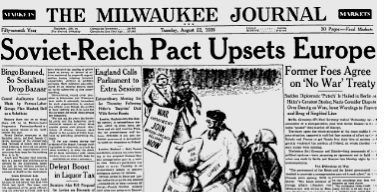
Milwaukee Journal, June 6, 1944.

I’ve never seen any explanation of this curious statement, although the impression was that the French personnel of the station had taken advantage of the chaos and taken over the station.

The truth, however, appears to be even more interesting. It seems likely that the “German controlled Calais radio station” was actually Soldatensender Calais, a German-language station operated not by the Nazis, but by the Political Warfare Executive of the British Foreign Office. Soldatensender Calais (Soldier’s Station Calais) was broadcasting not from Calais, but from the village of Milton Bryan, Bedfordshire, England, with a massive 500 kilowatt mediumwave transmitter. It broadcast on 612 kHz, 714 kHz, and 833 kHz, frequencies shared by Radio Deutschland.

Joseph Goebbels himself lamented in his diary in 1943:

In the evening the so-called “Calais Soldiers Broadcast” which evidently originates in England and uses the same wavelength as Radio Station Deutschland when the latter is cut out during air raids, gave us something to worry about. The station does a very clever job of propaganda and from what is put on the air one can gather that the English know exactly what they have destroyed and what not.

The transmitter had originally been ordered by WJZ in Newark, New Jersey (now WABC, with its city of license New York), in hopes that the FCC would authorize the high power to match the superpower signal of WLW in Cincinnati which had in use on and off from 1934 to 1939. But when the FCC insisted on maintaining the 50 kW limit for standard broadcast stations, the station was eager to sell the transmitter to the British government for £165,000. At the time, the station was the world’s most powerful mediumwave station. It had the code name of Aspidistra, and remained in use by the BBC until 1982.

It was able to successfully spoof Nazi broadcasts to the point that it was regarded as a reputable source of information. When real German stations went off the air during air raids, the powerful British station would rebroadcast the signals of other German network stations still on the air, thus giving the impression that it was part of the German network. The superpower transmitter could blanket the continent, thus allowing it to join the Nazi broadcast network seemlessly. But into those programs, it could subtly insert misinformation. For example, it could be used to issue false evacuation orders to send civilians to clog the roads during German military movements. Captured German POW’s, even those who were aware of the station’s source, commended the British on the station’s plausible deniability. If a German officer walked in while the men were tuned to the station, they could plausibly claim that they thought it to be an ordinary German station.

The station’s creator, Sefton Delmer, described its programming as “cover, cover, dirt, cover, dirt.” Most of its programming mimicked the official German stations. But when needed, disinformation could be inserted. The Germans eventually figured out what was going on, and they preceded official instructions with the following announcement:

The enemy is broadcasting counterfeit instructions on our frequencies. Do not be misled by them. Here is an official announcement of the Reich authority.

Of course, the English station then began its messages with the same announcement!

The only reference I could find to Soldatensender Calais with respect to the invasion was that when Calais later fell to the Canadians, the station was renamed Soldatensender West. I haven’t been able to find any explanation as to why the station made its English broadcasts on D-Day. But it seems to me that the intention was probably to demonstrate that Calais had already fallen in the early morning hours of June 6, and that the French staff of the fictitious station had taken matters into their own hands to start broadcasting music for the benefit of the invading Allied armies.

And since the American press apparently fell for it and reported the activities of the “German controlled Calais radio,” this tactic seems to have worked.

References

Read More at Amazon:

Deutsch:


The “Foxhole Radio” Turns 70

FoxholePictorialI suspect that most who are familiar with the “foxhole radio” learned about it from the 1950’s era book All About Radio and Television by Jack Gould. This book, a staple of many elementary school libraries, includes the crystal set shown here, which was constructed using a razor blade and pencil lead as the detector. Gould recounts how such a radio was used by soldiers in the fox holes of World War 2, and I suspect that it was the appearance in Gould’s book that popularized the name.  And it turns out that Gould probably originated the name.

The name “foxhole radio”, and perhaps the concept, seems to have originated from the construction of simple crystal sets by soldiers at Anzio in 1944. From March through early May, 1944, fighting was light, “living was leisurely” for the thousands of soldiers on the beachhead, and the beachhead was a “honeycomb of wet and muddy trenches, foxholes, and dugouts.”

One of the first references to the fox hole radio I’ve been able to find appeared in QST for July, 1944. It doesn’t use the term “foxhole radio,” but this “Stray” reads as follows:

According to Toivo Kujanpaa, a licensed ham op stationed on the Anzio Beachhead, several of the radio men there rigged up a field version of a “crystal” set using a razor blade for a detector. Their efforts were rewarded by the reception of a “jive” program (along with some German propaganda) aimed at the American forces from an Axis station in Rome.

About that same time was when, as far as I can tell, a variation of the name “foxhole radio” first appeared in print.  Time Magazine for July 17, 1944 made the report,.   Time reported that one Lt. M.L. Rupert was one of “hundreds of U.S. infantrymen” who made the foxhole receiver to kill time and boredom at Anzio.  Lt. Rupert wrote to Marlin Firearms Company (the manufacturer of the razor blades) with a description of the set.As QST later lamented, Time “as usual” hadn’t given credit to hams for coming up with the idea.

A similar account, also crediting Lt. Rupert’s letter to the manufacturer, appeared in the New York Times on June 25, 1944. According to the New York Times, the idea of using the pencil lead originated with O.B. Hanson, NBC’s vice president of engineering, who refined on the concept sent to the razor blade manufacturer. Interestingly, the byline of the New York Times account is none other than Jack Gould, the author of All About Radio and Television.  So it’s safe to say that Gould is the originator of the name “foxhole radio.”

There were two follow-ups in QST. The August issue contains the following Stray:

Further details on the foxhole radio sets now have been received from a correspondent in Italy. The razor blade and safety-pin detector is described as follows: “A station was found by moving the point of the safety pin, anchored at the other end, over the opposite end of the blade from where it is connected to the coil and antenna. The ‘phones are inserted between the pin and the grounded side of the coil.” He adds that “reception was very good.”

Finally, a letter appears in the October issue of QST from Justin Garton. No call sign is listed, but Garton’s address is shown as 448 Riverside Dr., New York, N.Y. Garton reports that the boys on the Anzio beachhead were able to receive Rome during the day and Nazi propaganda programs from Berlin at night. Garton also includes the following schematic:

1944FoxholeSchematicQST

I wasn’t able to find a call sign for either Kujanpaa or Garton. Since the Stray indicates that Kujanpaa was licensed but didn’t give his call, I’m guessing what happened was that he was licensed after Pearl Harbor and consequently did not receive a call sign. It’s possible that he received a call after the War, but I wasn’t able to find it. According to this enlistment record, one Toivo J. Kujanpaa of Massachusetts, born in 1910, enlisted on June 11, 1943. According to the Social Security Death Index, he was born on June 19, 1910, and died on January 6, 1991.  Its quite likely that he got his amateur operator license after Pearl Harbor but before enlisting a year and a half later.  With the wartime moratorium on station licenses, he would not have received a call sign, despite being licensed.

If you’re an ARRL member and logged into your account there, you can download the QST articles cited above at the following links:

And this June 1945 Stray submitted by W2MIB includes an alternative detector,

Update:  Gould’s book “All About Radio and Television” is now available for free download at AmericanRadioHistory.com.

Click Here For Today’s Ripley’s Believe It Or Not Cartoon