July 26, 1914: The Great War Begins


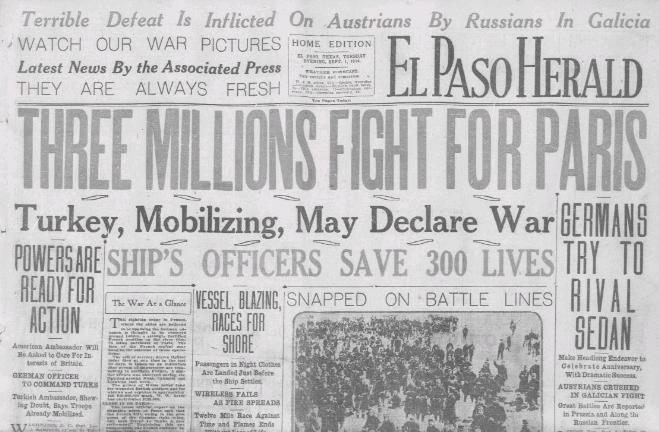
On June 26, 1914, Europe was at war. With its ultimatum  not heeded to its satisfaction, Austria declared war on Serbia and its army began marching on Belgrade. The Serbian capital, which the government had deemed indefensible, had been evacuated. King Peter of Serbia had instead shifted the seat of government 60 miles to the south to the mountain town of Kraguyevats. Within days, Russia, Germany, Britain, and France would join the war.


The Austrian Ultimatum, 1914

AustrianWarningA hundred years ago, the front page of the New York Sun of July 24, 1914 reported that the Panama Canal was scheduled to open on August 15 to vessels drawing less than thirty feet. It reported that the Canadian government’s upgrades to the Cape Race wireless station would double its range to 500 miles, making it the first point of communication with ships sailing to North America.

And it also reported the Austrian government’s July 23 ultimatum to Serbia (then usually spelled Servia) in the wake of the assassination of Archduke Franz Ferdinand.  Another report in the same paper states that Germany and Italy support the Austro-Hungarian action, and that many believed that war was inevitable.

Europe was now days away from war.

WoolfFirstAidStation

Samuel J. Woolf, First Aid Station at Seicheprey, oil, 1919 at Google Books


One-Tube and Two-Tube Radio Kits from 1939

One Tube Flashlight Set

One Tube Flashlight Set

75 years ago, the 1939 Allied Radio catalog carried these two kits. The “One Tube Flashlight Set” sold for $4.45, and included everything (tube, batteries, and coils) with the exception of the headphones, which started in the same catalog for 66 cents. The “Hurricane Receiver” sold for $3.85, but in addition to the headphones, also required a 6J7 and a 6F6 tube, which sold for 77 cents each.

Both sets ran on 6 volts. The one-tube “flashlight” set tuned shortwave, 18 to 200 meters, with four plug-in coils.

Hurricane Receiver

Hurricane Receiver

Both of these sets are regenerative receivers, and originated as construction articles in Popular Mechanics. The “Flashlight” set originated in the April 1938 issue, where it was billed as a “one-tube DX short-wave set” that ran on flashlight batteries, hence the name.

The “hurricane set” was featured in the February 1937 issue, which stated:

The primary idea behind the design is to provide a simple, rugged portable receiver that will work from a 6-volt storage battery, or a few dry cells, when other sources of power fail. When floods, hurricanes or other natural catastrophes occur and all ordinary means of communication go out, it is satisfying, and sometimes vitally important, to be able to learn from outside radio stations just what is going on. As a portable knockabout set, it also has other useful applications in the home, boat or camp.

The article promises that with six volts, the hurricane set with a 25-foot antenna should be sufficient for satisfactory reception of medium or high-power stations within a range of about 500 miles.

Parts List for “Flashlight Set”

If you are interested in building a one-tube radio, the “flashlight set” would be a good starter, and you can use the Popular Mechanics article for all of the construction details. Some of the parts might be difficult to find. But all of them are available online. Some of the links below are rather expensive, so it’s best to find most of the parts locally. But if you’re missing one or two items, you can find them at the links below.

Some of the values shown here are not identical to those shown in the article, but all of them are close enough. The only effect of substituting parts is that the tuning range of the radio will vary, depending on the exact dimensions of the coil, and the value of the tuning capacitor. Therefore, you’ll have to experiment a bit to figure out the exact tuning range of the radio once it’s done.

Mister, We Could Use A Man Like Herbert Hoover Again, Part 3: Outbreak of War

Herbert Hoover in about 1920.  Google Books.

Herbert Hoover in about 1920. Google Books.

A hundred years ago, the forces of war were relentlessly at work in Europe, but few other than heads of state and diplomats knew that the continent was about to erupt into conflict. Tens of thousands of Americans were in Europe, and the outbreak of hostilities caught them by surprise.

LiberalDemocratAmericansinEuropeThis article from the Liberal (Kansas) Democrat of August 14, 1914, reports the plight of those Americans who found themselves in Europe. Most found themselves stranded, food was scarce, and a great number of them found themselves penniless. One woman with two children, for example, was reported to be stranded in Prussia without cash but holding $2500 in checks.

The self-made millionaire mining engineer Herbert Hoover would later relate that this was the time that he ceased to be a private citizen. He became renowned for his relief efforts for Belgium, and later for the rest of Europe. And he began by assisting stranded Americans in London. The paper reports:

Herbert C. Hoover, a Californian, opened an office today in the American consulate and advanced amounts of $25 and upward to persons unable to get money by other means. Altogether Mr. Hoover gave assistance to 300 Americans who were absolutely without cash and announced that he would continue to aid them as long as his currency lasted.

As author Vernon Kellog later described this venture:

He gathered together all his available money and that of American friends and opened a unique bank which had no depositors and took in no money, but continuously gave it out against personal checks signed by unknown but American-looking people on unknown banks in Walla Walla and Fresno and Grand Rapids and Dubuque and Emporia and New Bedford. And he found rooms in hotels and passage on steamers, first-class, second-class or steerage, as happened to be possible. Now on all these checks and promises to pay, just $250 failed to be realized by the man who took a risk on American honesty to the extent of several hundred thousand dollars.

Read More at Amazon:


The Shohola Train Wreck of 1864: A Telegrapher’s Negligence

Shohola Tran Wreck of 1864

Shohola Tran Wreck of 1864

A hundred fifty years ago, the technology of the telegraph had been adopted by the railroads, and great reliance had been placed upon the device. And the Shohola train wreck of July 15, 1864, shows the horrific consequences apparently caused by one telegrapher’s negligence. On that day, at least sixty men died because the telegrapher failed to relay a message.

On that day, an 18 car train was transporting 833 Confederate prisoners of war, many of whom had been captured at the Battle of Cold Harbor.  They were guarded by 128 members of the Union Veteran Reserve Corps.  The train was travelling from from New York, where the prisoners had arrived by steamer from Maryland, to the prison at Elimira, New York.

The train was designated as an “extra,” meaning that it was not scheduled service, but instead followed behind a scheduled train. The scheduled train displayed flags which alerted that the extra was following, and continued to have the right of way.

The train with the prisoners had been delayed while guards located missing prisoners, and while it waited for a drawbridge. It was running four hours behind schedule by the time it got to Shohola, Pennsylvania. At about 2:45 PM, the train was on the single track between Shohola and Lackawaxen junction, proceeding at about 25 miles per hour.

At Lackawaxen was stationed the telegraph operator Douglas “Duff” Kent. In the morning, he had seen the scheduled train pass with the warning flags, and it was his responsibility to hold all eastbound traffic until the extra train had passed. At about 2:30, a coal train arrived at Lackawaxen, and the conductor asked whether the track was clear to Shohola. The telegrapher, Kent, answered in the affirmative.

The trains were barely a hundred yards apart when the horrified engineers realized their predicament. There was no time for the engineers to even jump from the engine, and both were killed, along with the two firemen and one brakeman. In addition, 51 Confederate soldiers and 17 Union soldiers were killed. The Confederate dead included thirteen members of the 51st North Carolina Infantry. Two prisoners escaped and were never accounted for.

Most of the dead were buried alongside the track. The Confederate prisoners were buried in coffins hastily constructed from the lumber of the wreckage, four to a coffin. The Union soldiers were buried singly in pine coffins which had been brought to the scene. In 1911, all of the dead were exhumed and brought to Woodlawn National Cemetery in Elmira. The citizens of Shohola, Pennsylvania, and Barryville, New York, tended to the wounded “without regard to the color of their uniforms.”

Soon after the collision, Judge T.J. Ridgway arrived on the scene and impaneled a jury. An inquest was held and the burials proceeded. The verdict was that no railroad employee was to blame, and that the accident was unavoidable.

The New York Daily Tribune of July 18, 1864 noted that it was “desirable that something more than the sham investigation by the jury should take place.” The Daily Tribune reports that the telegraph operator is “said to have been intoxicated the night before, but until he can be met with, and the public will demand of the State authorities to see that he is, and can be confronted with the conductor of the coal train, it will not do to place too much reliance on the statement of the latter.

The Tribune continues, “it is the duty of each telegraph clerk to telegraph to the clerk at the next depot immediately the train has passed his station. At Lackawaxen were were unable to see the book kept by the absconding operator.”

And abscond he did. Other reports were that Kent “did not take the wreck very seriously,” and reportedly went to a dance that evening. When the public began to realize his role, he left town and was never seen again.

The Tribune’s reporter wrote:

Sadly familiar as the last three years have rendered the country and the public with tales of blood, scenes of slaughter, and the accumulated horrors of the battle-field, we are not yet so used to them as to feel unmoved when, on a smaller scale, some fearful railroad catastrophe brings them to us, face to face, amid the quiet of civil life. One of these terrible catastrophes, the most terrible that has happened in this country for some years, took place on Friday morning last, when the grave was again opened to receive a hecatomb of human life, offered at the shrine of managerial inefficiencyand subordinate recklessness.

References

The Great Shohola Train Wreck

Shohola Train Wreck at Wikipedia

Read More at Amazon:


Downtown St. Paul, 1851

3rdRobert1851

This view shows the corner of Third and Robert streets in downtown St. Paul, in 1851.  You can find the original at Google Books in A History of the City of St. Paul and the County of Ramsey, published by the Minnesota Historical Society in 1876.


Honeyville Discount Code for Emergency Storage Food

On my website, I have a number of pages regarding emergency food storage.  Even if, like me, you don’t own a single piece of camouflage clothing and don’t think of yourself as a “survivalist,” it is prudent to keep some food on hand in case of emergency.  You can find my food storage pages at these links:

One excellent source for bulk food for emergency storage, Honeyville Grain, has a sale this week (until August 26, 2014). By using coupon code SCHOOL14, you will receive 15% off your order.

No matter what size your order is, the flat rate shipping cost is only $4.99. Therefore, it is very economical to order food in bulk. To take advantage of the discount until August 26, 2014 use coupon code SCHOOL14 when you check out.

You’ll find a full selection of their food storage products at this link.Here are some of the products that I think are most useful.

Milk Alternative

Honeyville’s “Milk Alternative” is about the best way I know to store large quantities of powdered milk. It’s not actually whole milk, but it is a dairy product, and has nutrition very similar to milk. The first ingredient is whey, and the second ingredient is nonfat milk. While it doesn’t taste exactly like real milk, it’s actually quite close, and tastes much better than products such as Carnation instant milk. It’s also quite economical. It’s also available in chocolate and strawberry.

Fruit Smoothie Mixes

The fruit smoothie mixes  are excellent. You’ll use them regularly, and they’ll ensure that you have an emergency dairy product on hand.

Hot Cocoa Mixes

The hot chocolate mixes are about the same price that you’ll find for comparable products in the supermarket. But in my opinion, they’re better quality, and come in a variety of flavors.

Powdered Drink Mixes

The powdered drink mixes are comparable to what you’ll find in the supermarket. These are economical for storage large quantities.

9-Grain Cereal

The Honeyville Nine Grain Cereal is excellent. It makes a hot cereal that tastes much better than oatmeal and is more nutritious. It’s quite economical, and you’ll use it in your normal menu, as well as for emergency storage.

Powdered Eggs

Admittedly, most people have a bad reaction to the words “powdered eggs,” usually stemming from a prior bad experience. Fortunately, the Honeyville powdered eggs do not live up to that reputation. They are excellent, and when used in scrambled eggs or baking, they are indistinguishable from the real thing. They can make an excellent source of protein in an emergency.

The only downside is that they come in a large can. They’re good when you open the can, but after about a month, they once again start to live up to the reputation. Therefore, they are hard to use in your daily cooking. But for emergency storage, I highly recommend them.

Note: All of the above links are affiliate links, and I get a small commission is you make a purchase after following these links. But in my personal experience, the Honeyville products are all excellent, and I’ll probably be placing an order myself this week.


Where To Get Crystal Set Parts

Some of my earlier articles have shown crystal radios from the early days of radio. For example, I have an article with the history of the “foxhole radio” popularized by soldiers in World War 2.  I also have a link to a 1922 newspaper article with details for building one.   I also have links to this and this radio, both from 1914.

I received an e-mail from someone who wanted to build a crystal set with his grandson, who requested construction details and parts lists. There are many sites with such information, the best of which is The Xtal Set Society.  You’ll also find some simple plans at this link. The first radio I made as a youth was basically identical to the fourth one shown on the bottom of the page. It requires only a board, a toilet paper tube, some enameled wire, a piece of metal to use as the slider, a diode, and the earphone.

It’s an interesting project, and as long as you have at least one fairly strong AM radio station nearby, almost any design you put together will work. If you have an antenna, ground, detector, and headphones, you’ll hear one or more stations as soon as you connect them together, in almost any configuration. Therefore, I can’t add much as far as construction details. Any of the sets you find on the internet should work just fine. It’s best to start with a simple set of plans and work your way up.

If you can’t find all of the parts locally, here are some tips on finding them.

The Detector

The heart of the crystal set is the detector. This is what changes the radio signals into an audio signal that you can hear. You have two options. First, you can simply buy a semiconductor diode. The most commonly used diode for a crystal set is the “1N34” or “1N34A”. You can buy it on Amazon at any of the following links. As you can see, they are quite inexpensive, and you can afford to stock up in order to make multiple sets.

The other “old style” detector is the “cat’s whisker” and crystal, from which the radio gets its name. The crystal is a piece of the mineral galena, which you can find at many hobby shops. At most science museums, you’ll find for sale samples of various minerals, and you’ll be able to find your piece of galena for a low price. (If you can’t find it locally, you can buy a chunk on Amazon.)  To use it as the detector, you attach one wire to it firmly, perhaps with an alligator clip or by firmly clamping it down. The other connection is a thin wire which makes contact only at one point. This other wire is called the “cat’s whisker”. You’ll need to rig up some kind of spring to keep the wire in contact with the crystal, and you’ll also need some method to move the wire around to look for a “sweet spot” on the crystal.

And for the mad scientist who wants a very unusual type of detector, you can make a detector using an open flame.

The headphones or earphone

The headphones or earphone will be the most difficult part to find. Unfortunately, most modern headphones will not work. The crystal set requires a “high impedance” headphone. Most modern headphones are “low impedance” and simply won’t work, unless perhaps the station you are listening to is extremely strong. Typically, a “high impedance” earphone or headphone will have an impedance of about 2000 ohms. Modern “low impedance” headphones, such as for a stereo or computer, are generally about 8 ohms. I’ve found that headphones with an impedance of 600 ohms generally work OK. So if you can find some of that approximate value, they will work. Old “language laboratory” headphones generally are about this value.

The most commonly used is an earphone like this one, which is available on Amazon:

As you can see, this one comes with a 3.5 mm plug. Since you’ll need to wire the earphone directly into your circuit, you have two choices. First, you can simply cut off the wire, or perhaps make the attachment with
alligator clips
.

If you want to keep the plug intact, you can purchase the matching jack:

This jack requires soldering, but it should work adequately by simply twisting the wires firmly around the lugs. If you want to invest in a soldering iron, they’re much cheaper than you probably expected. This one, for example, comes complete with the solder, as well as some other tools that might come in handy:

Another option is to use the low-impedance headphones but with a suitable transformer, such as this one:

One side will be marked “600 ohm” and the other side will be marked “8 ohm” (or similar terminology). Ignore the center pin on either side. Hook the other two terminals of the “600 ohm” side to the radio’s output, and hook the two outer terminals of the “8 ohm” side to the headphones. This will allow the headphones (which you can get at the dollar store) to work.

Wire

The best wire for winding the coil is enameled wire of about 24 gauge.  This is also sometimes called “magnet wire”:

The enamel coating is insulation, so that the turns don’t short out. However, if you’re building a set with a slider, you’ll want to sand off the enamel at the top so that the slider can make contact with the wire.

For making connections between components, and for making the antenna, you’ll want flexible stranded wire such as this:

Capacitor

Some of the circuits will call for a capacitor, and some will show you how to make your own. (In older literature, the term “condenser” is used.)  The simplest circuits don’t have one, and the exact value is not critical, and for most circuits a capacitor of 0.1 uF will be about right:

Another good source for ordering parts such as resistors and capacitors is Jameco Electronics.  You can order online at.

Connectors and Hardware

Many of the early circuits will show “Fahnestock clips” for making connections. These certainly aren’t required, since you can simply twist the wires together. But if you want to give your crystal set a vintage look, they’re a nice touch. They’re also available at Amazon:

Most of the circuits you see are put together with wood screws, which you surely have lying around the house. If you don’t, you can go ahead and order an assortment such as this one:

If you need a piece of pine board to mount the whole thing, you can get that on Amazon as well:

Kits

If you want to bypass the whole procurement process and make a radio that works, but without the “retro” look, any of the following kits will fill the bill. They include everything you need along with directions:


A Parental Kidnapping Solved, 1919

BLrewardposterIt appears that the pages of Boys Life magazine were used to solve a parental kidnapping case in 1919.

This ad looks somewhat out of place in the November, 1919, issue of Boys Life magazine.  It reports that Graydon Hubbard, age 12, was an active member of his Scout Organization at Brookville, Indiana, when he and his brother Harold, age 8, were “stolen from their home early last July.”

The ad goes on to say that Graydon “will undoubtedly make an effort to get in touch with the nearest Boy Scout Unit to the point where they are located,” adding ominously, “if they are in this country.”

“If any Boy Scout–or Scout Master–learn their location–and will advise the Cincinnati Office of the William J. Burns Int. Detective Agency, Inc., of their address–upon receipt and verification of same–the above reward will be paid.”

The advertisement appears to have been successful, and it seems that some Scout in Riverside, California, must have collected the reward money. The November 30, 1919, issue of the Indianapolis Star reports that the boys’ mother, Mrs. M.P. Hubbard, was indicted in Indiana on a charge of kidnapping after the father, M.P. Hubbard, had been granted custody.

The boys were returned to Indiana from Riverside,California, by the chief of police and his wife, along with a private detective from the agency named in the advertisement. The article reports that Mrs. Hubbard had assumed a different last name and “had taught the children to go by that name.”  The article goes on to say that she had recently been named defendant in a lawsuit brought by the former husband.


More Radio Scouting, 1922

1922RadioScouting


This photo, form the New York Tribune, July 9, 1922, shows William Hodson, a Boy Scout from Troop 108, Brooklyn, along with two other scouts, operating a receiver. But it’s not just any receiver. It’s a “three-coil duo lateral regenerative set with loud speaker attachment.”