World’s Largest Radio Tower, Tuckerton, NJ

TuckertonTower

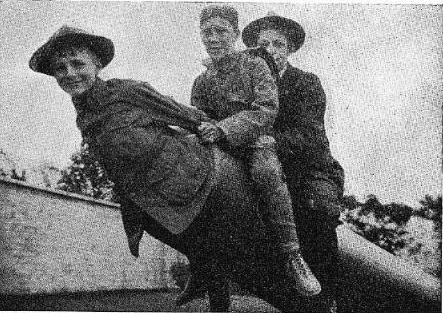
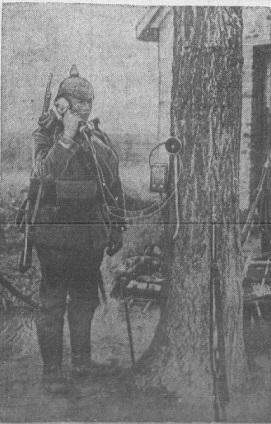
This photo from the November, 1914, issue of Popular Mechanics shows the world’s largest radio tower at Tuckerton, New Jersey.

The caption notes that the station was now under the control of the U.S. Navy Department. As mentioned in an earlier post, this station was originally German and part of the Goldschmidt System, and communicated with the German station near Hanover. Even though under Navy control, German nationals continued to operate the station until the U.S. entered the war, at which time the staff became prisoners of war.

The tower itself stood 680 feet tall. At the time, it operated with the call signs WCI and WGG. After the war, the station was seized by the U.S. Government as part of Germany’s war reparations, and was sold to RCA, which operated it under the call sign WSC. The tower was taken down in 1955, but its three massive anchor blocks still exist. A good set of photos of these massive monolith cubes can be viewed at this site.


Radio and the Longitude Problem

RadioLongitude

The wireless telegraph  solved the Longitude Problem once and for all.    Many maritime disasters over the centuries were the result of sailors not knowing their longitude. Determining latitude is relatively simple. From any position on earth, it is easy to determine the local time by observing the sun or stars. When the sun is at its highest point for the day, this is, by definition, noon local time. The sun’s altiude at that time can be used to quickly determine the observer’s latitude.

Longitude, however, was a much more difficult problem. With instantaneous communication, it’s trivially simple to determine longitude. The observer merely determines local noon, and then compares that with the local time at a known longitude. The difference in time can quickly be converted to difference in longitude. If it is noon at my location, and I know that it is 6:00 PM at Greenwich, then I instantly know that I am 90 degrees west of Greenwich. The time diference is 6/24 of one day, which is 1/4. Therefore, the difference in longitude is 1/4 of 360 degrees, or 90 degrees.

Of course, instantaneous communication was not availalbe for most of the history of navigation. Therefore, the problem remained formidable. It wasn’t until the late 1700’s that sufficiently accurate chronomoters became available. And even then, a backup method (careful observation of the eclipses of known stars by the moon) involving laborious calculations was required.

These problems were  solved by the use of wireless time signals. A mariner could set his chronometer accurately (generally, to about a tenth of a second) by use of time signals broadcast by stations such as NAA in the United States or the Eiffel Tower in France.

But even as recently as 90 years ago, this problem was still receiving attention, as shown by the article in the November, 1924, issue of Radio News. Listening to the time signal by ear and noting the time on the chronometer was accurate enough for maritime navigation. But for land surveying, a more precise automated method was necessary. Telegraph lines could be used, but the relays used in long lines introduced a delay. Radio was ideal, since the only delay was the speed of light, and even that could be accounted for. The article explains how the time radio time signal from the naval observatory was graphed along with the time from a locally calibrated chronometer. The result was a very accurate indication of the time difference, and thus the longitude difference, between the two locations.

The article shows how the time signal from Annapolis, Maryland, was used to determine exact longitude in Skagway, Alaska, 3000 miles away.

Read More at Amazon


Atomic Bombs in 1914

1914AtomicBombs

You probably wouldn’t expect to see the words “atomic bombs” in the newspaper a hundred years ago, but here they are, as they appeared in the Willmar (Minn.) Tribune a hundred years ago today, November 4, 1914.

H.G. Wells (Wikipedia photo.)

H.G. Wells (Wikipedia photo.)

This actually isn’t a news story. It’s part of the serialized novel The World Set Free by H.G. Wells.

By the time the book was published, the war in Europe was well underway. Wells predicted it, but he saw it as not taking place until 1956. He did correctly predict that by that time, the combatants would be equipped with “atomic bombs.” The bombs in Wells’ book did use nuclear reactions, but he got some of the details wrong. Instead of releasing all of their energy in an instant, Wells’ versions continued to ignite for months or years, leaving much of Europe uninhabitable.  The previous peaceful use of atomic energy in the book had consisted of small amounts of the reaction material, the fictional element “carolinum,” used to power vehicles and machinery.

In the aftermath of Wells’ war, the people of the world united into a utopian one-world government. On the one hand, the new world government renounced monarchy. But on the other hand, the new government was presided over by the former kings, with the King of England at the helm of the new benevolent dictatorship.

If you don’t like plodding through old newspaper clippings, the entire novel is available as a paperback. It’s also available for free as a Kindle book. If you don’t have a Kindle, you can download the free Kindle reader app. It’s also available for free download at Google Books.

Other Books by H.G. Wells at Amazon


The Irresisto 1914 Phonograph

Irresisto

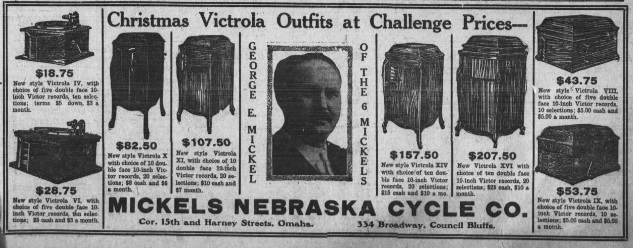
The Irresisto is apparently a brand name that never quite caught on. I couldn’t find any reference to it, other than old advertisements such as this one from a hundred years ago today, November 3, 1914, in the Tacoma Times.

According to the ad, these were equal in every way to $200 phonographs, but could be had for $5 down, and easy payments until the marvelously low price of $82.25 was paid. It came with a large number of needles, an oil can, 16 of the latest dance records, and eight additional records.

Read More at Amazon


Combination Book Light-Radio, 1939

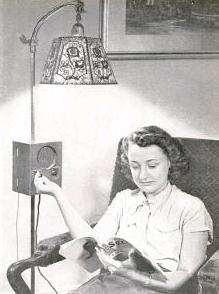
BookLightRadioI’m not sure exactly why one would want a combination book light and radio, but if you wanted one 75 years ago, Popular Science for November 1939 showed you how to build it.  It was billed as being extremely useful for reading in bed, assuming of course, that you have a handy aerial and ground connection nearby.

The radio itself is a basic one-tube BookLightRadioSchematicregenerative receiver.  It uses two trimmer condensers, one of which handles tuning and the other regeneration.  The particular tube used in this circuit appears to be unobtanium.  It looks like a standard miniature tube, but it’s actually a Hytron “Bantam Junior,” with a proprietary bakelite base.  The receiver drove a pair of headphones, presumably for quiet bedtime listening while reading.


1934 One Tube Radio

Nov34QST

Occasionally here at OneTubeRadio.com, we have, well, a one tube radio. This one appeared 80 years ago this month in the November 1934 issue of QST.

This circuit uses half of the dual-triode Type 19 tube as the regenerative detector, and the other half as an audio amplifier. It’s not very different from the 1950 Boys’ Life receiver I featured in an earlier post.  The tube is equivalent to the slightly more modern 1J6 with an octal base, and that tube is available for less than $4 from Antique Electronic Supply.

If you’re looking for a simple circuit for a one tube radio, here it is! For pointers on finding some of the other parts, see my earlier article on the subject.


Happy Halloween!

Halloween1914Happy Halloween from OneTubeRadio.com! All of your party needs can be found here, in the Washington Times, all at 1914 prices.


WCFL vs. Border Blaster XEAW


MilwJournal103039The radio column for the Milwaukee Journal 75 years ago today, October 30, 1939, touches on the phenomenon of “border blasters” in Mexico and how they affected U.S. radio listening. Milwaukee was essentially the same radio market as Chicago. Even though Milwaukee had its own stations, listeners there ordinarily listened to the Chicago stations, including WCFL, then on 970 kilocycles. In 1939, WCFL carried the NBC “Blue” network, and would have been the main outlet in Milwaukee for listening to that network.

During the daytime, WCFL would have provided good coverage to the Milwaukee area, but the situation was different at night. The radio columnist, Edgar A. Thompson, pointed out that listeners who wanted to hear the NBC symphony, conducted by Arturo Toscanini, especially in the northern suburbs of Milwaukee, would experience difficulty to to the 100,000 watt signal of Mexican station XEAW in Reynosa on 960 kilocycles.

The solution was to tune instead to KDKA Pittsburg on 980 kilocycles, where the columnist reported that he heard the entire concert on a five tube “midget” table radio with good reception.

XEAW was one of the “border blaster” stations in Mexico, broadcasting with powerful transmitters that blanketed North America from just across the Mexican border.  XEAW was owned for most of the 1930’s by Dr. John R. Brinkley, a Kansas physician (with a degree from a diploma mill known as the Eclectic Medical University in Kansas City).  Brinkley’s most famous cure involved an extract from goat testicles that would allegedly cure various maladies.  By 1939, Brinkley had sold the station to Carr Collins, another practitioner of alternative medicine, whose “Crazy Crystals” from Mineral Wells, Texas, were reported to have various curative properties.  It was probably Collins who was causing the interference to WCFL reported in this news item.

Brinkley owned at one time or another various of the “Border Blaster” stations in Northern Mexico, and he was quite well known throughout the United States.  My dad recounted hearing Dr. Brinkley, and his broadcasts were apparently a source of amusement on the farm radio in Indiana.  XEAW, weighing in at only 100,000 watts was one of the lower powered border blasters.  Some operated with power of up to 500,000 watts.  At one time, Brinkley was the owner of the most powerful radio station in the world,

The problems caused by the “Border Blasters” were largely solved in 1941 by the North American Radio Broadcasting Agreement.  Unlike Canada and the United States, Mexico had never been assigned any “clear channel” stations, and it therefore had little incentive to rein in powerful stations like XEAW.  The new agreement assigned clear channels to Mexico, on 800, 900, 1050, 1220, 1550, and 1570 kilocycles.  To make room for the new channels, the broadcast band was extended upward from 1500 to 1600 kilocycles.  As a result, most American stations changed frequencies (usually moving up the dial) the morning of March 29, 1941.  At that point, WCFL moved from 970 to 1000 on the dial.  It remained there as WCFL until 1987, when it became WLUP and later WMVP, which still inhabits 1000 on the dial.

Presumably, after 1941, WCFL’s listeners north of Milwaukee no longer had to worry about goat testicles interfering with their concert listening.

After the 1941 agreement, “Border Blasters” didn’t completely go away.  For example, Wolfman Jack famously broadcast on XERF, Ciudad Acuña, Mexico, in the 1960’s.  XERF went on the air in 1947 using the facilities of one of Brinkley’s old stations, which had been seized by the Mexican government in 1939 and had been dark for eight years.  XERF, however, operated on 1570, in full compliance with the 1941 agreement assigning this channel to Mexico as a clear channel.

References

Border Radio at Texas State Historical Association

Border Blaster at Wikipedia


Can You Vote Before Your 18th Birthday? Maybe

Wisconsin teen Zachary Ziolkowski won’t be allowed to allowed to vote Tuesday, since his 18th birthday is Wednesday. Most comments that I’ve seen online have been critical of the teen for even trying, and the Wisconsin Government Accountability Board ruled against him. But he has a credible argument.

The 27th Amendment states that “the right of citizens of the United States, who are eighteen years of age or older, to vote shall not be denied or abridged by the United States or by any State on account of age.” And Wisconsin Statute 6.02 provides that “every U.S. citizen age 18 or older who has resided in an election district or ward for 28 consecutive days before any election where the citizen offers to vote is an eligible elector.” Section 6.05 goes on to say that this means “any person who will be 18 years old on or before election.

But, you say, Mr. Ziolkowski doesn’t “turn 18” until the day after the election. After all, he won’t get a birthday cake until Wednesday, November 5, and his birth certificate apparently says that he came into the world on November 5, 1996.

Of course, the matter is further complicated by the fact that most people are not born at the stroke of midnight. If someone was born at 12:01 AM on November 4, 1996, then there is no question that they are 18 years old on election day. If the polls open at 8:00, then they are 18 years and 7 hours old, clearly old enough to vote. But what about the prospective voter who was born at 11:59 PM? That person, even if they show up at closing time, has not been around for eighteen years. They are only 17 years, 364 days, and 20 hours old.

Most people would recognize that the kid born at 11:59 PM has the right to vote. Mathematically, that person is not 18 years old. But we need to draw the line somewhere, and most people assume that we draw the line with the birthday: When you wake up on your 18th birthday, you are 18 years old. That’s where the Wisconsin Government Accountability Board decided to draw the line.

But Mr. Ziolkowski has a pretty credible argument that the line should be drawn elsewhere. And the Social Security Administration, among others, agreed with him when it was called upon to decide whether a girl was entitled to social security benefits for the month of November 1962. The girl was born on December 1, 1944, and “turned 18,” under the common parlance, on December 1, 1962. She was collecting death benefits until 18. She was 17 years old the entire month of November, so one would think that she should collect benefits for that month. But the Social Security Administration ruled against her. It held that “a person attains a given age on the day before his corresponding birthday, i.e., the anniversary of his birth corresponding to that age.” In this case, the girl attained the age of 18 on November 30, the day before her birthday. Therefore, she was not entitled to benefits for November.  (Lest you think the government was being heartless to the poor girl, they recognized that the same rule should apply for the more common situation of calculating when benefits start, which they noted would be the day before the retiree’s 62nd birthday.)

The Social Security Administration noted that this rule “has been applied consistently by the courts.” It also noted that the rule was cited by both Blackstone and Kent. Interestingly, Blackstone’s phraseology is somewhat ambiguous:

So that full age in male or female is twenty-one years, which age is completed on the day preceding the anniversary of a person’s birth, who till that time is an infant, and so styled in law.

Blackstone’s Commentaries, page 92 (1915 edition)

Kent puts it this way: “The age of twenty-one is the period of majority … and that age is completed on the beginning of the day preceeding the anniversary of the person’s birth.”
Kent’s Commentaries, Vol. 2, page 265 (1860 edition).  Kent cites four cases for this proposition, two British cases and two American cases:

Anon. 1 Salk. 44. 1 Ld. Raym. 480, Sir Robert Howard’s case, 2 Salk. Rep.. 625, Hamlin v. Stevenson, 4 Dana’s Kentucky Rep. 597, and State v. Clarke, 3 Harr. Del. R. 557.

I didn’t find the full text of any of these cases online, but there is a nice summary of the Hamlin v. Stevenson case available here:

Stevenson owed Hamlin a sum of money which he refused to pay. Hamlin who was still an infant started this action against Stevenson to recover the debt. Stevenson had no real defense on the suit and so filed a dilatory defense to the effect that Hamlin was an infant and therefore ought to bring suit by a “next friend” according to the requirements of the court. It happened that Stevenson made this plea on the day preceding Hamlin’s twenty-first birthday and this was also the day of the trial. The question at issue was whether Hamlin had reached his majority on that day. Chief Justice Robertson gave the opinion of the Court: “It is the common law that a person is twentyone years old on the day preceding the twenty-first anniversary of his birth. Therefore, Hamlin was of age on the day when the plea was filed, and when the issue upon it was tried. Consequently he had the right to prosecute the suit in his own name without the intervention of a friend.

The Social Security Administration’s decision also cited two American cases, both of which are available online, United States v. Wright, 197 Fed. 297 (8th Cir. 1912), and Frost v. State, 45 So. 203 (Ala. 1907).  The Wright case states the rule very clearly, “an infant becomes of full age the first moment of the day before his twenty-first anniversary.”

It’s not surprising that Mr. Ziolkowski’s father happens to be an attorney. But according to the news item, he learned about the old common-law rule ” in his high school business law class.” At it certainly looks like he’s absolutely right.

The Wisconsin Legislature could have used the word “birthday” in the election statutes but did not do so. Elsewhere in the Wisconsin Statutes, the Legislature does use the word “birthday.” For example, under Wisconsin Statutes 938.18, a juvenile can be tried as an adult in certain cases when the offense took place “on or after the juvenile’s 15th birthday.” There’s a strong argument to be made that the phrase “age 18 or older” in the statute should be interpreted under the common law.

The Wisconsin Supreme Court has stated:

A statute does not change the common law unless the legislative purpose to do so is clearly expressed in the language of the statute. Id. To accomplish a change in the common law, the language of the statute must be clear, unambiguous, and peremptory.

Fuchsgruber v. Custom Accessories, Inc., 244 Wis.2d 758, 2001 WI 81, 628 N.W.2d 833 (2001).

Also, this isn’t really an issue of Wisconsin state law. As noted above, 18 year olds have the right to vote under the federal constitution. So the federal interpretation, such as that made by the Social Security Administration, seems compelling.

I’ll be an election judge in Minnesota on Tuesday. If you were born on November 5, 1996, and you walk into my precinct, this is above my pay grade. I’m going to call the county before I hand you a ballot. But I hope they say yes.

For further complications involving people who cross the International Date Line, there is a fictional case discussing the subject.  I believe it was in the book More Uncommon Law, but it might have been in the first volume, Uncommon Law: Being 66 Misleading Cases.


1939 Printing Press

CubPrintingPress

The aspiring young journalist 75 years ago could start his or her own newspaper with a capital investment of only $1.19, with this printing press advertised in the Chicago Tribune 75 years ago today, October 29, 1939.

For those interested in another archaic printing method, please check out my hectograph page.