A few weeks ago, I wrote about some plans for homemade microphones from 1945. One was very crude but easy to duplicate. But one was quite sophisticated, and could be made at home by growing a piezoelectric crystal from a saturated solution of Rochelle Salt.
The piezoelectric microphone is particularly intriguing because it should function equally well as a piezoelectric speaker. For this reason, it has an interesting application, albeit perhaps not one that is immediately practical.
Being Prepared for Inadvertent Time Travel
The knowledge of how to build such a speaker could come in handy in a couple of situations, at least one of which is probably unlikely. The first situation would be that of inadvertent time travel. If you get caught in a time warp and sent to the past, it would be wise if you could make the best of a bad situation and be able to “invent” some technological devices. (And as I’ve previously written, having a WikiReader in your pocket would make the situation much more bearable.) And as a loyal reader of this blog, it stands to reason that one of the technologies that you could “invent” would be radio.


While there are no documented cases of this ever happening, the science fiction literature is full of examples. Probably the oldest example is Mark Twain ‘s A Connecticut Yankee in King Arthur’s Court
 . Other examples include 1632 by Eric Flint
 and the Island in the Sea of Time
 series by S.M. Stirling.
Cobbling together a transmitter would be relatively easy, as long as the time period into which you were deposited had some rudimentary industries. You’ll need some wire for winding coils and putting up an antenna, some metal for building capacitors and a spark gap, some acid for making batteries, and a few other bits and pieces that should be readily available in the Middle Ages. With a bit of ingenuity, you should be able to come up with a transmitter with a range of hundreds of miles.
And with the exception of one component, a suitable receiver would be relatively easy to make. Once again, you’ll need some wire for the coil and antenna, a few pieces of metal for fabricating other parts, and something to serve as a detector. The detector would be quite simple. The most common material, which would give good results, would be a chunk of Galena (lead ore). If you find yourself in an area where this mineral is unavailable, there are many substitutes, as discussed in my earlier posts (this one and this one) about “foxhole radios” or my earlier post about emergency wartime crystal sets.
The one part, however, that will be difficult to procure is a suitable earphone. If you’re lucky enough to be transported back in time after the invention of the telephone, then your problem is partially solved. A telephone receiver will have an impedance that is too low for your receiver, but by rewinding the coil, you should be able to come up with a suitable headphone. If the telephone hasn’t been invented yet, you can of course take the honors and invent it. But if you want to jump ahead to radio technology, you’ll need to fabricate a suitable headphone to hook up to your radio.
This brings us back to the piezoelectric microphone we discussed earlier. This type of microphone works equally well in either direction: It can change electrical impulses to sound, as well as working the other way around and changing sound into electrical impulses. Therefore, if you build a piezoelectric microphone, you can hook it up to your crystal set and listen to that transmitter you put on the air.
As discussed in my earlier post, the piezoelectric microphone/headphone should be relatively straightforward. All you need, in addition to the scraps of metal you already procured, is a piezoelectric crystal. And the article linked there gives you the basics of growing one. In addition to water, all you will need is Rochelle Salt, also known as potassium sodium tartrate tetrahydrate. This compound was first prepared in 1675 by Pierre Seignette. So if your time travel lands you after that date, you should be able to procure it. Of if it’s about 1675 and you’re anywhere near La Rochelle, France, you would be advised to look up Monsieur Seignette and collaborate with him on the project.
If you arrive before 1675, all hope is not lost. According to this site, you can whip up a batch using the ingredients cream of tartar and washing soda. Cream of tartar is a byproduct of the wine making process, so it should be available at any time after the invention of wine, which dates back to antiquity. So as long as those ingredients are available, you should be able to recreate radio.
An alternative method of building the headphone is described in the book The Voice of the Crystal by H. Peter Friedrichs. This is a magnetic headphone which would require a very fine gauge of insulated wire, but a good jeweler of almost any era should be able to help you procure the components.
Rebuilding Civilization After a Collapse
The other time one would need to recreate radio technology would be after a collapse of society. There are billions of radios in existence, any many more component parts, so it is very unlikely that you would need to start from scratch. Even after hundreds of years of dark ages, many relics of our current technological society would still be available to provide usable parts. This scenario is discussed in detail in the book The Knowledge: How to Rebuild Civilization in the Aftermath of a Cataclysm by Lewis Dartnell, which I previously reviewed.
The most abundant source of headphones for your post-apocalyptic crystal set would probably be the microphones from the billions of cell phones currently in existence. In most cases, these are probably piezoelectric, and would work well for a crystal set headphone. (The billions of stereo headphones and earbuds probably wouldn’t be of much use, since they are too low an impedance to work properly with a crystal set.)
Science Fair Project
Even if you don’t anticipate time travel or TEOTWAWKI (The End Of the World As We Know It), a homemade speaker or microphone could be part of a most impressive science fair project. Even very young students could fabricate the simple three-nail microphone shown in my earlier post. And more advanced students will be capable of making speakers or microphones that rival commercially available ones.
A More Refined Version of the Piezoelectric Speaker
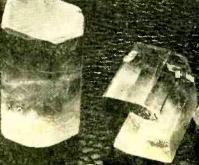
The 1945 piezoelectric microphone linked in my original post is probably suitable for all of your time travel or post-apocalyptic needs. However, a more refined version, shown at the top of this page, is from the May-June 1968 issue of Elementary Electronics. While the 1945 article probably gives enough detail for the experimenter to grow a crystal and put it to work, the 1968 article goes into much greater detail. It gives detailed instructions on growing the crystal, and the completed crystals, shown here, turn out nearly perfect. In particular, the 1968 article gives detailed instructions on starting with a seed crystal and maintaining the temperature of the saturated solution as the crystals form. While the 1945 article would probably result in a usable crystal looking like a piece of rock candy, the details in the later article result in a crystal that can be further ground to dimensions that would make it quite sensitive.
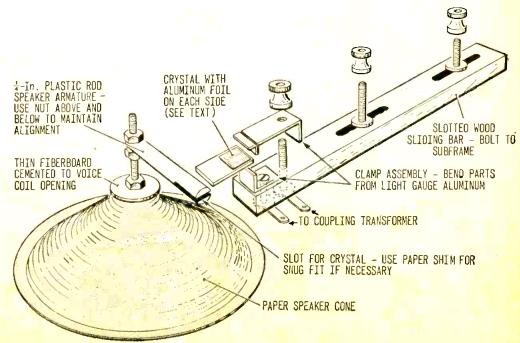
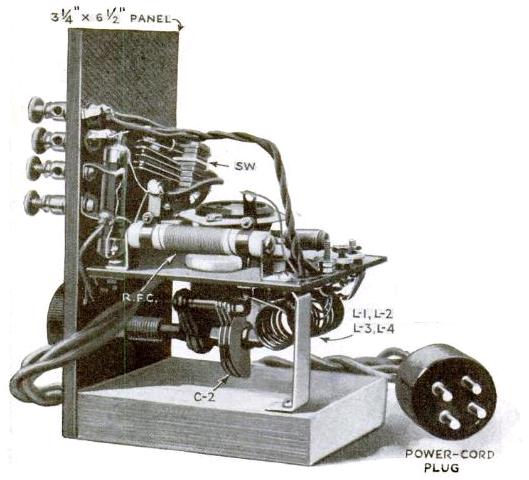
Construction details of 1968 piezoelectric speaker.
The construction details of the final speaker are shown above. The crystal is ground and polished to about 1/16 inch in thickness, and then sandwiched between two pieces of aluminum foil. (If your time travels take you to a time when aluminum was still considered a precious metal, substitution of other metal shouldn’t present a problem.) A current applied to the two pieces of foil causes the crystal to vibrate. The author of the 1968 article used the cone of a defunct 12 inch radio speaker, which could be replaced by some other type of cone. For use with a crystal set, the large cone might prove a detriment, since the crystal set might not be putting out enough audio to set it into vibration. Constructing some sort of headphone would probably be more suitable for a crystal set.
The photo above shows a matching transformer, but this would not be necessary for use with a crystal set. The example shown in the 1968 article was designed to replace a standard low-impedance permanent magnet speaker. The high impedance of the piezoelectric speaker would be perfectly suited to the output of a crystal set.

 For even more details on growing crystals, the author of the 1968 article recommends the book Crystals and Crystal Growing by by Alan Holden and Phylis Morrison, which is still available and in print. And if you’re just looking to make a crystal set and want to buy a piezoelectric earphone (or other needed parts), you can find them on my crystal set parts page.
Click Here For Today’s Ripley’s Believe It Or Not Cartoon


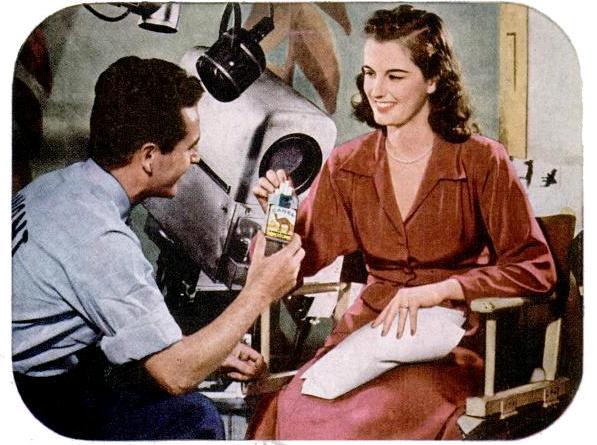
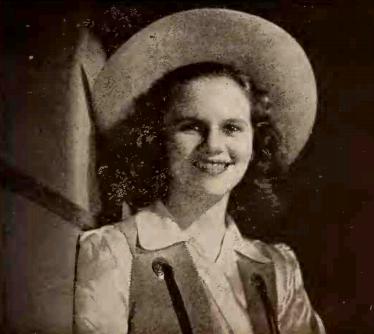
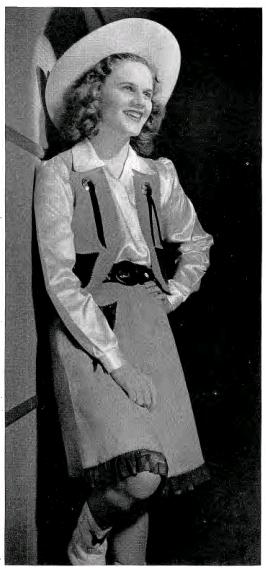
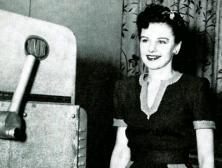 While not mentioning Miss Brophy, the Spring 1945 issue of Televiser carried a feature entitled “Women in Television.” At WABD, when the wartime manpower crisis put a damper on hiring, “women in slacks blossomed forth as ‘cable engineers’ (studioese for people who haul co-axial cables out of the way of the cameramen). One of WABD’s early staffers was Dotty Wooten, shown here. She was hired as a stenographer in 1943, but was one day called in to fill an emergency slot as announcer. The magazine reported that she had filled the announcing post ever since.


 or
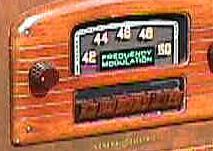
or  ). Much litigation and legal wrangling followed, which mostly served to further delay the widespread adoption of FM. But if we need to set a birth date for the modern FM band, December 1, 1945, is as good as any.