Buelah Clark, WMBB Chicago, 1926

BuelahClarkWMBB

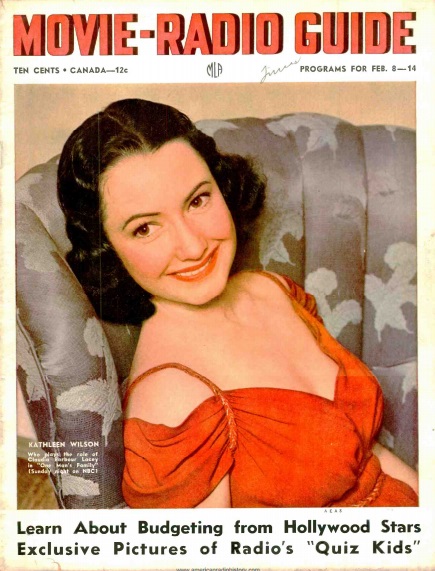
Shown here is Beulah Clark, who appeared on WMBB radio in Chicago. This picture is from the cover of Radio Digest 90 years ago today, January 9, 1926. The station first signed on in 1925, sharing the 1190 frequency with WOK. The stations eventually combined their operations, but left the air in 1928. The station broadcast from the Trianon Ballroom, which the station billed as the World’s Most Beautiful Ballroom, hence the call letters.

According to the magazine, Miss Clark shared beauty secrets with the listeners. Reportedly, “she arouses interest when she is heard and carries conviction when she is seen.”


Click Here For Today’s Ripley’s Believe It Or Not Cartoon


1916HeadAsReproducer

The photo is self-explanatory.  You don’t need any fancy electronics to listen to your phonograph.  All you need is a needle held between your teeth, and the music will play loudly in your head.  For more details, see this month’s issue of Electrical Experimenter, a hundred years ago.

WW2 Prisoner Radios

POWradio

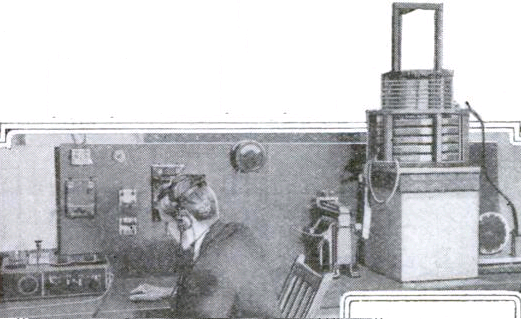
It’s unclear exactly when and where these grainy old photographs were taken, but they depict something rather remarkable.  The top photograph is a radio receiver used by Allied prisoners of war from 1940 until the end of the war in 1945.

This set belonged to the crew of a Canadian merchant ship which was captured early in 1940. They managed to conceal the set in their belongings and smuggle it in to the POW camp near Bremen. The set’s hiding place is the hollowed out butcher’s block shown in the bottom photo.

The photos appear on page 14 of the January, 1946, issue of Manitoba Calling, the monthly magazine and program guide put out by CKY in Winnipeg. The article contains other tales of Allied POW’s managing to listen to the radio during their confinement. The article contains other such stories of how prisoners managed to keep clandestine radio receivers concealed.

In one case, prisoners at a camp in occupied Poland managed to steal a transmitter from a German armored car. When the camp was threatened with an exhaustive search for the stolen set, it was returned, since the men didn’t want to risk losing the twenty clandestine receivers in their possession.

Unfortunately, the article is lacking details on the receivers in use, their power supplies, and other details. Nonetheless, it’s an interesting read, and confirms that Allied prisoners were often able to keep in touch with news from home.

The author of the article was Calvin Peppler, who was employed by CKY before and after the war. During the war, he was a Spitfire pilot in various squadrons for several years. In the last few months of the war, he was shot down and served for several months as a prisoner of war himself, attempting several unsuccessful escapes. Peppler died in Toronto in 2015 at the age of 96.

Click Here For Today’s Ripley’s Believe It Or Not Cartoon



The Glamorous Life of a Sound Man, 1936

1936JanRadioNews

Eighty years ago, sound man P.J. Stonor of Liverpool, England, discovered that a high quality American made audio amplifier was his ticket to meet pretty girls. In the January 1936 issue of Radio News, he reports that his sound company had been in business for only nine months, but had covered over fifty “public-address events, from whist drives to garden fetes.” In this photo, he is shown announcing the British Legion fete, with one of the beauty queens beside him.

Mr. Stonor reports that he is using a Lafayette 15-watt 6-volt portable amplifier which had been in constant use without a bit of trouble, not even requiring a tube replacement. He reports that in gain, quality, and price, it had its British counterparts beat.

The American amplifier used British microphones, speakers, and gramophone pickup. The 6 volt amplifier was selected because so many different kinds of current were in use in England, and running off batteries eliminated any problems.
Click Here For Today’s Ripley’s Believe It Or Not Cartoon


Combination Radio Lamp

LampRadioThe plans for this four-tube novelty set appeared in the 1940-41 Radio Television Reference Manual, a special edition put out by Radio Craft magazine. It’s a combination lamp-radio with a nautical theme. It’s a simple TRF set, with a 6K7GT serving as RF amp, 6J7GT as detector and first AF stage, and a 25L6GT final audio amp. A 25Z6GT rectifier rounded out the tube lineup.

The set actually contained two lamps. A 40 watt bulb in series with the tube filaments burned at diminished brightness whenever the set was turned on. If you really needed some light, there was a second independent socket for a larger bulb. The ship’s wheel served as the tuning dial. An external antenna was required, although the author noted that line cords with an extra wire that could be used as the antenna were available.

The article came with a couple of cautions. First of all, it warned against replacing the 40 watt bulb with any larger, since this would burn out the filaments. Also, since the radio’s chassis was hot, the article warned against touching any grounded object (“including yourself”) to the chassis.

The set’s on-off switch was simply the pull chain for the smaller bulb.

LampRadioDiagram

Click Here For Today’s Ripley’s Believe It Or Not Cartoon


Popular Science Turns 100

PSJan1916

The magazine Popular Science as we know it today turns 100 years old this month. A journal by that name was founded in May 1872, but was a scholarly journal with about ten articles per month. The last issue of that magazine came out in September 1915 and was replaced by one named Scientific Monthly. The rights to the name were sold to the Modern Publishing Company, which used it for a popular magazine resembling today’s version. The first issue of the new magazine hit the newsstands in January 1916.

The first issue ran about 160 pages, and included a fairly extensive radio section. As you’ve probably noticed, many ideas on this blog come from those pages. That first issue contained a fairly scholarly look at impedance. An article on recent radio inventions contained a look at a three-electrode vacuum tube detector and a heterodyne receiver.

It also included an article on radio stations in Alaska, a summary of recent books on the subject of radio, and answers to questions from readers.

Click Here For Today’s Ripley’s Believe It Or Not Cartoon


Color TV With the 1956 Colordaptor

1956ColorTV

Sixty years ago, the next big thing was color TV, and if you really wanted color, the January 1956 issue of Radio Electronics showed you the cheapest way to do it.  All you needed was your existing black and white set, and for about $85 ($50 if you had a well-stocked junk box), you could build yourself a Colordaptor.

The general idea is apparent from the picture above.  A color wheel in front of the screen would alternate red, green, and blue filters.  All that needed to be done was to synch them with the corresponding colors being transmitted.  This was accomplished with the six tube circuit shown in the article.  Some of the parts were available from the Colordaptor Company of Palo Alto, California, which also sold the device commercially.

Since the color wheel needed to cover the entire screen, it also extended above the screen, so it was hardly a compact design.  But if you didn’t mind the contraption on top of your set, and you didn’t mind it spinning while you watched, you would probably be the first on your block with a color TV.

The chasis of the Colordaptor could mount permanently on top of the set.  The color wheel could be removed for viewing black and white programs.

Click Here For Today’s Ripley’s Believe It Or Not Cartoon


1936 Crystal Sets

1936JanPM

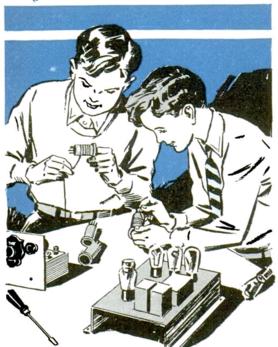
80 years ago, this dad was helping his kids put together crystal sets from the pages of Popular Mechanics, January 1936.  That issue included plans for two sets that were particularly selective.  The magazine also pointed out that the audio quality of a crystal set was particularly good, despite the requirement for high-impedance headphones.

1936JanPM1The first set, shown here, was a fairly typical design employing a tapped coil and variable condenser.   The second set, shown below, was a simpler set but with an interesting design.  It was built in a hinged box with a honeycomb coil inside the box, with another in the lid.  To tune the set, it was placed on end, and the lid was opened and closed to tune the band.

1936JanPM2

The article noted that either set could be built for a few cents.  The most expensive component was the headphones, which started at 98 cents.

All of the parts, or suitable modern substitutions, for both of these sets are readily available.  For help on tracking them down, you can visit my crystal set parts page.

Click Here For Today’s Ripley’s Believe It Or Not Cartoon


Grain Belt “Talking Scoreboard” circa 1965

GrainBeltRadio

A few weeks ago, someone posted an interesting photo on the Old Minneapolis page on Facebook.   That page is one of the best on Facebook, as every day it includes more fascinating photos.  The most interesting photos are invariably of subjects that were mundane when the photo was taken.  But with the passage of years, these mundane scenes are the most fascinating. Sometimes, the story behind the photo is included. Other times, the viewer is left to wonder what was going on in the picture and why it was taken.

The photo was of the interior of a North Minneapolis bar, and was apparently taken in 1965. One eagle-eyed netizen noticed behind the bartender a most interesting radio, the Grain Belt Talking Scoreboard, like the one shown at the top of this page. The set measures about 18 inches wide, and consists of a scoreboard brightly backlit with two old style Christmas tree bulbs, on which the bartender could write in the score for each inning with a grease pencil. Inside the case is a radio for pulling in the game for the benefit of the patrons.

The radio itself is a typical “All American Five” (AA5) superhet, using a miniature tube complement consisting of a 50C5, 12AV6, 12BA6, 12BE6, and 35W4. The front panel controls consist of the volume control and tuning capacitor.

IMG_0023aA sticker on the back identifies the device as a Talking Scoreboard, and admonishes that “this electronic advertising sign is the property of the Minneapolis Brewing Co. and is loaned with the understanding that it will be prominently displayed.” There’s no indication of who manufactured the set, although from the tube lineup and other parts, it appears to have been manufactured in the late 1950’s or early 1960’s. At first I didn’t see them, but the set does have the triangular CONELRAD markings at 640 and 1240 on the tuning dial, as are visible on the closeup here, This places the date of the set’s manufacture at pre-1963 when CONELRAD ended.  A likely date for the set would be 1961, when the Twins came to town.  However, the set is generic in that it’s not marked with the name of any team.  Since Grain Belt was sold in other Midwestern states, it’s likely that it found use in taverns with loyalties to other teams.  And apparently another version of the set was available with a football scorecard.  You can find more discussion of the set at the antiqueradios.com forum.

The set shown at the top of this page is owned by Chris Manuel of Brookfield, Wisconsin, who graciously gave me permission to use the photo. He reports that the loopstick antenna makes the set more directional than is common for AA5’s, most of which used a larger loop mounted at the back of the set. But presumably, the radio only had to tune one station, namely the one broadcasting the game. So once it was set in a suitable spot, the directional antenna wouldn’t be much of a hindrance.  Perhaps the directional antenna even proved useful on occasion for nulling out a noisy neon sign.

Click Here For Today’s Ripley’s Believe It Or Not Cartoon


1976 Bicentennial Call Signs

BicentennialCalls

Today marks the 40th anniversary of the first use in the United States as the letter “A” for the first letter of Amateur Radio call signs. While the block AAA-ALZ had been assigned for decades to the United States, they had never been used for civilian call signs until January 1, 1976.

In honor of the U.S. Bicentennial, the FCC authorized U.S. amateurs to use special prefixes, starting at the stroke of midnight eastern time. At that point, since I was WB0MEB, I was authorized to use the call AB0MEB for the year. I used the special call a handful of times, but old habits die hard, and I signed my normal call most of the time. The chart shown above, from the January 1976 issue of QST, shows the complete assignments. Those of us with 2×3 call signs wound up with slightly shorter (on CW) calls. Those with older calls wound up with longer special calls, since W’s became AC’s, and K’s became AD’s. So the previous owner of my present call could have signed as AC0IS rather than W0IS.

Click Here For Today’s Ripley’s Believe It Or Not Cartoon