1941: Army Surveys U.S. Hams

1941ArmyQuestionaireSeventy five years ago, the U.S. was clearly gearing up quickly for war, and the War Department turned its attention to the communications manpower that the war would entail. As reported here in the February 1941 issue of QST, the Army was sending out a questionnaire to all of the hams listed in the call book.

The War Department made clear that response to the survey in no way constituted “registration” and did not impose any obligation, the Army believed that the statistical knowledge was of utmost importance.

The questionnaire asked for data on code proficiency, military status, education, occupation, and dependents. For those respondents who were not fit physically for military service, it asked whether they would be interested in participation in an aircraft warning net, or whether they would be available for civilian positions as radio operators, instructors, or technicians.

In addition, the survey asked for a brief description of the station.

The ARRL opined that “this seems a needed study and we are confident that amateurs will cooperate and fill out the forms promptly.”


Radio Scouting, 1926

1926FebRadioAge

Shown here in 1926 is Lyman F. Barry, 2OH, the Scoutmaster of Troop 503, Manhattan. In an article in the February 1926 issue of Radio Age, he describes the radio scouting activities of that troop and the equipment used. He first notes that nationwide, 75% of all scouts had radio receiving sets, and that radio had played a role in scouting from the very start. “Away back in 1914 when radio broadcasting was little known, thousands of scouts were studying the scout handbook and wiring up crystal receiving sets and learning the code.”

His aim was to have every scout in the troop in radio communication with the troop, in a system totally independent of commercial telephones. The troop headquarters was equipped with a CW transmitter capable of reaching every part of the city, and at least half of the members of the troop already had a receiver. The scouts were currently in the process of revamping those sets to tune down to 176 meters (1705 kHz), the wavelength employed by the troop station.

From 2OH, a daily bulletin was sent out at about 8 words per minute, a speed at which even the new scouts could pick out a few letters. At weekly meetings, the messages were handed in, and points were awarded to scouts copying without mistakes. Scoutmaster Barry noted that if any emergency mobilizations could be communicated via these bulletins.

At least one neighboring troop had installed a transmitter and receiver, and intercommunications with that troop was being carried out.

The troop also had a portable station, consisting of a regenerative receiver with a single WD-12 tube. This station was capable of tuning 50-50,000 meters, and would pull in broadcast stations from 15-20 miles, as well as the troop station.

The troop also regularly monitored time and weather broadcasts from NAA in Arlington, Virginia.

Troop 503 is mentioned again in the June 1928 issue of Boys’ Life, where it reported that it was in direct contact with a troop in Buffalo.  At that time, Troop 503 held the call sign 2AAQ for its portable station.


Carol Bruce, NBC Radio and WKRP


1941CarolBruce

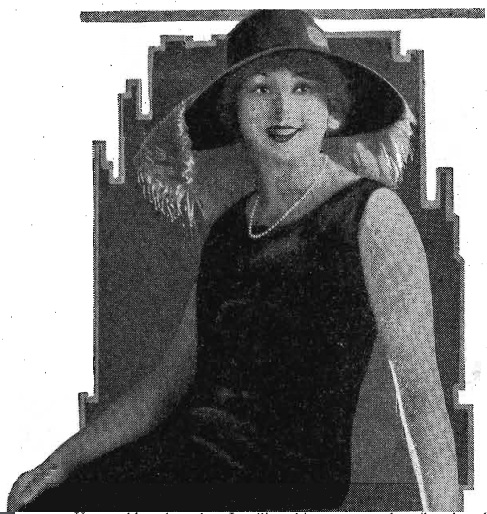
Shown here from the February 1941 issue of Radio Mirror is actress Carol Bruce.  In addition to her film and theater credits, she appeared on the Ben Bernie broadcast on NBC radio.

One of her most famous roles, however, also involved radio.  She played Lilian Carlson, the owner of WKRP in Cincinnatti and the mother of station manager Arthur Carlson.

She died in California in 2007 at the age of 87.


Radio Scouting 1916

1916WirelessAge

Shown here a hundred years ago are Scouts Bruce Clark and Roland D. Cosgrove, 1ON, of 14 Wright Street, Cambridge, Mass.  The photo appeared in the February 1916 issue of Wireless Age, and the caption reveals only that they “were operating a wireless set at the Boston Boy Scout rally.”


Happy Groundhog Day!

GroundhogThe groundhog shown here appeared in National Geographic magazine, May 1918.  As you can see, the groundhog’s shadow is visible, meaning that winter will last another six weeks (despite the visible flowers).

The article explains the phenomenon:

The prominence of the groundhog as a popular figure in the country lore of the Eastern States is shown by his having been given a place with the Saints on the calendar, February 2 being widely known as “Groundhog Day.” It is claimed that on this date the groundhog wakes from his long winter sleep and appears at the mouth of his burrow to look about and survey the weather. If the sun shines so that he can see his shadow, bad weather is indicated and he retires to resume his sleep for another six weeks. Otherwise, the winter is broken and mild weather is predicted. Even on the outskirts of Washington some of the countrymen still appraise the character of the coming spring by the weather on “Groundhog Day.”

To help you celebrate with an appropriate holiday dinner, here’s a link to some ground hog recipes.


1956 Emergency Crystal Set

Feb56PE

In theory, nothing could go wrong using this simple crystal set from 60 years ago, from the February 1956 issue of Popular Electronics.  As the photo makes obvious, it’s a simple crystal set that uses the house wiring as an antenna.  It has no tuned circuit, so it simply pulls in the strongest local station.

The circuit is isolated from the line by a .01 uF disc capacitor. A disc ceramic rarely fails, but one failure mode is a dead short. The article warns “do not omit the blocking capacitor under any circumstances.” It also points out that all of the internal wiring should be taped over or covered with spaghetti tubing. Only one blade of the plug is used, so presumably, even if the capacitor shorts out, there’s no immediate risk of electrocution.

But just to be on the safe side, the article also warns that you should “observe the same precautions in using this crystal receiver as when using the common a.c./d.c. household table radio. Don’t hold it while standing on damp basement floors, handling water faucets or gas stoves, or when taking a bath.”

Of course, if you’re using this set in an emergency when the power is out, I guess you’re OK.  But you still want to observe all of these precautions, because eventually the power will be back on.


Stewart-Warner Concert Grand Radio-Phono, 1941

101341MilwSentinel

Seventy-five years ago today, this high-quality radio-phono was under a hundred dollars (with trade in of your old radio), at Gimbles Department Store in Milwaukee. This add appeared in the January 31, 1941, edition of the Milwaukee Sentinel.

The set came in a deluxe mahogany cabinet, and featured world-wide reception (presumably meaning that it tuned both standard broadcast and shortwave).  The automatic record changer would accomodate up to fourteen records.  It also had a “built-in antenna and ground.”


Ice Age National Scientific Reserve: ARRL National Parks On The Air

The Ice Age Trail Marker at Interstate State Park.

The Ice Age Trail Marker at Interstate State Park.

Today, my kids (shown in the photos) and I did a little bit more exploration of a nearby unit of the National Park Service, for the ARRL National Parks On The Air (NPOTA) event.  There aren’t many actual National Parks within driving distance of the Twin Cities, but there are a number of units that are part of, or affiliated with, the National Park Service.

Another “National Park” Close to Home

I was suprised to learn that one of them was Interstate State Park in Wisconsin, which is one of nine Wisconsin parks included in something called the Ice Age National Scientific Reserve,  an affiliated unit of the National Park Service (NPS).  Therefore, an activation from this park “counts” for NPOTA, and today, I went to check out the possibilities.  The kids had the day off from school and it gave them a chance to get outside.

Pothole

Glacial Pothole at Interstate State Park. National Park Service photo.

The “Ice Age” nomenclature for Interstate State Park is very fitting, because the landscape was carved out by the glaciers.  The portion of the trail we were on today is called Pothole Trail, since it is the site of massive potholes carved into the rock by the combined action of glaciers and the rushing water as they receded.  Over the eons, boulders got captured by whirlpools, where they ground deep potholes into the solid rock.  Because of the snow cover, we didn’t see any today, but there are many examples just across the river in the eponymous Interstate State Park in Minnesota.

Good News for Parents of Fourth Graders

But more importantly, I had a selfish motive for bringing the kids along.  One of my kids is in fourth grade.  Under the National Parks Service Every Kid in a Park program, every fourth grader in the nation is entitled to a free pass to all national parks and other federal sites until August 31.  They can bring with them an unlimited number of children, and up to three adults.  Since Interstate Park has a connection with the National Parks Service, this means that I get in free, as long as I bring my daughter.

This represents a huge savings in money.  The National Parks Service normally charges about $80 for an equivalent pass.  And an annual non-resident vehicle sticker for the Wisconsin State Parks is normally $38.  So the fortuitous circumstance of having a fourth grader in the household will represent a big savings.  We buy a Minnesota State Park sticker every year, but don’t usually buy the $38 sticker for the Badger State.  Therefore, free admission to this Wisconsin State Park is a nice added bonus for the NPS permit.

Confirming a NPOTA “3’fer”

The reason why I wanted to scout out the park is because it offers a unique opportunity to activate three NPS units.  I’ve already operated from the St. Croix Wild and Scenic River, which serves as the park’s boundary.  Therefore, any operation from the park within a hundred feet of the water will count as two units.  But the park also serves as the Western terminus of the Ice Age National Scenic Trail.  Today, I had to confirm that there was a location that would qualify for all three.

The National Scenic Reserve activation requires operation anywhere within the park’s boundaries.  And the River requires operation from within 100 feet of the river.  Operation from the Scenic Trail requires two things.  First, the actual operating location must be within 50 yards of the trail, and must be reached using human power.  In other words, it is not permissible to operate from a vehicle.  Therefore, I had to confirm that there was a location within 50 yards of the trail that is also within 100 yards of the water.  And the photos shown here confirm that there is indeed such a spot.

IceAgeSciReserve

The viewing point just below the trail marker. The frozen river is directly below, as seen in the background.

The first photo at the top of this page is a marker indicating the Western Terminus of the scenic trail.  There’s a parking lot less than a quarter of a mile from this spot, and it’s an easy hike in.  The exact location of this boulder might be slightly more than 100 feet from the water, but the second photo shows an observation area, less than 50 yards from the trail marker, that is directly above the water.  There’s plenty of room for setting up a radio and a small antenna, and I’ll certainly be operating from this spot later this year.

I did talk to the Rangers to make sure they were aware of the NPOTA event.  One of them had already spoken to a local ham who planned to operate from the park some weekend.  They confirmed that there were no problems with operating from the park, as long as hams don’t get in the way of other visitors.  I reassured him that “Leave No Trace” principles were an important part of the NPOTA event.

I only had time to do a bit of operating.  While the kids were sledding in the park (no, not near a cliff over the river), I set up my mobile antenna and called CQ.  Unfortunately, this was at an elevation near the river, and it was a very poor location for RF.  Nonetheless, I did work three stations, one in Texas on 20 meters, and two in Colorado on 30 meters.  Interestingly, one of the stations I worked was also mobile.

Taking Advantage of the Reverse Beacon Network

I suspect that if I had been spotted on the DX cluster, I would have had a big pileup of stations looking for this still relatively rare unit, despite my poor operating location.  I had announced the activation, but I suspect that few would be patient enough to wait for me, since I was unable to predict the exact time of my activation.  However, this experience did highlight one tool that could be very helpful in locating weak NPOTA activations, the Reverse Beacon Network, an amazing system in which numerous receivers are constantly skimming the digital and CW bands looking for stations calling CQ.  As soon as they are heard, they are immediately spotted.

Here’s what the Reverse Beacon Network picked up from me today and made available to anyone who wanted to look for it on the Internet:

RBN

As you can see, I was 19 dB above the noise at at least one location, and copiable at many others.  In light of this experience, I encourage NPOTA chasers (and those operating similar events, such as Summits On The Air) to make use of this resource.  If you know that someone is going to be activating a park you need, but don’t know the exact time or frequency, simply search for that call at ReverseBeacon.net.  Even if you don’t plan to work the station on CW, this resource could be very helpful.  Even if you can’t copy CW, you will get the exact frequency, and you’ll be able to hear them.  When they stop, there’s a good chance that they are moving to phone.  You’ll know how strong a station you’re looking for, and you can tune the phone band looking for them.

As an experiment, I did make a CW CQ on the phone frequency where I was frantically calling CQ.  I was hoping that the Reverse Beacon Network would pick up this call as well.  But as I suspected, it did not.  It appears that the skimmers of the Reverse Beacon Network are scouring only the CW portion of the band.  Therefore, the network can’t be used to self-spot in this manner.

However, even if an activator is planning on working mostly phone, it would be a good practice to work CW or digital first, before QSY’ing to phone.  Even if you don’t make any contacts on CW, it will let others know that you are on the air, and they will know to look for you on phone if you plan to operate there as well.

When conditions for outdoor operation get better, I encourage other activators to take advantage of the “3fer” status of this particular park.  The spot I located was on the “Pothole Trail,” which can be found on the park map.  For mobile activation of only the park, the best location is probably the parking lot of the Ice Age Interpretive Center, which appears to have the highest elevation of any of the parking lots in the park.  It also contains a number of interesting exhibits regarding the nature and geology of the park.  And it’s absolutely free, as long as you have a fourth grader willing to accompany you!


Missionaries Martyred in Ecuador, 1956

Life013056

This month marks the 60th anniversary of the death of five American missionaries in Ecuador, Jim Elliot, Nate Saint, Ed McCully, Peter Fleming, and Roger Youderian. The five were taking part in Operation Auca, an ultimately successful attempt to evangelize the Huaorani, a tribe of about 700 spread out over about 7000 square miles of jungle.

Despite the initial setback, the effort was successful, after the Huarani realized that the Creator, with Whom they were acquainted through His creation, wanted them to abandon their warlike ways.

Sixty years ago today, the incident was featured in a prominent story in the January 30, 1956, issue of Life Magazine, entitled “Go Ye And Preach the Gospel: Five Do and Die,” from which the photo above is taken.

Much of the news of those events came to the attention of the world through HCJB radio.


117L7GT One Tube Transmitters, 1941

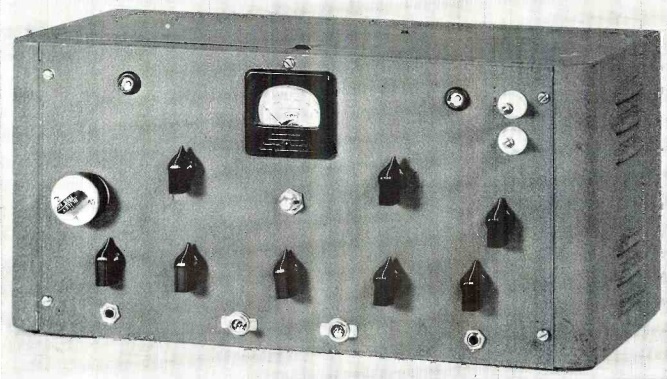
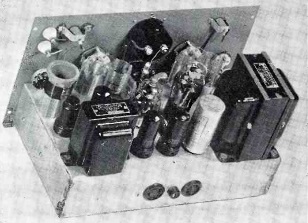
117l7xmtr75 years ago this month, the January 1941 issue of QST contained the plans for two one-tube transmitters, both using the recently introduced 117L7GT tube. The tube was ideal for a simple transmitter, since the filament ran directly off line current, and the envelope contained a rectifier and beam-power tetrode. Thus, the set could operate directly off line current, with no transformer required. The set shown above was made by R.T. Lawrence, W8LCO, of Dayton, Ohio. The schematic below is the similar set made by Keith Hayes, W9ZGD, of Milwaukee, Wisconsin.

117l7xmtr2

Either set could be easily reproduced, with minimal part substitutions, from readily available components.  It should be noted that neither of these transmitters has much in the way of output filtering, so it would probably be necessary to add an output filter to comply with modern regulations.

In his article, W9ZGD reports what many modern QRP’ers have rediscovered:

Although 4 or 5 watts doesn’t sound like much input, it is surprising what one of these little transmitters will do, particularly to one who has never tried anything like it before. Possibley, according to tradition, I should list the stations worked but, since the antenna, receiver and operating ability affect the statistics as much as the transmitter power, I’ll just mention the fact that 5 watts give a signal about one “S” point lower than 20 watts and 2 “S” points lower than 80 watts. And, anyway, it’s more fun to fish with barbless hooks!

The W8LCO QSL card shown here is from the builder of the transmitter shown at the top of the page. The QSL was for a contact a few years earlier, in which he reports running 24 watts input.