National HRO Receiver, 1936

HRO1936

While interestingly not mentioning the name, 80 years ago this month, the January 1936 issue of Popular Mechanics contains a glowing review of the National HRO receiver. It stressed the set’s sensitivity and selectivity, and pointed out that the unique tuning dial represented a dial scale twelve feet long.  Without revealing the manufacturer or model name, the review simply describes the set as a “Short-Wave Receiver DeLuxe.”

The set was reportedly designed by Herbert Hoover, Jr., W6ZH, and Howard Morgan of Western Electric, with the design work done in Hoover’s garage. The set first hit the marked in 1935, with a price tag of $233, not including the speaker and power supply. Band switching was accomplished by changing the coil module below the tuning dial. Each coil came with an individually prepared calibration chart to show frequency, since the dial was simply calibrated between 0 and 500.


1966 Analog Computer

1966JanEI

Fifty years ago, you would probably be the only one on your block with a computer if you built one of these. The January 1966 issue of Electronics Illustrated contains the plans for building this analog computer, suitable for addition, subtraction, multiplication, division, squares, and square roots.

Each dial is calibrated from 0-10, and there is a small ammeter.  For an addition problem, you set the switch to +/-, and adjust the two left knobs to show the numbers you want to add.  Then, you adjust the right knob until the meter is at zero.  Subtraction problems are done in the same fashion, except you set the right knob to the larger number, the middle knob to the smaller number, and the answer is shown on the left knob when the meter reads zero.  A similar procedure is used to do multiplication and division.  In the image shown above, the computer confirms that 5 times 4 does indeed equal 20.

For squares and square roots, a second section of one of the dual potentiometers is used so that both have the same resistance.  That dial shows a number, and the dial on the right shows its square.

The article points out that the device is basically the electronic equivalent of a slide rule (and probably much less accurate).  And like with a slide rule, you were on your own when it came to figuring out where the decimal point went.

I do remember in the elementary school library a book showing a similar contraption, which was wired up only for addition.  Instead of having three potentiometers and a meter used only for zeroing, it had two potentiometers and a meter from which the answer was read.  Despite thinking about how much easier that would make my math homework, that setup was probably much less accurate than the one shown here.

1966JanEI2Shown here are simplified schematics showing the circuit used for addition and multiplication.  The combined wiring diagram showing the switches is, of course, also included in the article.  But the simplified diagrams give a good idea of how the thing works.  Both merely take advantage of Ohm’s law.  R1 and R2 are one tenth the value of R3.  As might be guessed, the parts list calls for linear tapered potentiometers.

Click Here For Today’s Ripley’s Believe It Or Not Cartoon


Cuba-U.S. TV Broadcast Aircraft Relay

1956JanRadioElecSixty years ago this month, the January 1956 issue of Radio Electronics carried this item about a relay of a telecast from Cuba to the United States.  The program, carried by NBC, originated with CMQ in Havana.

Cuba was the first country in Latin America with television, and by 1954, it had a national network, with CMQ as its flagship station.

This 1955 program was relayed from atop a 35-story apartment building in Havana to an aircraft doing figure 8’s halfway between Havana and Miama.  It relayed the program to NBC’s receiving equipment atop the Fontainbleau Hotel in Miami Beach.

For more discussion of the use of aircraft to relay TV signals, see my earlier post about Stratovision.


POTUS to Military: Read The Bible

FDRBible

Imagine the outrage that would ensue if the President of the United States penned the following words, knowing that they would be distributed to most members of the Armed Forces:

To the Armed Forces:

As Commander-in-Chief, I take pleasure in commending the reading of the Bible to all who serve in the armed forces of the United States. Throughout the centuries men of many faiths and diverse origins have found in the Sacred Book words of wisdom, counsel and inspiration. It is a fountain of strength and now, as always, an aid in attaining the highest aspirations of the human soul.

But on this day 75 years ago, the Commander in Chief did exactly that.  This personal message by FDR was included in a pocket Gideon Bible (New Testament, Psalms, and Proverbs) distributed to military members.  And apparently no outrage ensued.


National Parks On The Air: Saint Croix Boom Site

StCroixJan23A

Installing the antenna.

I rarely get a chance to experience a “pileup” on the radio, but today I was able to.  As I recounted in an earlier post, the ARRL is sponsoring an event called National Parks on The Air in which hams are encouraged to operate from units of the National Park Service and to make contact with those stations.  In addition to the 59 National Parks, this includes other units of the National Park Service.  Two of these are located within a few miles of my house, the Saint Croix National Scenic Riverway and the the Mississippi National River and Recreation Area.  Under the ARRL rules, as long as the station is within 100 feet of one of these rivers, it qualifies.

My assistant operator.

My assistant operator.

A close examination of Google Maps revealed that most of the parking lot of the Saint Croix Boom Site near Stillwater is within 100 feet of the river.  In addition, it’s at a high location above the river, which is better suited for radio transmissions.  And until today, nobody had activated this unit.  So this afternoon, along with my daughter, I set out for this location.  As with my previous activation, my station consisted of my Yaesu FT-817into a Hamstick mobile antenna mounted with a trunk mount.  The antenna, about six feet long, is shown in the photo at the top of this page.

Today, I operated for only about a half hour, but was almost immediately confronted with a pileup.  In just over thirty minutes, I worked 36 contacts:

StCroixLOTW
Since I was on 20 meters, I had few, if any, contacts within a few hundred miles.  On that band, those close-in contacts are within the “skip zone,” meaning that the signals are reflected by the ionosphere only much further distances.  I believe my closest contact was Colorado, but I had contacts with locations such as California, Alberta, and New Hampshire.  The amazing thing is that I was using only five watts of power.  I was getting the power from the car (which I kept running for heat), but I could have just as easily made all of those contacts with the radio’s internal 8 AA batteries.  And my antenna, only about five feet long, is grossly inefficient.  In addition, as you can see from the photo, it was partially blocked by the car itself.  But it goes to show that if hams really want to make the contact, they’ll listen for the weak ones.

Google Street View of my operating location.

Google Street View of my operating location.

Living in the city, it’s easy to forget how close some of the natural wonders of the area really are.  and Saint Croix National Scenic Riverway includes a lot of gems.  In addition to the National Park facilities, at least four Minnesota State Parks border the river:  William O’Brien Interstate, Wild River, and St. Croix.  I’ve already identified several sites in their campgrounds that are within a hundred feet of the water, and I will almost certainly make more activations later in the year from one of these spots.

The site from which I was operating today is the Saint Croix Boom Site, which is just north of Stillwater on Highway 95.  In fact, downtown Stillwater is visible as you look down the river.  But as you look upstream and at the Wisconsin side, it’s clear that you’re at the beginning of the wilderness.

The historic marker at this site commemorates the St. Croix Boom Company, which was chartered by the Minnesota Legislature in 1851.  The St. Croix River Valley was a major logging area, and the loggers floated the logs down the river to mills.  Each logging company’s harvest was marked with a timber mark, and the St. Croix Boom Company was granted its charter to collect all logs and deliver them to their owners.  At the location where I operated today, the company operated a series of “booms”–logs chained across the river, to catch the lumber as it floated downstream.  Workers gathered logs and formed logs of each company into rafts, which were steered downstream to the correct mill, some as far south as St. Louis.  In exchange, the company was granted the right to charge 40 cents per thousand board feet.  The photo below shows the Boom Site in operation in about 1886.

Minnesota Historical Society photo, via Wikipedia.

Today, the site consists of three stops on Highway 95.  In addition to the historical marker from which I operated today, there is a stairway leading down to the river, a modern rest area just to the north, and a public access boat launch just to the south.  The site also marks the transition between the federal and state zones of the river.  Upstream to the north, the river is under the jurisdiction of the National Park Service.  Downstream to the south, the river is still designated as the  Saint Croix National Scenic Riverway, but is under the jurisdiction of the Minnesota and Wisconsin Departments of Natural Resources.


The Regenerative Receiver Turns 100

1916Regen

True to our name here at OneTubeRadio.com, we frequently feature one tube radios.  And more often than not, they are regenerative receivers.  The regenerative receiver was popular in the early days of radio because it could deliver so much performance out of a simple circuit.  The single tube, in addition to serving as the detector, had some of its output fed back into the tube to amplify.  If there was too much feedback, the receiver would break into oscillation, which would result in a squealing sound from the headphones, as well as those of other nearby receivers.  The anti-squeal campaign featured in an earlier post showed how this could be the bane of other local listeners.  But this oscillation also allowed the reception of CW (and later SSB) signals by simple receivers.

As far as I can tell, the regenerative receiver was first introduced to the public a hundred years ago this month in an article in the January 1916 issue of Electrical Experimenter.

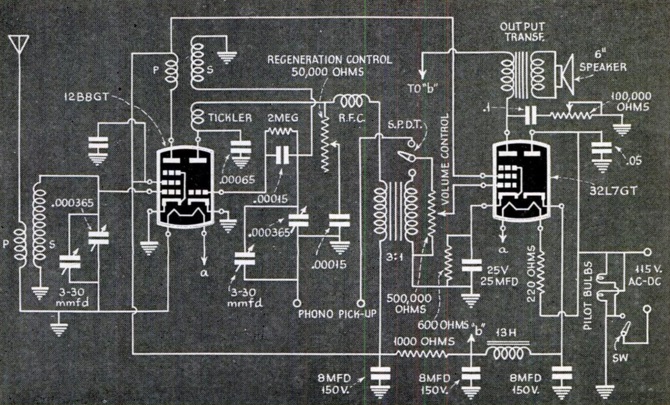
An article by Frank J. Collins entitled “Regenerating Audion Circuits for Wireless Receiving” includes the circuit diagram shown above. If the circuit looks familiar, it’s because it’s the same circuit, with minor variations, used in most of the one tube radios shown on this site.

The details given in the article are for the construction of a longwave version of the set. “As most of the high-power transatlantic and transpacific stations use wave lengths of from 5000 to 10,000 meters [30 to 60 kHz], dimensions are given to cover these wave lengths only.” The author reports that with an aerial 500 feet long at least 10 feet above ground, reception of strong stations 2000-4000 miles away was possible, day or night, but that the set would work well with an antenna of 100 feet.

Drawing from Armstrong patent.

Drawing from Armstrong patent.

While this seems to be the first popular construction article showing how to make a regenerative receiver, it was a couple of years old by the time this article was written. It was invented by Edwin Armstrong in 1912 and patented in 1914 (US Patent 1113149).

The article warns that “while the coils described herein may be constructed by experimenters, they are not permitted to sell them to others for the purposes described, as the invention is patented.”

The author concludes by noting that “this type of apparatus and connections are well worth constructing and using, as it constitutes the most advanced means known at the present time in the reception of both damped and undamped radio signals.”

Because of the relative simplicity of the circuit, a regenerative receiver is an ideal project even today.  I have featured numerous examples in this site, most of which can be easily constructed using the vintage plans, although some parts require a bit of creativity to replace with modern equivalents.  Sets designed for the AM broadcast band will give immediate gratification, since there’s guaranteed to be something that can be tuned in immediately after making the last connection.  Shortwave sets are surprisingly good performers, and will pull in signals from around the world with little difficulty.


For those wishing to bypass the parts procurement process, a number of good kits are available.  For example, the kit shown in the illustration here is available at Amazon at a reasonable price. It’s a two-tube set that tunes both standard AM and shortwave.  For those who don’t mind substituting modern transistors for the tubes, QRPkits.com puts out an excellent kit, the Scout Regen Receiver, It tunes only shortwave, but covers enough territory to almost ensure that you’ll be able to tune in something interesting, day or night.  At night, the dial will be packed with amateur, commercial, and shortwave broadcast signals from around the world.

My son and I put together the Scout Regen a few years ago, and it is an excellent performer for such a simple design.  One that appears to have similar performance, but probably a bit easier to put together because of its wide-open layout, is the Ozark Patrol receiver designed by David Cripe, NM0S and distributed by the Four State QRP Group.  If you build any of these, you’ll have a very sensitive receiver capable of pulling in many interesting signals, and you’ll also be working with the same circuit employed by experimenters a century ago.


January 23-24, 1916: 100 Degree Temperature Drop at Browning, MT

Modern day Browning, Montana. Wikipedia photo.

Modern day Browning, Montana. Wikipedia photo.

A hundred years ago today, the town of Browning, Montana experienced a 100 degree drop in temperature within 24 hours.  On January 23, the temperature was 44°F, dropping to -56°F the next day as an Arctic cold front slammed through.

The event is recorded in the Guiness Book of World Records as the greatest temperature range in a day.  While this record for temperature drop still stands, the record for greatest change was actually broken in 1972, but not immediately recognized.

NWS Observer Jim Wood at the location of the 1972 record. NOAA photo.

NWS Observer Jim Wood at the location of the 1972 record. NOAA photo.

This record was actually broken on January 14-15, 1972, at Loma, Montana.  National Weather Service cooperative observer Jim Wood recorded a temperature of -54°F at 9:00 AM local time on the 14th, which rose to 49°F by 8:00 local time the next morning, a 103 degree difference.  The dramatic change in temperature was the result of a Chinook wind from a system centered over Wisconsin.  Neither the observer nor the local weather office were aware that a record had been broken, and it was unknown to the National Climate Extremes Committee of NOAA, which had been formed in 1997 to make definitive rulings on weather records.  It was not brought to the committee’s attention until 2002.

Wood, a former member of the Montana Legislature, died in 2013 at the age of 89.


References

Click Here For Today’s Ripley’s Believe It Or Not Cartoon



Boswell Sisters, 1931

1931BoswellSisters

This photograph of the Boswell Sisters appeared 85 years ago in the January 1931 issue of What’s On The Air magazine.  They were then appearing on NBC’s Camel Pleasure Hour originating in San Francisco.

The sisters Martha (1905-58), Connie (later spelled Connee, 1907-76) and Helvetia “Vet” (1911-88) grew up in New Orleans where they studied classical music, but their mother also made sure that they were exposed to the African-American music the city had to offer. They were well known performers in New Orleans in their young teens, and in 1925, they made their first recording. The landed in California in the late 1920’s. After their NBC appearances, they moved to New York, where they had a program on CBS from 1931-33. The sisters were also shortwave pioneers, appearing in 1932 in the first broadcast of “Hello, Europe,” a CBS program beamed to Europe.

They also appeared in a number of films. One of the earliest uses of the phrase “Rock and Roll” was their rendition of a song by that title in the film Transatlantic Merry-Go-Round in 1934, performed here:

Even though they are not well known today, the Boswell Sisters did have a lasting impact on American music. The Andrews Sisters started out as imitators of the Boswell Sisters, and a young Ella Fitzgerald was a great fan and patterned her own singing style after Connie Boswell.

Listen at Amazon


Click Here For Today’s Ripley’s Believe It Or Not Cartoon


ARRL National Parks On The Air

The Ice Age National Scenic Trail at the St. Croix River, by MDuchek at English Wikipedia. Licensed under Public Domain via Commons.

This year marks the 100th Anniversary of the National Park Service (NPS), being established on August 25, 1916.  The national parks actually predate the establishment of the NPS.  For example, the first national park, Yellowstone, was established in 1872.  Prior to 1916, the National Parks and National Monuments were individually managed under the Department of the Interior.   Today, the NPS consists of 483 administrative units, including National Parks, National Monuments, and other historic, cultural, and recreational sites.

To celebrate the anniversary, the American Radio Relay League is sponsoring an operating event known as National Parks On The Air (NPOTA) in which individual hams or groups of hams will operate from one of these 483 locations, and other hams at home will attempt to make contact with them.  So far, the event has been a great success, with about 200 activations of individual parks, and more than 2300 hams making at least one contact with those parks.

For me, the most exciting part of this event is that it allows any ham to take part in a “Field Day” type event at any time during the year.  Field Day is an annual event where hams set up portable stations at remote locations.  These stations can be either simple or elaborate, and it is an extremely popular activity.  But it only takes place once a year.  NPOTA gives an opportunity for hams to engage in the same activity on very short notice.

Every state of the Union has at least one NPS site within its borders.  Minnesota, for example, has Grand Portage National Monument, the Mississippi National River and Recreation Areas, the North Country National Scenic Trail, Pipestone National Monument, the Saint Croix National Scenic Riverway, and Voyageurs National Park.  Two of these, along with one Wisconsin site, the Ice Age National Scenic Trail, are located conveniently to the Twin Cities, allowing an activation with little advance planning.

The two metro-area rivers, the Mississippi and St. Croix, are easy to activate because the NPOTA rules specify that the activating ham must be within 100 feet of the river.  One particularly convenient spot to do this activation (although it leaves something to be desired for radio propagation) is Raspberry Island in St. Paul.  It’s located just across (and partially underneath) the Wabasha bridge from downtown St. Paul, and most of the parking lot is within 100 feet of the river.

Last week, I did a very minimalist activation of this location, and worked 12 stations, running just 5 watts with my Yaesu FT-817into a Hamstick mobile antenna mounted with a trunk mount to the car.  Despite the minimal station, I worked stations as far away as New Hampshire and Utah in less than a half hour, and then drove home in fifteen minutes.
LOTWscreenshotWinter weather precludes many outdoor operations, but even with cold temperatures, operating mobile from a warm car is a fun way to get out and get on the air.  My next such operation will probably be from the Saint Croix Boom Site near Stillwater, where it appears that most of the parking lot is within the required 100 foot distance from the river.

When the weather gets a bit warmer, I’ll probably also do some VHF activations of the Mississippi River from one of the bridges crossing the river between Highway 169 and Hastings, all of which appear to be in the NPS unit.

One NPS unit which I wasn’t even aware existed was the Ice Age National Scenic Trail in Wisconsin.  It starts at the St. Croix River in Interstate State Park in St. Croix Falls, at the point shown above.  Since the trail begins at the river, this spot actually counts for both NPS units.  Under the NPOTA rules, activation of a scenic trail requires that the equipment be brought in by human power, so this one cannot be done mobile, and will probably wait until this summer.  But it requires little advance preparation, it’s less than an hour from home, and I can be on the air working the pileups within a half hour of arriving.

Click Here For Today’s Ripley’s Believe It Or Not Cartoon



American Shortwave Broadcasting, 1941

1946JanPS

Seventy-five years ago, American shortwave broadcasters were clearly gearing up for war, as shown by an article in the January 1941 issue of Popular Science.

The article reports that in 1930, there were only three short-wave stations in Europe, but by 1941, there were at least 40, with more being built all of the time. In particular, the German radio, financed by the government, was pumping out Hitler’s speeches on as many as six transmitters at a time. They were targeting South America in particular, and the Americans wanted to keep up. Two million dollars was being spent on new transmitters, and according to the article, the investment was paying off. America had previously had only two transmitters running 50,000 watts or more, WLWO of Crosely Corporation in Mason, Ohio, and WGEO, owned by GE in Schenectady, N.Y.

New stations coming online included WNBI and WRCA, owned by NBC in Bound Brook, N.J., WCBX in Wayne, N.J., owned by CBS, WCAB and WCAU in Newtown Square, Pa., Westinghouse stations WBOS in Millis, Mass. and WPIT in Saxonburg, Pa., WRUL and WRUW in Scituate, Mass., and GE stations KGEI San Francisco and WGEA South Schenectady, NY.

There were 2.1 million shortwave receivers in South America, and they were a major target for the U.S. signals. NBC reported that in 1936, it reeceived fewer than fifty letters a month from South America, but was then receiving 2500 a month. Most of them were reportedly full of praise and reported their disgust with the propaganda fed by European stations.

For more information on the shortwave broadcast bands during World War II, see some of my previous posts:

Click Here For Today’s Ripley’s Believe It Or Not Cartoon