Kimbark Electric, Chicago, 1945

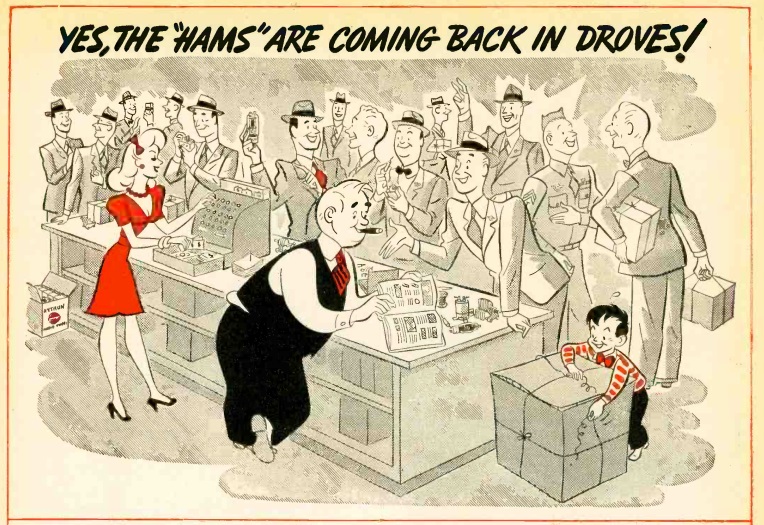
Eighty years ago, there was still a war going on, but people were itching for things to get back to normal. For example, civilian radios were still out of production, but this dealer guessed (correctly, it turns out) that there would be new ones rolling off the assembly line come fall. The picture appears on the cover of the July 1945 issue of Radio Service Dealer, and that issue gives no clues as to exactly where the sign is located.

But with a little bit of detective work, we found the location, and we also determined that the picture shown above was Photoshopped! The sign above reads “This Fall! New Radios.” The magazine doesn’t say where the sign is located. The magazine states only “dealer looks forward.”

But the identical photo appeared in the December 1943 issue of the magazine.  Well, we should say that it was almost identical.  Because the sign really said, “Wanted-Used Radios.”  I bet they still wanted them in 1945, but a graphic artist (if not the dealer) guessed that the end of the shortage was in sight.

The 1943 issue reveals that the shop was Kimbark Electric Appliance Co., 1309 E. 53rd St., Chicago.  The owner was Harold E. Wollenhaupt, who died in 1989.


1925 Portable Radios

A hundred years ago, the July 1925 issue of Talking Machine World carried this ad from RCA showing Radiola models 24 and 26.  These models had performance on par with modern receivers, as they were superheterodynes containing six UV-199 tubes.

Millions of Americans were heading for sea and mountains, and this ad reminded dealers that they were all prospects for a set such as this, if only the dealer took time to sell them on the idea.

They weren’t cheap, however.   They started at $195, which works out to over $3600 in 2025 dollars.  Today, for a tiny fraction of that price, you can get an inexpensive portable which will pull in AM, FM, and weather broadcasts.  (And, of course, don’t forget to buy some extra batteries, which we guarantee will weigh a lot less than the ones this gentleman is using.)


Some links on this site are affiliate links, meaning that this site earns a small commission if you make a purchase after using the link.

1965 Sprage Quig Connectors

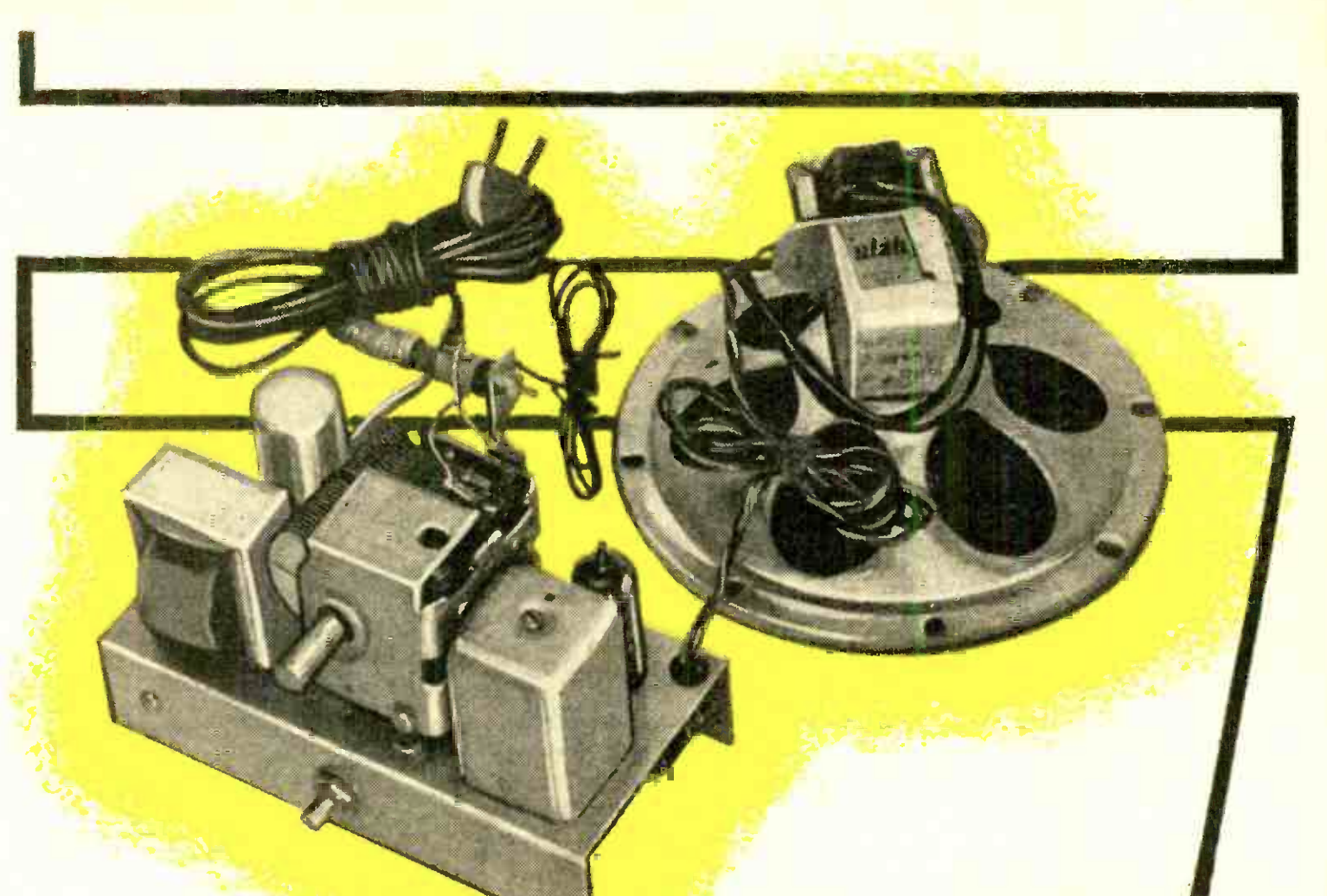
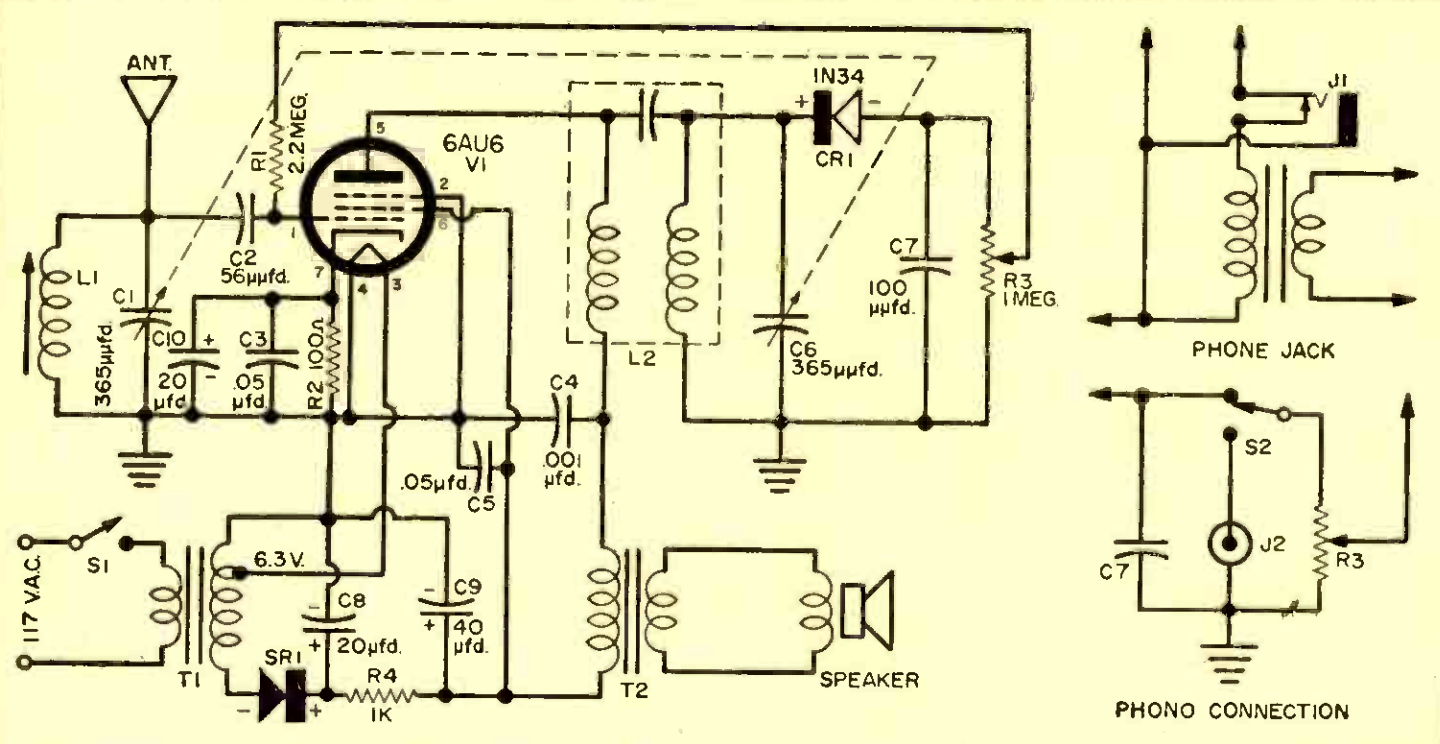
Sixty years ago this month, the July 1965 issue of Electronics Technician carried this ad for a useful product from Sprague Capacitors, the “Quig”. It was for making connections for replacement components in tight spaces. It was essentially a solder-covered spring. When removing the old component, you would leave part of the lead in place, slip the Quig over it, and then slip the new component into the Quig. With one hand, you could hit it with the soldering iron, and be done with the job.

As far as I know, the Quig no longer exists. But for replacing components in old radios, a similar method is employed. You leave a portion of the old lead, and then wind a little spring on the new component. You slip that over the old lead and solder it in place (with two hands).


Easy HF Mobile Antenna

Now that I have my little zBitX transceiver, I’ve been trying it out during POTA activations. For Field Day, I set up a temporary dipole, but it’s always nice to be able to operate right from the car. In the past, I’ve used a trunk mount and a magnetic mount antenna. The trunk mount doesn’t fit very well on my car (a 2014 Dodge Journey), and the magnetic mount is old and in pretty bad shape.

So I stopped at a truck stop on the way home from an activation and bought the mirror mount shown here. It fits (just barely) on the factory roof rack. I did have to make a run to the hardware store to replace the two bolts, as the ones provided weren’t quite long enough.  But it fits snugly and is secure.

As you can see, the coax connection just barely fits.  You do need to connect it before mounting the bracket.  I can use it with any of my Hamstick antennas, and today I tested it on 20 meters.

The mount that I purchased is Amarillo Supply Co. stock number 6163935, which is the store brand of Love’s Truck Stops, and you should be able to find it on the shelf at one of their locations.  Otherwise, it appears to be identical with this one at Amazon.

The purists will note that the rack appears to be made out of plastic, which is non-conductive.  So for a ground, I simply added a “radial” about 16 feet long.  You can see it attached to one of the bolts.  I ran that in the door, and around the molding of the rear door, out of sight.  Inside the car, also out of sight, it then goes to the front door, where it also runs around the molding.  I’ll probably add a couple more radials.

There are undoubtedly better ways to do it, but this provides an adequate ground.  I did another POTA activation today, and you can see that I was picked up on FT8 as far away as Costa Rica and Alaska.  And on CW, my signal was also picked up in the U.S. and Canada, as shown by the bottom map.


Some links on this site are affiliate links, meaning that this site earns a small commission if you make a purchase after using the link.

Hypothetical Invasion of Britain, 1940

Eighty-five years ago today, the July 15, 1940, issue of Life Magazine analyzed a hypothetical invasion of England by the Germans. These images are among the artist’s conception of what the battle, the opposite of the Normandy invasion, might look like.


1940 British Air Raid Shelter Radio

Eighty-five years ago, this British family was taking refuge in their air-raid shelter, and had the luxury of information and entertainment courtesy of their radio. The July 13, 1940, issue of of Practical Wireless gave some pointers on the best way to equip the shelter with radio. The magazine acknowledged that there was no single solution for every case, but the provided food for thought.

One option was to employ a remote speaker with the normal family radio. Somewhat counter-intuitively, it suggested that the best option might be to place the radio in the shelter, and put the speaker in the house. This was because they would have access to the radio while in the shelter, and could change stations if the need arises. And, of course, if the set was turned off, it could be turned on without delay getting to the shelter.

The magazine also discussed the possibility of a portable. Here, it cautioned that if the shelter had a damp environment, it might be best to store the set outside. Finally, it discussed the possibility of using a car radio, particularly if a battery were in place for lighting.


Radio to the Rescue, 1925

A hundred years ago, this young woman experienced a flat tire. But fortunately, she had brought a radio with her, so she was able to keep herself entertained until this gentleman arrived and fixed the tire for her.

The illustration appeared on the cover of Radio in the Home, July 1925, and the artist is Ralph Pallen Coleman.


Homemade QSL Cards, 1940

Eighty-five years ago, the July 1940 issue of Shortwave and Television showed this hint for making homemade QSL cards with a standard penny postcard. You simply cut a stencil with the design. To print one, you placed the stencil over a postcard and held them down with tacks. Then, you used an old toothbrush to apply the ink.


Weather Radios Save Lives!

Watch for Severe Weather While You Sleep.

The recent flooding in Texas should serve as a reminder that everyone should have a weather radio! In most cases, your cell phone provides accurate up-to-date weather information.  But it has limitations, particularly in an emergency.

It appears that many of the Texas victims were caught unaware of rising flood waters.  The flood happened at night, and even though the information was available on the phone, the victims were asleep and not looking at their phones.  In addition (especially at low-lying areas in a river valley), the phone might not have had service.

But a NOAA weather radio would have awakened sleeping victims, and given enough advance warning so that they could go to higher ground.

According to news accounts, the flood waters hit Camp Mystic at about 4:00 AM on July 4.  And according to news accounts, the first NOAA Weather broadcast would have been at 1:18 PM Thursday, when a flood watch was issued by the National Weather Service in San Antonio.  Since this was a watch, I don’t believe that it would have triggered an alarm from a weather radio.  But it would have been broadcast repeatedly during the day on NOAA Weather Radio, so someone tuning in to check the weather would have heard it.

At 11:41 PM, a Flash Flood Warning was issued for Bandera County, and would have set off the loud siren on any weather radio in the area.  That loud siren would have gone off again at 1:14 AM Friday, with a warning for Bandera and Kerr Counties.  This time, the message would have included that there would be “considerable” flooding.  More warnings continued through the morning hours.

If people had a NOAA Weather Radio, they would have been awakened by the loud siren.  (As we’ve reported earlier, add-ons are available to allow deaf people to be awakened by a weather emergency.)

Unlike cell phone coverage, which can sometimes be spotty, the NOAA Weather Radio transmitters blanket most of the nation.  In the map above, white areas have coverage, and only the beige areas lack coverage.  In this case, transmitters in both San Antonio and Kerrville would have provided warnings.  You can find out if you have coverage at this interactive map.

There are three types of weather radios you can buy.  The cheapest option is a radio like this that allows you to listen to the 24 hour weather broadcast.   That can be very handy, but it doesn’t have an alarm, and it won’t wake you up if there’s a warning.

The best option is a weather radio similar to the one shown here, the Midland WR-120B.  If you ever want to hear the weather, you can push the button and you will hear it.  But more importantly, it sits silently until there is a warning.  At that time, it sets off a loud siren that will wake you.  This model has “SAME” encoding, meaning that you can program it in advance to hear warnings only in certain counties.  This is a useful feature, because it  prevents false alarms for warnings from neighboring counties.  But this feature is not essential.  For example, the radio I have does not have SAME encoding.  I find it useful to know what’s going on in neighboring counties.

This radio also runs off household current, meaning that you can just plug it in and forget it.  It does have battery backup in case the power goes out.

Another radio I own is the one shown at the left, the Midland ER-10VP.  It has a weather radio with the alert feature, so it will wake you up in the middle of the night.  It does not have SAME encoding, so you will hear warnings for neighboring counties.  It has a rechargeable battery, which can be charged from a USB charger just like your cell phone, or from solar or hand crank.  The battery power is both an advantage and disadvantage.  It will work even if the power goes out, but you do have to be mindful and keeping the battery charged.  If you are going to use it at home, I would recommend getting a USB charger and keeping it plugged in all the time.

The hand crank and solar charger could be handy in an emergency, since you can listen to the radio more or less indefinitely without external power.  But charging the battery with an external charger is much more convenient for daily use, especially if you use it for the alert feature and want to just plug it in and forget it.

The cost of these radios is so low that everyone should have one.  But this is particularly true if you are responsible for the safety of other people.  So if you are in charge of a school, a summer camp, or any other place where people gather, you really ought to have one of these.


Some links on this site are affiliate links, meaning that this site earns a small commission if you make a purchase after using the link.

Bringing the Car Radio Inside in Britain, 1940

Eighty-five years ago, there were few private automobiles on British roads due to the war. But for those that were still in use, a restriction went into place on June 1, 1940. According to the July 1940 issue of Practical Wireless, as of that date, it was illegal to have any radio apparatus in a motor vehicle after that date. According to the magazine, the order applied to both built-in sets as well as portables. It also applied to the antenna, which had to be removed as well.

Since you had to take the radio inside anyway, the magazine showed this rather self-explanatory diagram of how to hook it up at home. It discussed options such as the best way to keep the battery charged.

As we previously reported, the ban was lifted in 1944, and the magazine showed how to re-install the radio.