I recently acquired the inexpensive radio shown here, a GPX Portable Armband Radio, model number R300S. I bought it at Walmart, and it’s also available at Amazon. It’s a very inexpensive AM-FM radio, but of astonishingly good quality for the price. It measures about 4 by 2 by 1 inches. It has a digital tuner with LCD display, and also features an alarm clock which displays the time when the radio is turned off. The WalMart product description incorrectly states that it has an analog tuning control. Instead, it has plus and minus buttons that you use to tune the digital display up and down the dial. It comes with an armband, although this can be removed to turn it into a nice pocket-sized radio. It does not have a speaker, but has a stereo headphone jack and comes with a set of earbuds.
I didn’t use them, but the radio does have a number of preset memories. I simply used the up-and-down tuning and didn’t bother with the memories.
The Need for a Cheap Receiver
I purchased it from Walmart because I needed it quickly and didn’t have time to order online. My pastor will be traveling to Africa to visit a remote congregation with which we partner. Our denomination also helps sponsor an FM radio station in the closest city. I do not know whether it is possible to receive the signal at “our” church in the remote village. Therefore, I wanted her to do a test to see if it’s possible. If she is able to receive even a weak signal, then it will be an easy matter to send some solar radios and perhaps an external antenna so that they can listen on a regular basis.
Therefore, I had to quickly find a suitable radio that I could send with her. And despite all of the radios I have lying around the house, I didn’t have exactly the right thing. It needed to meet the following criteria:
- It had to be small. I’m sure her suitcase will be packed to the brim, not only with her personal belongings, but with other gifts to leave.
- It had to have digital tuning. The person doing the experiment for me is not a radio expert. To do the experiment, the radio needs to be set to the exact frequency, and then moved around to see if any signal comes up out of the noise. This wouldn’t be possible with an analog dial.
- It had to be relatively cheap.
- It had to be sensitive. I’m unsure of the exact distance, but the station we want to receive is miles away, and only puts out 1 kW. Therefore, it had to be a good tuner. Selectivity probably isn’t important, since there will be few, if any, other FM signals.
I found the GPX R300S at WalMart for about $8. It met the first three criteria, and I hoped against hope that it would meet the fourth. It was in stock at the local WalMart store, so I ordered online and picked it up at the store about an hour later while doing some other shopping.
Surprisingly Good on Both AM and FM
I was pleasantly surprised to discover that this is an extremely good tuner on both AM and FM. I only had time to play with it for a few minutes, but it did pull in all of the local FM stations, even weak ones, with no difficulty. If any commercial receiver is going to pull in the station we want to hear, then this one probably will. If it gets absolutely nothing, then I’m satisfied that a more expensive receiver won’t, at least without a high antenna.
It wasn’t necessary for this particular experiment, but I was also astonished at how good an AM receiver this set is. Unfortunately, in most cheap radios these days, the AM receiver is tossed in as an afterthought (if it’s included at all), and is only able to pick up the strongest local stations. I did the test at night, and was astonished to see that the radio was pulling in something on almost every 10 kHz channel. I was able to positively ID WSM Nashville and KFAB Omaha from my Minnesota location. Those stations are obviously powerhouses, but in my experience, most cheap AM receivers these days are not able to pull them in. The internal AM antenna was very directional, and I was able to easily null out signals by turning the radio.
Selectivity was also remarkably good for such an inexpensive set. Local 50 kilowatt blowtorch WCCO is on 830 kHz, and on many cheap radios spills over onto the adjacent channel. But I was able to hear another station faintly on 840, with no sign of interference from WCCO.
Has 100 kHz Tuning Steps on FM, But Only 10 kHz Steps on AM
The station we want to hear in Africa is on FM, so the AM performance wasn’t necessary for my test. But it was amazing how well it worked on that band. Unfortunately, the radio tunes only in 10 kHz steps, covering the AM band in the Americas, where all stations’ frequencies end in zero. Unfortunately, in the Eastern Hemisphere, stations are 9 kHz apart. Some frequencies are used in common, e.g., 540, 630, 720, etc. And some stations will be off by only 1 kHz, e.g., 549, 621, 639, etc. But some stations will be off by as much as 5 kHz, e.g., 585, 675, etc., and will be very difficult to tune. This is one case where an analog tuner would be better. I suspect it’s probably possible to modify this receiver to tune in 9 kHz steps. After all, they probably sell a similar version elsewhere in the world. But the instruction manual didn’t hint at any method of doing this.
The station we need to tune in happens to be on a frequency that is also used in the Americas. In other words, it’s on an “odd” frequency following the 200 kHz separation band plan, namely 96.7. Therefore, any North American receiver would have worked. This radio, however, does tune in 100 kHz steps and includes the “even” frequencies, such as 96.8, that are also used in the Eastern Hemisphere. Therefore, it will be able to tune in all local stations.
Usefulness in Rural Africa
I told my pastor to leave the radio as a gift with someone in Africa, since there’s no good reason for the set to make a round trip. If it’s not useful in the village where our partner congregation is located, it will certainly be useful in the city, where there are a number of FM stations, and she’ll have an opportunity to leave it there. The AM stations are more distant, and hopefully the radio will be able to pull at least some of them in at night. I noticed one of them in the nation’s capital was on a frequency ending in zero, so it least it will be able to pick up that one at night. The radio also contains an alarm clock, and I set it to the Eastern Africa time zone.
Unfortunately, it won’t be of much use after the batteries run out. It uses two AAA cells. It’s unlikely that those are available in the village. They almost certainly are available in the city, but I’m not sure at what price. I included two extra sets of batteries, which I assume will allow it to work for a few months of listening an hour or two a day. A solar radio would be much more suitable, and if we send any in the future, that’s what I will use.
Bottom Line
Most of the online reviews are favorable, but a few are not. So it’s possible that quality control is not the greatest, and that some units do not perform as well as mine. But for the low price, it’s certainly worth the risk. For the price, the GPX model R300S Portable Armband Radio is a very solid performer. If you need a cheap radio that still pulls in both AM and FM stations well, this radio is what you need.
Note: Some links on this page are affiliate links, meaning that this site earns a small commission if you make a purchase after clicking on the link.

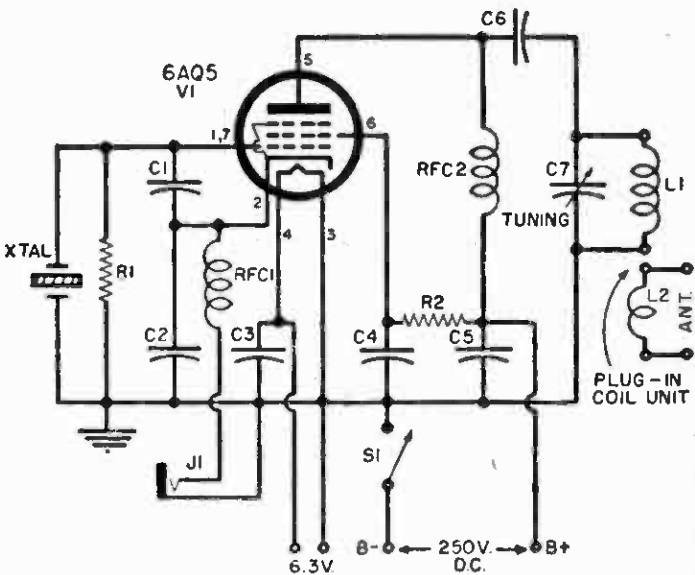
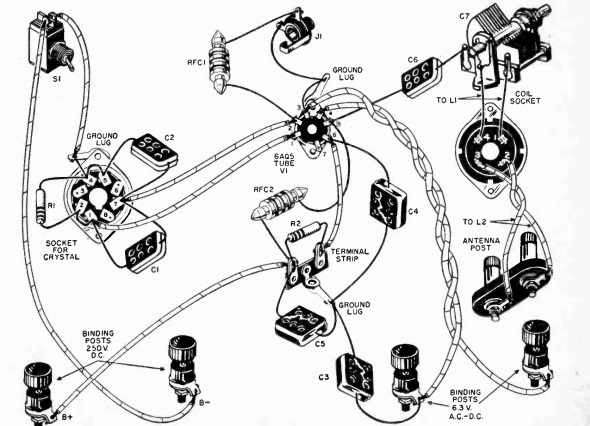
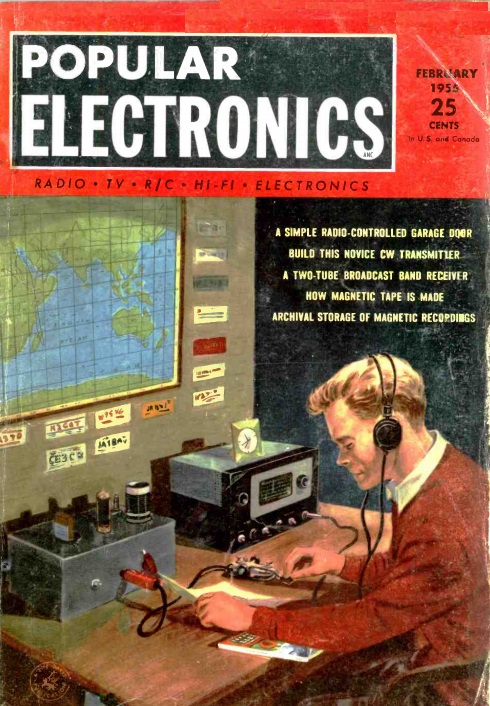 Sixty-five years ago this month, the February 1955 issue of Popular Electronics carried the plans for this CW transmitter especially designed for the Novice. The rig used a single 6AQ5 tube to put out a signal on the 80 or 40 meter bands. Tuning up was accomplished by using a 6 volt bulb attached to a 1-1/4″ loop of wire. This was held near the transmitter’s coil and the rig tuned for maximum brightness.