1940 Bike Radio

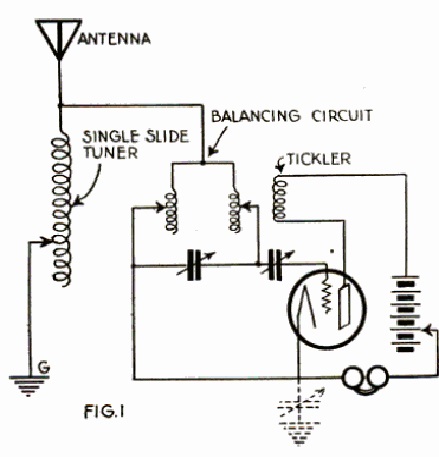
1940AprilPSThere’s a good reason why this young man dressed up to go ride his bike. That’s because its basket contained a four-tube radio capable of providing loudspeaker volume on local broadcast stations.

Because of its nondirectional characteristics, a four-foot rod antenna was used. Grounding was necessary, but an attachment to the bicycle frame provided an excellent counterpoise.

The set featured a DPDT key-lock switch to keep curious onlookers from running down the batteries. The magazine also advised locking the set to the basket or bicycle frame. The set used three 1N5GT tubes as RF amplifier, detector, and the first stage of AF amplification. A 1T5GT served as final AF amplifier to drive the speaker.

The set appeared 80 years ago this month in the April 1940 issue of Popular Science.


Lafayette Sunflex KT-132

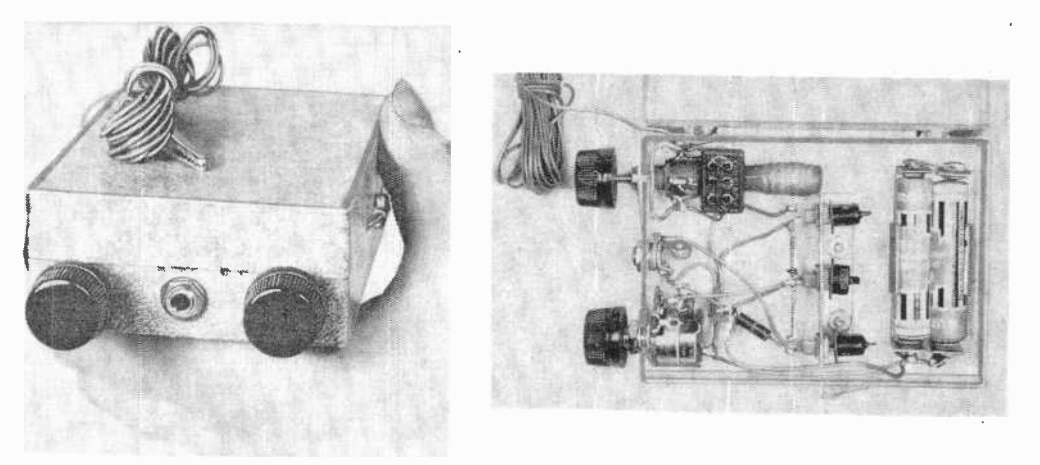
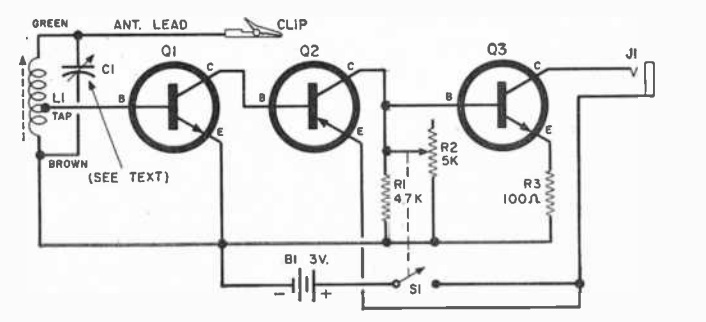
1960AprEI1960AprEI2Sixty years ago this month, the April 1960 issue of Electronics Illustrated carried a review of the Lafayette Sunflex radio kit (model KT-132). It derived its name from the fact that the two transistors did the work of three, thanks to reflexing, and that the set could be powered by the sun, using an optional solar battery. The set was said to be very sensitive, and also ran off two penlite batteries. Power switching was done by plugging the earphone into the appropriate jack–one for the internal battery, and the other for the solar battery.

The kit retailed for $11.95, with the solar battery selling for $7.75.  According to the magazine, the kit took about six hours to put together.


1920 Robbins Telephone

1920AprilBLA hundred years ago, the Scout or “any Real Boy” desiring to set up his own private telephone exchange couldn’t go wrong with these telephone sets from the Robbins Manufacturing Company, 1807 North Central Park Avenue, Chicago. For $2, the company would supply two transmitters, two receivers, and a hundred feet of wire. The sets would work over a much longer distance with ordinary bell wire.

For Real Boys desiring a deluxe setup, two wall phones (suitable for grown ups, too) and 300 feet of wire were available for only $6.

The ad ran a hundred years ago this month in the April 1920 issue of Boys’ Life.


Build a Theremin!

1955AprPE
1955AprPE2This musician-electronic hobbyist, shown on the cover of the April 1955 issue of Popular Electronics is playing the Theremin that he built according to the magazine’s plans. The magazine stressed that the project was not for beginners, but for those with some electronic experience, it was fairly easy to assemble.

Once built, the owner could use the instrument to play music, or to provide background sound effects for amateur theatricals. “A complete show can be produced by combining its abilities to emit both music and sound effects.”

The instrument depended on hand capacitance on the two antennas. The one marked “T” was the tone. The variable capacitance changed the frequency of an RF signal generated by an oscillator. This was mixed with another oscillator to produce a heterodyne which was amplified. The “V” antenna controlled the volume.

Several column inches were devoted to instructions on how to play the instrument, the final one being: “Practice! Practice! Practice! Practice!”  To give an idea of what the instrument sounds like for someone who did practice, here’s what a 1929 Theremin sounds like:

Building the Theremin today with modern solid-state components would probably be simpler, and definitely much cheaper than 65 years ago.  You can buy a Theremin already assembled.  If you just want to experiment with the concept, you can start with this inexpensive kit.


Answer to Yesterday’s Quiz

1970AprSciElecYesterday, we showed this diagram from the April-May 1970 issue of Science & Electronics magazine and asked what current is shown on the ammeter.

The puzzle is easier than it appears, once you see the trick.  The answer is 3 amps.  Despite the confusing diagram, the three resistors are wired in parallel, so the total resistance is 1 ohm.  You can do the math in your head using the “reciprocal of the reciprocals” method.  1/3 + 1/3 + 1/3 = 1, and 1/1 = 1.  To get the current, it’s 3 volts divided by 1 ohm, which equals 3 amps.


Today’s Quiz

1970AprSciElecToday’s quiz appeared 50 years ago this month in the April-May 1970 issue of Science & Electronics magazine. What is the current shown on the ammeter?

This was sent in to the magazine by a reader who was given the question during a job interview for a position as an electronic technician. We’re guessing he didn’t get the job, since he wrote to the magazine to explain it. If you’re also stumped, we’ll have the answer tomorrow.


1940 4-Tube Superhet Portable

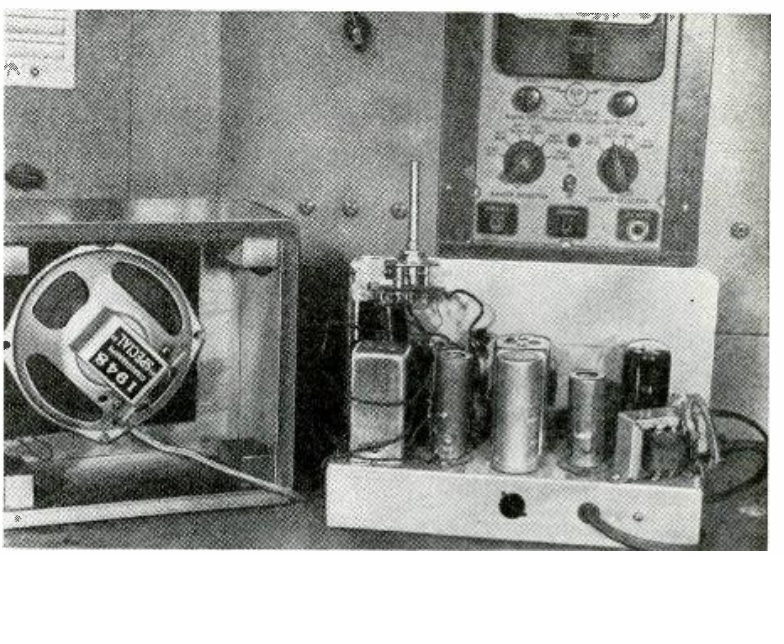
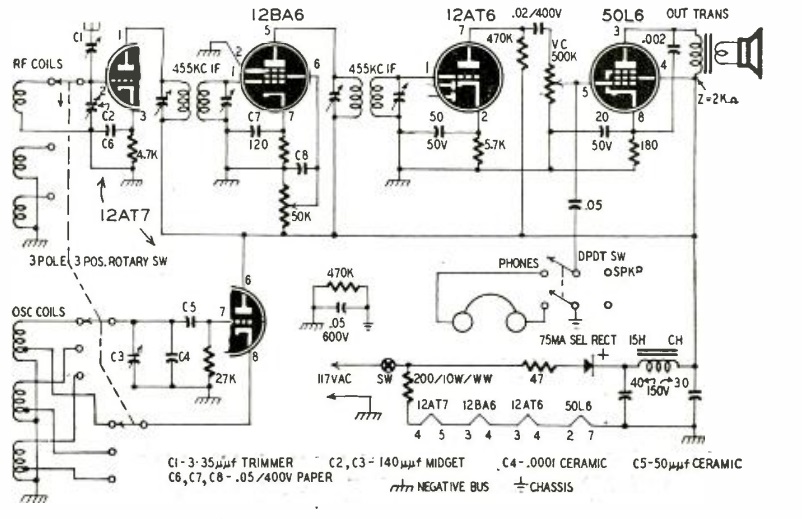
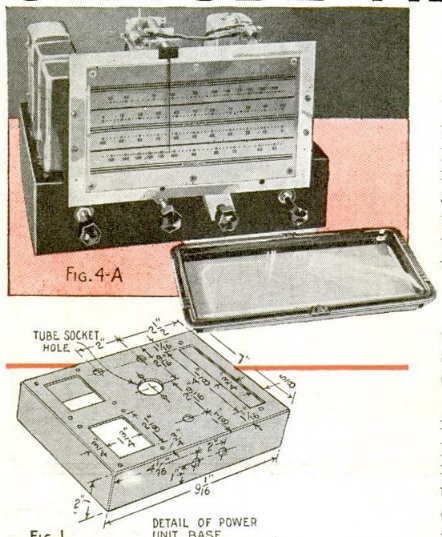
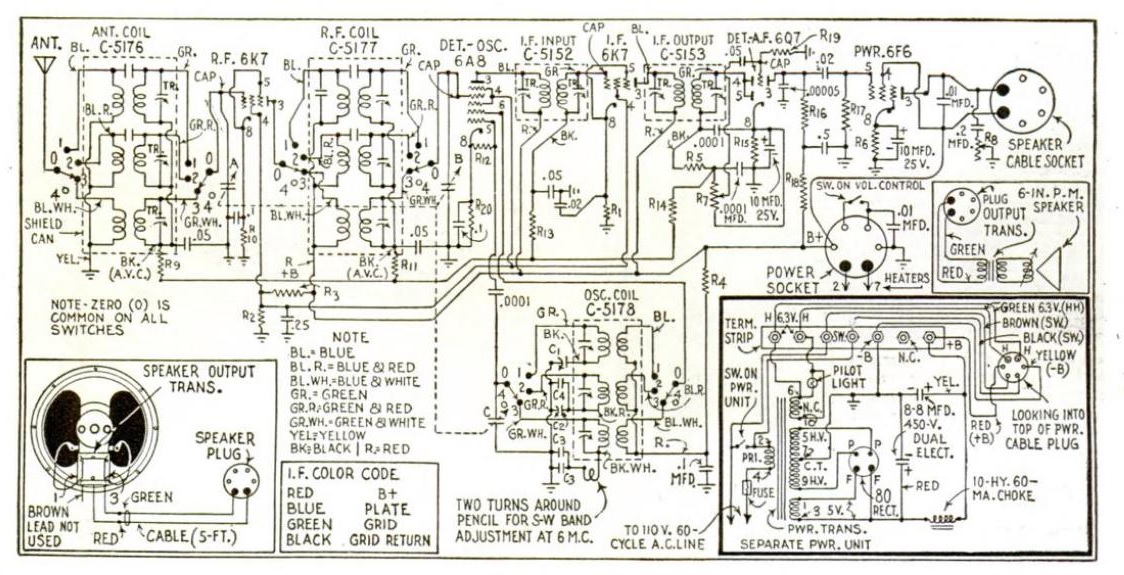
1940AprPM2The plans for this handsome four-tube superhet portable appeared 80 years ago this month in the April, 1940, issue of Popular Mechanics. The set was said to be suitable for anyone with even a little radio construction and wiring experience. It used 1.4 volt tubes and was a highly flexible and portable receiver.

For those without metalworking tools, the chassis was available pre-punched and drilled. A loop antenna meant that no external antenna was necessary for local stations.

1940AprPM1


Larsen E. Enterprises, 1960

LarsenEI’ve never had the opportunity to visit yet, but my bucket list certainly includes a trip to the headquarters of Larsen E. Industries. The company was founded by technical genius Larsen E. Rapp, WIOU, sixty years ago this month. This announcement of the momentous event appeared in the April 1960 issue of QST.

From most browsers, clicking twice on the image will show you an enlarged version.


Science Fair Idea: Eli the Ice Man

1945MarRadioCraftAIf you ask any serious student of electricity to name their favorite ice man, they’ll undoubtedly tell you that it is Eli. Eli the Ice man (a friend of Roy G. Biv) is a mnemonic to help you remember that in an inductive circuit (L), the voltage (E) leads the current (I). And in a capacitive circuit (C), the current (I) leads the voltage (E).

You can prove this concept with this simple experiment shown 75 years ago this month in the March 1945 issue of Radio Craft. In addition to the capacitor and inductor and a few miscellaneous parts, you’ll need a voltmeter and ammeter. During the war, those analog meter movements would have been hard to come by, but these days, you can get buy with two cheap multimeters. Stores sometimes give digital meters away for free, but this experiment will look a lot cooler with an analog meter.

You wire up the circuits and then observe the meter when the current is turned on. In the capacitive circuit, the ammeter will move before the voltmeter. In the inductive circuit, it will be the other way around.


COVID-19: How You Can Help

masksAs I write this from the safety of my home, millions of workers are literally risking their lives to serve their country. The obvious ones include healthcare workers, police officers, firefighters, paramedics, and National Guard members. But just as important are the bus drivers, postal workers, delivery drivers, truckers, grocery store workers, warehouse workers, factory workers, and countless others who are making sure that the public has access to the goods and services needed to sustain life. They are risking infection to serve us, and they deserve our respect and our thanks.

Others, like my wife, a medical interpreter, are able to provide needed services from the safety of their own homes.

And then, there are a lot of people like me, who don’t have any vital services to perform. Many are wondering what they can do to help, and there are a number of opportunities.

masksSewingMy wife and daughter have been busy making surgical masks such as the ones shown above.  They are made according to instructions posted online by one of our local hospital systems (see below).  One of our neighbors supplied some of the materials, picked up the finished masks outside our door, and delivered them to the hospital, where they are being picked up curbside at a designated location.  These masks will be used in less critical situations by staff and patients in order to conserve the N-95 masks that are in dangerously short supply.

I know at least two friends with 3D printers who are making other needed products, such as

Face shields being 3D printed. Courtesy Don Seiford.

Face shields being 3D printed. Courtesy Don Seiford.

face guards.  American factories can’t meet the demand for these lifesaving supplies.  But the millions of Americans who own equipment such as sewing machines and 3D printers can help meet the need until American industry ramps up its production.

Virtually all health care facilities are in need of supplies.  Many will have their own particular requirements, so it’s probably best to contact them first (checking their website first is probably best, so that staff doesn’t have to spend valuable time answering the phone).

Check neighborhood social media sites, such as neighborhood pages on Facebook or NextDoor.  Chances are, some of your neighbors are already working on needed items.  Coordinate with them to share materials.  In addition to hospitals and clinics, items are needed by dentists, nursing homes, assisted living facilities, home health care agencies, and probably many others.  Some of these institutions are non-profit, and some are for profit.  But it doesn’t matter.  They need supplies, and they can’t get them.  They are counting on you.  If you honestly can’t find anyone who needs them, then send me an e-mail, I’ll give you my mailing address.  You can make the masks shown below, send them to me by U.S. Mail, and I’ll make sure they get to a hospital in my area.  But chances are, the need is just as acute in your area.

Do not have direct contact with people outside your own household.  Do not go to a store to buy supplies.  Use the materials that you have at home, or that can be safely delivered by neighbors leaving outside the door.  The idea is to be of service, and you will be of no help if you get infected or infect someone else.  Be part of the solution, and not part of the problem.

Here are some opportunities for you to serve:

1.  Making Surgical Masks

If you have a sewing machine and know how to use it, your skills are desperately needed.  My wife and daughter are making the style shown above, which are destined for Blue Cross Blue Shield and Allina.  More information and complete patterns and instructions can be found at this link:  https://blog.bluecrossmn.com/covid19masks/

North Memorial Hospital in Minneapolis has a different pattern, which you can find at this link:  https://northmemorial.com/covid-19-donations/  North Memorial also has a mailing address shown on this site.  So in the unlikely event that you can’t find someone locally to take the masks, you can mail them.  Do not go inside the post office to mail anything.  You can buy postage online and leave the item for your letter carrier.

Update:  The following website allows you to search by zip code for facilities in your area that need masks and other supplies.  In the unlikely event that you don’t find anyone locally, it also lists facilities that you can mail them to:

https://www.donategoodstuff.org/covid-19-crisis-how-you-can-help.html

The Facebook group mentioned below also contains patterns for an isolation gown.  I don’t know of particular hospitals that are requesting these, but there’s apparently a need.

2.  Help Sewers and/or Donate Materials

Even if you don’t know how to use a sewing machine, others in your neighborhood probably do, and they are probably working.  They also need unskilled help from people like me to cut the fabric to the correct size.  Also, if your household, like many, has a stash of old sewing supplies, it’s very likely that your neighbors need these items to make masks.   A critical shortage in our neighborhood was the elastic.   If you have some in that box of old sewing and crafting supplies, your neighbors probably need it.  The other need is new 100% cotton fabric.

3.  3D Printing

I know that persons with 3D printers and similar equipment are using them to make face shields and other needed medical supplies.

If you are able to help, a Facebook group named “Open Source COVID19 Medical Supplies” has formed and is coordinating these efforts.  I’m aware of the face shield plans at this link:
https://3dverkstan.se/protective-visor/

Prusa Research has the following information regarding face shields at its Facebook page:

4.  Lending Your RV

If you’re an RV’er, it will probably be a while before you’re able to go camping.  Consider lending it to a medical professional who needs to be isolated from their family.  This is being coordinated at this Facebook group:  https://www.facebook.com/groups/rvs4mds/