Making LOUD Crystal Sets: 1945

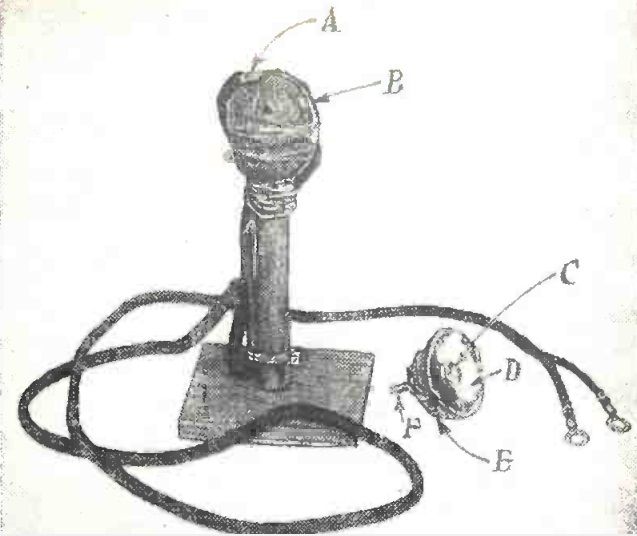
1945SepRadioCraftSeventy-five years ago this month, the September 1945 issue of Radio Craft carried these pointers by Joseph Dante Amorose for making a crystal set that did well. The author had been working on crystal sets for a quarter century, and he reports that this one was “LOUD–louder than any set I have tried in 25 years.” The article is not so much plans for a set, but a discussion of the attributes that made the set pull in the stations so well and so loudly.

While the article hit the newstands after peace had been won, the author noted the value of a crystal set in the time of war in which the article was written: “In this day of scarce electric radios, that should provide something of value; a radio set that stays constantly on the job is a real asset these days.”

He began by noting that the aerial should be at least 150 feet of 14 gauge wire, but 500 feet showed noticeable gain. The antenna led to a loading coil, which the author said must be used to add volume and improve both selectivity and range. He found that 60 turns of number 24 wire on a 3 inch bakelite form worked best.

The ganged condenser not only saved money, since they were cheaper than two separate units, but also added gain since there was coupling between the two capacitors. The article included much discussion of the tuning coils, and then turned to the detector. The author recommended using multiple detectors and using a switch. He noted that the loudest crystal was steel galena. But when there were a lot of local stations, then iron pyrite would provide more selectivity. And for experimentation, a fixed detector should be used. When swapping out components, any change in volume would be very apparent if the detector was not adjustable.

An extremely good ground was required. In the country, the best was the pipe running to the well. In the city, it would be the cold water pipe, and not the steam pipe. He notes that one ground works well, but five are better, and ten isn’t too many.

Finally, he stressed the importance of using the best possible headphones, with a high impedance, and from a good manufacturer. In short, he stressed that you should use the best you can afford.

1946JunPSIt appears that the author copyrighted a booklet entitled “How to build the Amorose loud speaking crystal radio,” and in June 1946, he ran this classified ad in Popular Science to sell some of his writings.


The USPS Delivers!

MailTest1We take unwarranted criticism of the U.S. Postal Service very seriously around here. As we reported previously, the Post Office stood ready to serve the nation even after a nuclear war, and during COVID-19 the men and women of the USPS have acted heroically to ensure that the mail goes through. Even when rioters burnt down two post offices in Minneapolis, the Postal Service quickly regrouped to make sure that its customers would continue to receive mail with minimal interruption.

Recently, for political reasons, the USPS has come under intense criticism, the gist of which being that they can’t do anything right. They were allegedly in the process of ripping out all of their sorting machines, and even removing mailboxes. The particular conspiracy theory was that without these sorting machines, they would be unable to deliver millions of ballots. This didn’t make much sense to us, since most ballots in a given locality would all be addressed to the same city or county election office, and wouldn’t require much sorting, by machine or otherwise.

And allegedly, the removal of mailboxes was to prevent voters from sending their ballots. The theory was that a voter would go to a spot where there used to be a mailbox, would see that the mailbox was gone, and then give up in despair. For the theory to work, the voter would have to be too dumb to look for another mailbox, take it to the nearest post office (where they would find a mailbox in the parking lot), give it to their friendly letter carrier, or just take it to the election office themselves. In short, as conspiracy theories go, it wasn’t very plausible, but a lot of people seemed to subscribe to it.

So as an experiment, I decided to test the United States Postal Service. I asked for volunteers on Facebook and NextDoor. I had them send me their address, and I mailed them an honest-to-goodness piece of snail mail. I had ten volunteers, and I asked them to inform me when they received the letter. I mailed the letters from three different locations. Some I mailed from a blue mailbox in front of a local strip mall (one of the boxes that was allegedly being torn out). Some I mailed from the drive-up mailbox in front of my local post office. And some I placed in my own mailbox, and the friendly letter carrier picked them up with the mail.

A small sampling of my letters is shown above. All ten were delivered in a timely fashion. Most of the transit times included a Sunday, but I included it. All ten of the letters were delivered in four days or less. Crosstown letters were delivered in either one or two days (the two day period included a Sunday). I tracked the average speed of each letter (measured by road miles from the center of the two ZIP codes). The slowest traveled an average speed of 0.16 miles per hour (845 feet per hour). That sounds slow, but keep in mind that I dropped it in a box in the afternoon, and there’s no way it could have arrived any earlier than the next day.

The fastest letter got from Minnesota to Maine at an average speed of 19.6 miles per hour. Remember, this included a Sunday, when it presumably didn’t travel at all. It was undoubtedly in multiple trucks during its trip. In my humble opinion, travelling at that speed for a mere 55 cents is an amazing bargain. Letters to Texas and Washington got similar excellent service. The full results are shown in the table below.

All of my letters were addressed by hand, and as my elementary school teachers would attest, my penmanship isn’t the greatest.  But the post office managed to sort them.  And all of the letters I saw had bar codes printed on them.  These would have been printed on the envelopes by an automatic sorting machine, and they are designed to be read by other automatic sorting machines.  These, of course, are the automatic sorting machines that the USPS allegedly ripped out and put on the scrap heap.  But somehow, my letters all made it through one or more of these allegedly non-existent machines.

In short, the criticism of the USPS is unfounded. As they have done throughout the pandemic, as they have done despite civil unrest, they continue to serve their country proudly.

If you’re wondering about the design on some of the envelopes, I copied the design from a 1944 patriotic cover. (You can see that cover and read more about it at this link.)  Just like they do today, during the war, the Post Office Department made sure that they mail went through. I’m sure there were detractors back then, but someone decided to print up some special envelopes to thank their letter carrier for heroic service.

We ought to do the same today.  If you haven’t done so recently, thank your letter carrier for his or her hard work.  And for the workers behind the scenes, you can invest 55 cents and mail them a thank you card.  Just address it to “Postmaster” and your city, state, and ZIP code.  I’m sure it will get pinned up to the employee bulletin board.  They’ve worked hard to serve you, and they deserve your thanks.

MailTest2


1940 Fish Pole Antenna

1940SepPSWhen this unnamed Hoosier took his girl fishing 80 years ago, we can’t help but believe that she was impressed by her date. Not only did he wear a tie for the occasion, but he demonstrated his ingenuity. He discovered that a steel fishing pole provided good reception when used as an antenna for his car. While the article doesn’t say, we have no doubt that he easily pulled in most of the Chicago stations in South Bend, Indiana, about 90 miles away. But when the couple arrived at the fishing hole, he removed the antenna and used it for its customary purpose as a fishing pole.

The photo appeared in the September 1940 issue of Popular Science, which doesn’t identify the couple, other than to note that he was a South Bend radio and fishing fan. We have no doubt that they had a fish dinner that night.


Postwar Radio Sales Begin

1945SepRadioRetailingSeventy-five years ago this month, the September 1945 issue of Radio Retailing was a thick one–175 pages. It was packed with ads from radio suppliers announcing that new radio would be rolling off the assembly lines for the first time in over three years. There was a pent up demand, and it was going to be a great time to be a radio dealer.

This editorial from that issue of the magazine tells all about the great day that was finally there. It was going to be a prosperous time, as Americans hit the showrooms for radios, appliances, and even television.

From most browsers, you can click on the image above to view it, and then click again for an enlarged version.


Laying Telephone Wire by Airplane

1945SepPMIt looks like Bell Labs was working on this idea toward the end of the war, and it probably wasn’t implemented, at least on a very large scale. But this ad from the September 1945 issue of Popular Mechanics sounds like a good idea for quickly laying lines for military field telephones. Instead of having men do the work on the ground, possibly through enemy territory, an airplane does the job, at a rate of 16 miles in 6 – 2/3 minutes. One end, with a weight and parachute, is dropped to the ground. Then, wire is spooled out continuously.


1940 Portable

1940AugPS3Europe may have been at war 80 years ago, but it was still peacetime in America, and this happy couple was enjoying a radio program while on the go, thanks to this new portable receiver, said to resemble a camera. The manufacturer is not named, but it’s shown in the August 1940 issue of Popular Science.

The set resembled a camera in its outward appearance, and was available with either a carrying strap or handle. It weighed in at 4.5 pounds, and measured 4 by 5 by 8 inches. It employed miniature tubes, and used normal flashlight batteries for the “A” battery. The superheterodyne receiver featured a built-in aerial and dynamic speaker. It also had a connection for headphones for private listening or pulling in distant stations.


2020 Minnesota State Fair

My view of the 2020 Minnesota State Fair Food Parade.

My view of the 2020 Minnesota State Fair Food Parade.

Fairchild.JPGLike many large public events, the 2020 Minnesota State Fair was cancelled due to COVID-19. While we understand the decision, it was very disappointing, since I have attended every Minnesota State Fair since 1971, and most (or possibly all) of them from 1961-69. (I have slowly come to grips with the issues surrounding missing it in 1970. My family had just returned home from a month-long vacation, and even though we were home for the last day of the fair, they deiced not to go.)

The fair had been cancelled in 1945 due to wartime fuel shortages. Even though VJ Day came before the start date, by that point, I assume it was too late to plan it. It was cancelled in 1946 due to another public health emergency, namely, a polio epidemic. And this year, a solid run from 1947-2019 was interrupted by the COVID-19 pandemic.  Since this year would be my 50th consecutive, it was disappointing when the news came down that it had been cancelled.

But even though it wasn’t the same, I still managed to attend twice this year, kind of.  I did my best to keep my streak alive.

The first announcement came a few months ago that the fair’s fine art exhibition would take place as scheduled. Tickets were about $10 per person to get into the art exhibit, but most importantly, it would allow admission to the fairgrounds. Even though we were supposed to “proceed directly” from the outer gate to the art exhibit, we were able to take our time, and at least walk through the fairgrounds one time. Below, I have four  videos that I shot during the visit my kids and I made.  There were people about, but knowing that it was the second day of the fair, the absence of large crowds was eerie.  In the videos, I do my best to narrate the sites visible along Cosgrove Avenue.  If you want the opportunity to get in yourself, there are still a few hundred tickets available, which you can purchase at this link.

At the food parade, stay in your vehicle unless, well, it's urgent.

At the food parade, stay in your vehicle unless, well, it’s urgent.

After the art show was announced, there was another announcement of an opportunity to visit the fairgrounds. They conducted a “food parade,” in which you could enter the fairgrounds by car, and were able to purchase a limited selection of state fair food items from your car, similar to a drive-up window of a restaurant. Tickets to this well publicized event sold out immediately, but we were able to nab one from a neighbor on Nextdoor.

Between the two, my personal preference was the art show. One attraction of the fair is greasy expensive food, and the food parade provided that. But for me, the chance to walk the fairgrounds, even just a portion, made it feel like I’m now allowed to say that I attended for my 50th consecutive year.

I hope you enjoy the videos, and if you decide to go, there are a few hundred tickets left for the art show.  You need to purchase tickets for a specific date and time.  While the food parade is continuing, all of the available tickets were snatched up in minutes.  While they might be available from scalpers at inflated prices, I don’t think they would be worth any premium over the face value.  The art show, on the other hand, gives you the chance to say that you went to the State Fair in 2020, at a reasonable price.  It will be a bittersweet visit, but better than nothing.

You can view some of my previous posts about the Minnesota State Fair at this link.

Part 1:

Part 2:

Part 3:

Part 4:


1945 FM Phono Oscillator

1945AugPM21945AugPM3The woman shown above, in the August 1945 issue of Popular Mechanics, appears to be tuning in a program on her broadcast radio. But looks are deceiving, and the set actually tunes the prewar FM band, which covered 42-49 MHz.  And she’s not listening to a radio station.  Instead, she’s listening to a record being played by the gentleman at left, who is a few feet away.

Phono oscillators which played records over a standard AM broadcast radio were fairly common, but this one played the records over an FM radio. According to the article, no claim was made that the simple circuit would give absolutely perfect reproduction, but results from the Popular Mechanics laboratory were satisfactory. The set was more a challenge to the experimenter to open up the new field of FM radio.

The whole circuit was remarkably compact, and consisted of a 6C5 triode tube along with a few other components. Even with wartime parts shortages, most of the parts could probably be scrounged up fairly easily. The whole circuit mounted right on the tone arm, which was constructed of hardwood.

1945AugPM4


1970 Soviet 8 Transistor Portable

1970AugYoungTechnician2

Fifty years ago, if a young Soviet comrade were ambitious, and perhaps had a better than average access to parts, he or she would be rewarded with this handsome 8 transistor superheterodyne radio that covered longwave, medium wave, and shortwave broadcast bands.

The plans appeared fifty years ago this month in the August 1970 issue of
Юный техник (Young Technician) magazine.

1970AugYoungTechnician

1970AugYoungTechnician3