Marketing Personal Portables: 1940

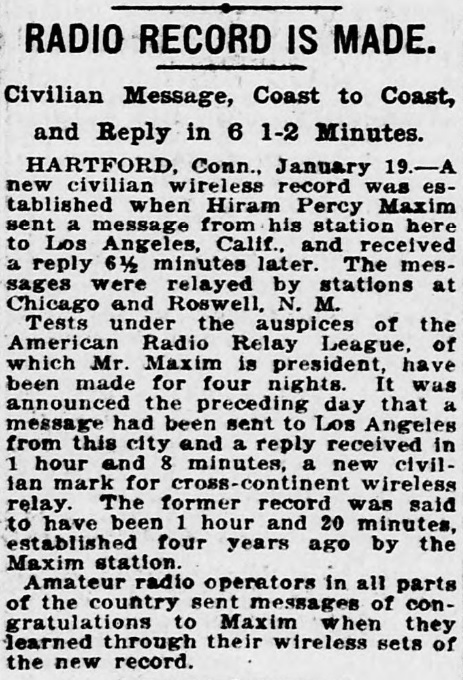
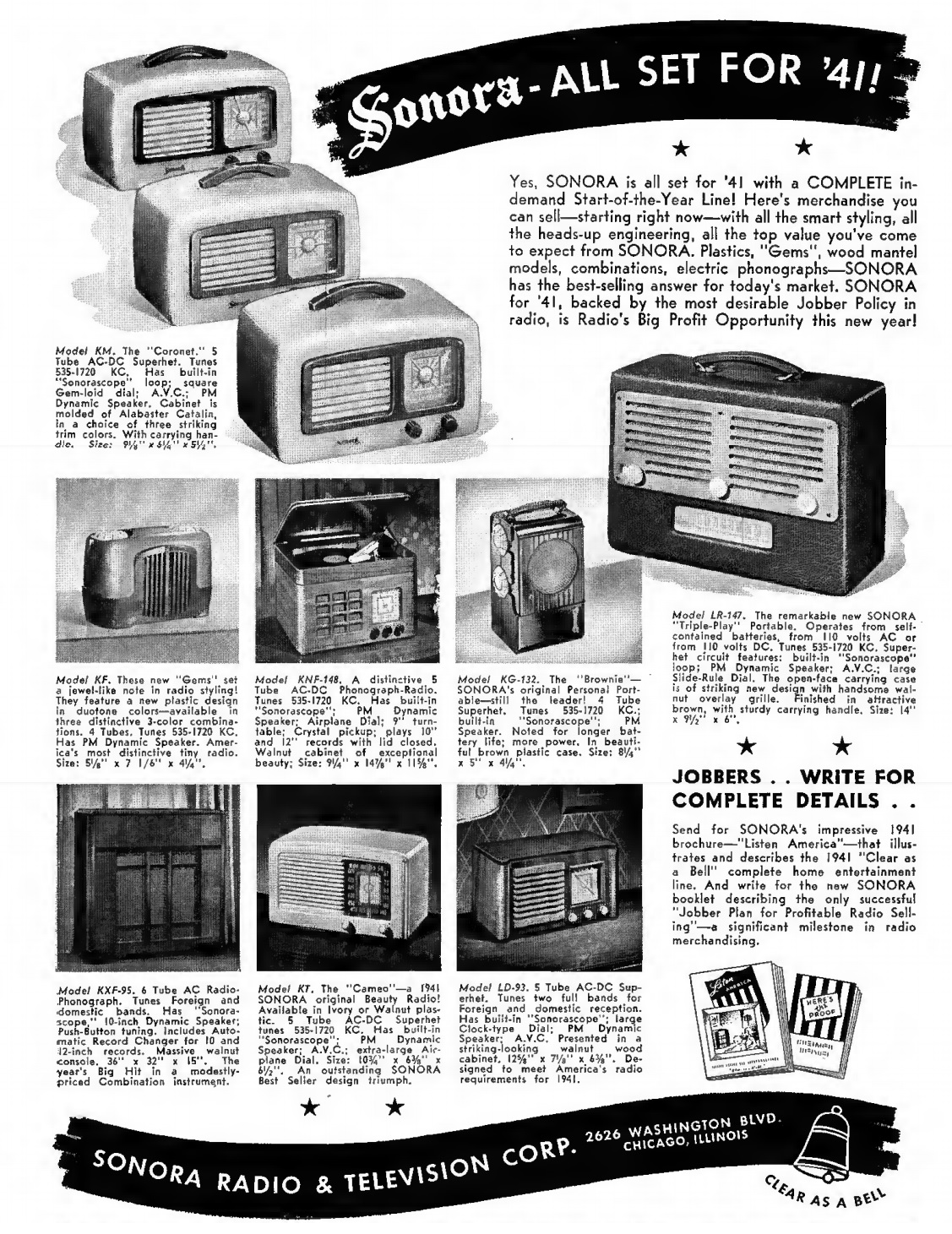
1940DecRadioRetailingEighty years ago this month, according to the December 1940 issue of Radio Retailing, everybody, including Santa Claus, stopped, looked, and listened to the new personal portables that had been hitting the market. When America entered the war, sourcing the required batteries would become an iffy proposition, but in the meantime, the sets were popular.

It’s quite possible that Santa got the idea from having lunch in downtown Denver. According to the magazine, the radio buyer of the Denver Dry Goods Company harnessed the power of “women paid to gossip” to sell the sets. You could put one on layaway for a dollar down and a dollar a week. Then, to drum up excitement, “certain shopgirls were loaned instruments, subsidized to play and talk about them during lunch in the smartest restaurants in town.”

The young women shown below are on their lunch break from their duties at the store at one of the aforementioned smart restaurants. For each sale they referred, they earned a one dollar commission.

1940DecRadioRetailing2

According to the article, twenty radios were sold the first day, and “in this case, it paid to pay women to gossip.”


1940 Two Tube Radio-Phono

1940DecPM1Eighty years ago, Junior was hard at work putting together this inexpensive two-tube receiver, while Dad unobtrusively keeps an eye on the progress. He is holding the construction article (complete with his own picture) as it appeared in the December 1940 issue of Popular Mechanics.

When complete, the set would provide about a watt of loudspeaker volume and pull in the local stations. In addition, it had a phono input for connection to a record player, which could be had for about $6. To accomplish this easily, the set was equipped with two volume controls. When you wanted to listen to records, you simply turned down the radio and turned up the control hooked to the record player.

The tube lineup was 25B8GT serving as RF amplifier and detector, with a 70L7GT as rectifier and AF output. When working as a phonograph, the detector stage of the 25B8GT was pressed into service as an audio driver. The set was said to provide volume sufficient for the average room.

1940DecPMschematic


1970 Grocery Prices

1970Dec1PghPressHere’s a snapshot of what grocery prices looked like 50 years ago today, December 1, 1970, from that day’s issue of the Pittsburgh Press.  This store had just started a practice that is quite common today, namely, posting the unit price of items, rather than having to do the math in the store.

Flour was $1.77 for a 25 pound bag with coupon, or $2.18 without the coupon. Many canned goods, such as beets, green beans, kidney beans, and store brand soup, were 8 for a dollar. Margarine was 5 pounds for a dollar, and 3 pounds of peanut butter was 99 cents.

Saltines were 4 boxes for a dollar, a tuna was three cans for a dollar. Ground beef was 59 cents a pound, and bacon was either 59 cents or 79 cents a pound, depending on brand. You could also get one pound of bacon in a can for only 79 cents. One pound loaves of bread were a quarter.

In the produce aisle, bananas were 8 cents a pound, carrots were a dime a pound, and grapes were 29 cents per pound. A ten pound bag of potatoes would set you back 89 cents. Cans of store brand pop were a dime.

The federal minimum wage was $1.65 at the time, as opposed to the current $7.25 per hour, about 4 times higher. Postage had just gone up to 8 cents, compared to 55 cents today, almost 7 times higher. So depending on how you account for inflation, you would need to multiply these prices by a similar number.  A pound of hamburger cost 59 cents. If you use the cost of postage to track inflation, that works out to about $4 a pound.  Fifty years ago, you had to work just over 3 minutes at the minimum wage to buy an 8 cent banana.  Today, that same amount of work would earn you 40 cents.

From most browsers, you can click on the image above to open it in a new browser, and then click on it again to enlarge.


1920 Cigarette Ad: Ham Contacts Mars

1920Nov30PennsacolaJournal

This ad for Chesterfield cigarettes appeared in a number of papers, including the Pensacola (Florida) Journal, a hundred years ago today, November 30, 1920. The ad copy reads as follows:

Young Hiram Jinks
had tried for weeks
to talk to Mars
by Wireless.

He’d pounded his key,
calling “Mars, Hello, Mars,”
until his right biceps
was the village pride.
He hardly dared to sleep
lest he miss the call,
And say! One evening,
he got an answering buzz,
“yep, this is Mars.”
And Hiram shook all over
and stuttered back in Morse,
“have you any word,
for us on Earth?”

Quick came the answer.
“You can tell the world,
they satisfy!” Then silence.

Hiram ran to the corner store
and shouted in triumph.
“A message from Mars!
You can tell the world.
They Satisfy.”

But the village elders,
merely snorted “shucks
known that for years.”

While out in the army camp,
the radio man,
who’d been kidding Hiram,
threw away his butt
and laughed himself to sleep.


1920 Grocery Prices

1920Jul29GreatFallsHere’s a snapshot of grocery prices a hundred years ago, from the November 29, 1920, issue of the Great Falls (Montana) Daily Tribune.

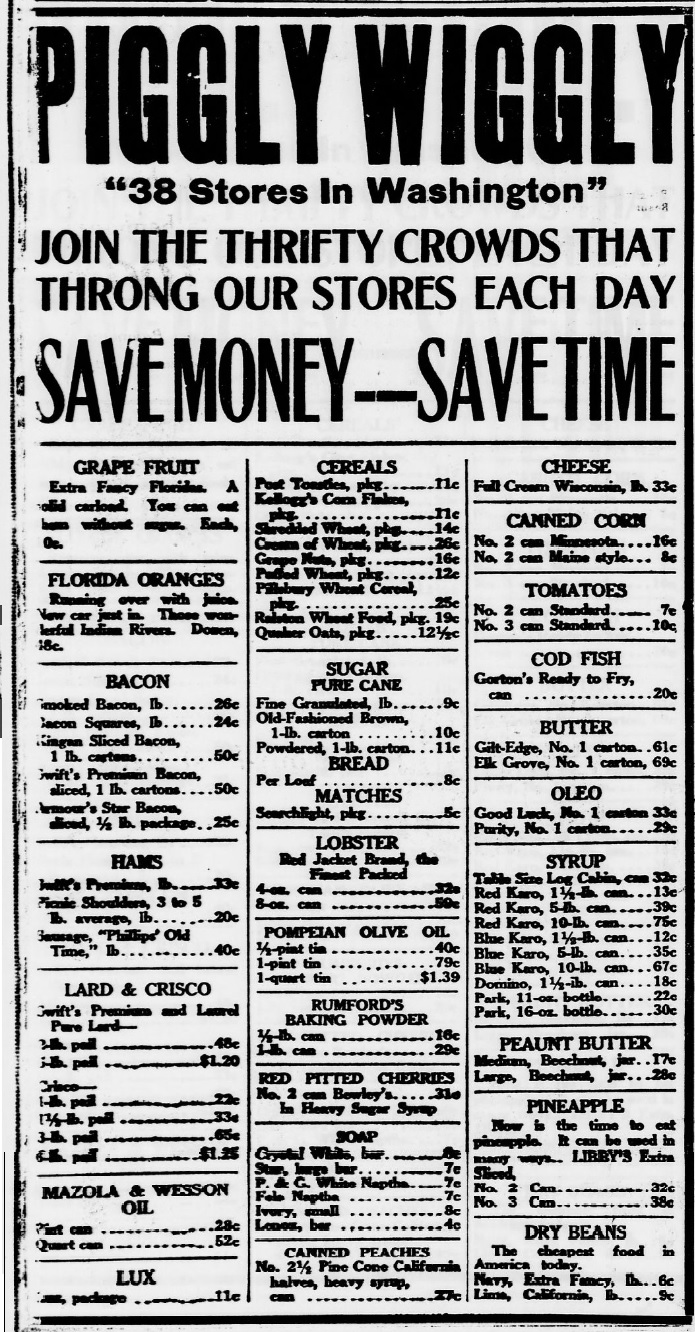
When looking at pre-1964 prices, it’s always good to remember that one dollar meant ten silver dimes, four silver quarters, or one silver dollar, which was one ounce of silver. Today, that ounce of silver would be worth about $22, so one good way to compare prices is to multiply these by 22.

A box of crackers, “N.B.C. Sodas,” which I assume means Nabisco, was 38 cents, which sounds cheap. But when you put that into today’s dollars, it’s $8.36.

10 pounds of lard would set you back $2.50, which works out to about $5 per pound in today’s money. In the cereal aisle, you could get a box of Post Toasties or Kellogg’s Corn Flakes for 12 cents, or Shredded or Puffed Wheat for 14 cents. Thirteen bars of “Palm Olive” soap were a dollar.

Coffee was about 50 cents per pound, or about $11 in today’s money. Cans of milk, presumably condensed, were 25 cents a can.


1940 One Tube Audio Amp

1940NovPM2These young men previously built a one-tube radio, but now they want to enjoy loudspeaker volume. So they are putting together a simple one-tube audio amplifier described in the November 1940 issue of Popular Mechanics.

To get that volume, they 90 volts on the plate of the 1Q5GT tube, whereas the radio probably required only 45 volts. The article describes how they can use two 45 volt batteries, one running the receiver, with an additional one added in series to supply the amplifier. The article noted that the amplifier could also be used with a magnetic phonograph pickup, or a carbon button microphone could be used to make a simple PA system. If the microphone was used, a different transformer was required on the input, and there would need to be 4.5 volts in series with the mike.

As the picture shows, Fahnestock clips were used for quickly hooking up to the input, output, and power connections.

1940NovPM3


Happy Thanksgiving!

1940Nov26PghPress

Happy Thanksgiving from OneTubeRadio.com!

Thanksgiving this year will be different. But perhaps the things we took for granted last year will be things we are thankful for this year. A hundred years ago, a world war and a global pandemic were still vivid memories. And seventy-five years ago, the boys (and a few girls) had either come home or were on their way home, but some never came home.

Today, we offer another snapshot of prices back in the day. These were the prices for a Thanksgiving dinner 80 years ago, in 1940. Europe was at war, and most Americans, if they were honest, knew that they would soon be at war as well. Yet they were thankful, and they bought turkeys, and pumpkin pies, and all the rest. The ad appeared in the Pittsburgh Press 80 years ago today, November 26, 1940.


1945 One Tube Broadcast Set

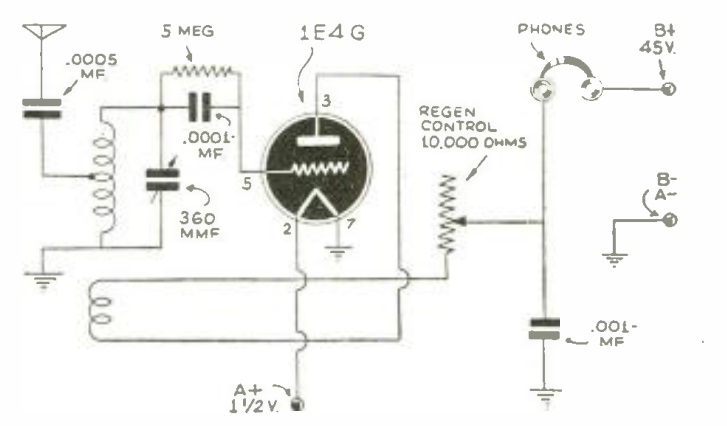
1945NovRadioCraftSeventy-five years ago this month, the November 1945 issue of Radio Craft carried this circuit for a simple one-tube receiver for the broadcast band. The set used either a type 30 or 1G4 tube, with as little as 3 volts B+ on the plate. The circuit had been sent in to the magazine by Bill Buehrle, Jr., of Ferguson, MO, who reported that he was able to pull in a half dozen stations clearly from 25 miles away.

Even though the circuit was published after V-J Day, it’s likely that it was perfected while the War was still in progress with its attendant parts shortages. The author points out that parts weren’t critical. In addition to the tube and headphones, the circuit required only six manufactured parts, two resistors, two fixed capacitors, and two variable capacitors. The coils and the RF choke could be wound at home.

The circuit could be easily duplicated today. The tube is still readily available on eBay. The type 30 and the 1G4 are electrically identical, but my preference would by the 30, since its glass has the classic styling of the 1930’s era bottle, as opposed to the more “modern” octal style 1G4.   It’s such a simple set that it would form the basis for an excellent science fair project. And with only 3 volts involved, it would even be a safe project. The original article contains some suggestions on how the circuit could be modified, so comparing some of these modifications would make the project very worthwhile.  The young scientist needing to track down the parts will find some helpful leads on my crystal set parts page.


1970 Soviet Antenna Ideas

1970NovYoungTechnWhile we’re not able to decipher most of the text, most of these diagrams are self-explanatory. Figure 1 shows a fine longwire running from a mast on the dacha to a convenient tree. Figure 2 shows some details of the insulator, and figure 3 shows how to bring the lead-in inside.

I’m not sure what figure 4 is showing, although the vertical element at the left is labeled as the mast. Figure 5 shows how to make a good ground connection, and figure 6 shows how a knife switch can be used to disconnect the antenna when not in use.

For the young comrade without a dacha, figure 7 shows a slightly dangerous but effective idea. The component is labeled “kondensator”, which is obviously condenser or capacitor. One end is plugged into the receiver’s antenna jack, and the other end goes to the 220 volt AC mains. The same thing was done on this side of the Iron Curtain, such as this 1956 emergency crystal set which used the AC mains as an antenna. As long as the capacitor doesn’t short out, nothing could possibly go wrong!


1960 Grocery Prices

1960Nov21PghPressYesterday, we looked at 1950 grocery prices, and today we move to 1960.  Here’s a snapshot of what grocery prices looked like sixty years ago, with an emphasis on Thanksgiving fixings, from the November 21, 1960 issue of the Pittsburgh Press.

The turkey itself would set you back 39 cents per pound. If you were a non-traditionalist, hams started for about 69 cents per pound.

The cranberry sauce was two cans for 45 cents. If you were going to make your own cranberry sauce, the berries were 19 cents per pound. And if you were making your own pie (which you probably did), the pumpkin was two cans for 39 cents.

Mayonnaise was 69 cents for a quart, and you could get 8 one-pound cans of Van Camp Pork and Beans for a dollar. Jello was 12 boxes for a dollar, and cake mixes were three for a dollar.

In the produce department, oranges were two dozen for 79 cents, and lettuce was 2 for 35 cents.