1925: A Factory Set or Homemade?

One hundred years ago, this family is enjoying a program on their new radio. It was probably a Christmas present, and it was undoubtedly a factory set.

The picture appeared on the cover of Radio In The Home, December 1925, and the magazine carried a feature discussing the relative merits of homemade sets and factory sets. It noted that even five years prior, most radios were of the homemade variety, often wound on an oatmeal canister. But just as America had moved from homemade clothing to store-bought clothes in the prior century, it was decidedly moving toward factory sets. But while the transition in clothing might have taken a couple of generations, it was much faster with radio. While most sets were homemade just a few years earlier, the factory set was decidedly more popular in 1925.

The magazine did note, however:

Of course, there is still another class of home-made set builders besides the amateur and the radio wizard. This group consists of the men to whom a kit of tools and a mess of radio equipment is the finest recreation. It is a matter of almost complete indifference whether the finished set is better, or even quite as good as that which could be bought. The important thing is the pleasure obtained in the building. To such radio construction “fans” (they are really not amateurs because the building, not the experimenting, is the game) we all extend our best wishes, for theirs is both a wholesome and instructive avocation. Most of us, are, however, of another type.

We, that is you and I and our wives, most especially our wives, want a fine cabinet suitable for the living room. Dealers and manufacturers know this. Their displays at the radio shows this winter are centered around such fine cabinet sets.

This is probably true of most of our readers. A kit of tools and a mess of radio equipment is the finest recreation. But we still want that fine cabinet in the living room.


1965 General Electric Radios

Sixty years ago, as today, a Scout is Thrifty, and General Electric provided some advice for Scouts looking to buy a new radio, in the December 1965 issue of Boys’ Life.

The ad pointed out that getting a new radio wasn’t easy, and entailed a lot of saving and waiting. So when you spent all of the money, you wouldn’t want to wind up with one that sounded tinny or burned through batteries. Fortunately, GE made radios that weren’t expensive, and they are shown here.

The Model P1800 Personal Size portable could be had for less than $11 and featured big sound. For those who liked classical music or jazz, the P1820 gave both AM and FM for less than $28.

The C-545 clock radio would put you to sleep and wake you to music. Finally, if you had less than $8 to spend, the P1710 pocket portable had big clear GE sound.


Radio Dancer, 1925

A hundred years ago, this youngster was overjoyed and enthralled by the “radio dancer”, a small toy which was placed on a radio speaker and would dance to the vibrations. The image is the cover of Radio News, December 1925, and the issue contains complete plans for making the toy.

The author of the article is none other than Hugo Gernsback himself. He was the publisher of the magazine and often offered his editorial views. He penned the construction article, and noted that one of his favorite toys as a child was a similar one that danced when placed on top of the piano. Here’s a description of such a toy from an 1881 book:

For Gernsback’s modern 20th century incarnation of the toy, he cautions that for sufficient vibrations, the radio set must have at least three tubes, and there needs to be a strong local station, in order to generate sufficient volume.  He notes that, of course, the dancer won’t work with a crystal set.


1940 Barrage Balloons

Eighty-five years ago this month, the December 1940 issue of Practical Mechanics had this illustration of the barrage balloons that were a familiar sight over London. My mid-1940, about 1400 such balloons had been deployed there and in other British cities. Each was tethered to a truck. They carried a steel cable to make navigation at lower altitudes dangerous or impossible. Enemy bombers were forced to higher altitudes. This made them more vulnerable to anti-aircraft fire, since the relative motion, as seen from the ground, would be much slower than a plane zooming by at ground level.


1955 Arvin Radios

Seventy years ago this month, the December 1955 issue of Boys’ Life carried this ad encouraging boys to drop hints for an Arvin radio for Christmas.  The ad featured the model 952P four-tube portable, the 848T four-tube clock radio, and the “unbreakable”  and economical 840T, available in six sharp colors with, you guessed it, four tubes.


1955 Transistor DX

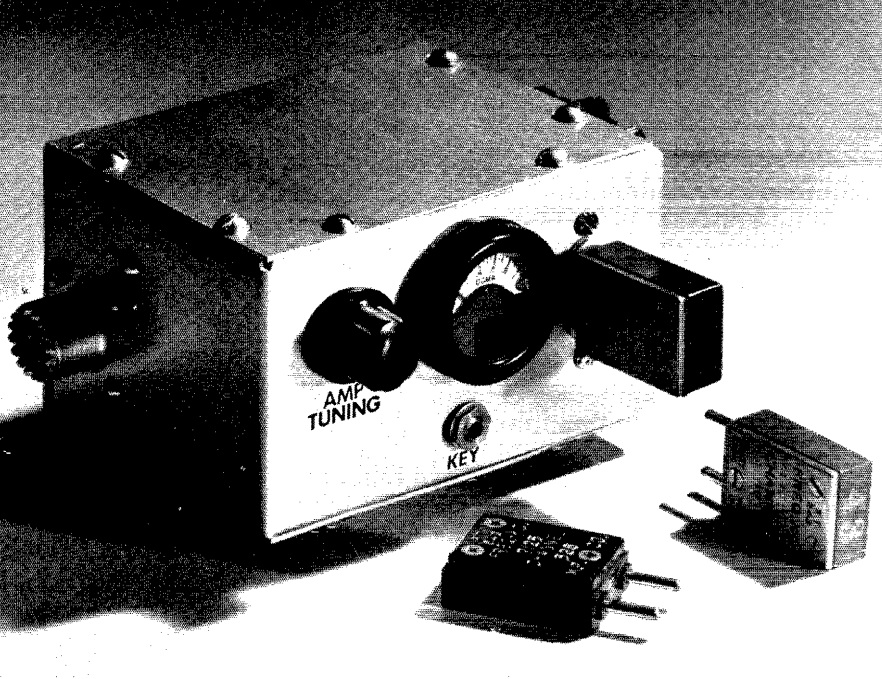
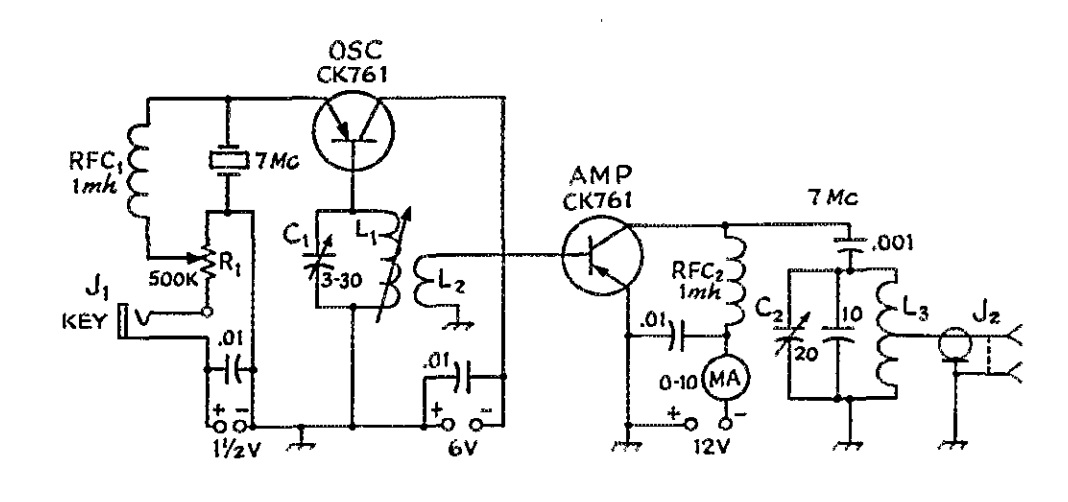
Seventy years ago this month, the December 1955 issue of QST carried this item from Charles Atwater, W2JN, detailing his experience with what we would call today QRPP operation.  He put together a transistorized 80 meter transmitter employing a 2N113 transistor.  His first contact spanned 266 miles with 30 milliwatts, and was copied over 400 miles away.

He later made a two-way QRP contact with W2PEO, who was running 20 milliwatts.

The distance to W2PEO isn’t given, but his first contact with W1QGU was a respectable 8866 miles per watt.  If W2JN sounds familiar, it’s because we featured him previously for his construction of a transmitter in 1928.


1945 General Transformer Corp. Battery Eliminator

Eighty years ago, if you had a battery powered portable radio, you could run it at home on household current for only $15, thanks to this battery eliminator from General Transformer Corp., 1250 W. Van Buren St., Chicago.  That address is now an apartment building overlooking the Eisenhower Expressway.

The ad appeared in the December 1945 issue of Radio Retailing.


Magnavox TRF-5, 1925

If you were looking for a radio in Milwaukee a hundred years ago, this Magnavox TRF-5  would have been a good choice.  As the name implies, it had five tubes.  Apparently, 3 of them were for RF, with the other two for audio amplification to drive the included speaker.

It is shown here in an ad for Gimbels, in the December 5, 1925 issue of the Milwaukee Leader.  The price tag of $89 works out to $1651 in 2025 dollars.


1945 Radio and Toaster Sales

Eighty years ago, this picture appeared on the cover of Radio Retailing, December 1945. I wasn’t quite sure what was going on, so I asked ChatGPT for the back story:

In the winter of 1946, the little shop on Westbury Avenue still smelled faintly of machine oil and warm dust—the scent of radios waking up after a long night. Mr. Harland, the shop’s proprietor, prided himself on being able to fix anything with a dial, but that morning he wasn’t repairing a set. He was demonstrating one.

“This one,” he said, patting the glossy black radio as though it were a fine horse, “has FM. Not many folks know it yet, but FM is the future. Clear as a bell—no static at all on a good day.”

Across from him sat a young woman in a tailored dark suit, gloves folded neatly in her lap. Her name was Margaret Hale. She had just returned from Washington, where she’d been decoding signals for the Navy. The war was over, but she hadn’t quite learned how to live quietly. She felt strange having nothing urgent to listen for.

Her aunt had suggested she buy a new radio. “Something cheerful,” the aunt had said, “to bring a bit of the world back into the house.” So Margaret found herself in Harland’s shop, watching the man beam with pride over the technology he’d been waiting years to see flourish.

He turned a dial, and warm music floated out—strings, a gentle swing rhythm, the kind of melody that wrapped itself around a person’s shoulders. Margaret smiled for the first time in weeks.

“It’s lovely,” she said.

“It is,” Harland agreed. “And next year—television. Mark my words. Pictures through the air. Folks’ll gather around these things like they once did around the piano.”

Margaret imagined it. Scenes unfolding in real time, stories arriving right into one’s home. She wondered what sort of world would rise now that the explosions had quieted. Maybe one with more voices, more connections, more ways to understand one another.

“I’ll take it,” she said.

Harland brightened even further. “Excellent choice. I’ll have it delivered this afternoon.”

As she stood to leave, she paused beside the radio. The music was still playing, light and hopeful. For the first time since the war ended, Margaret felt the faint stirrings of a life with room for ordinary joys—songs in the morning, news in the evening, perhaps even laughter filling the quiet corners of her home.

Outside, the cold wind of January 1946 swept past, but she felt warm. The world was humming again, and she was ready to listen.

I’m pretty sure that’s a toaster, and not an FM radio just to the left. But I can’t quite see what Mr. Harland is fiddling with, so it’s quite possible it’s an FM radio.  But one way or another, the world was humming again.


1940 Motorola Model 61-F Radio-Phono

If you were Christmas shopping for someone in a small apartment 85 years ago, then you really couldn’t go wrong with this radio-phono from Motorola.  The record player was automatic, it had “BIG” reception, and the cabinet was beautiful walnut veneer.  The model number is not stated, but it appears to be a Model 61F (or a slight cabinet variant).

If that small apartment already had a radio but not a record player, then for only $29.95 you could get a fully automatic wireless phonograph (sometimes called a phono oscillator) to listen to your records over the radio.

The ad appeared in Life magazine 85 years ago today, December 2, 1940, and also reminded readers that Motorola had radios designed to fit your car.