Grant’s Department Store Radio Department, 1926

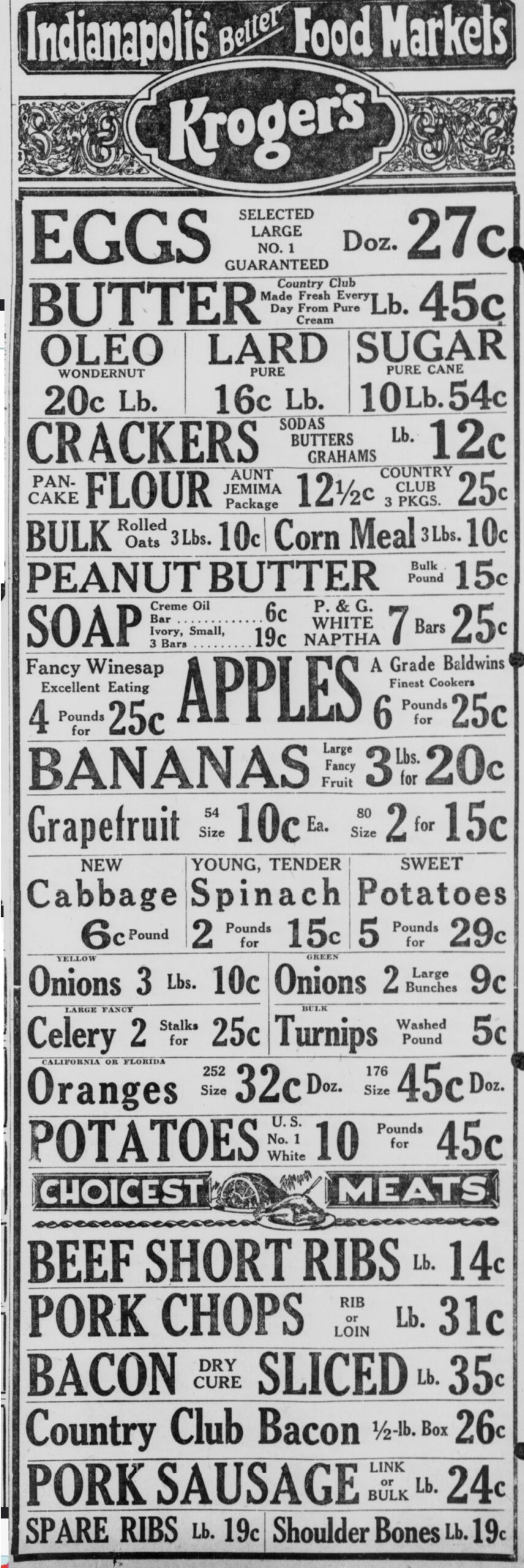
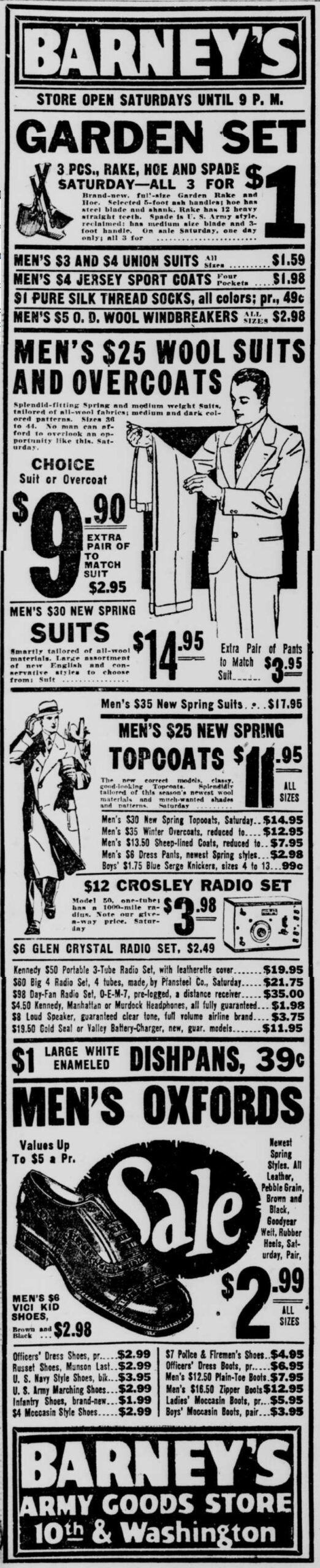
A hundred years ago, if you were in need of radio parts in San Antonio, then you couldn’t go wrong by heading to the Radio Department of Grant’s Department Store, 305-311 East Houston Street, where you could find tubes, B batteries, or even tuning condensers for just a dollar a piece. This ad appeared in the San Antonio (TX) Sun, January 8, 1926.


1926 British “Ultra” Crystal Set

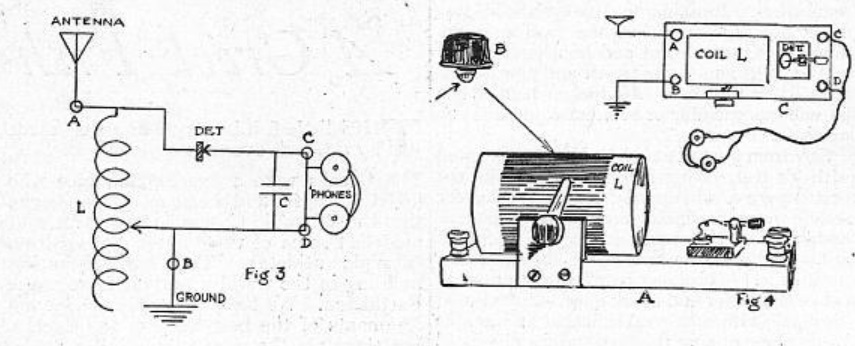
A hundred years ago, the January 1926 issue of theBritish publication Popular Wireless showed how to put together this “ultra” crystal set.  It was designed to  pull in the main BBC broadcast, as well as the then-new transmissions of station  5XX on 187.5 kHz.  That station broadcast from Daventry with high power (then 25 kW), with the idea of blanketing Britain with its signal.

The set was named “ultra” due to the fact that the honeycomb coils were designed such that the primary and secondary would always have their main portions directly next to one another, for maximum signal transfer.


1926 Guarantee Portable Phonograph

If you were a retailer a hundred years ago and wanted to sell portable phonographs, you couldn’t go wrong with this model from the Guarantee Talking Machine Co., 109 North Tenth Street, Philadelphia. Your cost was $11.50, and it retailed for $25. This ad appeared in the January 1926 issue of Talking Machine World.


George Washington Carver National Monument

Replica of the Jessup Wagon used by Carver as a mobile agricultural classroom.

We recently had the pleasure of visiting the George Washington Carver National Monument in Diamond, MO, Carver’s birthplace.  For the Route 66 fans, that’s not far from Joplin, MO.  Since Carver lived until 1943, we had no doubt that radio would play an important part of the exhibits.  And we were not disappointed, as one of the galleries contained the stylized antique radio shown above, which allowed visitors to listen to several radio broadcasts made by the scientist and inventor.  In addition, there were microphones and headphones which visiting students could use to create a similar radio interview.

You can find a sampling of broadcasts by Carver at the Iowa Public Radio website.  At this link, you can listen to the 1939 broadcast of “Strange As It Seems” about Carver, including an interview.

The monument also includes a classroom and laboratory.  The classroom is a non-specific period room, while the lab is modeled after Carver’s laboratory at the Tuskegee Institute.  The Monument is geared up for school field trips.  I noted that there were a number of rules written on the board in the lab, such as “four on the floor.”  One of the rules was the mortar and pestle must stay together, as I’m sure the mortar and pestle would otherwise make interesting toys for the students.

Carver died 83 years ago today, on January 5, 1943.


Inventions Needed: 1956

Seventy years ago, the January 1956 issue of Popular Electronics gave some suggestions on the kinds of things that electronics hobbyists could think about inventing.  The ideas came from the National Inventors Council, a governmental agency tasked with encouraging independent inventors to come up with ideas useful to the government and military.

Shown above is a 3D radar display.  The magazine noted that a “truly three- dimensional display would not only have wide application in military work, but might have wide commercial application in the development of a three -dimensional television system for home use.”  (We should note that Mr. Whoopee didn’t come up with his version until 1963.)

Some of the inventions described in the magazine did come to fruition.  For example, it mentions that the military is in need of a recording method which would cover a huge spectrum, up to 1000 MHz, but that current tape and wire recorders weren’t up to the task.  Today, it’s pretty commonplace for a software-defined receiver (SDR) to have recording capabilities, so that you can play back a huge chunk of spectrum.  Today, your computer has enough capability to do just that.

Similarly, the portable power sources that the military was looking for 70 years ago are probably in your pocket right now, as the battery in your phone meets most of those specifications.

The magazine mentioned that hams could probably come up with a “microwave oscillator, suitable for both continuous – wave and pulsed operation, with an output of 1 kw. or more.”  The idea shown at left did, indeed, come to fruition, and you probably have it installed on both your computer and phone, in the form of some kind of voice-recognition software.  So someone must have come up with that new approach mentioned in the caption.


Keeping Your Store Before Her Eyes: 1946

Eighty years ago, with the War in the rear view mirror, this woman needed a radio, or perhaps a home appliance, and she was calling her friendly local radio dealer, who had the foresight to make sure that she had his number handy.

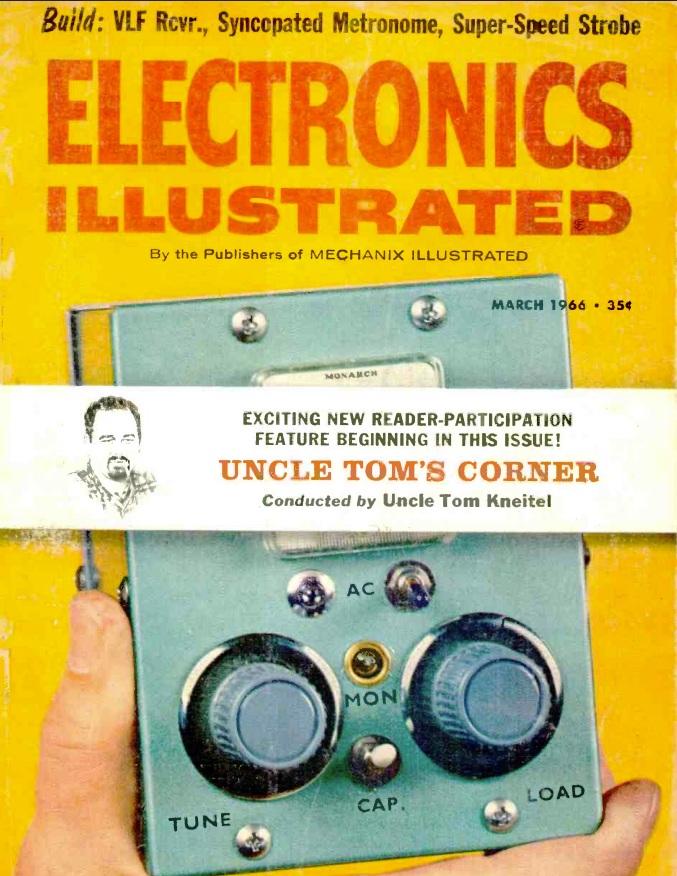
She is shown on the cover of Radio Retailing, January 1946. The magazine reminds dealers that soon there would be a flood of products onto their sales floors: “Let’s forget the past. Forget the days of famine and the days of “in-the-bag” sales. Let us remember what happened in other fields. -There are plenty of cigarettes now; there are beefsteaks, metal razors, face tissues and nylons.” And soon, there would be plenty of radios.


Happy New Year!

Happy New Year from OneTubeRadio.com!

Once again, as a public service, in recognition of the high cost of calendars, we bring you this perfectly good 1931 calendar.  Since 1931, like 2026, is a non-Leap Year beginning on a Thursday, you can use the old calendar again.  So instead of buying one, we recommend that you simply print the calendar, mark it 2026, and use it.

The calendar originally appeared in the January 1, 1931, issue of the Arkansas Farmer.


Liberty Bell By Radio, 1926

We previously reported how the Liberty Bell sounded in 1915, with the sound transmitted by telephone.  But to mark the start of the nation’s sesquicentennial year in 1926, it sounded again on January 1, 1926.  This time, the sound was transmitted by radio over station WIP.  This announcement appeared 100 years ago in the December 30, 1925, issue of the South Bend (IN) News-Times, and recounted how the wife of the Philadelphia Mayor, Mrs. W. Freeland Kendrick, was to have the honors of sounding the bell.

She actually tapped out 1-9-2-6 in Morse code, as detailed at this site.


1940 Three-Tube Radio

The December 1940 issue of Radio and Television Magazine showed how to put together this three-tube set for the broadcast band. A 6J7 served as regenerative detector, with a 6J5 audio amplifier. The 6C5 was pressed into service as rectifier, with a line-cord resistor dropping the filament voltage.

You’ll get some idea of the size by the fact that the front panel is made out of a standard household outlet cover. With a short antenna strung around a picture frame or on the floor behind furniture, the set would pull in local stations. Strong local stations might be strong enough to run a speaker.


1925 One Tube AM-CW Transmitter

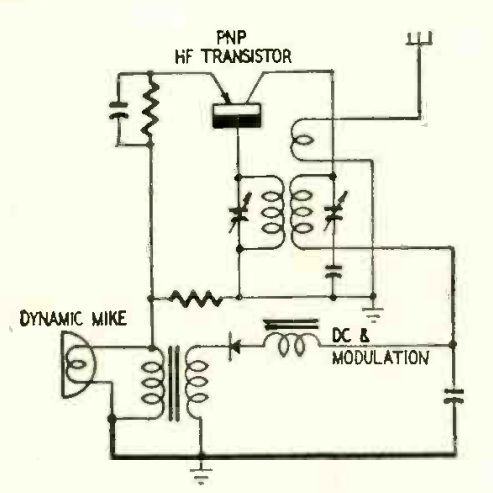
One hundred years ago this month, the December 1925 issue of QST carried this circuit for “an inexpensive low power transmitter from receiving parts.” The author, Rufus P. Turner, 3LF, noted that many broadcast listeners, when they became interested in transmission, were put off by the high cost of transmitting apparatus. But he noted that this needn’t be an issue, since this low power CW and ‘phone transmitter could be built from receiving parts, including a C-301A or UV-201A tube, wired as a Hartley oscillator.

He noted that while some may view such a transmitter as a “worthless toy,” it was actually an effective low-power device. He reported that he had used it for three months, and worked many locals (in Washington, DC) on ‘phone, as well as many 2’s (New York) on CW, during daylight hours.

When the station was built, the next step was to obtain a license, which required submitting the proper form to the local Supervisor of Radio. Once that was out of the way, you were to call a local ham in your area and ask him to listen. “Hold down your key and speak into the microphone, using his station call and ‘signing’ your own.” When he heard you, you adjusted the coil and condenser until your signal was on about 170 meters (1.76 MHz).

The editor noted that phone operation was permitted only on 170-180 meters, whereas CW could be used on all other amateur bands. He noted that the circuit could easily be used on 80 meters. The editor also noted that he was “absolutely opposed to the use of the microphone in amateur transmission,” since “‘phone stations create enormously more interference than telegraphic stations. However, it is all right when using only a receiving tube and a 90-volt battery.”

The name of the author, Rufus Turner, should sound familiar, as we previously featured him.  He is believed to be the first African-American licensed radio amateur. He had no formal education in electronics, but nonetheless became a Professional Engineer in two states and was involved in the development of the 1N34 diode. He finally went to college in the 1950s, but earned degrees in English and became a Professor of English.