1957 Two-Tube VHF Superregen

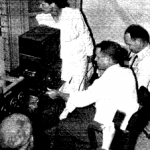
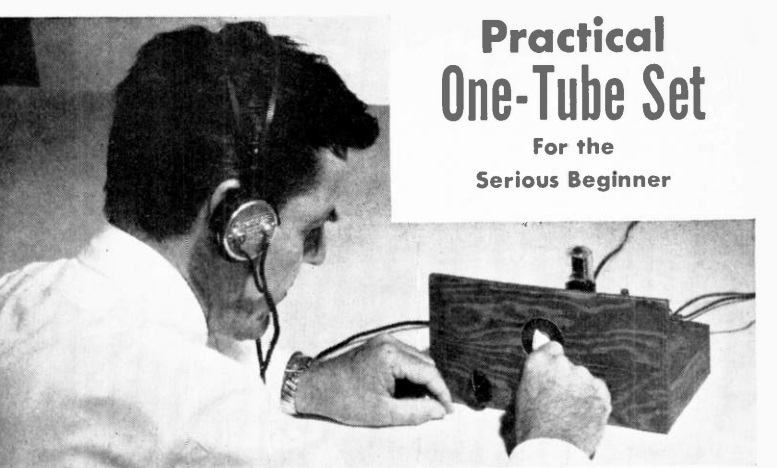
1957FebPE31This young man is exploring the action bands of the VHF spectrum with a two-tube superregenerative receiver from the February 1957 issue of Popular Electronics.

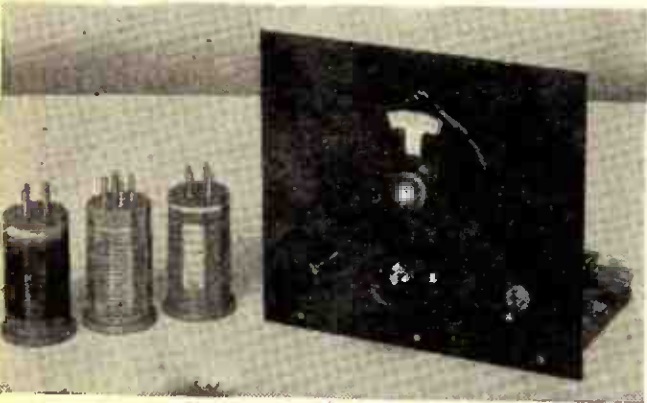
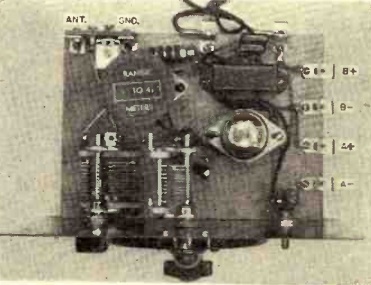
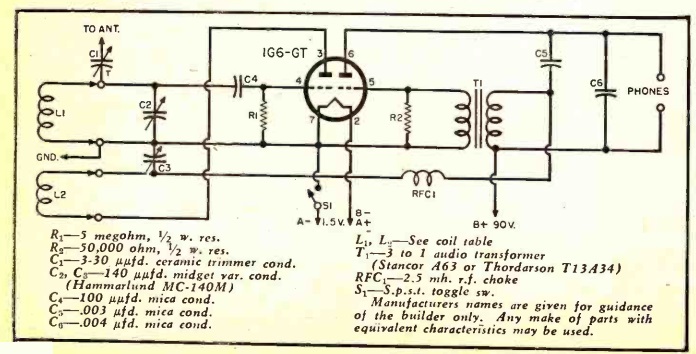
The set tuned 28-175 MHz, which included the FM and TV bands, as well as amateurs, police, fire, and aircraft. The magazine noted that the layout of the circuit was critical, and cautioned builders to construct it according to the photographs, in addition to the schematic. In particular, short lead lengths in the RF stage were critical.

A 12AT7 served as RF amplifier and detector, with a 6AF4 serving as audio amplifier. A signal generator was suggested for final calibration, but in the absence of one, TV and FM broadcast stations could be used to figure out the dial positions. Three plug-in coils were used for band switching.

1957FebPE32


1922 Boys’ Life Receiver

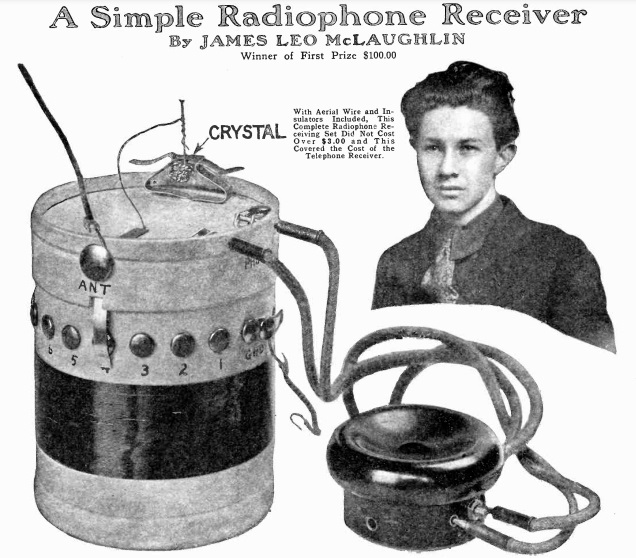
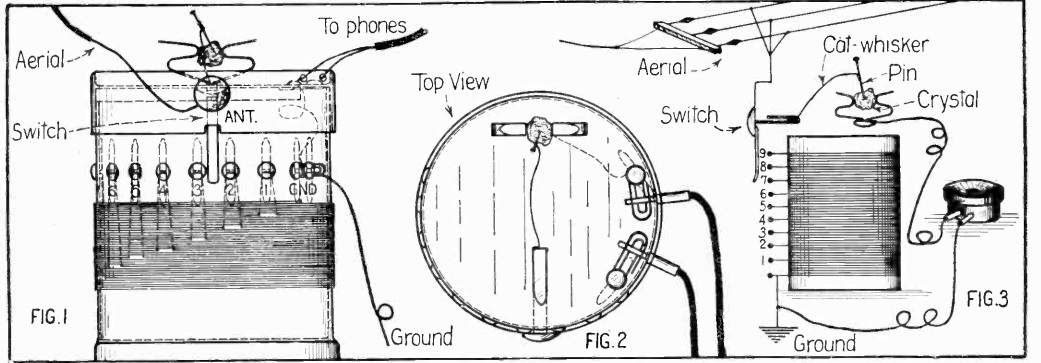
1922FebBLA hundred years ago this month, wireless column of the February 1922 issue of Boys’ Life showed scouts how to put together the simple radio receiver shown here.  The magazine noted that just a few years prior, there was still little to hear on the airwaves in most of the country.  Near the coast, it would be possible to pick up Morse transmissions to and from ships, and in larger cities, there might be a few signals here and there.

But in most of the country, there had been little to listen to.  But that ways changing, and by 1922, just about anywhere in the country, there were plenty of interesting signals just waiting to be pulled in.  In fact, even in areas without newspapers, the radio could be used to pull in stories straight off the news services, and it was possible to get sports scores long before your neighbors could.  There were even concerts being listened to by hundreds of thousands of people in many states.


Illusion: Candle Burning in Bottle of Water

1937FebPS01For a simple illusion that can be part of a science fair project, this self-explanatory diagram shows how to make a candle look like it’s burning inside a bottle of water.

A plate of glass is placed as shown.  Since it allows light to pass through, but also reflects light, when it’s viewed at the correct angle, it appears that the candle is inside the bottle of water.

This idea appeared 85 years ago this month in the February 1937 issue of Popular Science.


1937 Grocery Prices

1937Feb18PghPostGazette

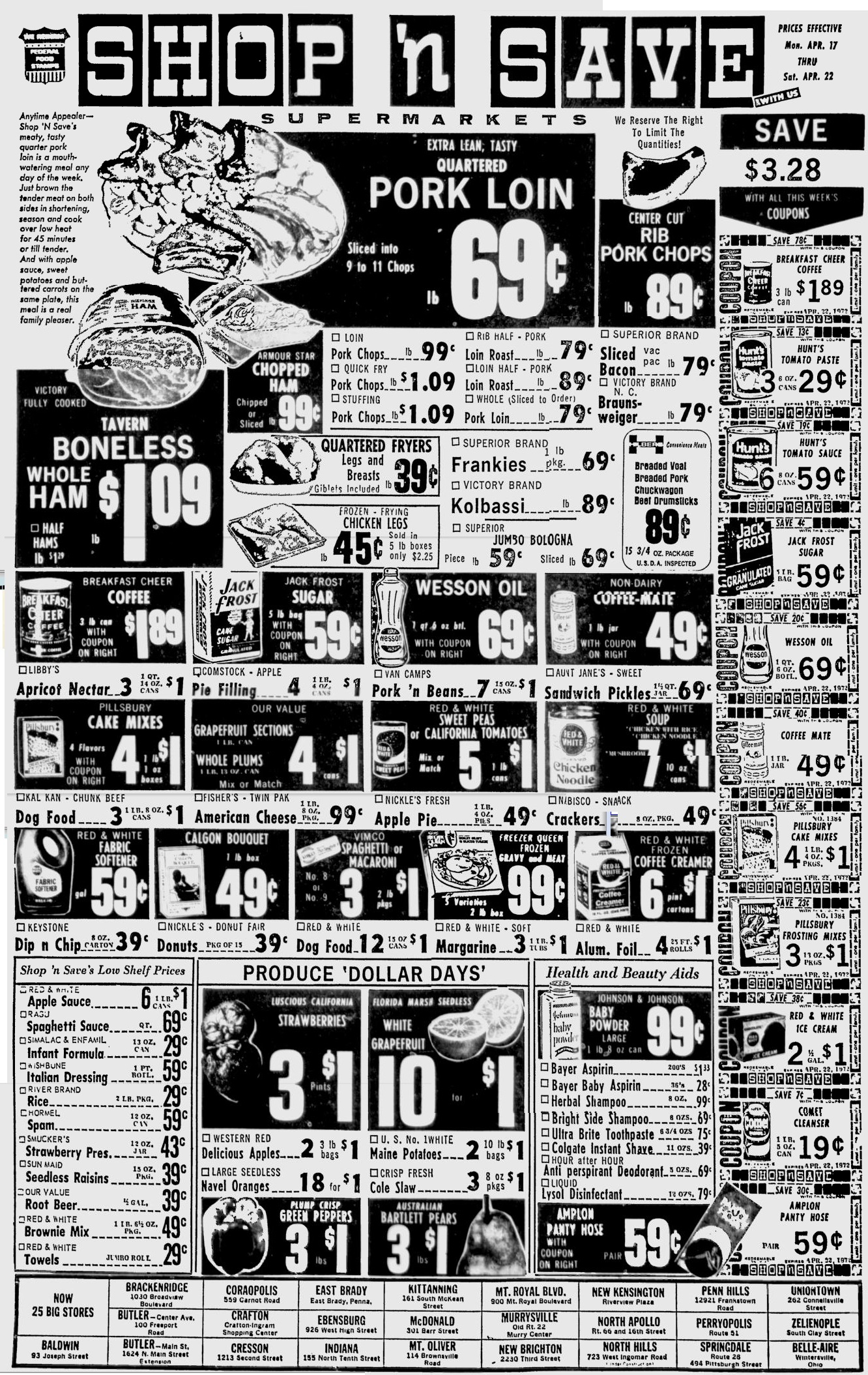
For a snapshot of grocery prices 85 years ago today, this ad appeared in the Pittsburgh Post Gazette on February 18, 1937. At first glance, the prices look like bargains, but the Great Depression was in full force, and for many, there wasn’t a lot of money to go around. According to this online inflation calculator, one dollar in 1937 was the equivalent of $19.36 today. For round numbers, let’s call it $20, so spending a nickel in 1937 would be about the same as spending a dollar today.

Some things were cheaper then. For example, for the ground beef, veal, or pork, you would need to hand over ten nickels, so the three pounds is the equivalent of about $10 today, or about $3.33 per pound.  How does that compare to today’s price, which you can find on Amazon at this link.

On the other hand, three pounds of coffee for 75 cents sounds like a bargain until you realize that’s five nickels per pound, or the equivalent of $5 per pound today. To compare, you can find the current price at Amazon at this link.

Potatoes were a nickel a pound, meaning that they were the equivalent of a dollar a pound today. Eggs were three dozen for 89 cents. What would that be in today’s money, and how much would those same eggs cost today?  You can find out at this Amazon link.

Surprisingly, duck was cheaper than chicken.  Duck was 25 cents per pound, but chicken was 29 cents.   If you don’t want to cook, you can eat in the store’s cafeteria. Lunch for two people was 54 cents, and a five-course dinner with table service was 75 cents each.


Some links on this site are affiliate links, meaning that this site earns a small commission if you make a purchase after clicking the link.

TV Relay Tower, 1952

1952FebRadioElecI remember as a kid seeing a structure similar to this one. I don’t remember exactly where, but it was somewhere along the route between Minneapolis and Duluth, with one horn facing south, and the other facing north. I asked my parents what it was, and they said it was for relaying TV signals. It made perfect sense to me, since the two horns looked a lot like TV screens.

I didn’t know what was inside, but now I do. The electronics were on the top floor, the B+ power supply was on the third floor, the filament power supply was on the second floor, and a backup generator was on the ground floor.

This diagram appeared 70 years ago this month in the February 1952 issue of Radio-Electronics.  Click on the image to see the full size version.


1962 Phone Answering Machine

1962FebPSTelephone answering machines didn’t really become a thing until the 1970s, and even then, they were expensive and rare. At first, even their legality was dubious, since The Phone Company was jealous of anyone making any kind of direct electrical connection to the Public Switched Telephone Network.  I didn’t have an answering machine myself until well into the 1980s. Surprisingly, there was a time when the phone just kept ringing when nobody was home, and there was no way to leave a message. Similarly, if your phone rang, the only way to find out who was calling was to pick up the phone and talk to them.

For those who were unwilling to wait for the future, the February 1962 issue of Popular Science showed you how to put together your own answering machine. And since there was no direct connection to the phone line, you didn’t have to worry about provoking the ire of The Phone Company. When the phone rang, an inductive coil placed under the phone would sense it, and it would trigger a solenoid which would physically lift the button on the phone. It would also turn on the tape recorder, which had been left in the “play” position. The tape recorder would then play your outgoing message through the speaker, which was close to the telephone handset. At the end of the outgoing message on the tape, you had painted silver paint on the back of the tape. When this passed through an outboard sensor you had added to the recorder, it would trip a second solenoid, which would flip the switch on the tape recorder from “play” to “record”. The microphone was placed next to the receiver, and it would record for thirty seconds. At the end of this thirty-second piece of tape, there was another section of silver paint, which would reset the whole contraption for the next call.

You would need to prepare the tape in advance for as many calls as you expected to get, including multiple outgoing messages and silver paint sections.

For the outgoing message, you were instructed to tell the caller to leave their 30 second message when they heard the “click.” Presumably, the sound of the tape recorder switching over from playback to record would be sufficiently loud to serve as the cue.

To hear your messages, you would first glance at the tape to see if it had been used. If so, you would need to first remove the tape from the external switch, since running the tape through it unnecessarily would quickly remove the silver paint. You would then plug the tape recorder directly into the wall, rewind, and listen to the tape, which would include both your outgoing messages and the incoming messages.

As you can see from the schematic below, the control circuit used tubes, to switch the relays and solenoids. Since one of the relays was used to turn the tape recorder on and off, the tape recorder itself would need to be a solid state model, since there would not be time for the tubes to warm up.

After it was built, the device had to be adjusted. In particular, there was a sensitivity control for the circuit triggered by the ringer. In order to adjust it, the phone had to be ringing. And, of course, the only way to do that was to call someone else and ask them to call you.

1962FebPS2


1957 SWL’ing

1957FebPESixty-five years ago, people still dressed up to listen to the radio, as shown by this avid SWL shown on the cover of Popular Electronics for February 1957.

The magazine issue featured the shortwave hobby, and contained a number of pointers for pulling in foreign stations. The listener shown on the cover was well equipped, since she is shown with what appears to be a Hammarlund HQ-180, an excellent receiver even by today’s standards.


Happy Valentine’s Day!

Happy Valentine’s Day from OneTubeRadio.com!
1922MissValentineShown here, from a century ago, is Miss Valentine, from a pamphlet published in 1922, Dennison’s Gala Book, containing numerous suggestions for your parties–nay galas. All of them make use of fine Dennison products, including Dennison crepe paper.

The booklet includes numerous paper costumes, such as this one of Miss Valentine. “The illustrations and instructions are so easy to follow and the cost of materials so trifling that you will have as much fun making a costume as you will wearing it.”  It notes with respect to this costume, “who would not enjoy her tea more if it were served by charming Miss Valentine?” Her costume consisted of a slip-over apron trimmed with red hearts. The bill of materials consisted of two folds of decorated crepe paper, two folds of white crepe paper, and one fold of red crepe paper.


Some links on this site are affiliate links, meaning this site earns a small commission if you make a purchase after clicking the link.

1962 Fallout Shelter Antenna

1962FebPMSixty years ago this month, the February 1962 issue of Popular Mechanics carried this hint for using an outdoor antenna in the fallout shelter. The magazine noted that the shielding required for fallout protection could also shield against vital radio broadcasts. Since most radios didn’t have an external antenna jack, the magazine showed how to add one. A small coil was placed over the loopstick antenna, and that coil was hooked to an outdoor antenna. For optimal reception, you would tune in a station close to 640 or 1240, the CONELRAD frequencies, and slide the coil along until the signal was strongest. At that point, you would add a little cement to fix the coil in place.

The antenna could be unplugged when in normal use, but quickly put to work in the shelter in time of emergency.


Lancaster County Seed Co, 1937

85 years ago, if you were an impecunious boy, girl, man, or woman, and wanted some luxury items in your life, then this advertisement would certainly appeal to you. You could earn any of the prizes shown on this page, with absolutely no cost other than a little old fashioned initiative. You could do this by getting into the seed business, and that was as simple as filling out the coupon and mailing it back to the Lancaster County Seed Company of Paradise, PA. Or if you were truly thrifty, you could copy the information on a penny postcard and get started that way.

No money had to change hands. The Lancaster County Seed Company trusted you, and as soon as they received the coupon, they would send you 24 beautifully colored packets of “Garden Spot” Seeds, which everybody planted, according to the ad, and they were guaranteed to grow. You would sell them for a dime each. Lots of people would buy five to ten packets. In fact, your own family, along with a few friends, would buy all of them.

After you sold the seeds, you would get a money order for the $2.40 proceeds, along with your prize selection. With the exception of the wrist watch, you could have any of the prizes shown on this page: The musically inclined could chose between the guitar, ukulele, or guitar. Sports enthusiasts could get the basketball or roller skates, or even the air rifle. The moving picture machine or spy glass would undoubtedly appeal to many boys. And the practically minded could chose between the bed spread, the curtains, the cooking set, or the clock. For those with their eyes on the wrist watch, they could pay an additional 99 cents, or just sell another 24 packets of seeds.

The ad emphasized that the company trusted you, and there was no need to send any money. Most of the entrepreneurs who signed up probably fulfilled their obligations, but this site shows a letter from the President of the company to those who didn’t promptly return the money. According to the letter, “we know you are perfectly honest and will want to pay whatever you owe.” It reminded the recipient to get a money order from the post office or RFD carrier and send it back right away. If the seeds hadn’t all been sold, then “you should make a final effort to do so.”

The letter assured the recipient that as soon as the money was in hand, the premium would be sent. For those who had given up hope, the letter asked them to send a money order for what they had sold along with the remaining seeds in good condition, and the company would follow through with a premium for the amount of work which you had done.

The ad appeared 85 years ago this month in the February 1937 issue of Radio Mirror.