Category Archives: World War 2

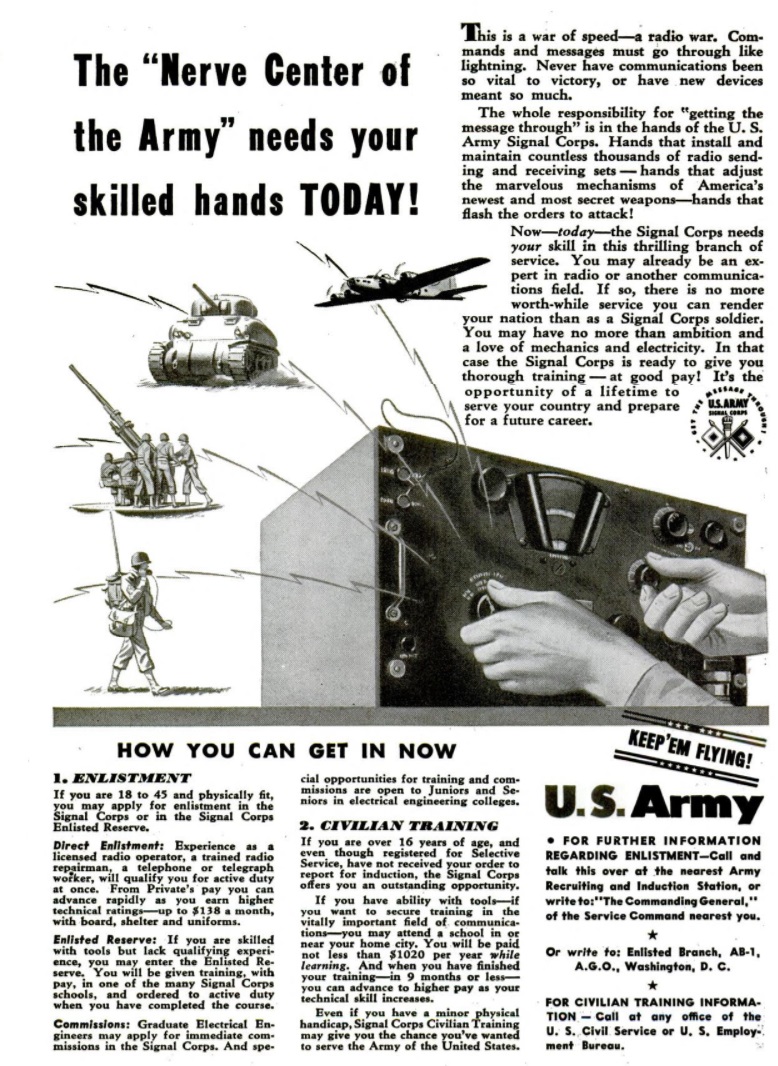
US Army Signal Corps, 1942

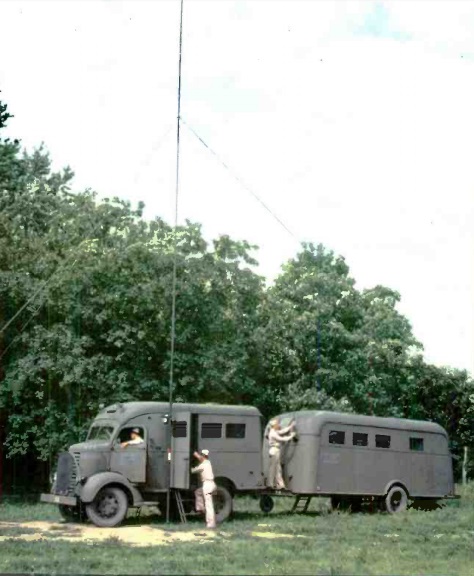
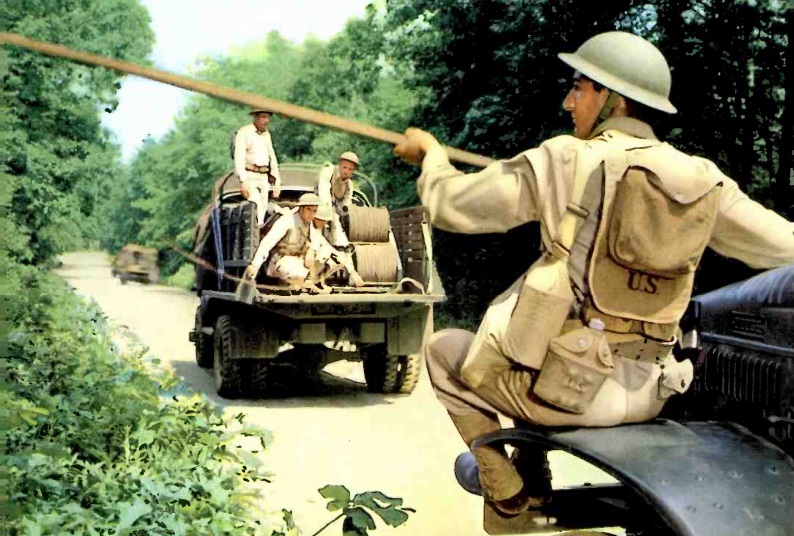
Signal Corps mobile radio unit.

Signal Corps mobile radio unit.

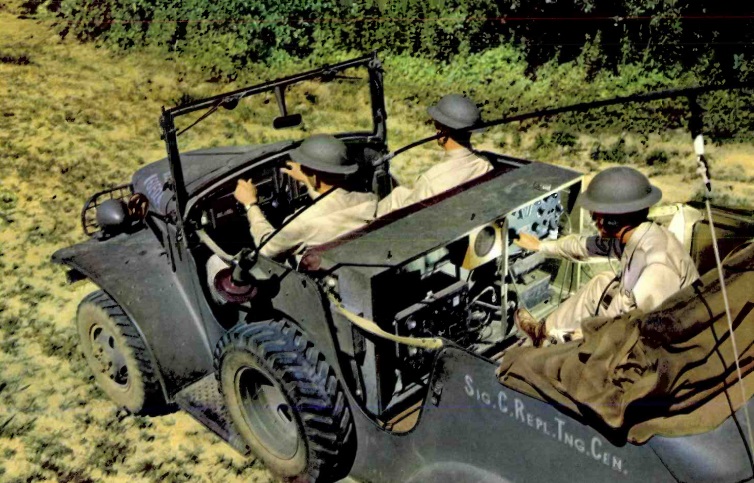
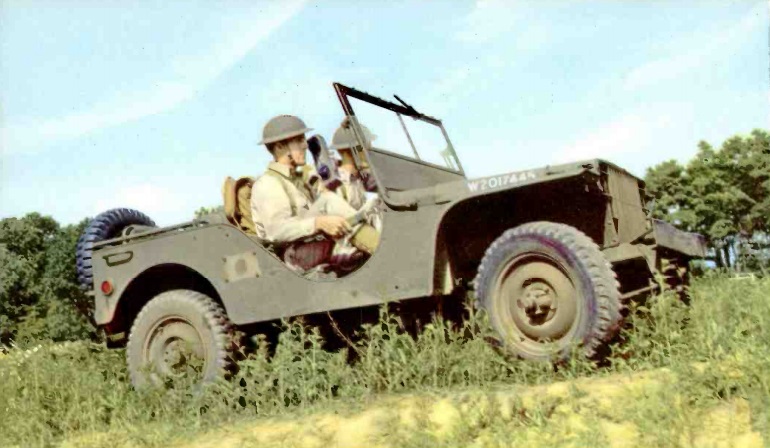
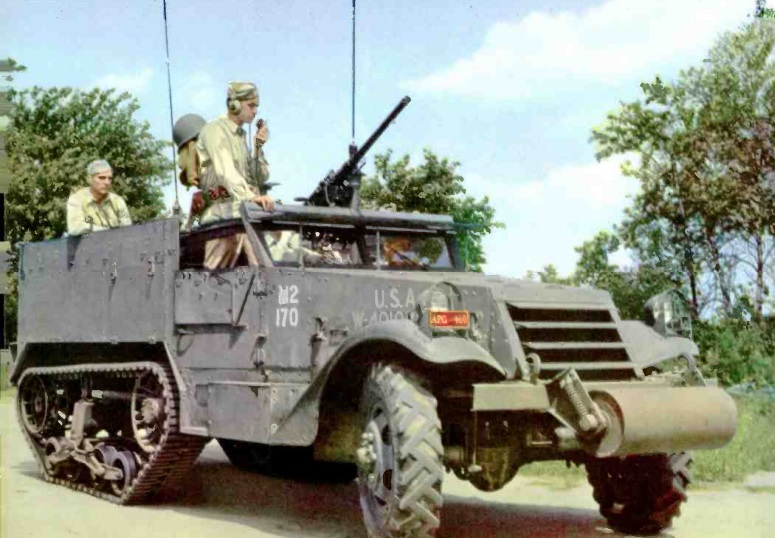
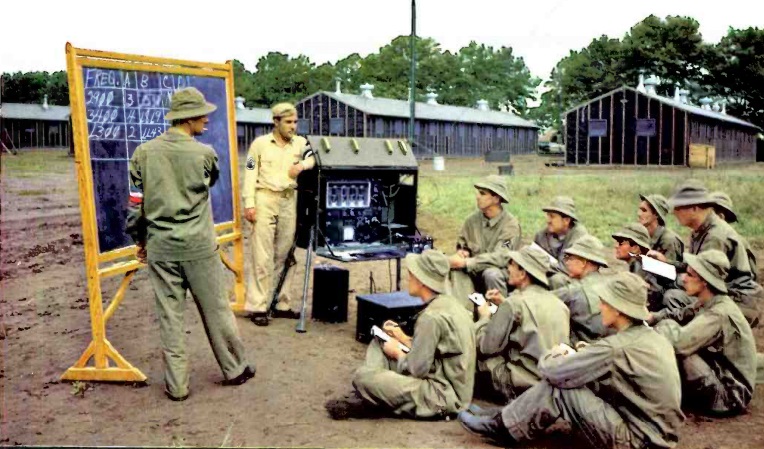
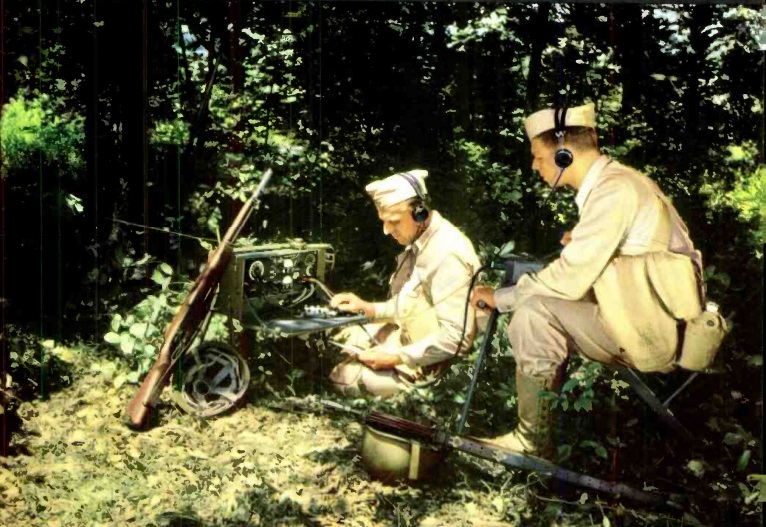
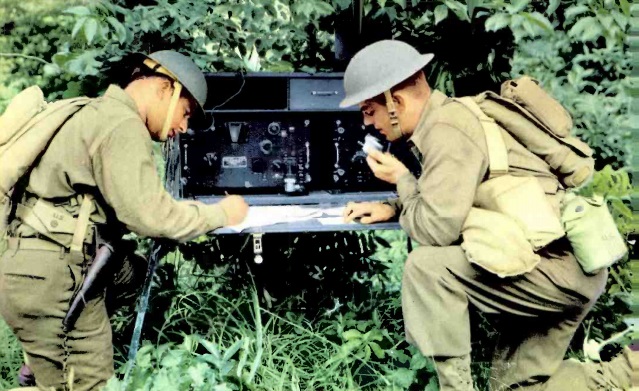
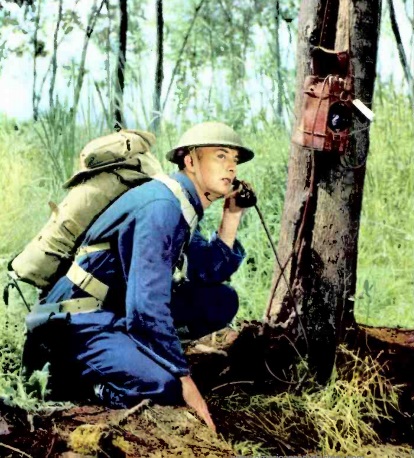
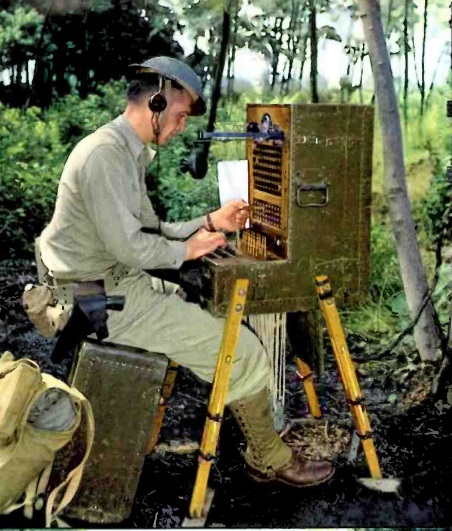
Seventy-five years ago this month, most of the November 1942 issue of Radio News was devoted to the U.S. Army Signal Corps, and included dozens of photographs, including the color photos shown here. The photos themselves were taken by Signal Corps photographers, which comprised a branch of the service.

Here are a few of them, showing various phases of both wireline and radio communications.

Command car equipped for both voice and code communication.

Command car equipped for both voice and code communication.

Operation of handheld radio from Jeep, probably around 50 MHz.

Operation of handheld radio from Jeep, probably around 50 MHz.

Radio-equipped halftrack.

Radio-equipped halftrack.

Students receiving instruction on portable transmitter.  Note operating frequencies of ___ kHz.

Students receiving instruction on portable transmitter. Note operating frequencies of 2300, 2900, and 3400 kHz.

Operating radio from concealed position with hand-driven generator.

Operating radio from concealed position with hand-driven generator.

Operating four-band portable field set.

Operating four-band portable field set.

Field telephone in operation.

Field telephone in operation.

Field telephone switchboard.

Field telephone switchboard.

Placing telephone lines.

Placing telephone lines.


1942 RCA Shortwave Transmitters

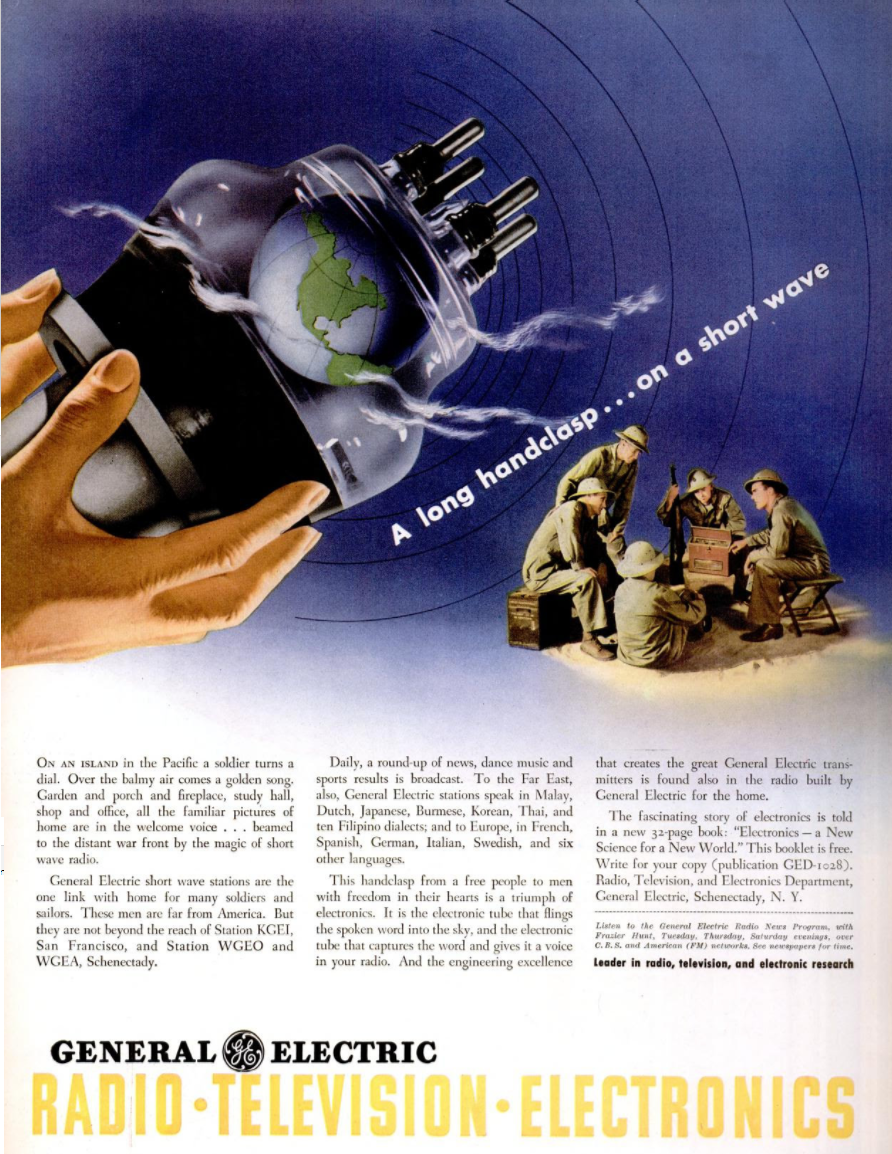
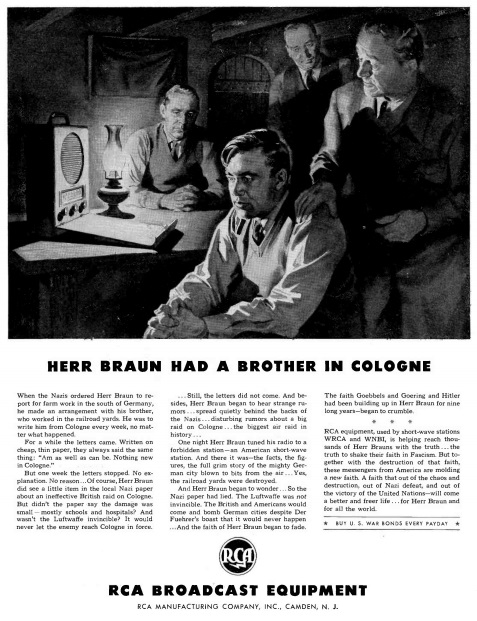
1942Nov16BCSeventy-five years ago today, the November 16, 1942, issue of Broadcasting carried this ad with a story showing the importance of the nation’s shortwave broadcast transmitters.

When Herr Braun was ordered to report for farm work in the south of Germany, he made an arrangement with his brother who worked in the rail yards. No matter what happened, the brother promised to write from Cologne every week.

At first, Herr Braun received letters written on cheap thin paper. But one week, the letters stopped with no explanation. The local Nazi paper reported an ineffective British raid on Cologne, but with only small damage. The Luftwaffe was invincible, according to the paper, an the enemy could never reach Cologne in force.

But the letters never came. So one night, Herr Braun tuned to a forbidden station–an American shortwave station. “And there it was–the facts, the figures, the full grim story of the mighty German city blown to bits from the air. Yes, the railroad yards were destroyed.”

So Herr Braun started to wonder. The newspaper had lied. Thanks to the powerful shortwave transmitters using RCA equipment, Herr Braun’s faith began to fade.


Armistice Day 1942

1942Nov11PghPress

Seventy-five years ago today, November 11, 1942, was the nation’s first wartime remembrance of Armistice Day.

The two pictures shown here appeared in that day’s Pittsburgh Press, showing a parade of 20,000 men who marched in celebration of the end of the last war. The included both the veterans of the First World War, along with their comrades fighting the Second.

The newspaper noted that the parade, which had been underway for an hour, halted at 11:00 AM while buglers sounded Taps in “an official and solemn recollection of the end of the last war, the tribute to the honored dead of that war, and, it seemed, a spiritual pledge of victory in the new and immensely greater war.”


Ying Ong, American Radio Patriot

1942NovRadioCraftShown here in the November 1942 issue of Radio Craft is Ying Ong of Phoenix, Arizona, rightly described by the magazine as an American radio patriot.

Mr. Ong took it upon himself to listen to and transcribe the broadcasts from Chungking Radio. He took the contents down by shorthand, and then relayed them to his fellow Chinese-American countrymen and to American news services. His dispatches often were made by telegram, and he bore the expense himself. He also sent copies to the FCC, Chinese-American newspapers, and the Chinese consulates.

The nationalist Chinese government took note of this, and at one point sent him a check for $100 to help cover his expenses. He endorsed the check over to the China War Relief Fund.

The broadcasts of the powerful GE San Francisco shortwave station KGEI often, the magazine noted, contained in its newscasts the phrase “Chungking radio says….” These reports were able to hit the air so quickly thanks to Mr. Ong’s transcripts of the broadcasts.

I was not able to find a listing for Mr. Ong in either the 1940 or 1946 call books, so I don’t believe he was a licensed ham.  But as an SWL, he certainly performed a service to both China and America by ensuring that nationalist broadcasts were received in this country by all who needed to hear them.

According to the Social Security Death Index, a Ying Ong, born on 25 August 1918, with a place of residence in Phoenix, died on 17 July 1992. He is buried at Greenwood Memory Lawn Cemetery in Phoenix.


Roy Gould, W6UKX, KFXM Engineer & Engineering Professor

1942Oct26BCSeventy-five years ago today, the October 26, 1942, issue of Broadcasting carried this picture of the transmitter engineer of KFXM, San Bernardino, California, who appears to be dutifully taking some transmitter readings for the log.

Because of wartime labor shortages, the engineer responsible for keeping this station on the air was a fifteen year old high school student, Roy Gould, W6UKX.  (A few days ago, we saw how wartime labor shortages led a group of New York radio servicemen to train high school students to keep their shops open for the duration.)

Gould had received his ham ticket shortly before Pearl Harbor, and had managed to get on the air, with a homemade transmitter and receiver on 10 meter AM, before the war shut down amateur radio for the duration.

Since Gould also held his first class commercial license, he managed to stay on the air by getting a job at the broadcast station, which was at the time running  100 watts at 1240 kHz, sharing air time with KPPC, a Pasadena Presbyterian Church station.

According to the caption of the photo, Gould’s plans after the war were to go to college to “become a radio engineer.”

I was able to track down Mr. Gould–or I should say Professor Gould–and learn that his plans changed somewhat, although his early days in radio were clearly the inspiration for his career.  I received a nice e-mail from him, and also found a 1996 Oral history interview.

In his e-mail, he writes:

Thanks for the links, I have never seen this picture.

I remember those days well. I used to operate the transmitter and on Sunday evenings, record a Mutual Don Lee network program on the big 16″ acetate covered disks for replay at a later time. There was no announcer in the studio on Sunday evenings so I even signed the station off at the end of the day. I also covered remote broadcasts of some of the big bands at the San Bernardino Civic Auditorium, setting up microphones and operating the control box during the broadcast.

I got my ham license W6UKX in early 1941, and did a little operating before WWII shut down ham radio. I let it lapse in the 1950’s when I was in graduate school. However, that call sign was never reissued, so I was able to get it back under the vanity call sign program in the 1990’s. I have a web page, w6ukx.caltech.edu, but for some reason it Is down now. I’ll look into that. [Here’s the 2015 archived version at the Wayback Machine.]

Thanks again for the great photo with the short note. 73.

Roy

Roy W. Gould

Prof. Roy Gould. Caltech photo.

Gould never became a “radio engineer”.  According to his biography at Caltech, he received his undergraduate degree from Caltech in 1949, with graduate degrees from Stanford and Caltech.  He became Professor of Electrical Engineering and Physics at Caltech, and served a stint as the chairman of the school’s Division of Engineering and Applied Science.

According to his Wikipedia entry, he received the 1994 James Clerk Maxwell Prize for Plasmaphysics, and served as the Director of Fusion Research at the Atomic Energy Commission.

In his 1996 interview, Gould credits his early radio experience as the seed for his career.  He reports that in high school, he was “not a very good student.”  But his uncle’s barn was full of old radio equipment and magazines, and he “used to go up there and read these things and look at the equipment, play with it and stuff like that.  I got started in electronics with crazy experiments.”  Of course, we are also advocates of crazy experiments, and students seeking inspiration will find ideas, some crazier than others, in our science fair idea posts.

The shortage of broadcast engineers meant that he was able to get the job at the radio station, which he reported as being more interesting than was going on in school.

The broadcast station where Gould got his start, KFXM, doesn’t appear to be around in its original form.  However, the station and call letters live on as a noncommercial low-power FM station, KFXM-LP.  The old AM station appears to have been a major Top-40 outlet during the 1960’s, and when it went dark, the low power FM station was licensed to The Organization For the Preservation & Cultivation of Radio to carry on the tradition.

After letting his license lapse during grad school, Gould got his ticket after achieving emeritus status, and is again active on HF, including a number of portable DX operations detailed at his website.


1942: Putting High School Students to Work Servicing Radios

1942OctRadioRetailingSeventy-five years ago, these high school students in Watertown, N.Y., were seen as a resource that would help the radio industry deal with wartime labor shortages. An article in the October 1942 issue of Radio Retailing explained the plan by which high school students could be trained to fill the gap. A group of servicemen in northern New York were planning to run an intensive course in radio servicing, open to high school seniors with a year of physics. The course was to be offered five nights per week, two hours each night, for ten weeks, and was taught by local servicemen who would both lecture in the classroom and offer periodic trips to the shop to tackle real receiver problems.

Classes would be small, and after it was completed, one or two students would take over the shop of an owner who had entered the military, running the shop on an evenings-only basis. The student would be paid a weekly wage based upon volume. Repairs would be paid by check or money order. The idea was to keep the shop open as a community service, with enough income to cover the shop’s rent, overhead, and cost of equipment.

The students would continue to attend school during the day and work at night.


Taking a Break With the Radio, 1943

1943BeverlyAnnGrimm

Shown here in 1943 is eleven-year-old Beverly Ann Grimm of Buffalo, New York, taking a break from sweeping to listen to the radio. Beverly was largely forced to take care of herself and her five younger brothers and sisters. Her  mother was widowed, and worked all week as a crane operator with Pratt and Letchworth.  The mother’s name isn’t shown on the photograph caption, but according to the 1940 census, she was Thelma Grimm, and in 1940 lived at 60 Newman Street, Lackawanna, New York.  According to the photo caption, Mrs. Grimm was 26 years old in 1943, but according to the census, she was 26 years old in 1940.

The photographer was Marjory Collins of the Farm Security Administration. The photo, taken here from Wikimedia, was digitized by Yale, and more information is available at this link.  In the photo below, Beverly is shown bringing home the groceries purchased from her mother’s list.

I’m not able to make out the brand of the radio, which makes identifying it difficult.  If anyone has any clues, please let me know!  You can also find more information about this family and some of the artifacts in the pictures at this link.

1943BeverlyAnnGrimm2


The Banana Plug Goes To War

1942Oct12Life

The war effort of the United Nations depended on many minor miracles, and according to this ad in the October 12, 1942, issue of Life magazine, one of those minor miracles rolled off the assembly lines of the United-Carr Fastener Corporation of Cambridge, Mass.

That minor miracle was the banana plug, or as it was called here, the banana pin. The cause of war was calling Americans to every corner of the globe, and their communications depended on American radio equipment. And those sets contained banana plugs, lots of banana plugs. Hundred of thousands of banana plugs were in constant operation in planes, ships, and tanks, under all conditions of weather and battle. The banana plug was unseen and inconspicuous, but it insured the constant contact to keep the far-flung forces in touch with their commands.


RM2C Robert Melvey, W7HUX, 1924-1944

1942OctRadioNewsThe October 1947 issue of Radio News contains this report of a rare case of the FCC issuing a specially requested amateur callsign prior to the “vanity” callsign programs of later decades.

Ernest Melvey, formerly W7HVS, of 6416 Francis Avenue, Seattle, Washington, requested a waiver of the rule requiring calls to be assigned systematically.  Specifically, he requested the call sign of his son, U.S. Naval Reserve Radioman Second Class Robert Melvey, W7HUX, who had been killed in action, along with 132 other sailors, when the cruiser Nashville had been hit by a Japanese kamikaze plane on December 13, 1944.

USS Nashville after the kamikaze hit. Wikipedia photo.

The elder Melvey had made the request “in remembrance of the good times,” and the FCC was sympathetic to the father’s request to perpetuate his son’s call letters on the air.  The FCC granted the request, but “did not mean that it was relaxing its long adhered to policy against transfer of amateur call letters or requests for particular amateur calls.”

The younger Melvey is interred at Evergreen-Washelli Memorial Park, Seattle.

USS Nashville (CL-43) off the Mare Island Naval Shipyard on 4 August 1943.jpg

USS Nashville, 1943. Wikipedia photo.


1942 Homemade Battery Charger

1942OctPMbatterycharger1The plans for this battery charger appeared in Popular Mechanics 75 years ago this month, October 1942.

The project had a decidedly wartime angle: “Should it become necessary to store your car, this tungar battery charger will keep a 6-volt storage battery fully charged so that you can operate your auto radio indoors. This is only one of many timely civilian defense uses for an efficient and inexpensive battery charger.”

The only electronic part necessary to construct the charger was a GE tungar bulb. The “tungar” name for this type of rectifier came from the fact that it contained a tungsten filament and the bulb was filed with argon gas. The bulb specified by the project had a two-volt filament, and screwed into a standard lightbulb socket, with a separate lead running to the anode. The whole charger was mounted on a wooden board. The article specified that it should not be enclosed, in order to allow ventilation. Thus, the 110 volt terminals were left exposed.

1942OctPMbatterycharger2The transformer was also homemade. The core consisted of strips of stovepipe iron, carefully cut and shellacked together as shown here.  Wood from a cigar box was used as a form to construct the core. The windings went over a layer of electrical tape, with the secondary winding also containing a layer of “empire cloth, available from electric shops.” The iron laminates were clamped together with hardwood or bakelite, bolted together firmly to keep the transformer from humming. The instructions called for the cord to be placed in a “moderate oven” and baked until dry.

The windings in the article were made with wire from a burnt out transformer. The primary consisted of 605 turns, with a coat of shellac after each layer. The secondary had 85 turns to supply 15 volts to the rectifier, with another 11 turns to provide the 2 volts for the filament. Finally, a knife switch was connected to the battery, to be flipped one way to charge, and the other way to play the radio.

1942OctPMbatterycharger3