Category Archives: World War 2

1944 Kiddie Tractor

1944AprPM1Shown here, from the April 1944 issue of Popular Mechanics, is the son of Robert C. Cross of 507 Main St., Woodland, California. The elder Mr. Cross built the 240 pound Caterpillar-type tractor for the young man, who undoubtedly had lots of fun driving around with the 3/4 horsepower engine.

Steering was accomplished the same way as a full-size tractor, with clutches and brakes on the rear axle controlled by levers. The cab also featured a throttle and choke control, as well as a cut-out switch. Mr. Cross reported that the cost of the tractor was about $125.

The younger Mr. Cross would be in his 80’s today, and since we know that people like to Google their own names, it’s not inconceivable that he is reading this. If you are, we would love to hear from you with your recollections of this most interesting toy.


Milwaukee Radio Listings, April 10, 1944

1944Apr10MilJournal

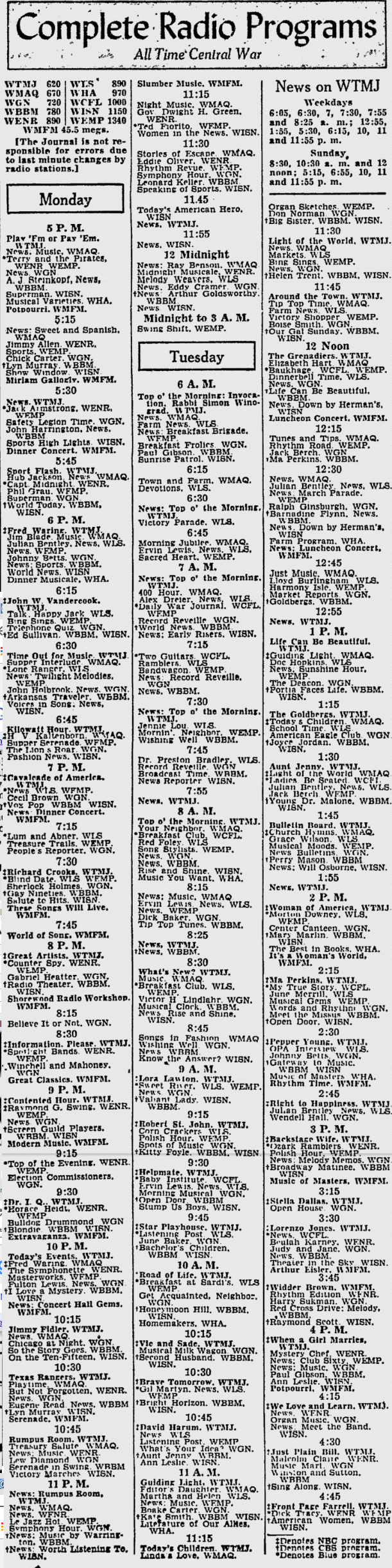
Here’s what was on the radio 75 years ago today. These listings appeared in the Milwaukee Journal, April 10, 1944 and show programs for April 10 and 11.  (You can click twice on the image above for a larger version.)


Wartime Tube Substitutions

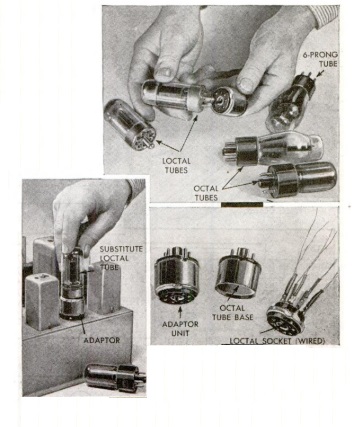
1944AprPMDuring World War II, many radio tubes were unavailable, and the magazines were full of ideas on how to cope. The April 1944 issue of Popular Mechanics showed how to make adapters to use similar tubes that might be available, but used different base types.

In particular, the magazine pointed out that loctal tubes were often available. Therefore, the adapter shown here allows a loctal tube to be plugged into a standard octal socket. The bottom half of the adapter was a defunct tube (probably the one being replaced), and the top half was a socket to match the new tube.


Helium, 1919

Screen Shot 2019-03-21 at 9.52.23 AMContrary to your first guess, no, this is not a picture of the Hindenburg.  Instead, the picture appeared on the cover of Popular Science one hundred years ago this month, March 1919, a full 18 years before the Hindenburg’s crash on May 6, 1937.  The picture is actually of an explosion during inflation of an observation balloon at Fort Sill, Oklahoma.

The article explained that this scene was a thing of the past thanks to the discovery of the element helium, and its great availability as a byproduct of the decay of radium in Kansas,  Oklahoma, and Texas.  But the article hints at the later disaster by asking how the first world war might have been different if the Germans had helium for their zeppelins.

As we previously wrote, despite the Roosevelt Administration’s eagerness to sell the strategic gas to Germany, Interior Secretary Harold Ickes nixed the idea, keeping helium out of the hands of the Germans.


Live TV Blood Donation: 1944

1944FebMarNRIWe have to admit that today’s vintage TV program isn’t quite as good as the one we shared yesterday, in which a shortwave receiver was built from scratch before live TV cameras. But radio parts were hard to find during the war, so WRGB in Schenectady, NY, had to work with what was available, and that was blood.

The February-March 1944 issue of National Radio News detailed another “first” in American television, namely the first broadcast of an actual blood donation. As part of a three-part broadcast showcasing the American Red Cross, the blood donation was done live on the air. Another part of the broadcast showed it being processed into plasma.

The program concluded with the scene shown above, the staging of a battlefield scene where the plasma was administered.


1944 Income Taxes

1944MarRadioMirrorSeventy-five years ago this month, the March 1944 issue of Radio Mirror carried these helpful pointers on filing your income tax return, which was due on March 15.

The magazine noted that some fifty million Americans would need to file, ten million of which would be first-time filers.  Single persons were required to file if their income was over $500 per year.  For married couples, a return was required if either spouse had income of $624, or if their combined income exceeded $1200.

Even though it was new to many people, the government was there to help.  Government men would be sent to many offices and plants to help workers fill out the forms.  Also, volunteer lawyers and accountants would be strategically located at banks, post offices, and schools.  The magazine encouraged seeking out these forms of help, and warned of the perils of talking to other self-styled experts.

According to the magazine, 95% of the income tax went to winning the war.  It also noted that the income tax was an important way to fight inflation, “that enemy within our home-front ranks.”


Burnt Out Fluorescent Tube Crystal Set: 1944

1944MarRadioCraft1Seventy-five years ago this month, the March 1944 issue of Radio Craft magazine contained this interesting idea for using a burnt out fluorescent tube as a radio detector.  Even though the filament is open, current can still flow from one end to the other through the ionized gas, and apparently it can rectify.

The magazine also showed how the tube could be used as an audio oscillator, as shown in the diagram below.

Even though there were wartime parts shortages, the experimenter could probably get his hands on a burnt out lamp.

1944MarRadioCraft2


1944: Sky Radio Blankets Enemy

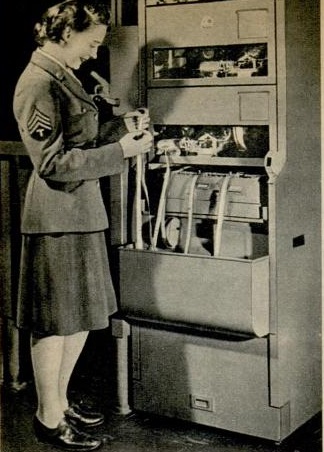
1944MarRadioCraftSeventy-five years ago this month, the March 1944 issue of Radio Craft magazine presented this idea of how invading forces could blanket the enemy with radio by sky. The idea was to alert civilians as to the invasion and give instructions. The expendable 500 watt transmitters shown here would be dropped over the teritory in question and would broadcast a prerecorded message from magnetic tape or wire. Another possibility would be to drop PA systems, which would begin playing at 3000-4000 feet.

The advantage of this system was said to be that the aircraft could leave the area immediately. In more recent times, the U.S. military has, indeed used airborne transmitters, but stationed in the aircraft.


Charles D. Tandy, 1918-78

1979MarEEForty years ago this month, the March-April 1979 issue of Elementary Electronics carried this tribute to Tandy Corporation founder Charles D. Tandy, who had died of a heart attack at the age of 60 in November 1978. Tandy was best known in the electronics world as having purchased the fledgling Boston Radio Shack chain in 1963. The author of the magazine was none other than Lewis Kornfeld, the president of Radio Shack both before and after Tandy’s purchase.

According to Kornfeld, nothing made Tandy angrier than empty hooks in the parts department. He questioned why there could be even a single out-of-stock item when “I’ve made your life simple by eliminating thousands of slow movers.”

Tandy got his start in the leather business, and while serving in the Navy during World War 2, he noticed sailors being taught knitting and needlepoint as part of their recuperation. He believed the men would prefer leatherwork, and established a system of craft work for the hospitalized men.

The author of the tribute took over Tandy’s role in the company. The company’s monthly flyers included a “Flyer Side Chat,” in which Kornfeld would offer his opinions on some subject of interest. Interestingly enough, most (or perhaps all) of the Flyer Side Chats have been collected into a single volume. In addition, students of marketing would be well advised to read Kornfeld’s classic, “To Catch a Mouse, Make a Noise Like a Cheese.”


Where Are the Radios in Manila?

1944FebServiceSeventy-five years ago this month, this ad in the February 1944 issue of Service magazine asked where all of the radios in Manila were.  The Japanese flag and soldier gave the answer, namely, that the invaders took them.

The ad noted that of all war weapons, radio was one of the most important. “it unites the free peoples in a common purpose and links them instantaneously with their Governments. It maintains the power to resist of the conquered. It unites and aims the hammer blows of armies.”

America had 59 million radios, and it was the patriotic duty of the radio serviceman to keep those receivers functioning. The reminder came from the Jackson Electrical Instrument Company of Dayton, Ohio, which provided the tools to do just that.