Category Archives: World War 2

1944 Expedient Winter Clothing

1944FebBL

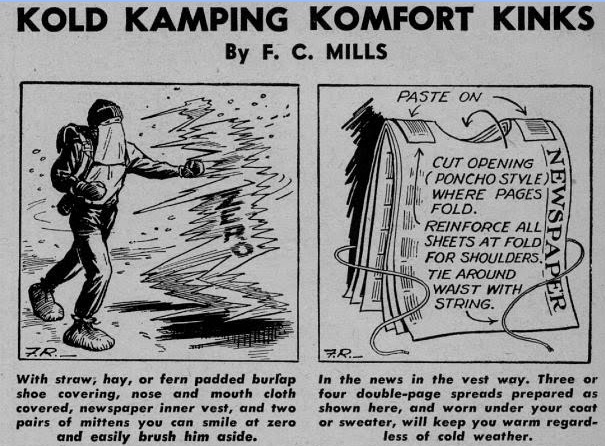
Seventy-five years ago this month, the February 1944 issue of Boys’ Life gave some pointers on how to keep warm on a budget. The burlap foot coverings are the same general idea as what we previously offered for expedient winter footwear. And if your jacket isn’t quite warm enough, then lining it with a few layers of newspaper will surely do the trick.


KFAB Lincoln, NE, 1944

1944Jan31BCSeventy five years ago today, the January 31 issue of Broadcasting carried this ad for KFAB, then in Lincoln, Nebraska, and on 780 kHz.  As we noted earlier, KFAB shared the frequency with fellow CBS affiliate WBBM in Chicago, and the two stations coordinated their signals.

The station made the move to Omaha and to its present frequency of 1110 kHz in 1948.  The move allowed both WBBM and KFAB to boost their transmitter power to 50 kW.


1944 Crystal Sets With Homemade Parts

1944JanPM1

Wartime parts shortages were undoubtedly the inspiration for these two crystal sets from the January 1944 issue of Popular Mechanics. While commercial parts could be used, from the junk box, salvaged from an old radio, or from a mail-order house, the article showed how to make most of the parts. The article notes that the newcomer needed only a good set of headphones to build either set from scratch.

1944JanPMcapacitorThe first set, shown above, omitted a variable capacitor, as it used a variometer for tuning. It did require one fixed capacitor, but the article shows how to make one using copper foil and either mica or wax paper.

A commercial fixed crystal can be used, but the article also shows how to make one. The crystal is mounted inside an old tube base and sealed with wax. The use of an old 4-prong tube socket meant that a commercial fixed crystal could be substituted at a later time.

1944JanPMxtal

1944JanPM2

The second set, shown above, featured a variable capacitor for tuning, which was constructed “book” style. The top plate, made of spring brass, was hinged and moved up and down from the lower plate.

1944JanPMvariablecap

The sets were said to have a range of about 25 miles.

1944JanPMschem11944JanPM2schem


1944 Locator Soldier

1944JanRadioNewsSeventy-five years ago this month, the January 1941 issue of Radio News showed this soldier, somewhere on the East Coast of the United States. The helmet and stethoscope-like attachment allowed him to listen for and trace the origin of sounds, such as approaching aircraft. The specially trained locator soldiers were required to have binaural hearing, meaning that they had the ability to trace the origin of sounds.


1943 German Light Phone

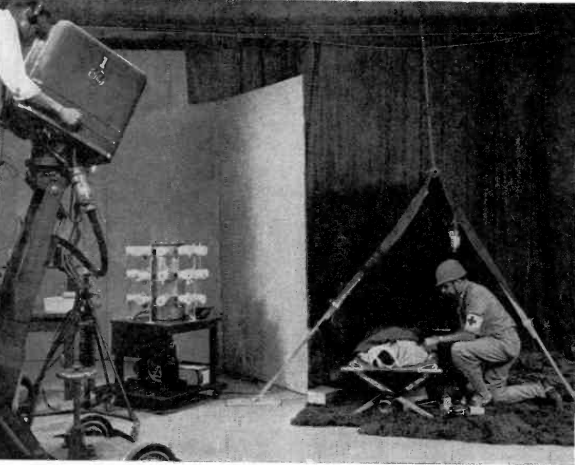
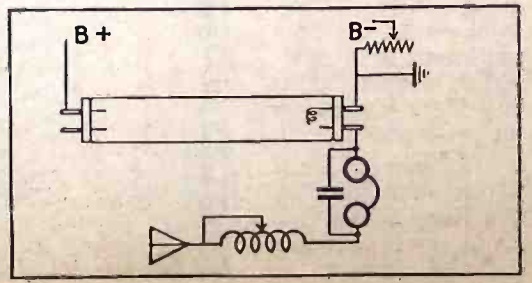
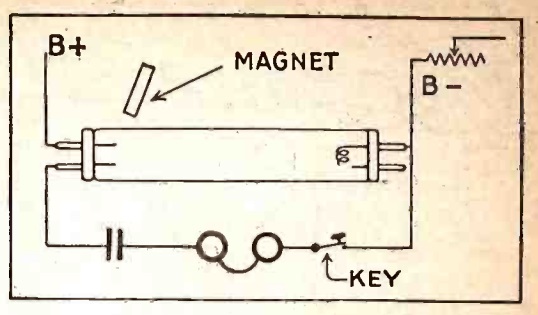
1943DecRadioCraftSeventy-five years ago this month, the December 1943 issue of Radio Craft included a description of this light-phone reportedly in use by the Germans.

The set could operate in three modes: white light, red light, or infrared. Obviously, simple morse signalling was possible, but the beam could be modulated with audio.

The article noted that the applications of the device were rather limited, but wondered whether the Allies would be adopting a similar system at some point.


1943 Bike Radio

1943DecPMJust because there was a war going on didn’t mean that you couldn’t listen to the radio while riding your bicycle, as shown in Popular Mechanics. December 1943.

The set was billed as a “big town” bike receiver, and the article pointed out that it would pull in the local stations “as you ride around in any city where powerful stations are located.” The set itself was just a crystal set, using a fixed detector. The set was mounted in a tin can, which in turn was afixed to the bike. The tuning condenser and headphone connections were conveniently accessible while riding, and a whip antenna was used to pull in the strong local signals.


1943 Signal Corps Training

1943NovRadioNewsUnfortunately, the magazine doesn’t seem to provide any details as to what’s going on in this picture, from the cover of Radio News, November 1943.

But obviously, these men are mastering the finer points of voice communication.