Category Archives: World War 2

Checking for High Voltage Without a Meter

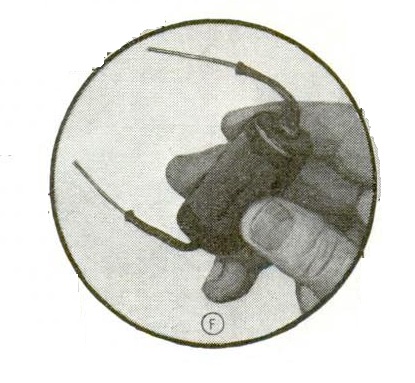
1943NovPM75 years ago, wartime shortages meant that meters were not readily available. The November 1943 issue of Popular Mechanics offers this tip for checking whether high voltage is present. A small capacitor (.25 to 2 uF, 400 volt) has spaghetti tubing placed over the leads, which are connected where the high voltage is being tested for. The capacitor is then removed and the ends shorted. A spark indicates the presence of high voltage.


Happy Halloween!

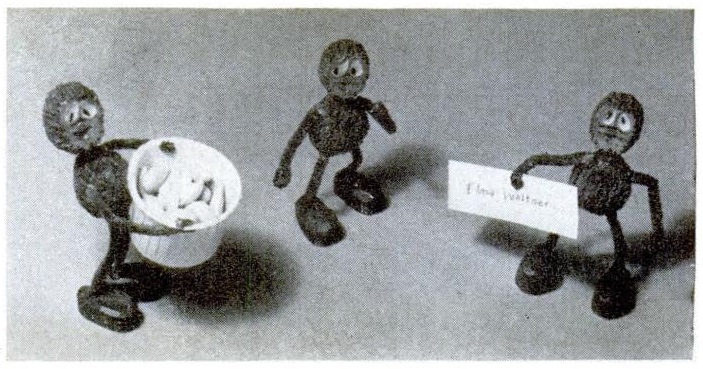
1943NovPSFor Halloween this year, we offer this Halloween craft project from 75 years ago, courtesy of the November 1943 issue of Popular Science. Wartime shortages of Halloween decorations needn’t have put a damper on things, since you could just make these. They could be placed around the room for decorations, or serve as nut holders or place tag holders at the Halloween dinner table.

All that was needed were some walnuts, pipe cleaners, and a few miscellaneous bits that could be found around the shop. The main cuts were done with a coping saw, with the nut held in a vice. The magazine provided instructions on how to finish up the tiny goblins.


1943 112 MHz Transceiver

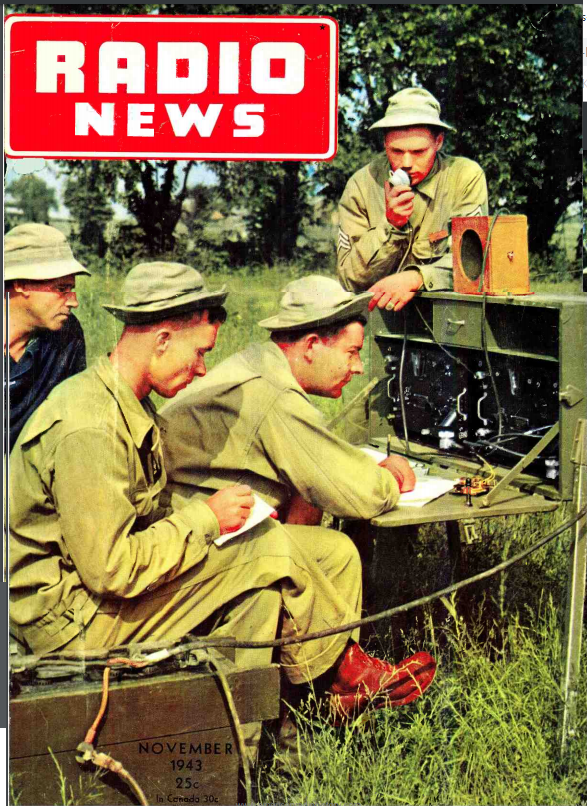
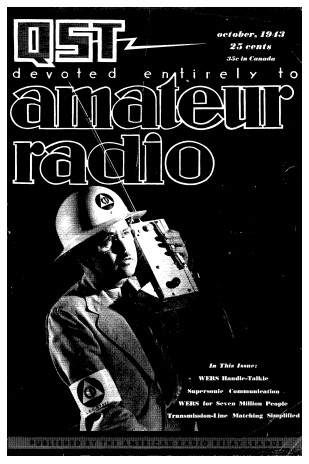
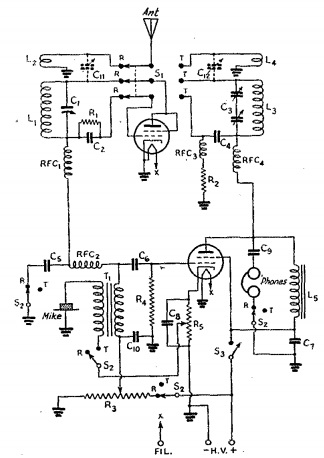
1943OctQSTcoverThe cover of the October 1943 issue of QST showed the  transceiver dubbed the “Handy Andy,” a two-tube handie talkie for use on the 112 MHz WERS band. The author notes that strictly speaking, the set is not a transceiver. Even though the same tube is used for both the transmitter and superregenerative receiver, different tank networks are used for each, allowing the frequencies to be adjusted separately. Switching was taken care of with a homemade switch, since both the audio and RF sections needed to be switched over.

B batteries could be used, but the author noted that it was being used with a 130 volt vibrator power supply running from the car battery, which provided about 6.5 watts input power. Range was said to be between a quarter and half mile, which could possibly be extended with larger tubes and higher plate voltage. The RF section could use a 6J5, 6C5, 6F6, or 6V6GT. The audio tube could be a 6F6 or 6V6GT.

1943OctQSTschematic


1943: Milwaukee Sends Smokes to Servicemen

1943Oct19MilJournalSeventy-five years ago today, the Milwaukee Journal and its subscribers were doing their part to win the war by sending cigarettes to the fighting men overseas. The October 19, 1943, issue of the paper carried this announcement that the following day’s paper would include an envelope taking up a collection.  Readers were to put some money in the envelope, and give it to their paper boy along with the normal collection.

The newspaper would buy cigarettes for the fighting men at a nickel a pack, and send them overseas in cooperation with the War Department.  A sticker on each pack would establish that the generosity of well-wishing Milwaukeeans made the gift of smokes possible.


1943 Aviation Training for High School Students

1943OctPSSeventy-five years ago, a technically inclined high school student might have given serious consideration to the proposal contained in this ad, which appeared in the October 1943 issue of Popular Science for the Aero Industries Technical Institute, 5247 W. San Fernando Road, Los Angeles,

The ad starts out by reminding that students in technical training might be eligible for a draft deferment, and the school would give students a head start. They could complete their senior year of high school and at the same time gain a year of training in Aviation Mechanics or Engineering. High school courses were taught by state certified instructors, and the aviation instructors were approved by the CAA and military. Upon completion, the student would walk away with a California high school diploma and a certificate for completing the Master Mechanics Course.

Students lived in comfortable new dormitories where they would enjoy wholesome food and real companionship. Campus activities included a band, basketball, and baseball, and students had privileges at the nearby YMCA.

The location of the school today appears to be occupied by the International College of Beauty Arts & Sciences.


Canadian Red Cross Packing Plant, 1943

1943OctManitobaCallingThe Canadian women shown here are volunteers packing prisoner of war Red Cross food parcels on their way to Canadian POWs, primarily in Germany and Italy.

The photo appeared in the October 1943 issue of Manitoba Calling, the magazine and program guide of CKY Winnipeg.  It shows the Red Cross packing plant in Winnipeg, the largest of five in Canada. The plant was staffed five days a week by volunteers and turned out food parcels at a rate of 4400 per day. The plant was described as businesslike, with two long conveyor belts. As the parcels moved down the line, a woman placed a food product in the same spot in each box. Items were picked for their nutritive values, and included chocolate, raisins, tinned butter, and corned beef. An acknowledgement card was included in each parcel, which were signed by prisoners and returned by mail to the Canadian Red Cross as proof of delivery.

From Canada, the parcels went by sea to Lisbon. From there, they were taken by Red Cross ships to Marseilles and then by train to Geneva to the warehouses of the International Red Cross. From there, they were distributed within the enemy countries.

The magazine noted that many of the volunteers were related to prisoners, 900 of whom were Manitoba boys.


1943 Cable Reel

1943OctPM

In 1943, teen girls went for the boys on the Audio-Visual crew, as shown by this illustration from the October 1943 issue of Popular Mechanics.  (Note the book bag at her feet, ready to be carried home by one or both of the helpful lads.)

The two shown here are running wire to an extension speaker using the large diameter reel shown in the magazine. Not only are they impressing the girl with their knowledge and skill, but they’re being patriotic by being careful with wartime strategic materials, since storing the cable on such a reel made it last longer than if simply hung on a nail or small diameter peg.

1943OctPM1The boys probably made the reel in wood shop where they showed their skill, since the magazine noted that the unusual design, shown here, “provides an interesting sawing problem for students.”


Bringing the Car Radio Inside

1943SepPM2With the family car out of service for the duration, the September 1943 issue of Popular Mechanics offers this suggestion for putting the radio and battery to work by bringing the radio into the house.

Here, the set is mounted on a small shelf, with a speaker mounted above it. The six-volt car battery is in a carrier on the floor underneath, connected to an optional trickle charger. The antenna is mounted on a bracket on the wall. The ground wire is run to a metal plate which could be placed under a carpet or, on the ground floor, to a piece of sheet metal placed under the floor joists.

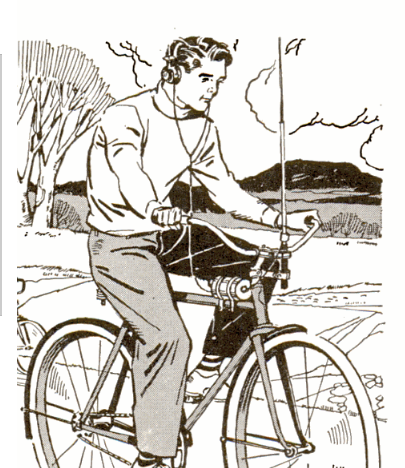
The magazine points out that the car radio probably provided good reception. If the project looks familiar, we previously carried a similar one for mounting the radio inside, and another for putting the radio on a bicycle.


Another Flashlight Saves the Day

1943SepPMSeventy five years ago this month, the September 1938 issue of Popular Mechanics carried this Eveready ad with another harrowing tale with a happy ending, thanks to a flashlight with fresh batteries.

The ad recounts the tale of Mr. & Mrs. James Sponston of Cheshire, England. Night after night, the couple would hear the German bombers headed toward Liverpool. But one night, as they were preparing to retire for the evening, the elderly couple heard the sirens begin to shriek.

Mr. Spronston grabbed his flashlight, and they hurried downstairs to black out the windows. Then one explosion, and then another, shook the house. The house was half demolished, and the stunned occupants were thrown to the floor. Fortunately, Mr. Spronston remembered the faithful flashlight in his hand and began waving it. Two passing air wardens saw it and quickly directed the rescue.

Since the story was from England, there was no claim that Eveready batteries were involved. But still, American readers were encouraged to make sure their flashlights were loaded with fresh Eveready batteries. The ad cautioned, however, that you shouldn’t blame your dealer if you can’t get genuine Eveready batteries. The Army, Navy, and Lend-Lease had priority, and only a few were left for civilians. To conserve critical war materials, readers were cautioned to use the flashlight normally as little as possible. In particular, it advised making a habit of flashing it intermittently rather than continuously.


Courtney’s Radio Service, Stratford, Conn., 1943


1943SepRadioRetailingShown on the cover of Radio Retailing Today 75 years ago this month, September 1943, is Mrs. Wallace Courtney, the wife of the owner of Courtney’s Radio Service in Stratford, Conn. When a representative of the magazine entered the shop, he was greeted by Mrs. Courtney, who was busily engaged in her work of servicing radios. When the reporter asked about the set she was working on, she reported that the rectifier was intermittently glowing red hot. After some poking around, she found a high voltage lead with frayed insulation that had been shorting out against the chasis.

1943Aug30BC2Mr. Courtney was working in a war plant installing radios in airplanes, and left the shop in the able hands of his wife, who juggled the business with caring for the couple’s twelve-year-old son, who was said to be earning good marks. It was her quiet, pleasant voice that answered the phone when customers called. She wasn’t able to make service calls, but when customers brought in a set, she would get it repaired as fast as humanly possible.

According to the magazine, Mrs. Courtney was “typical of a lot of American wives and mothers, who without any fuss or furore, have stepped calmly into their men’s places for the duration in whatever capacities the jobs may call for.” She ran the shop during the day, and in the evening helped her husband work out any repair problems in whatever hours he could spare.