Category Archives: World War 2

1945 MacGyver Power Supply

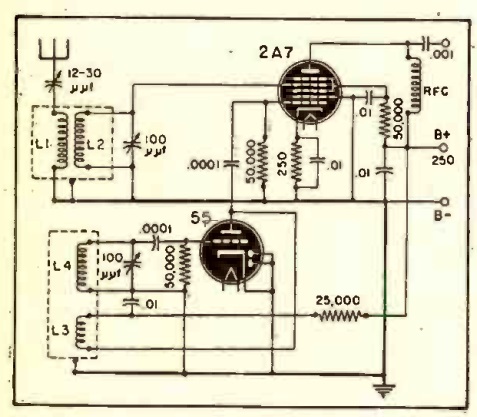
1945MarRadioCraftB

According to Wikipedia, MacGyver was born in either 1951 or 1952, so he couldn’t have been responsible for this wartime power supply. Instead, it was sent in to the the March 1945 issue of Radio Craft by one Richard F. Reed of Jacksonville, Florida. But MacGyver must have been inspired by Reed, since this power supply ingeniously makes use of available parts, despite wartime shortages.

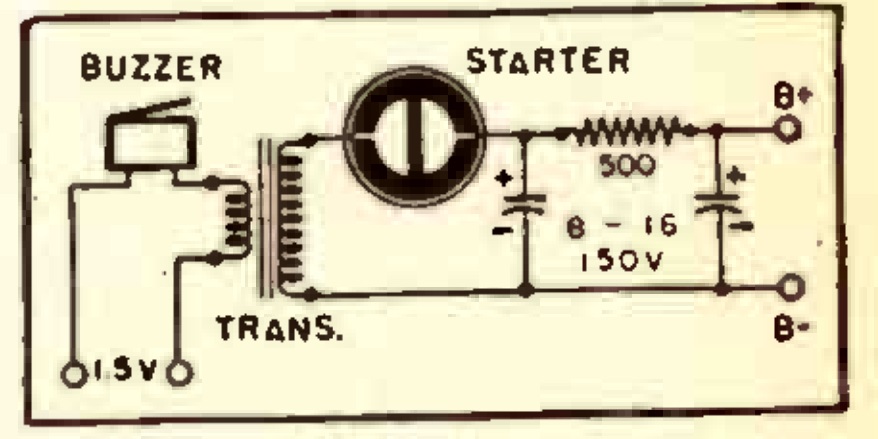
Reed needed to 90 volt power supply, and used this circuit to get it out of a 1.5 volt battery. The transformer could have been an audio output transformer, but Reed had on hand a model plane induction coil, so he used that. In lieu of an inverter, he used a 1.5 volt buzzer in series with the transformer.

For a rectifier, he used the starter from a fluorescent light. He reported that the supply put out 95 volts at 25 mA.


1945 Three Tube Broadcast Set

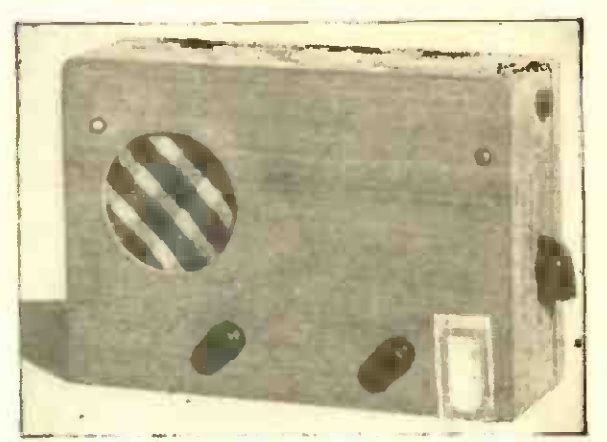
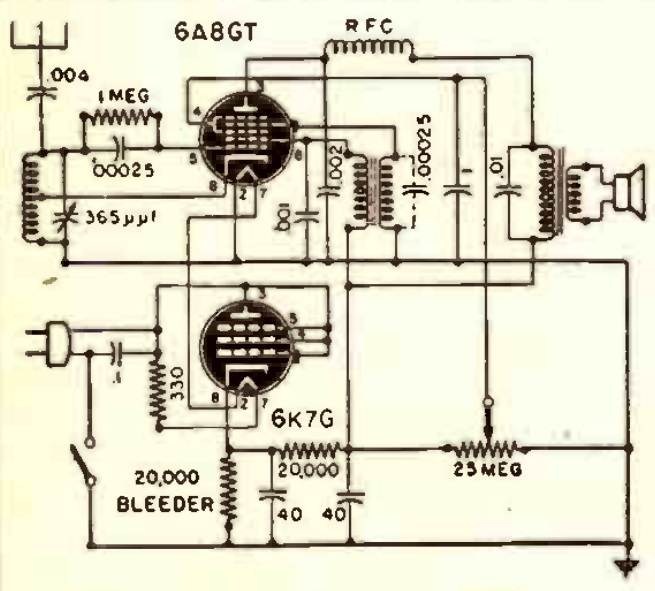
1945MarRadioCraftThis handsome but utilitarian wartime cigar-box set was put together by G.L. Keirstad of Toronto, and described in the March 1945 issue of Radio Craft magazine. According to the author, the set pulled in all four of the local Toronto stations, as well as WGR and WBEN in Buffalo. At night, it would also get the New York stations with loudspeaker volume quite adequate for a personal radio.

1945MarRadioCraft2


Stromberg-Carlson 1945

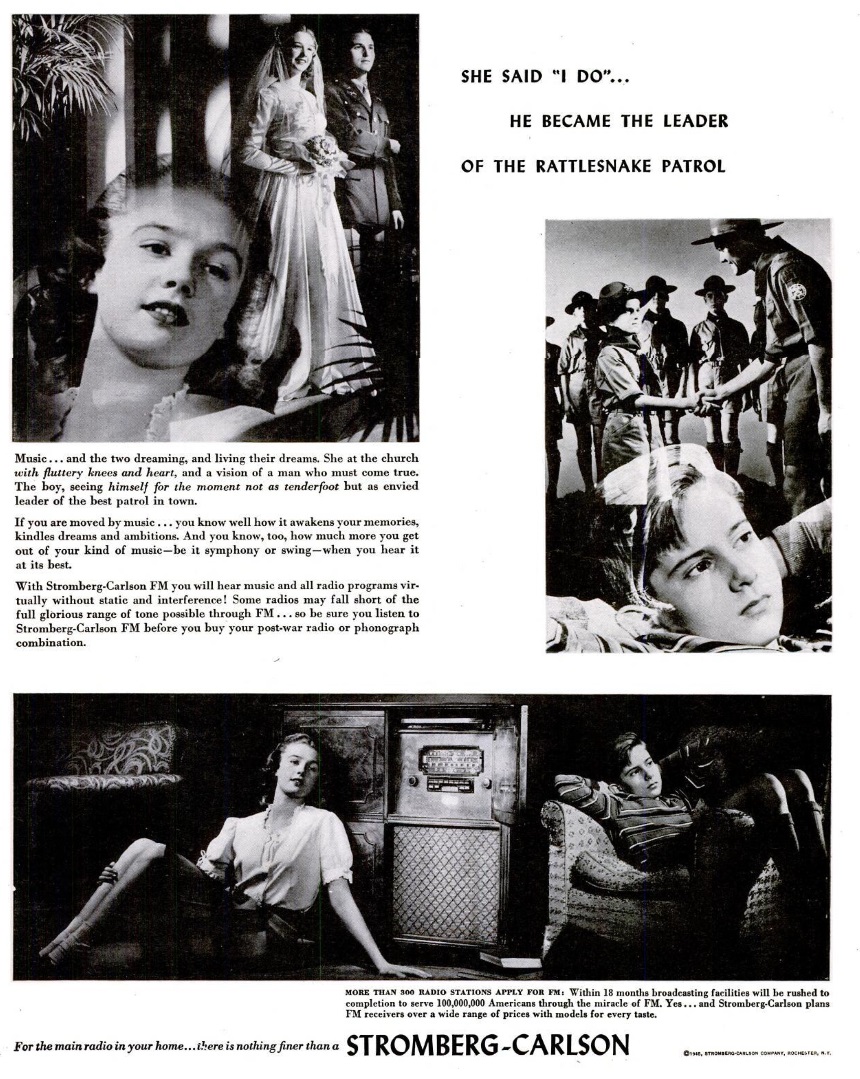
1945Mar12LifeIn March 1945, the war was still on, and that meant that there was no production of civilian radio receivers. But the manufacturers knew that there would be a big sales boom as soon as the war was won, and they were getting their name before the public.

This ad from Stromberg-Carlson appeared in Life Magazine 75 years ago today, March 12, 1945.  And the company was betting on the miracle of FM being the wave of the future.  These young people are listening to some postwar program daydreaming.  The girl dreams of marrying the man of her dreams, and her tenderfoot little brother dreams of being the patrol leader of the best patrol in town.


1945 “Little Giant” TRF Broadcast Set

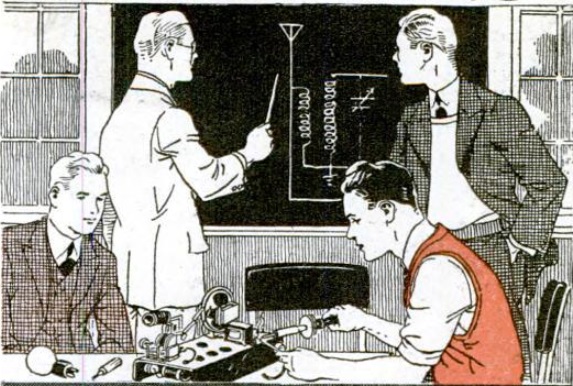
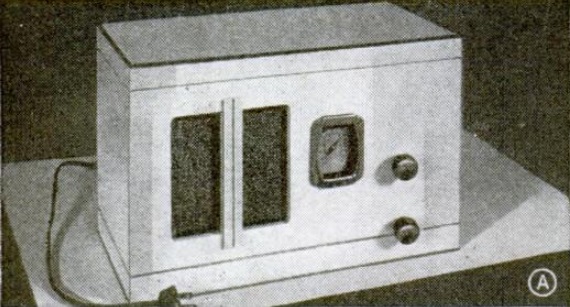
1945MarPM31945MarPM1Every year, Popular Mechanics featured plans for a receiver dubbed the “Little Giant,” and these gentlemen are putting together the version described in the magazine’s March 1945 issue.

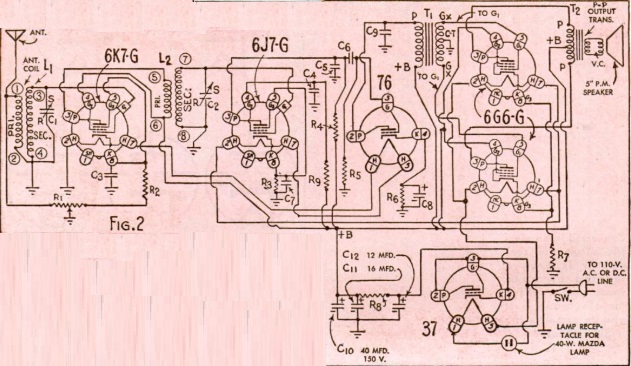
Despite a war going on, this set was somewhat more elaborate than most.  It featured push-pull audio, with two 6G6-G tubes driving the speaker.  To drop the voltage for the filament string, a 40 watt light bulb was used.  It could be mounted on the chassis, or a lamp could be plugged in to the radio.  The set used a TRF circuit, and the magazine recommended a 75 foot antenna to pull in distant stations.

1945MarPM2

1945MarPMSchematic


Answer to Yesterday’s Quiz

1945MarPSYesterday, we featured this brain teaser from the  March 1945 issue of Popular Science.

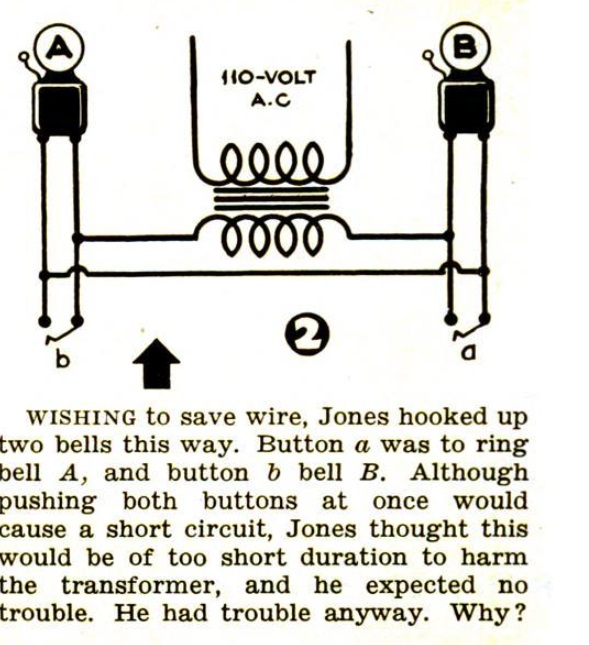
At first glance, it looks like it will work.  If you trace the path with button a pushed, bell A should ring.  But what you might not have noticed is that with neither button pushed, both bells are hooked up to the transformer in series.  So they will ring continually, albeit probably at reduced volume.

So wartime shortages or not, Jones will have to scrounge up some additional wire.


1945 Electrical Quiz

1945MarPSWartime shortages were undoubtedly the reason that Jones tried to save wire when hooking up his two doorbells. But can you figure out what went wrong? We’ll have the answer tomorrow.

This item appeared 75 years ago this month in the March 1945 issue of Popular Science.


Chicago War Worker: 1945

1945FebRadioNews
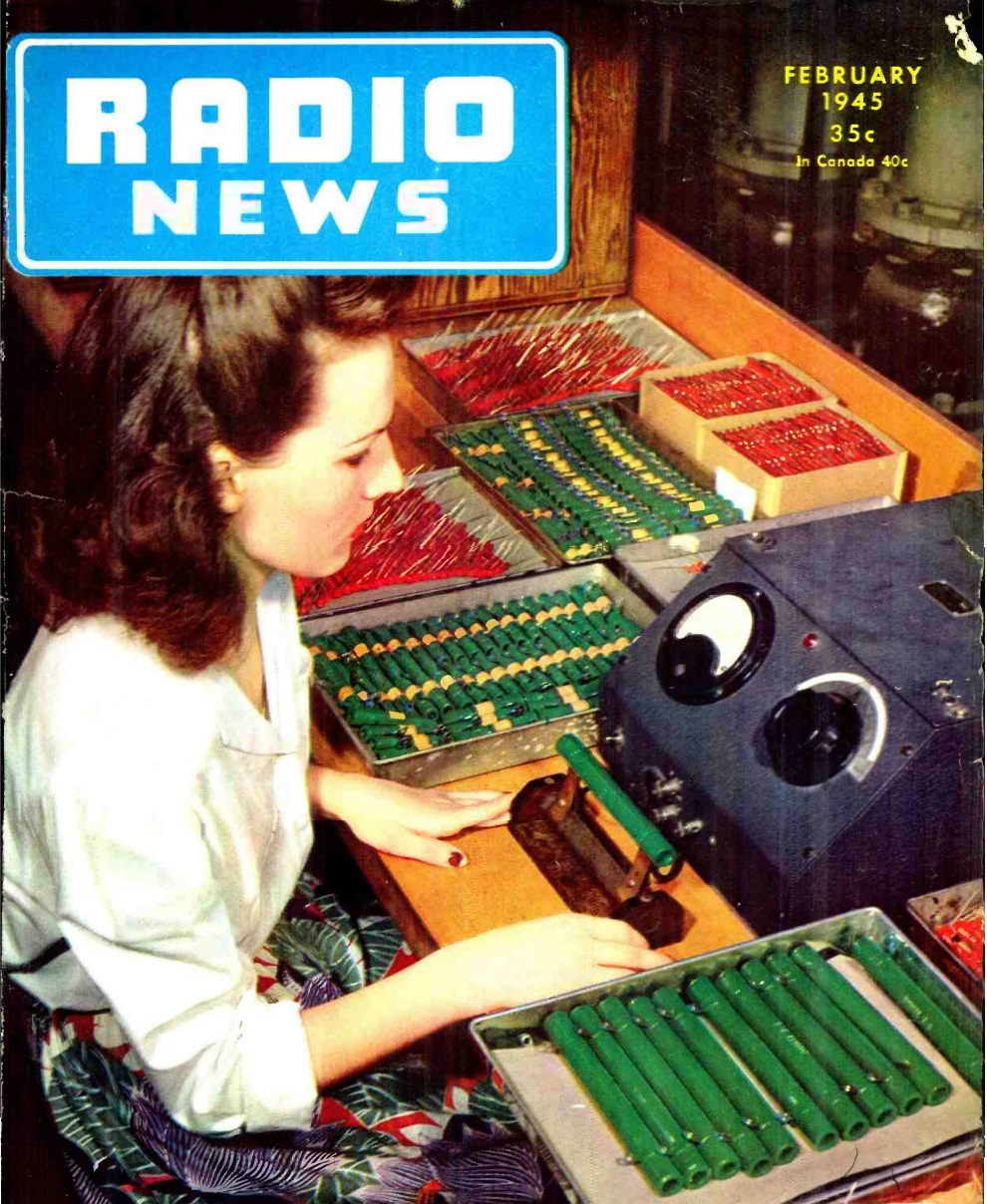
Seventy-five years ago, this Chicago war worker was testing RF chokes for their Q factor as they rolled off the assembly line of the Ohmite Manufacturing Company plant. The picture is the cover of the February 1945 issue of Radio News.


Mahr & Van Name, 1945

1945FebRadioRetailing29BeachStStatenIslandSeventy-five years ago, this trapezoidal building was the home of Mahr & Van Name, a radio dealer at 29 Beach Street, Stapleton, Staten Island, New York. The shop was featured in the February 1945 issue of Radio Retailing.

According to the magazine, both before and during the war, the shop stressed quality and material, rather than selling on a grand scale. With wartime shortages, that philosophy proved to be especially important.

Even before the war, the shop also sold table lamps, and those sales, along with service, kept the store open during the war. The owner predicted big things for both FM and TV, both of which the store had sold before the war.

As shown from the current Google Street View shot, the building still stands, although its unclear who occupies the radio shop’s former space.

1945FebRadioRetailing2


Admiral Model 12-B-5, 1940

1940FebRadioRetailingEighty years ago this month, the February 1940 issue of Radio Retailing carried this ad for the Admiral model 12-B-5, a five tube set that covered both standard broadcast (including police at the top of the dial) and shortwave signals from 5.65 to 17.1 MHz.

With Europe at war, this inexpensive set would pull in the news straight from the warring powers. I wasn’t able to find much information about this set, but it looks like an “All-American Five” with the shortwave band added. It probably did an adequate job with the strong stations, and at $12.95, it was modestly priced for a shortwave set.


1945 Army Flight Nurse

1945Feb12LifeShown here, in the February 12, 1945, issue of Life magazine is U.S. Army flight nurse Lt. Victoria Pavlowski, giving a glass of juice to Pvt. Charles V. Reusch, who is being evacuated from Leyte to a hospital in Hawaii. Lt. Pavlowski, described by the magazine as “young, courageous, and pretty,” was among the first class of flight nurses, and was working the 18-hour round-trip flight evacuating injured servicemen from the Pacific theater.

The Life article was penned by Shelley Smith Mydans, who with her photographer husband had been captured in Manila and spent two years in a Japanese internment camp. (We previously wrote about her capture.) She described the group of nurses as “very young, almost like college girls, sitting cross-legged on their beds, smoking and laughing. Their make-up was fresh, their nails brightly polished and their man-sized khakis and flight suits less baggy than the modern coed uniform.”

ArmyNurseLt. Pavlowski went on to marry another officer, and retired from the Army some 20 years later as Maj. Victoria Dragoui. She was profiled in Warrior Medic magazine in 2011, from which the picture at left is taken. She died in 2010 at the age of 98.