Category Archives: Radio history

1926 Closeout Bargains

If you were in the market for radio supplies (or auto parts or electric appliances) a hundred years ago, then Milwaukee was the place to be, as evidenced by this ad in the Milwaukee Leader, March 27, 1926. Times Square Radio & Auto Supply Co. (corner of Wells and Second Streets) was having a closeout, and was selling at sacrifice prices. Even the fixtures were for sale, and the building was up for rent, as shown in this ad from the Milwaukee Leader, March 27, 1926.

You could take home a Timesco 5-tube radio (complete with genuine RCA tubes, batteries, speaker, antenna and ground) for only $47.50. Many other accessories were also available.

And if you needed an electric iron, coffee percolator, toaster, or waffle iron, you could also get those at great prices. Interestingly, it looks like at least the coffee pot seems to come with the adapter, so that you can plug it in either to a two-prong outlet, or screw it directly into a lamp socket. Those little adapters can often come in handy, and you can still find them today at Amazon.


Some links on this site are affiliate links, meaning that this site earns a small commission if you make a purchase after using the link.

1941 British Four-Tube Portable

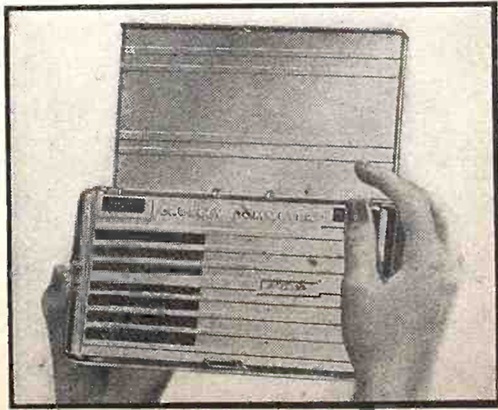
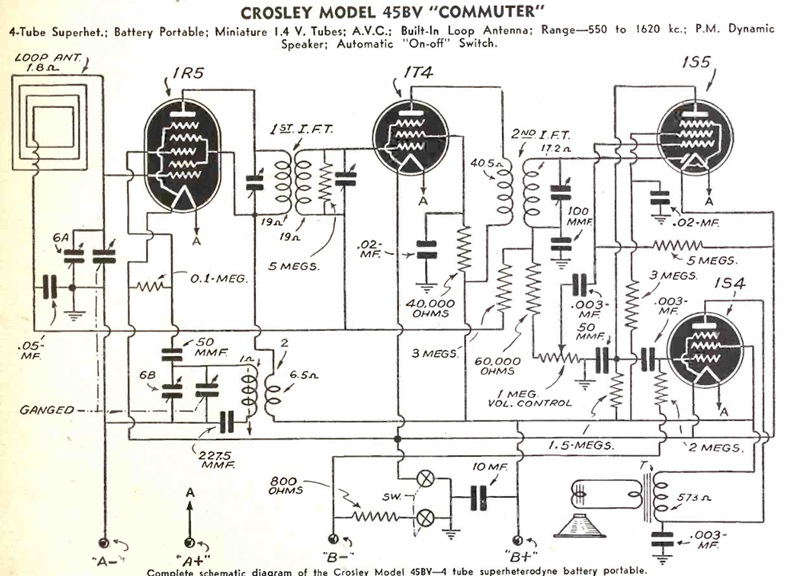
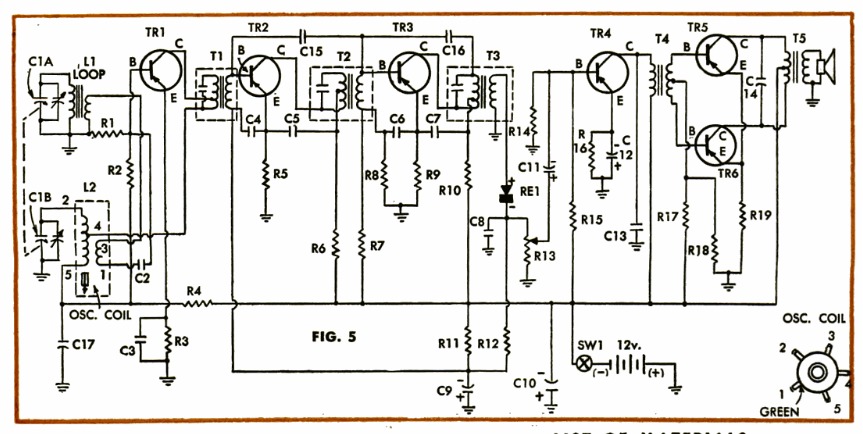
Eighty-five years ago, Britain was at war, but that didn’t stop the March 1941 issue of Popular Wireless from carrying instructions for building this 4-tube superheterodyne portable receiver, comparable with commercial sets. The “all dry” designation refers to the battery, which was a dry battery. A single “Type H” battery was used, as it contained one tap for the 1.4 volt filaments, as well as a higher voltage for the B+.

The construction article was to continue in the next month’s issue.


Adding a Metronome to a 5-Tube Radio, 1956

Seventy years ago, the March 1956 issue of Radio Electronics showed this idea, sent in to the magazine by one Jess Jacobson, of how to turn a 5-tube radio into a metronome for the aspiring musician. A few components, including a neon lamp, are simply added to the radio to form a relaxation oscillator from the final audio stage. An RC circuit charges up until it is able to light the neon lamp, at which point a click is heard in the speaker of the radio, which has been tuned to a blank spot on the dial.


1956 Two Transistor Transmitter

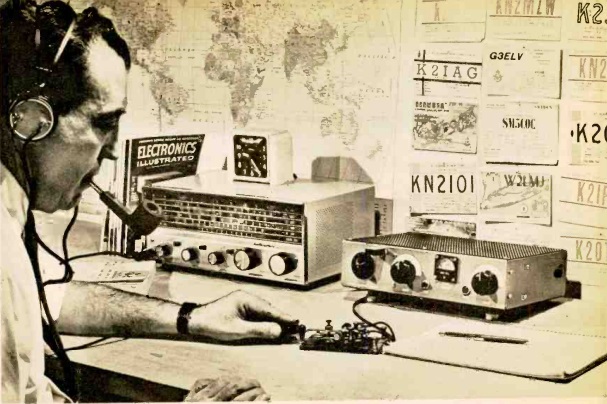
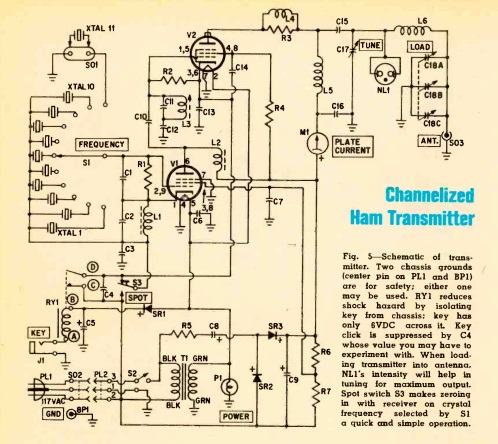
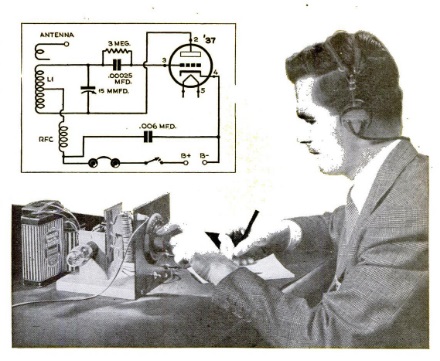
Seventy years ago, the March 1956 issue of QST featured this two-transistor transmitter for 40 meters. The author, Laird Campbell, W1CUT, noted that the QRP rig probably wasn’t going to get a top score in any contest. It was strictly for experimenters who wanted to get up to speed on the new transistors that had recently become available. He also noted that this was probably the first time ever that QST had shown pictures of a transmitter full size!

The circuit used to CK761 transistors, running on 8 penlight batteries. Since different parts of the circuit required different voltages, multiple taps were used. Campbell reported that the set had worked many contact over the prior months, including 8 states worked. The best DX was 800 miles. All of this was accomplished by simply calling CQ, without any prearranged schedules, which he deemed unsporting. He did not the problem, though. Another station hearing his call might assume that the path was simply not there, even though the QRO signal would get through just fine. He dismissed calling “CQ QRP,” as this would be interpreted as wanting to make contact with other QRP stations. He proposed something that never caught on, namely, calling CQ TR to let the other guy know that the weak signal was the result of a transistorized QRP rig.


1966 Tube Testers

In the 1960’s, tube testers were common fixtures in many retail stores. In my case, if I had a tube to test, I would take it to the neighborhood drug store. And I generally treated the results as gospel. But the machine was there for one reason, and that reason was to sell tubes. So they tended to err on the side of caution, and caution meant giving a slightly pessimistic evaluation. Maybe the tube would still function OK in its circuit, but the tester said it was time to replace it.

Apparently, this was also the state of affairs in Italy, as shown by this cartoon in the March 1966 issue of Radiorama. In this case, the meter on the tester is calibrated “bad” and “worse”. The caption reads merely, “speechless.”


Robert Gunderson, W2JIO, 1951

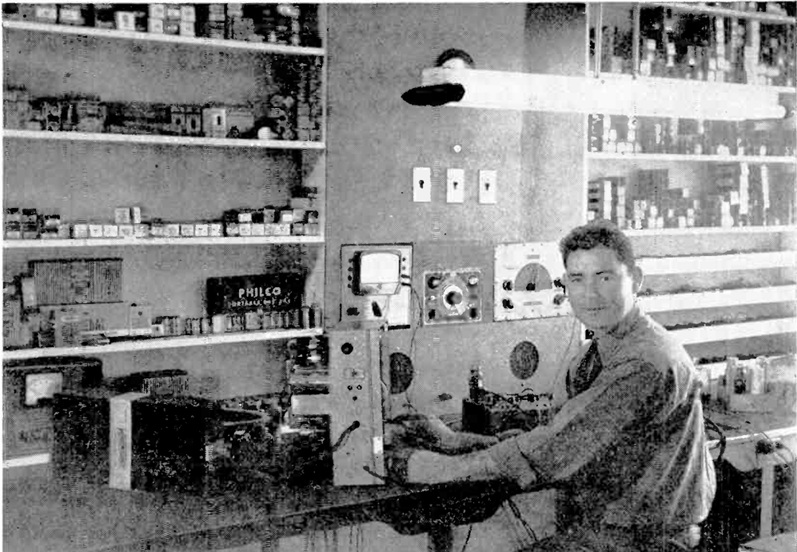
Seventy-five years ago, the cover of the March 1951 issue of Radio Electronics featured Robert Gunderson, W2JIO,  in his radio lob, sound studio and ham shack at the New York Institute for
the Education of the Blind.  We’ve previously seen Gunderson as the mentor, in 1941, of deaf-blind ham Leo Sadowsky, W2OFU.  But Gunderson was a remarkable figure in his own right.  He started at the Institute as a student in 1928.  Upon graduation in 1937, he was put to work heading the school’s radio vocational department.  You can see a complete biography at this link.  You can also find a good look at his work in the March 1951 issue of QST.

The magazine included an article by Gunderson regarding adaptation of test equipment for the blind.  But as the cover hints, it wasn’t just a matter of accessibility for the blind.  Gunderson made the instruments better for sighted individuals as well.  Most of his adaptations involved audible signals, showing when a Wheatstone bridge was in balance, or when two signals were zero beated.  Since these phenomena involved extremely precise measurements, they were beneficial to all servicemen.  And since the feedback was audible, even a sighted repairman benefited, since he could keep his eyes on the work while making the measurement.


1926 Crystal Set

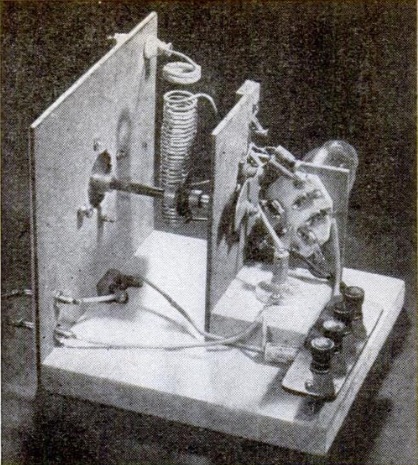
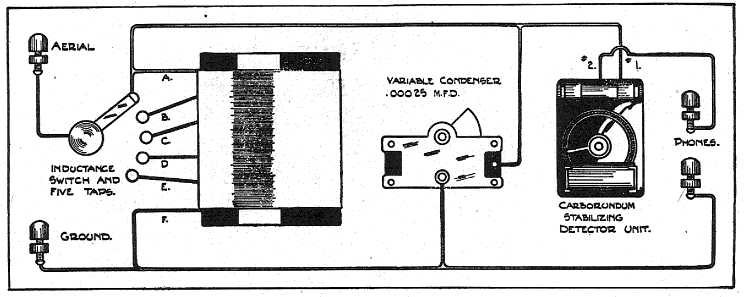
One hundred years ago this month, the March 1926 issue of Popular Mechanics showed how to build this crystal set, which the magazine said could be put together for just fifty cents. A unique feature was the tuning. The coil, wound honeycomb style, was rotated through two tin plates. According to the magazine, the set would provide good volume on local stations.


1926 Radio Drawing Contest

One hundred years ago this month, the cover of the March 1926 issue of Radio News announced the magazine’s drawing contest, in which readers would show their ideas for the ideal radio set. I’m sure the women were delighted to see that there were special prizes reserved for them. But wait a minute….

That’s right.  Women don’t qualify for the big prizes, and “special” apparently means smaller.


CHU Canada, 1956

Shown here 70 years ago, in the March 1956 issue of Popular Electronics, is CHU station staffer J.P. Henderson making an adjustment to one of the  timing devices in use by the station at the Dominion Observatory in Ottawa.  The voice announcements were recorded on the soundtrack of 35 mm film, and a system of cams was used to start the correct announcement of station ID, hour, and minute.

The magazine noted that during the summer months, the observatory was open to the public for astronomical viewing on Saturday nights.  During each session, there was also an open house at one of the observatory’s divisions, meaning that radio fans had a couple of opportunities each year to visit the radio station and see it in action.

Since January 1, 1955, the station had been on the air giving the exact time on its then frequencies of 3330, 7335, and 14,670 kHz.  Many North American hams, like me, undoubtedly used the 7335 signal as a means of making sure their 40 meter receiver was in calibration.  These days, the 40 meter frequency has moved to 7.85 MHz, but the other two frequencies remain in operation.


General Electric L-678 Radio-Phono

These young women are now in their 90’s, but they undoubtedly have an appreciation for good music, thanks to their parents’ foresight in putting a six-tube GE model L-678 radio phonograph in their room. This ad, which appeared 85 years ago today in the March 10, 1941, issue of Life magazine, points out that they can listen to the music their mother wants them to hear, whether it’s on records (much of which was specially arranged for children) or on the radio. For only $39.95, the set had excellent tone, and it could be operated by even a three year old.

The ad also highlights the L-500 table radio for $9.95, and the JB-410 portable for $19.95.