Category Archives: Radio history

Farnsworth CT-59 Portable, 1941

This broadcast listener is pulling in a favorite program on her portable Farnsworth CT-59, a 5-tube 3-way (AC/DC/Battery) set. The photo appeared in the May 1941 issue of Radio Retailing, and the accompanying article reminded readers that customers were already preparing their summer vacations, and dealers would be well advised to make sure they had a portable to take with them.


Emergency Communications for the Railroads, 1926

A hundred years ago, this railroad station agent was reviewing a message sent from another station via amateur radio. You need communications to run a radio–before sending a train down a westbound track, you better make sure that there’s not an eastbound train coming toward you. Normally, those orders go out via telegraph, but if the wires were down for any reason, that was a problem.

As late as the 1940s, you see occasional reports of amateur radio operators helping out the railroads with this vital traffic, such as during the 1949 Midwestern blizzard.  It is illustrated here on the cover of QST, May 1926. The accompanying article explains how the ARRL was approached by the Pennsylvania Railroad to set up a reliable backup system. Over the course of 10 weeks, tests were conducted to make sure there would be a smooth transition in case of emergency. All of the cities shown on the map below were represented, in most cases by multiple stations.


1956 Emergency Radio Receivers

Seventy years ago this month, the May 1956 issue of Popular Electronics showed these ideas for an emergency radio receiver. If the power was out, or the radio otherwise out of commission, the emergency adapter was simply placed near the loop antenna. Inductively coupled, it would use the set’s tuning circuit, and you could hear it through headphones. Three versions were shown. The cigar box version had the advantage of furnishing a place to store the headphones. Another one used a loop antenna from a broken radio, and the third variation had the coil taped permanently in place on the outside of the radio.


Winding Your Own Transformers.

If you are in need of an unobtainium transformer, you can always just make your own! As the elementary student of electricity has learned, a transformer consists of nothing more than two coils of wire wound on a suitable core. In practice, it’s a bit more complicated than that, but not much more. The hardest part is probably coming up with a suitable core, but that is explained in the diagram at left.  The finished product is shown above.  If you need complete instructions, they were published 85 years ago in the April and May 1941 issues of the British magazine Practical Mechanics.

For a student looking for a unique science fair project, this series of articles will give many ideas.


1941 Phono Oscillator

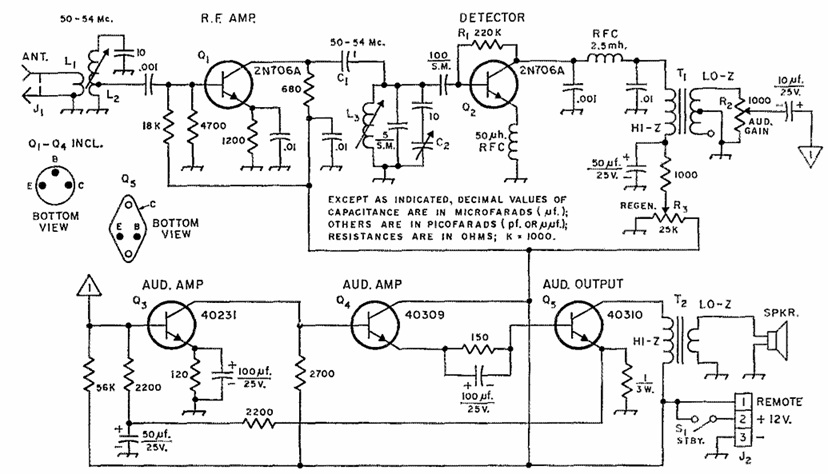
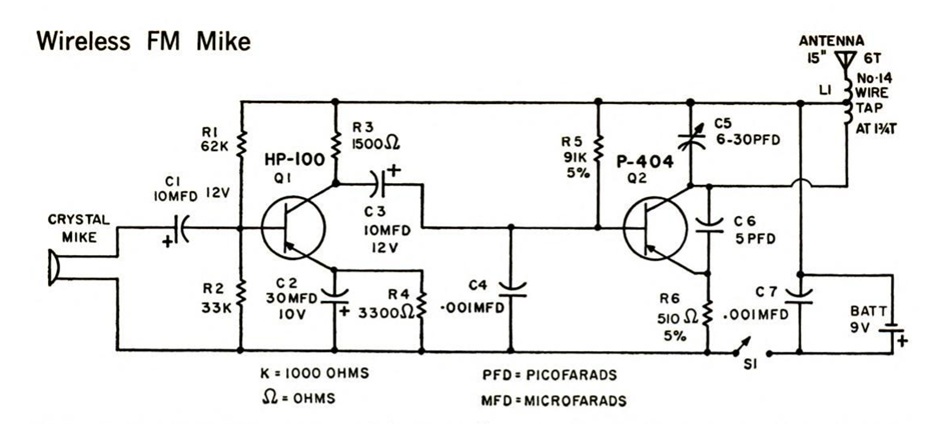
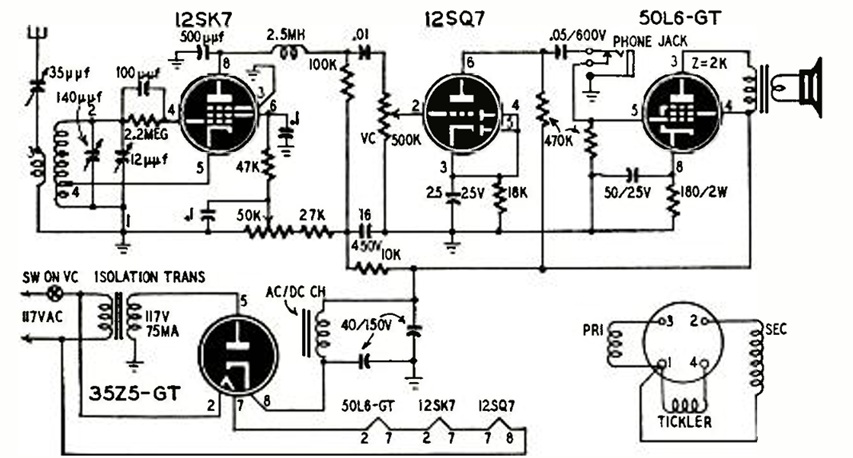
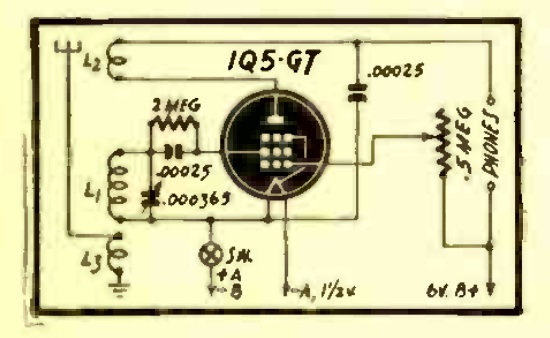
Eighty-five years ago this month, the May 1941 issue of Radio Craft carried this circuit for a simple phono oscillator. It had been sent in to the magazine by one Eugene Simpson of Naperville, IL, who pointed out that there had been a lot of interest recently in phono oscillators, and many enthusiasts were looking for a simple circuit. He recommended tuning the coil to the high end of the broadcast band, and cautioned not to use an antenna, as “The F.C.C. doesn’t like people who do otherwise!”


1941 Portables

Eighty-five years ago, this young woman is enjoying a favorite song from her portable phonograph. Hers was an electrical model, but there were many options for portable music, as detailed in the April 1941 issue of Radio Retailing.

The magazine noted that it was the perfect time of year to start marketing portables. Since April marked the beginning of the warm weather season, portables would get their greatest natural play. It also pointed out that since portables were still owned by relatively few people, they had a novelty factor that would help build store traffic.

Options included both radios and phonographs. While the unit shown above is electric, there were still many purely mechanical record players available, and the magazine provided an extensive directory of spring machines with no tubes. The least expensive was the Model 11 from Favorite Manufacturing Co., 105 E. 12th Street, New York, with a list price of $8.39.


1956 Custom Hi-Fi

Seventy years ago this month, this high fidelity enthusiast was making adjustments to the H. H. Scott control panel of a custom installation, put together by Custom Sound Systems of Orange, New Jersey.  The two lower drawers contained a De Jur tape recorder and Audiosphere stereophonic tape player.  The upper drawers contained a Rek-O-Kut record player and an Altec amplifier.

This deluxe setup is in the home of one Robert Ossorio of New York City.  But while this young woman appears at ease with the equipment, she’s actually a model, Mona McHenry, hired for the photo shoot.  The photographer is by Dan Rubin, and the photo appeared on the cover of the April 1956 issue of Radio-Electronics.


Getting the Antenna Higher: 1941

If you need to get the end of your antenna up a few more feet, you might try this idea sent into QST 85 years ago this month, April 1941. The idea is self-explanatory–you just hoist a new section of mast up your existing mast. The bottom of the new section contains a ring of heavy wire. The idea was submitted to Hints and Kinks by Bernard S. Shields, W5AJJ, who noted that if the guy wires are added to the top section, an appreciable height could be achieved.


Build Your Own Scope: 1951

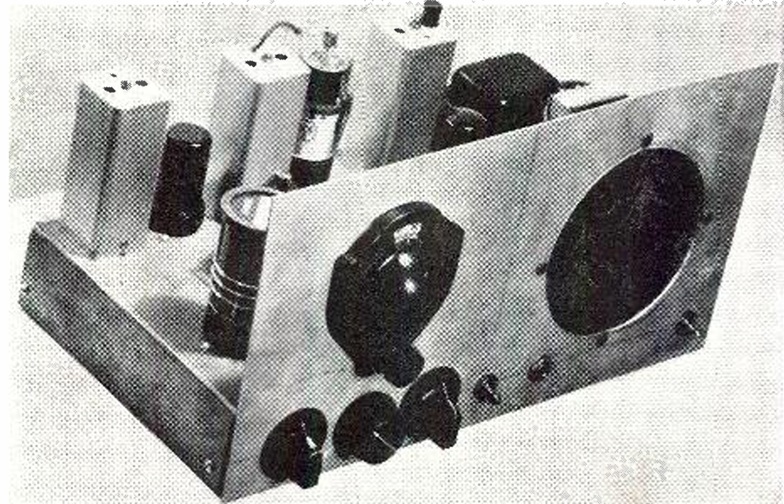
Seventy-five years ago, the April 1951 issue of Radio Electronics showed how to construct your own oscilloscope. The magazine pointed out that many were daunted by the prospect, but a basic scope for work on AM and FM radios was well within the capabilities of the average builder. The model they show used five tube, including rectifier, plus the CRT.

These days, you don’t need to break out the soldering iron or track down those five tubes. You can go to Amazon and get a pocket-sized version.


Some links on this site are affiliate links, meaning that this site earns a small commission if you make a purchase after using the link.

Motorola 3A5 “Playboy”, 1941

Eighty-five years ago this month, the April 1941 issue of Radio News showed the Motorola model 3A5 “Playboy.” The four tube (plus rectifier) portable radio was said to play anywhere, and the manufacturer backed up that promise: The set would play where other personal portables failed, or the customer’s money would be refunded.

The set measured 6-1/4 x 4-5/8 x 3-1/2 inches, and weighed in at 4-1/4 pounds. It started playing automatically when the lid was snapped open, and shut off when closed. It was “encased in a crackle finish metal case of modern design with shimmering chrome trim and a front cover of Polystyrene, the new plastic.”