Category Archives: Radio history

We Take You to London: 1939


RadioGuide092939Seventy-five years ago, American radio listeners were frequently hearing the phrases, “we take you to London,” “we take you to Paris,” and “we take you to Berlin,” as Americans learned how close they were to Europe’s troubles. As this item from Radio Guide for the week ending September 29, 1939, points out, we were close enough to hear a man breathe in Paris or the rustle of a paper in Berlin.

The diagram shows the example of how NBC would connect to its correspondents in London, Fred Bate or John Gunther. From NBC’s New York studios, the cue would go via telephone to the RCA short wave transmitter at Rocky Point, Long Island. The signal would be picked up by an English receiving station and sent by telephone to Broadcasting House in London. The English broadcast would go by telephone to the English short wave transmitter and picked up by the RCA receiving station at Riverhead, Long Island. From there, the signal would go back to NBC’s Radio City studios for retransmission to the network.

The process concludes when the American listener picks up the broadcase and says to himself “fervently and with conviction,” and alas, in vain, “We must stay out. We must stay OUT.”


1964 Console Stereo

AdmiralStereo

In the 1960’s, most self-respecting American homes would boast a console stereo in a prominent spot in the living room. The position would be second in honor only to that of the television.

And fifty years ago today, September 25, 1964, Life Magazine carried this ad from Admiral featuring this handsome unit. The Danish modern lowboy cabinet, made of genuine walnut veneers and hardwoods, contained an all solid state stereo featuring tuner and phonograph.


Belgian Carrier Pigeons, 1914

CarrierPigeons

Radio was coming to the fore as a method of communication during the great war, but the tried and true methods of the past were still being used. A hundred years ago today, the Philadelphia Evening Public Ledger for September 23, 1914, shows a carrier pigeon, which the paper notes were being used with great success by the Belgian Signal Corps. This bird is shown before its release containing a coded message. The french words bois (woods), pont (bridge) and cole (mine) are included in plain text.

In other war news, the paper reports that 31,200 Canadian troops, along with 7500 horses would be sent to Europe within the week, to be sent to the front immediately. In addition, the Canadians planned to recruit 19,000 more men who would be sent to the front before November.


Army Signal Corps Field Buzzer, 1916

U.S. Army Signal Corps Field Buzzer.  Technical Equipment of the Signal Corps: 1916.

U.S. Army Signal Corps Field Buzzer. Technical Equipment of the Signal Corps: 1916.

A hundred years ago today (September 21, 1914), the Calumet (Mich.) News carried an article entitled, “Communication Big Factor in Modern War Machinery,” which explained the technological developments in communications in use in modern warfare. The article runs down the developments in telegraph, telephone, and wireless in use in the war.

One that caught my attention was a rather ingenious telephone-telegraph that was used in situations where the lines were in poor shape. As the article points out, lines near the battlefield “are often laid at high speed, are of high resistance and are frequently leaky.” In those cases, it described a “special instrument known as the buzzer.”

It describes the instrument as a metal-lined leather case with a dry battery, induction coil and interrupter, key, telephone transmitter, and telephone receiver. It could be used as a field telephone, or by use of the buzzer, the key could send out an intermittent current which would traverse the line where the distant receiver would give out a sharp note. Thus, the telephone could be used to send Morse code via audio.

It notes that these “Morse signals are audible over an incredibly bad line.” It cites one case where a signal was successfully sent over bare wires lying on wet ground.

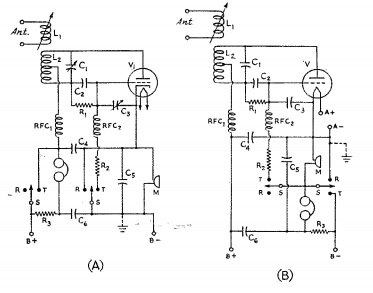
The schematic of the instrument is shown here:

The field buzzer itself is shown above as it would be carried, and it is shown dismantled here:

This diagram of a typical hookup of the buzzer shows its use with a line of dubious quality:


References

Camp Telephone for the Army, Telegraph and Telephone Age, July 1, 1917, page 302.


Allied Radio Newspaper Ad, 1964

AlliedAd17Sept1964

We didn’t have an Allied Radio store in my neighborhood, but they were still big in 1964, as evidenced by this full-page newspaper ad fifty years ago today, in the Milwaukee Journal, September 17, 1964.

Having good stereo gear was a rather expensive proposition. A turntable, amplifier, and speakers would set you back $129. A set including an AM-FM stereo receiver was $199. A twelve-inch black and white TV was $99.

A 3-1/4″ reel-to-reel tape recorder was available for only $9.99 (limit one to a customer). For the serious audiophile, a stereo tape deck was $169. Transistor radios started for $4.44. The nine-volt batteries for that radio were six for 99 cents, and flashlight batteries were nine cents each, but both limit 6 per customer.

While those prices appear modest, 1964 was the last year that that money was made out of real silver. By comparison, other ads in the same issue show that you could buy a case of beer for $1.79. At the Walgreen’s lunch counter, you could get a turkey dinner for 65 cents. Tires for your car started at $5.99. And at the supermarket, chuck roast was 45 cents a pound, carrots and bananas were a dime a pound, and five pounds of flour was 42 cents.

One would think that very few products made by Gonset showed up in normal commercial newspaper advertising, but this is a case where one did.  The ad shows the Gonset G-15 CB transceiver, normally $199.95, on sale for $99.  The 10-tube radio had four crystal-controlled channels, and its receiver tuned all 23 channels.  It operated on either 120 volts AC, or 6 or 12 volts DC with its built-in vibrator power supply.


Operation Washtub: Stay-Behind Agents After Soviet Invasion of Alaska

1954 letter seeking background on Valdez, Alaska, amateur radio operator.

1954 letter seeking background on Valdez, Alaska, amateur radio operator.

A recent batch of documents obtained under the Freedom of Information Act by
GovernmentAttic.org paints a fascinating picture of U.S. Government plans to deal with the possibility of a Soviet invasion of Alaska in the 1950’s. The 701 pages of formerly secret documents are available at this link.

The program, code named Operation Washtub, was put into place, and agents were trained as detailed in many of the documents. The plan was to have in place “stay-behind” agents who would be recruited and trained in peacetime and paid a stipend of $3000 per year to remain on standby. At such time as Alaska fell to Soviet invaders, they would provide intelligence, engage in covert activities, and aid downed U.S. airmen.

Rather extensive equipment was assigned to the agents, including a “Gibson-Girl” type radio transmitter-receiver.

Interestingly, one potential agent was an Amateur Radio operator. It appears that the author was referring to a particular individual, although there doesn’t seem to be any indication that this particular individual was ever recruited. But he does seem like a quintisential resident of the last frontier:

An example of a typical person to be one of the principals is a professional photographer in Anchorage; he has only one arm and it is felt that he would not benefit the enemy in any labor battalion; he is an amateur radio operator; he is a professional photographer; he is licensed as a hunting or fishing guide, and well versed in the art of survival; he is a pilot of a small aircraft; he is reasonably intelligent, particularly crafty, and possessed of sufficient physical courage as is indicated by his offer to guide a party which was to have hunted Kodiak bear armed only with bow and arrow. If such an individual were chosen it is believed that he would be eminently satisfactory as a principal.

A one-armed ham is one thing, but this one was apparently proficient with archery!

At least one ham was, however, recruited. The last page of the 701 pages of FOIA documents are the request for a background check of the manager of a Valdez hotel. His name is redacted in the document (probably because he was born after about 1914 and might be a living person), but the document does alert the FBI that this person is a Ham radio operator.

Surely there weren’t very many one-armed Anchorage photographers who were also hams and archers. And surely there weren’t very many hotel managers in Valdez who were hams. It would be interesting to follow up on these gentlemen and learn more about their role in the Cold War. If you have any information as to their identities, I’d appreciate hearing from you.

References:


Civil Defense Postattack Broadcast Planning: 1963

1962XtalSets

“Perfectly adequate” civil defense receivers for those close to transmitters. 1962 Radio Shack Catalog.

In an earlier post, we looked at how the Defense Civil Preparedness Agency had been planning for emergency broadcast antennas in 1973. The agency and its predecessors had long recognized the need for dissemination of information by radio, and had commissioned a number of studies on the subject. One which took a comprehensive look at the subject was conducted by Technical Operations Incorporated of Burlington Massachusetts. The study culminated in a report issued on 7 January 1963, entitled “The Civil Defense Role of Radio Broadcasting in the Postattack Period.”

The report began by identifying three distinct phases of the postattack period. The first was the Buttoned-Up Period, during which time the population would be confined to shelter because of high radiation levels or because further attack was anticipated. This would be followed by the Emergence Period when some outside exposure would be possible. At such time as a full workday was possible outside of the shelter, the Recovery Period would begin and recovery would be the focus of the public’s activities. Each of these time periods had distinct requirements with respect to broadcasting, and the report then moved on to discuss the numerous broadcast needs.

The first broadcast information discussed related to fallout, which would need to be broadcast frequently during the Buttoned-Up Period to facilitate planning by shelterees. In addition to general forecasts, these would include warnings of local hot spots, instructions on methods of decontamination and identification of safe foods, and information on the length of time over which shelter supplies would need to be rationed.

Broadcasts would also need to convey a large amount of information as to how the public could access emergency services, and would also serve a role in alerting those furnishing those services. Locations of food and water supplies could be broadcast, along with admonitions to avoid hoarding of those limited supplies. Locations of emergency hospitals and medical supplies could be broadcast, along with pleas for blood donors and volunteers to staff the hospitals. Information as to sources of fuel and power could be broadcast. And if the electrical mains were operative, the instructions might include rationing instructions. If fires were burning out of control, the broadcasts might include calls for volunteers to assist in their control, as well as warnings of fires close to particular shelters.

Much educational programming would be necessary. In addition to broadcasts of food decontamination methods, emergency first aid instructions would need to be broadcast during the Buttoned-Up Period, since no outside medical aid would be available at that time. Since some shelters might be stocked with radiological instruments with no trained personnel, this training could be broadcast as well, along with training on sanitation, shelter management, rationing of supplies, and even disposal of the dead.

During the Recovery Period, a very high civil defense priority would be re-establishment of public transportation. Once again, broadcasting would play an important role, since it could be used to call drivers back to work, as well as to announce schedules.

Even apart from this vital information, radio would be important to the public morale. The report stressed the importance of morale-boosting messages from the President, as well as by state and local leaders. Similarly, to stop the spread of rumors and boost morale, it was deemed important to broadcast news of the attack and counterattack. This would also prepare the people for the conditions they would face upon emergence, and also instill a feeling in the people that this was not a personal disaster, but that the whole population of the nation was included. The report noted that good news is always best, but that even bad news is superior to no news at all, since it helps define the environment and diminish uncertainty. The report noted that any unaffected regions of the country should be kept up to date, in order to properly tailor relief and rescue operations.

Broadcasts should frequently give the time and date, since in such emergencies, people frequently lose track. In addition, program schedules should be announced, in order to facilitate conservation of scarce batteries.

Broadcasting could also play a role to re-establish normal commerce during the Recovery Period. Even during the Buttoned-Up Period, the report recommends that people be informed as to the rules and regulations over such things as “whether the needy will be allowed to take what they require without being charged with illegal looting.”

Radio would also play a role in the care of displaced persons, since stations could broadcast information to reunite families who were separated at the time of the attack. These broadcasts would include locations of camps, shelters, and displaced person centers. In addition, during the nighttime hours, lists of people safe in various shelters could be broadcast for the benefit of their families in other areas.

Evacuation instructions and warnings of another attack would obviously have a high priority for broadcast.

The report notes that broadcast stations would undoubtedly be used to call civil defense personnel and members of the National Guard to duty and provide some instructions. Broadcast stations could even be used to relay civil defense messages from one area to another. The nighttime hours, in particular, might be put to use relaying such official messages, and civil defense officials in other areas could be assigned to monitor broadcasts from neighboring areas.

Finally, the report recommends that some entertainment should be furnished, particularly during the time in which people are in shelters. It notes that “music properly chosen many substantially aid morale in the rebuilding phase.” The report warned, however, that people with battery-operated radios should be advised to conserve batteries by listening to only a minimum amount of non-essential programming.

The overall contents of the broadcast day of a typical local station are shown in this chart:

CDbroadcastday

After identifying all of these needs, the report goes on to a discussion of how these needs can be satisfied. While some other options (such as public address systems) are briefly discussed, the only reasonable method of addressing these needs was with standard AM broadcasts. Virtually all American households had a radio receiver, and a large number had a battery-operated set. The report even notes that “for the really economy-minded, there are crystal sets selling for as little as $1.49,” which would be suitable for receiving local stations with no batteries, but with adequate antenna and ground. The footnote for this assertion is to the Radio Shack catalog, and the price obviously refers to the “Rocket Radio” shown at the top in the illustration at the top of this post.

The report did address many of the practical issues confronting broadcasting in the post-attack environment. Presumably, most information would originate at the civil defense Emergency Operations Center (EOC), and links would be necessary to studios or, preferrably, direct to the transmitter site. Since telephone lines would be vulnerable, mobile broadcast units would be advisable, although the report toyed with the idea of installing AM transmitters directly at the EOC, or the use of mobile or even airborne transmitters. Protection of station staff and equipment was addressed in this and other studies.

The report lamented the fact that the radio industry, even though some personnel served on relevant civil defense committees, largely lacked civil defense plans. For example, even radio station switchboards were poorly suited for civil defense needs. As addressed in my earlier post, vulnerability of transmitter towers to blast damage was a very big issue, as was fallout sheltering for station staff.

Station power was discussed, although the report noted that some stations already had emergency generator capability.

At the time of this report, public shelters were not stockpiled with radio receivers, and the report noted that this oversight should be rectified. This, of course, was never done, apparently the planners going along with the reasoning, “surely some people will bring radios to the shelter.”


More Dancing on the Beach to Radio, 1922

Dancing on the beach to the beat of a radio receiver was a popular pastime in the 1920’s, as evidenced by yet another photo of another young woman doing exactly that. And we see that the fad has spread to the Pacific coast, where Miss Pauline Chambers of Ocean Park, California, was captured in the act by this 1922 press service photo.


Civil Defense Emergency Antenna Instructions, 1973

ExpedientHorizontalWire

In 1973, the Defense Civil Preparedness Agency was grappling with the issue of how to keep broadcast stations on the air after a disaster, presumably up to and including nuclear war. It was recognized that a station’s weakest link was its antenna. While most antennas are designed to survive normal environmental disturbances, they are the most exposed element of a station and could be destroyed by extreme disturbances. Therefore, the agency commissioned a study on the subject, the final report of which is available online.

In the report, the engineers propose that expedient antenna kits be supplied to stations, and proposed instructions are included. The report proposed kits for both AM and FM stations, along with instructions for station personnel to deploy them. The cost of the expedient AM antenna kit, a quarter-wave horizontal wire, would be $425.37. The expedient FM antenna kit would be about $1000. Both antennas would require installation at the station, prior to the disaster, the necessary utility poles that would support the antennas.

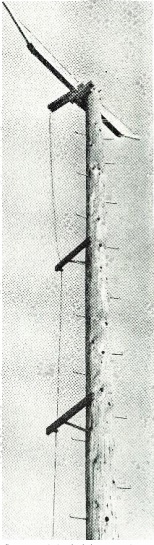
Recognizing, however, that the government might not want to bear this expense, the report also includes instructions for station personnel to construct an AM antenna using available materials. Once again, the recommended antenna is a horizontal wire, either the length of the destroyed tower or a quarter wavelength. The diagram of the recommended antenna is shown above.

Ideally, the feed point of the emergency antenna would be at the base of the fallen tower, but other options are discussed. A last resort, if the feed line were destroyed, would be to put the feed point of the antenna directly at the transmitter. The instructions caution that “it is possible to construct a transmission line, but don’t try. The performance of an antenna fed at a transmitter without a good ground will probably be better than the performance with a good ground and an improvised transmission line.”

These instructions also presuppose that the utility poles were never installed prior to the disaster. Instead, it advises to use “any existing structures available such as trees, buildings, and utility poles. A step ladder or even an automobile can be used if nothing else is available.”

Improvised antenna insulators.

Improvised antenna insulators.

Since antenna insulators probably aren’t on hand, the instructions suggest some possibilities, shown here, using things that might be found around the radio station, such as the soft drink bottle.

The main idea was to get back on the air as soon as possible. “Time is more important than radiated power, so an inefficient operation in 15 minutes is better than full power in two hours.”


A 1950-Era One Tube Radio

DSCN2358

Photo, WS1K

Jon, WS1K, sent me these pictures of a very nice find: A regenerative receiver that he found under a dealer’s table at an antique show in Brimfield, MA. He originally thought it was the receiver from the 1950 ARRL handbook, but after finding this site, he realized that it was closer to the Boys’ Life set that I wrote about earlier.

Photo, WS1K.

Photo, WS1K.

Pictures of his receiver are shown here. In addition to the receiver, he got the AC power supply to replace the A and B batteries. It also came with a schematic diagram, which is shown here:

regen3

From the way this schematic is drawn, it looks like whoever drew it copied it from the actual constructed radio, rather than vice versa. This circuit is very similar to the 1950 Boys’ Life set, but there are a few variations. For example, the component layout is different (it’s basically a mirror image of the BL set). It also has plug-in coils rather than the fixed coil in the BL set. (Jon believes the coils are for the broadcast band and about 5-6 MHz.)

Unlike the Handbook version, this set uses a transformer to couple the two stages, just like the BL version. It does have a few minor differences, however. For example, the BL version uses only two of the terminals on the regeneration control. Jon’s version uses all three. Both circuits have the cathodes of the tube hooked to one filament pin. However, the BL version calls for the connection to be made to pin 8, whereas Jon’s version calls for the connection to be made to pin 7. There’s no electrical difference, but the use of the different pin indicates that the builder probably wasn’t using the BL schematic. Jon’s version also has another variable capacitor, presumably for fine tuning.

As you can see in the schematic, the hand-drawn diagram of Jon’s set is entitled, “Dan Drummond’s Set.” Despite a little bit of sleuthing, neither of us was able to figure out who Dan Drummond was.