Wartime parts shortages were a major inspiration for the design of this short wave receiver from the January 1945 issue of Popular Mechanics. The lamp isn’t there for decoration; it’s one of the parts.
The receiver used three identical tubes, the 6C5. It ran directly off house current. The three 6-volt filaments are run in series, and to avoid the need for a filament transformer, a 40-watt light bulb in series is used to drop the 110 volt house current to the 18 volts necessary to light the tubes. A standard household receptacle is mounted directly on the chasis, into which a desk lamp can be plugged. Another alternative was to mount the bulb directly on the chasis, using a lamp adapter plug.
Speaking of the chasis, the set is constructed on a literal breadboard, sourced from the nearby dime store. The coil form was also obtained at the dime store, in the form of a plastic drinking cup. The coil is wound with cotton-covered wire, held in place with fingernail polish.
The two variable condensers, one for tuning and the other for regeneration, were scavenged from old broadcast receivers. For regeneration, only half of the 350 mF condenser is used. For tuning, the two sections of the 350 mF condenser are wired in series, rather than parallel, resulting in 88 mF, which is better suited to the 25 and 31 meter bands the set tunes. An additional five resistors and five capacitors round out the parts list.
One of the 6C5 tubes is used as a rectifier, one serves as the regenerative detector, and the final one serves as an audio amplifier. In the 1943 Allied Radio catalog, the tubes are available for 56 cents each. The catalog notes that most glass tubes were available in limited quantities. However, it noted that the metal tubes were generally available only to high priority customers.
The home computer is 40 years old. The one that appeared in January 1975 issue of Popular Electronics. Used copies of this issue typically fetch about a hundred dollars on eBay, but fortunately, a full scan of the issue is available at AmericanRadioHistory.com. The January issue carried a summary of the computer and some of the construction details. The February issue included an introduction to programming it.
The January issue carried an editorial announcing that the home computer was here. It correctly noted, “for many years, we’ve been reading and hearing about how computers will one day be a household item. Therefore, we’re especially proud to present in this issue the first commercial type of minicomputer project ever published that’s priced within reach of many households–the Altair 8800, with an under-$400 complete kit cost, including cabinet.”
The construction article billed the computer as the “Popular Electronics/MITS Altair 8800.” It was built around an Intel 8080 CPU chip, which could handle up to 78 instructions. The construction article did contain a parts list, but not full PC board templates. Those were available by mail, but it’s likely that most builders took advantage of the computer’s being available in kit form for $397, or fully assembled for $398 from MITS, Inc.
The basic computer came with 256 words of memory, with up to 65,000 being available through add-ons. The parts list called for a 2 MHz crystal, indicating the processor’s speed.
The January article suggested some possible applications for the computer, such as use as a programmable scientific calculator, machine controller, or automatic drafting machine. The February issue included the basics of programming the computer, along with a sample program to add the contents of two of the registers and store them in a third.
Programming was accomplished from the spring-loaded switches on the front panel. Another possibility for programming the computer was to use a computer terminal, and the article suggests the design that had appeared in the December 1974 issue, shown here. It’s probably not the mental image that would come to mind upon hearing the phrase “computer terminal.” It’s simply a method of sending an octal code to the computer, and receiving one back.
It was a year or two after the computer first appeared that I first saw one. When I saw it, the builder hadn’t really come up with anything for it to do. He was working on interfacing it with a teletype machine, and at that point, all he could make it do was have it output the character associated with a particular ASCII code. In other words, he entered a number using the front panel switches, and it printed out the corresponding letter. I remember not being too impressed, but I guess I did realize that at some point, I might have a computer in my house.
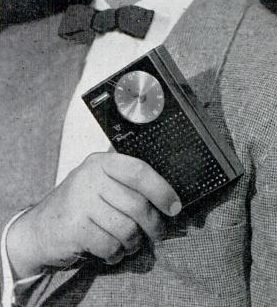
Sixty years ago, a new phrase entered the American lexicon: transistor radio. Shown here is the first commercially manufactured transistor radio, the Regency TR-1. It was first produced in 1954, and featured here in Popular Mechanics, January 1955.
As shown in the schematic diagram below, the radio used four NPN transistors from Texas Instruments. It was a superheterodyne, with one transistor as the mixer-oscillator, two for IF amplification, and one as an audio amplifier. The detector was a germanium diode. To function at RF frequencies, the transistors required a fairly high voltage, which was supplied by a 22.5 volt battery. (The battery, incidentally, is still available, but it’s now a very specialized item and very expensive.) The radio drew about 4 milliamps, meaning that a battery would last about 20-30 hours. While somewhat expensive to operate, this was an improvement over tube portable radios, which would typically operate for a few hours on a change of batteries.
Texas Instruments produced a prototype transistor radio in 1954, and began shopping around for a radio manufacturer interested in producing it. The major names in radio weren’t interested, but an Indiana company named Industrial Development Engineering Associates (I.D.E.A.) jumped at the opportunity. It was put on the market in November 1954.
The radio originally retailed for $49.95. To put that price in perspective, coinage of the day was still silver, meaning that the radio could be yours in exchange for 50 silver dollars. Today, that would represent about a thousand dollars. Still, the radio sold about 100,000 units in its first year on the market.
The radio was a generally poor performer. The original TI prototype had included 6 transistors, which was reduced to keep costs down. In particular, the single audio amplifier transistor provided meager volume to the small speaker. Also, it lacked sensitivity, making it suitable only for receiving strong local stations. A review of the radio in Consumer Reports recommended against purchase.
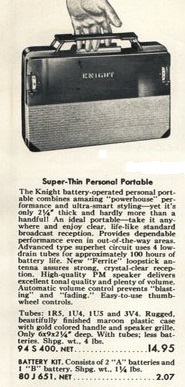
For 1955 listeners who needed a portable radio, a tube set was still the best option. While they were still bigger in size, the performance of a tube portable would be dramatically better, and the cost would be much lower. The radio shown here, for example, is a 4-tube portable from the 1955 Allied Radio Catalog. It sold for $14.95.
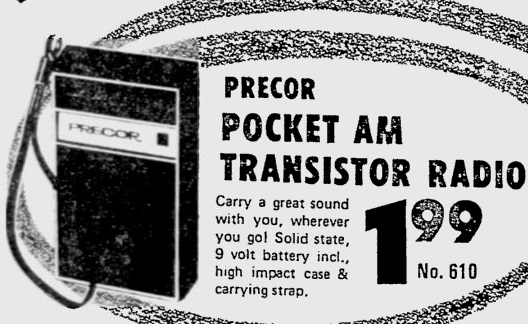
Over the years, the price of transistor portables came down dramatically. The same basic circuit was used in many inexpensive transistor AM radios. By the time I got one in about 1972, the price was down to $1.99, and that was after inflation. I believe I owned the exact model shown below, and I remember buying it after seeing a very similar ad in a local newspaper.
I’m not normally a covetous person, but I have to admit that in 7th grade, which would have been 1973-74, I did indeed covet. I didn’t covet my neighbor’s house, wife, servants, or animals. Instead, I coveted a classmate’s calculator. Santa Claus had brought him a $79.95 electronic calculator, and I was jealous. After all of these years, I still remember the kid’s name, but no, I’m not going to post it here.
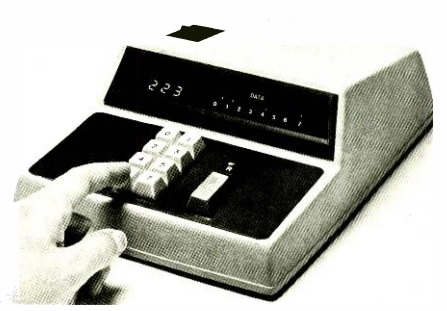
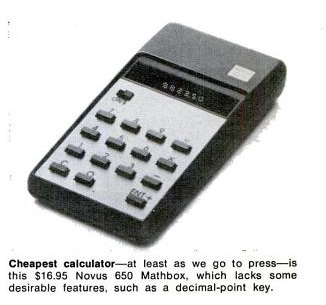
It turns out I shouldn’t have worried, since the price of these little gadgets were just about to start plummeting. Santa probably brought a lot more calculators the next year, since the December 1974 issue of Popular Mechanics shows this example, the Novus 650
Mathbox with a retail price of only $16.95, “with rumors flying of $10 calculators to come.” Those rumors proved to be true, since this same calculator was advertised on sale for $8.88 in time for Christmas 1975.
My parents wound up getting a TI-3500 desk calculator, which managed to serve my needs during junior high. In high school, I got my own calculator, the venerable TI-30, which set me back only $29.95. (According to Wikipedia, the price at introduction was $24.95. I probably paid $5 extra for the rechargeable battery option.)
By now, you’ve undoubtedly seen the (fake) viral YouTube video of people popping corn by placing the kernels next to a cell phone. In the unlikely event that you haven’t seen the video, there’s a link, along with a thorough debunking, at Snopes.
It’s not surprising that the modern version is impossible. It’s a simple matter of physics. There’s not anywhere near enough energy present to raise the temperature of the corn enough to pop it. (A typical cell phone will radiate about 0.6 watts, whereas a microwave oven will radiate about 1000 watts.)
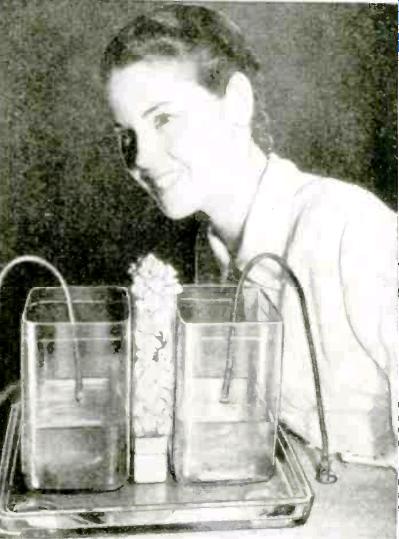
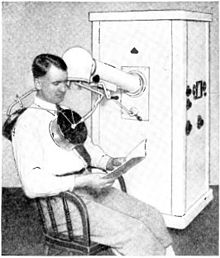
The general idea, however, is not new. Here, in the February 1936 issue of Short Wave Craft magazine, we see one Miss Alice Watherell successfully popping corn with the use of RF. In this case, the RF energy came from a diathermy machine, which is being fed into two containers of salt water. The radio energy, probably on 27 MHz, is absorbed by the corn, converted into heat, and pops the corn.
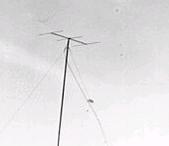
This photo was taken 70 years ago today, 26 December 1944, during the siege of Bastogne, part of the Battle of the Bulge. It was taken by a U.S. Army Signal Corps photographer, and shows troops of the 101st Airborne Division as they watch C-47s drop supplies to them. Of course, if you’re a ham, your eyes zero in on the antenna, shown below, and you see what appears to be a horizontally polarized VHF Yagi antenna on top of a tall mast. If you’re like me, you wonder what it is and what it’s doing there.
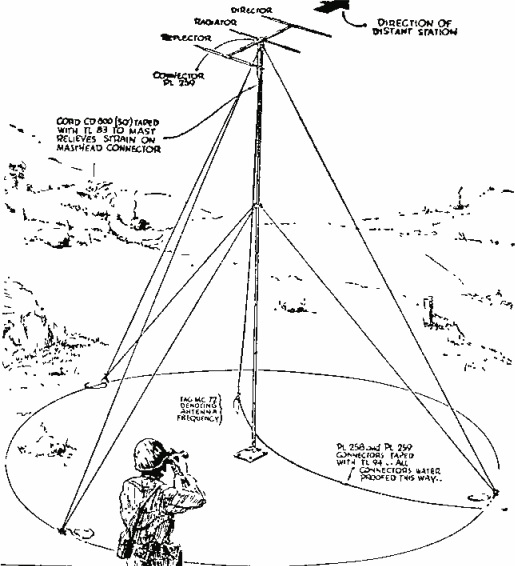
I apparently wasn’t the first to ask the question, since it had already been asked and answered on K4CHE’s site. The antenna in question is, indeed, a VHF Yagi, and it was part of a telephone relay system operating with 50 watts between 70-100 MHz. This was an FM full-duplex relay that could handle one voice conversation or four teletype channels. It was linked to telephone circuits and represented a low-cost alternative to stringing phone lines. A diagram of the antenna system, known as the AS-19/TRC-1, is shown below.
Later models had greater capacity, such as the one whose operating manual is available at this link. The range obviously depended on the terrain, but was normally used for links of 25-100 miles. The technical details are discussed in detail in the Radio News link below. Not surprisingly, the Yagi antenna was not referred to by that Japanese name at the time. It’s referred to as a “double H” type antenna.
I haven’t been able to find it, but one of the sources above indicated that a ham magazine published an article for converting this antenna to 6 meter use.
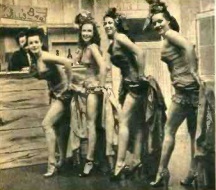
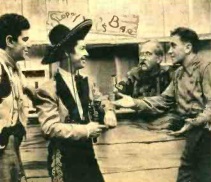
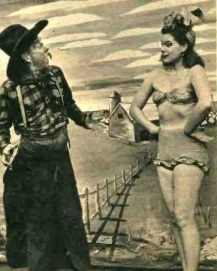
The three still photos shown here are, as far as I can tell, about the only remaining tangible evidence of a first in television history. They are from the September 28, 1944, telecast of the musical comedy The Boys From Boise, which was televisted by the New York DuMont station, WABD. The station originally came on the air as experimental station W2XWV, and in 1944 became the city’s third commercial station. As detailed in an earlier post, broadcasting as it came to be known after the war started in 1939. With the war, the other stations cut back on their programming, with much of it being devoted to civil defense training.
But flush with cash from helping develop radar for the army, founder Allen B. Dumont (the station bore his initials) invested $5 million in the company and expanded programming.
According to a January 1945 QST article, most of the staff of WABD was made up of hams. It was on the air three nights a week from 8:00 until 11:00. Practically the entire staff was working at the TV station on an overtime basis after working their normal day jobs at the DuMont war plant in Passaic, N.J. The station was located at 515 Madison Avenue on the 42nd floor. According to QST, the transmitter (which is described in detail) put out 6 kW. The QST article contains an additional image from the production of Boys from Boise.
According to the QST article, the station was on what was then known as channel 4, 78-84 MHz. When the channels were reallocated slightly in 1946, it moved to channel 5, which was then 76-82 MHz. The station is currently WNYW, the Fox network flagship.
One of the more ambitious projects was the production of The Boys from Boise. The program had a budget of $10,000. Given the scarcity of television sets capable of viewing the program, it’s very unlikely that the program made any money. It was sponsored by Esquire Magazine, which included three commercials during the intermissions.
The music and lyrics were written by Sam Medoff, who conducted the orchestra, and the production was directed by Ray Nelson. The show featured the following musical numbers. I haven’t been able to find any recordings of the music, or any of the scores.
Girls of the 8-to-the-Bar-X-Ranch
I’ll Take the Trail to You
Sunset Trail
That Certain Light in your Eyes
Chiki Chiquita
Thousand Mile Shirt
It’s a Mystery to Me
Broken Hearted Blues
Come Up and See Me Sometime
You’ll Put Your Brand on My Heart
Rodeo
Western Omelet
I’m Just a Homebody
Star-Spangled Serenade
The production had a cast of twenty. The only recording I’ve been able to find of Medoff is his recording of the Bridegroom Special on the American Jewish Hour program on WHN radio.
According to Billboard, the evening of this program was “the night television came of age. For the first time someone had guts enough and confidence enough to dig deep into the grouchbag for a lot of lure and put on a full-fledged show for the television cameras and audience.”
The Billboard review noted that by top-notch Broadway standards, the show wasn’t too much. But it drew praise as an example of what television was capable of. The reviewer noted that two hours was too long, and that future musicals should be capped at 60 minutes. It also noted that the cast was too large, and the dance numbers too elaborate, for the TV screen.
The plot, according to Billboard, was a “complicated, albeit typical musical, setting for the boy-girl theme.” A troupe of showgirls was stranded in Boise and had to take jobs as cowgirls to earn their fare home. There are rustlers, a villanesse who wants to foreclose the mortgage, and an undercover FBI agent.
It’s unlikely that any recording was made of the program. And even if there were, the old DuMont kinescopes reportedly wound up in the East River in the 1970’s. The still pictures shown here are probably among the few reminders of this first in TV history.
Update: It’s always great to hear from relatives of people I’ve featured here. In some cases, it clears up a mystery. When I originally wrote this post, I wasn’t able to find much information about Sam Medoff, the composer of the music and lyrics for Boys from Boise. I received a nice e-mail from his son, Mitch Manning, who pointed out that Medoff changed his name to Dick Manning, who went on to pen many familiar songs such as Fascination, Papa Loves Mambo, Hot Diggity, Allegheny Moon, Takes Two to Tango, and Hawaiian Wedding Song. You can listen to an interesting 1971 interview with Manning, including a performance of Fascination, at the video below. (This is a link to someone else’s video, and I’m told that the photo is not actually Manning’s.)
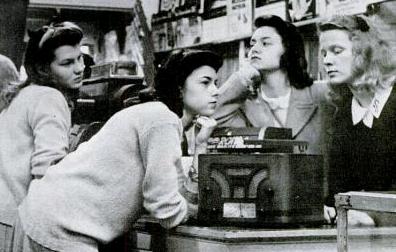
Seventy years ago, Life Magazine, December 11, 1944, featured the life of teen-age girls, and noted that all six million of them “live in a world all their own–a lovely, gay, enthusiastic, funny and blissful society almost untouched by the war.” Music stores bulged with girls listening to the singers and bandleaders they have made famous, and “half a dozen radio programs are aimed at homes where a daughter will cut off her father’s news to follow the fictional adventures of a contemporary.”
Shown here and above is Miss Pat Woodruff, a high school student from Webster Groves, Missouri, a suburb of St. Louis. She’s wearing her “after-school costume of blue jeans and a checked shirt,” undoubtedly getting ready to tune in one of those programs on the console radio in the parlor. She quickly gets to work tackling her homework, but with the radio playing full blast.
When the girls featured in the story were not listening to the radio or talking endlessly on the telephone, the phonograph occupied them. Here, a group of girls spends 2-1/2 hours listening to two dozen records at a record store, buying only one or two. Here, a group is completely engrossed listening to Dick Haymes‘ Together.
Dates were usually double, the article noted. Teen-age girls were primarily interested in themselves, with high-school boys running a poor second. Servicemen stationed near town rated last. An old high-school boy home on leave in uniform, however, was in a class by himself and rated tops.
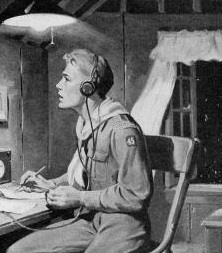
The December 1939 issue of Boys’ Life magazine carries an interesting short story, “Merry Christmas Hans” by Philip Lightfoot Scruggs. It’s full of technical inaccuracies, the author’s unfamiliarity with Amateur Radio, and even countless FCC rule violations. But it’s an interesting look at how Amateur Radio was viewed 75 years ago, and it pretty conclusively puts to rest the assertion that the Boy Scouts are somehow designed to militarize boys.
The hero of the story is Dave Smith, W2KSM. (It looks like the call was really in use, as shown by what looks like a Sweepstakes entry in this 1938 QST. And it was held in 1954 by one Howard M. Ames Jr.)
Young W2KSM, a 17-year-old Eagle Scout, decided to get on the air on Christmas Eve to wish a Merry Christmas to his DX friends in France, England, Belgium, or Holland. Much to his surprise, he heard the voice of Hans Schuler in Germany, where Amateur Radio was not allowed. (Amateur Radio actually did exist in Germany, and even continued somewhat during the war. Germany was one of the few belligerent countries where there were still a few hams on the air, even during the war. For more information, see my earlier post.) The story contains an editor’s note pointing out that the story was written before war was declared. Dave asked Hans what would happen if he was caught, and Hans replied, “the concentration camp at least.”
Still, the two continue their conversation, as Dave tells of freedom, and Hans tells of the repression in Germany, and even explains how he can quickly dismantle the station and antenna if the Gestapo got too close. Another Scout in New York City just happens to be listening to the contact, and alerts his father, a network executive, who spontaneously decides to broadcast the contact nationwide where millions, including Dave’s parents, listen to the boys talk.
Dave tells about Boy Scouts, and Hans tells of his experience preparing for war in the Hitler Youth. Dave concludes the contact by reciting the Scout Oath and Law, “that is our Scout Oath and Law, Hans–what we try to live by,” as Hans prepares to hastily disassemble his clandestine set.
Dave walks downstairs wondering whether his family will believe it, only to hear the end of the broadcast in which he and Hans had a starring role.
If you went to school in Minneapolis in the 1970’s, I bet these pictures look vaguely familiar. This is a 1972 ad from Setchell-Carlson, then known as SC Electronics, Inc., a subsidiary of Audiotronics Corporation, with an address of 530 5th Avenue NW, New Brighton, MN. This ad appears in the March 1972 issue of Broadcast Engineering.
The Minneapolis Public Schools were equipped with what I believe was the model at the left. I’m showing the one on the right to show the distinctive controls in the center, which are hidden behind the optional “tamper-proof control compartment door” of the black and white model on the left. I don’t think that Minneapolis had the door, or else the doors were routinely left open.
At Waite Park Elementary School, I don’t believe that every classroom was equipped with a TV. There were one or two of these that were wheeled in as needed.
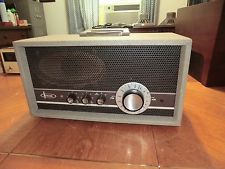
Every room, as far as I can recall, was equipped with a radio, although it was rarely used. The radio, shown here, was the Newcomb Model AV-750. This was an 8-tube AM FM receiver, and was obviously built for severe service. I’m sure I’m the only kid who noticed, but it had a connection on the back for an external AM antenna and ground. I was always jealous of that radio, since I dreamed of all the exotic broadcast band stations it would pull in if connected to an external antenna. There was also a connection on back for audio input, so it could be used as an audio amplifier.
I’m not positive, but I believe this Audiotronics phonograph was the standard issue model in the Minneapolis schools. Again, I believe one was issued to each classroom, and they saw a bit more use than the radio.
The televisions were made not far from the school. Setchell-Carlson made some consumer radios in the 1940’s, and TV‘s in the 1950’s and 1960’s. They were never a big name nationally, although they did have a strong presence in their home state of Minnesota. By the 1970’s, they had abandoned the consumer market, but they continued to make the institutional models shown above.
The company was founded in St. Paul in 1928 by Bart Setchell and Carl Donald Carlson as “Karadio Corporation.” As the name suggests, the company manufactured auto radios. Setchell claimed later to have been the “first” to use vibrators to power the car radio. The author of this article disputes that claim, but it is clear that Setchell-Carlson was one of the pioneers. In 1934, the company became Setchell Carlson, Inc., and made a few radios before the war. During World War II, the company was a defense contractor, and made products for the military, the most famous of which was the aviation receiver shown here. (For more information on this device, see my earlier post.)
In 1949, the company moved to New Brighton,
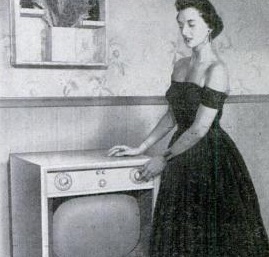
A Setchell Carlson TV from 1954, back when people apparently dressed up to watch TV. Popular Mechanics, Dec. 1954
Minnesota, and went into the TV business, which lasted until the 1960’s. At its peak, the company employed about 500, and also had a plant in Arden Hills. Setchell was later inducted into the Minnesota Broadcasting Hall of Fame.
One final note on the audio-visual equipment in use at my elementary school. The Minnesota Historical Society has this photo of the school’s public address system. The photo is dated about 1955, but based upon the one or two times I saw it, this is the same console that was in use in the 1960’s and 1970’s when I was a student there. Interestingly, the caption of this photo bills it as a “school broadcasting lab” and shows students at the mike. I never recall the console being used by students, certainly not on a routine basis.
The couple of times I saw this, I was quite impressed. It was in a separate room off the office, and in addition to the PA console, there was a radio receiver. I remember one dial being for the standard AM band. The other dial was calibrated in some numbers that did not look at all familiar to me. In retrospect, it’s possible that they were FM channel numbers, which were used for a short time on some FM receivers. Click Here For Today’s Ripley’s Believe It Or Not Cartoon

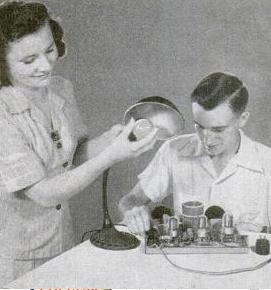 Wartime parts shortages were a major inspiration for the design of this short wave receiver from the January 1945 issue of Popular Mechanics. The lamp isn’t there for decoration; it’s one of the parts.
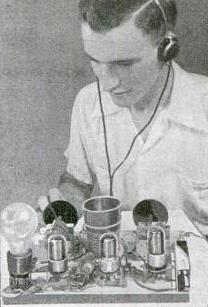 The two variable condensers, one for tuning and the other for regeneration, were scavenged from old broadcast receivers. For regeneration, only half of the 350 mF condenser is used. For tuning, the two sections of the 350 mF condenser are wired in series, rather than parallel, resulting in 88 mF, which is better suited to the 25 and 31 meter bands the set tunes. An additional five resistors and five capacitors round out the parts list.

 , but it’s now a very specialized item and very expensive.) The radio drew about 4 milliamps, meaning that a battery would last about 20-30 hours. While somewhat expensive to operate, this was an improvement over tube portable radios, which would typically operate for a few hours on a change of batteries.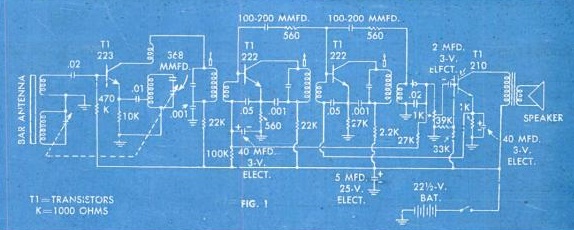



 )
)

 . It’s full of technical inaccuracies, the author’s unfamiliarity with Amateur Radio, and even countless FCC rule violations. But it’s an interesting look at how Amateur Radio was viewed 75 years ago, and it pretty conclusively puts to rest the assertion that the Boy Scouts are somehow designed to militarize boys.