Category Archives: Radio history

The 1939 Information Age

RobotInformationCabinet

Seventy five years ago, the March 1939 issue of Popular Mechanics shows the latest in mobile navigation technology.

The robotic “Infomat” provided information on the location of prominent places in a city. The user merely lifted the receiver and raised one of up to 500 levers with the name of the place. The user would then listen to the voice of the machine provide the information.


1934 Scout’s One Tube Radio

1934SeptRadioNews

Shown here in the September 1934 issue of Radio News is Scout Robert Crockett of Troop 3 of the BSA Siwanoy Council, Pelham, New York. He is shown operating the receiver that he designed and built, based upon a design in an earlier issue of the magazine. His circuit uses a single type 30 tube and a handful of other components, all of which can be obtained fairly easily today. For ideas on sourcing the components, you can visit my page describing another 1930’s era receiver or my crystal set parts page.  Full construction details are included in the 1934 article.

The author of the article was Robert’s “Scout Radio Examiner,” which presumably means Radio Merit Badge Counselor. According to this 1935 newspaper, Robert did go on to complete the Radio Merit Badge.  The magazine article concludes by pointing out that as his daily Good Turn, the Scout would be glad to help anyone building the set with their problems, and that such letters can be sent in care of the magazine. The article notes that he had logged over 300 shortwave stations with the set.

According to the National Eagle Scout Association database, Mr. Crockett became an Eagle Scout on February 24, 1937. And according to this newspaper and this one, he was serving in the military in 1943 and 1944. According to his sister’s 1943 obituary, his service was as an Ensign in the U.S. Naval Reserve.


1924: A Radio Summer

RadioCamping1924


In 1924, it was going to be a radio summer. This picture, from the May 1924 issue of Radio Age, shows two motor tourists who made the radio receiver an important part of their roadside camp. The magazine points out that such portable sets are easily made or purchased.


1964: The Last of the One Tube Radios?

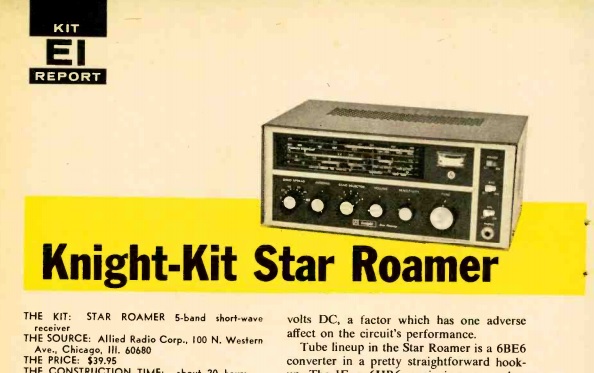
Sept64EEFifty years ago, the vacuum tube was still king, although its days were coming to an end. The September 1964 issue of Electronics Illustrated contained several construction projects, most of which relied on tubes. The Micron Electron Tube Company advertised a few dozen common tubes for 37 cents each. Other tubes were available at reasonable prices. For example, hams looking for finals for their transmitter could find an 807 for a dollar, or a 6146 for $2.45.

Some transistor gear was starting to show up, but it was pricey. E.F. Johnson advertised two transistorized CB handheld radios. The 100 milliwatt version sold for $109.50, and the 1.5 watt version commanded $129.50.

The construction projects included a CB preamplifier and calibrator for tuning 11 meters on a shortwave receiver.  This article bears the byline of prolific author Len Buckwalter, whose CB call KBA4480 is shown. (Buckwalter was also a ham, and his byline for ham related books and articles included his ham call, K1ODH.) This circuit used a single 6U8 (one of the 37 cent tubes), a dual pentode-triode, one half of which was used as the preamp, the other half being the crystal calibrator.

For hams, the magazine featured a transmitter for 80 and 40 meters, which the article claimed could be built for five dollars. It used a 6V6GT and a 5U4G rectifier, both of which were on the 37 cent list.

And, as fitting for this site, the magazine featured the one-tube AM radio shown above, which used a 6AL11 dual pentode. Half the tube was used as a regenerative detector, the other half being an audio amp which would deliver a full two watts to the speaker. According to the text, the circuit “has only one tube but in terms of performance it’s a mighty far cry from that one-tube job of 30 or more years ago,” with sensitivity and tone that will surprise you.

What’s intriguing about this project is that it’s probably one of the last times that an electronics magazine would feature an article on how to build a standard AM radio that appears to be designed for everyday use. The 1964 Radio Shack catalog included an “all American five” AM radio for only $7.95, so even the most frugal builder would probably save very little by building his own.

Len Buckwalter seems to still be around.  He is listed as a founder of publisher avionics.com of Leesburg, Virginia.  It appears that he let his ham license lapse at some point, but he appears to be currently licensed as KK4GJX, which is listed as being issued in 2012.  According to a biography, he graduated from college in 1951, which would mean that he’s now about 85 years old.

If you’re interested in building this radio, most of the parts should be readily obtainable. Antique Electronics Supply is probably the best supplier for the power transformer.  They don’t carry the tube, but it can be found on eBay.  On another post, I have links to suppliers where you can find most of the other parts.

References

Len Buckwalter at semiconductormuseum.com


Unlicensed 27 MHz Walkie-Talkie History


1969SearsWalkieTalkie

Like many aspiring young hams, I got my start in two-way radio with a set of walkie-talkies not unlike this set shown on page 561 of the 1969 Sears Christmas Catalog.

My set was a different brand, but quite similar to this set and millions of others like it. They all consisted of a crystal-controlled transmitter, usually on CB channel 14, along with a superregenerative receiver. The receivers on these sets were so wide that they could hear all 23 channels simultaneously, which meant that I could hear local CB’ers, as well as communicate with these and other toy walkie-talkies. And the superregenerative receiver meant that when a signal was not being received, the radio put out a constant rushing sound, undoubtedly to the great annoyance of millions of parents.

Despite hearing CB’ers, and despite valiant efforts on my part involving various attempts at external antennas, I never managed to make contact with any owner of a “real CB.” The antenna on mine was affixed to the case with a screw at the bottom, and to allow easy connection to an external antenna, I even put a Fahnestock clip on the outside of the case, attached to this screw. I could no longer set the radio down on its base, but it made for easy connection to various external antenna attempts.

There were two reasons for my lack of communication with the elusive “real CB’ers.” First of all, I was probably hearing all 23 channels at once, so even if the other station was quite close, he probably wouldn’t have been tuned to channel 14 to hear me. And even if he happened to be on channel 14, I would have been able to hear his 5 watt signal much further than he would be able to hear my 100 (if I was lucky) milliwatts.

One neighborhood kid claimed that he had made contact with a “real” CB’er with his toy walkie-talkie. I, of course, was extremely jealous of this accomplishment, although I didn’t let on. I had to content myself with contacting the other radio I owned, or those of other kids with whom I was playing, assuming we had enough pocket change to buy the requisite nine-volt batteries (or perhaps “borrow” them from other devices around the house). At this time, most of these radios came crystalled for channel 14, but since most had the wide receiver, it really didn’t matter which channel we were on. The typical range was from one side of the house to the other.

Interestingly, one friend’s walkie-talkie had a crystal for channel 9, which didn’t become the emergency channel until about 1970, as discussed in this February 1970 Popular Electronics article.

On those occasions when I didn’t have anyone to talk to, I sometimes used a rubber band to hold down the push-to-talk button and placed one near the TV. I could then listen in another room. Of course, I put an end to this practice when someone pointed out to me that I was at one point rebroadcasting a baseball game, without the express written consent of the Minnesota Twins, and suggested that doing this might land me in jail.

The era of these 27 MHz toy walkie-talkies came to an end with a change to the FCC rules in 1977, which is explained in detail in the August 1977 issue of Popular Electronics (page 46).

Until that time, these unlicensed radios were allowed on 27 MHz, as long as the input power was less than 100 mW. While many of these radios were equipped with a crystal for channel 14, there was no requirement that the radio opearate on any particular frequency. They were allowed anywhere in the range 26.97 to 27.27 MHz. Under the rules currently in effect (which I believe were the same as adopted in 1977), the limit for an “intentional radiator” of this type is now measured in terms of field strength, and the limit is 10,000 microvolts/meter at 3 meters. 47 C.F.R. §15.227. Since a 100 mW transmitter would exceed this limit by a very considerable amount, this regulation meant the end of toy walkie-talkies on 27 MHz.

Instead, the new 1977 rules called for the move of these toy walkie-talkies to five specific frequencies in the 49 MHz band, 49.830, 49.845, 49.860, 49.875, and 49.890. Under the new rules, the toy 27 MHz walkie-talkies could not be sold after March 1978.

We can see the transition from the Radio Shack catalogs for 1978 and 1979. The 1978 issue showed these toy walkie-talkies for 27 Mhz:

The 1979 issue showed similar models, but for 49 MHz:

One bit of confusion is added by the fact that 100 mW walkie-talkies for 27 MHz remained on the market. For example, if we turn in the 1978 catalog to the “toy” section to the “CB” section, we see a number of CB walkie talkies, some of which are 100 mW.

Under the old rules, these 100 MW units had a dual status. They could be used under Part 15 without a license, since they fully complied with the 100 mW limitation. However, these radios were also “type accepted” under Part 95 of the rules, meaning that they could be legally used by licensed CB’ers.  (These “real” CB walkie-talkies also typically had a superheterodyne receiver, meaning that they didn’t make the annoying “rushing” sound when no signal was present.)  The CB rules at the time allowed CB’ers to communicate only with other CB stations. Therefore, it was technically illegal to communicate between a “real” CB and a toy 27 MHz walkie-talkie. (Unlike the prohibition on retransmitting baseball games, nobody ever told me that my attempts to do so were illegal.  However, I doubt if there were many prosecutions for this particular offense.)  In the case of a cheap toy walkie-talkie, this would have been true even if the toy was being used by a licensed CB’er, since the radio wasn’t type accepted for CB use. But because of their dual status, the three100 mW walkie-talkies shown here could have been legally used to communicate with a toy walkie-talkie (since the radio was under 100 mW) or by a licensed CB’er to communicate with another CB’er (since the radio was type accepted under Part 95).

The 100 mW walkie talkies continued to be sold by Radio Shack and other retailers. In practice, some of these were sold as high-end toy walkie-talkies for kids, since the type-accepted units were generally of much higher quality. But technically, after 1978, the use of the 100 mW 27 MHz radios required a CB license.

In 1983, the FCC ended the requirement for CB licenses, as reported in the April 28, 1983, issue of the New York Times.  (Technically, CB is now “licensed by rule,” meaning basically that a license is required, but if you follow the rules, you are automatically granted a license by 47 C.F.R. §95.404.)

Therefore, it once again became legal (as long as the user obeyed the CB rules) for an unlicensed person to use the 27 MHz radios, whether they were the 100 mW model or one of the more powerful ones.


The Chorus Girl’s Radio, 1923

carhoodradioMiss Peggy Stohl is featured on the cover of the 23 June 1923 issue of Radio World.  The magazine reports that the roads are crowded with radio equipped vacationists, some of whom can’t wait until they arrive to listen in. Miss Stohl is in that category, as she listens to the radio while her garage man hurries along with some gas.

When she wasn’t listening to the radio, it appears that Miss Stohl was a chorus girl with the Zigfeld Follies and other shows, as shown by this entry at the Internet Broadway Database.


Radio Foxtrot On The Beach, 1924

wirelessbeachdancersThis image, from the cover of the July 19, 1924 issue of Radio World, shows Martha Breesh and Edna Jameson dancing on the beach at Atlantic City. According to the magazine, the two attractive vacationists are doing a Nymph-like dance on the beach, to the tune of a fox trot coming over the radio. Miss Breesh and Miss Jameson report that health and beauty depend on judicious exercise, and that they rate beach dancing to radio music as the apex of judiciousness.


1934 Metal Detector

1934MetalDetector80 years ago, this was the latest in metal detectors. This unit, shown in the August 1934 issue of Radio Craft magazine, is similar in concept, but larger in size, to inexpensive metal detectors available today. It consisted of a one-tube oscillator along with a five-tube receiver. When the oscillator’s coil came in proximity to metallic objects, the frequency shifted, and the change in frequency could be determined from the receiver. The oscillator is mounted in one cabinet, with the receiver in the other.

The complete plans were in the magazine, which also reported that the unit could be purchased commercially. It was reported as being sufficiently sensitive to detect a piece of metal 16 inches square at a depth of 15 feet.


U.S. Sets Wireless Neutrality Rules

German station at Sayville, Long Island, allowed back on the air.

German station at Sayville, Long Island, allowed back on the air.

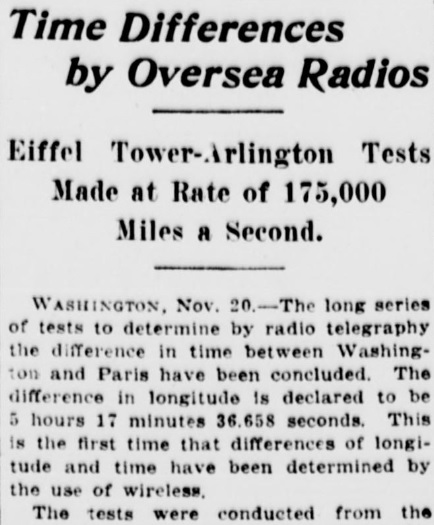
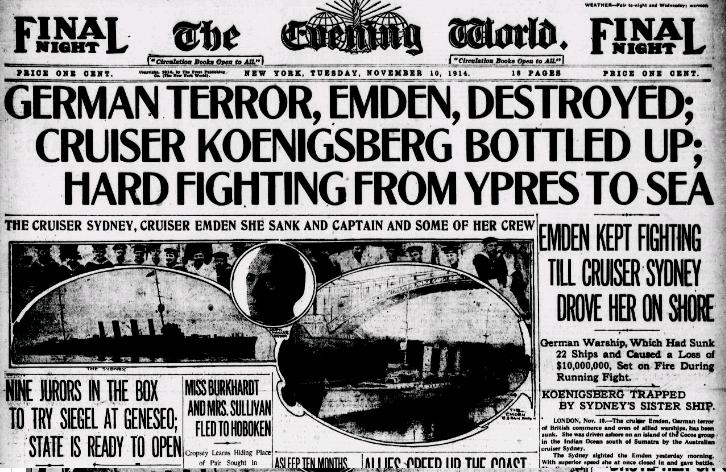
A hundred years ago today, August 21, 1914, President Wilson resolved the issue of use of wireless stations in U.S. territory by the warring nations. After protests from Germany, whose cable had been cut and had only wireless contact with Germany, it was decided that the warring nations would be permitted to send coded messages from their stations in the U.S.

Largely because of the practical impossibility, there would be no censorship of cable traffic on the remaining transatlantic cables.

As noted here earlier, it was Hiram Percy Maxim who brought to the government’s attention the German’s transmission of coded messages.

Among the newspapers carrying the report was the 22 August 1914 edition of the New York Tribune.

Read More at Amazon: