Category Archives: Radio history

Radio as a Tool of War, 1914

With the Great War, the wireless telegraph was clearly coming of age and was relied upon by the warring powers.  The need for wartime communications was best illustrated by the Battle of New Orleans.  The War of 1812 should have ended with the signing of the Treaty of Ghent on December 24, 1814, but word didn’t reach Louisiana in time to prevent the Battle of New Orleans from taking place on January 8, 1815.

By the time of the American Civil War, the telegraph had become an important tool of war, and both building and destroying telegraph lines became important military tasks.

The Great War was the first in which cutting telegraph lines was no longer a strategic priority. This was recognized early in the war, as shown by this report in the El Paso Herald, Aug. 21, 1914:

WIRELESS HAS BECOME AID TO ALLIED POWERS

France and Russia in Constant Touch, Despite Germany’s Efforts to Stop It.

Washington, D. C, Aug. 21. In wars of the 19th century an army spent much time in attempting to cut an enemy’s telegraph and telephone wires. To break the transmission of dispatches today is practically impossible, thanks to Mr. Marconi and his co-inventors, declare military experts here. The two allies against Germany and Austro-Hungary, France and Russia, are probably in constant touch every hour indeed every minute, of the day and night.

The can talk right over Germany, Moscow and Paris can cooperate perfectly. Probably Gen. Joffre and grand duke Nicholaievitch know each of them what the other’s forces are doing from hour to hour.

An incident of the Balkan war shows the remarkable possibilities of wireless. The allies bottled up Adrianople. holding all roads to Constantinople. But in the city was a 1-1/2 k.w. Marconi wireless telegraph station of the portable type. At no time did the station fail, and in the course of the siege, more than 450,000 words were transmitted to headauarters without hitch.

lhe allies attempted to stifle the station by placing wireless outfits to the east and west of Adrianople, but their attempt to “jam” the Turkish signals was in vain.

Usefulness Is Demonstrated.

The usefulness of wireless was also shown in the recall of certain ships at the outbreak of the present war. One ship was brought back after she had proceeded within two days’ journey of Europe, and thus was saved from the enemy.

Many small craft have been seized, because they were at sea. at the outbreak of hostilities and had no wireless. The effect of this experience will undoubtedly be the cause of a wide use of air communications, as a kind of assurance against capture by a hostile warship.

Austria-Hungary has four important government wireless stations; Germany, 17. France, 18; Russia, 28; and Great Britain, 68.

Try To Insure Privacy.

Many means are now used for insuring the privacy of a wireless dispatch. The Marconi stations are designed to obtain this result by changing the wave length of the transmitter at frequent intervals.

This change can be made in a fraction of a second. The operator can shift his “tune” after every three or four words if he considers it necessary. Just before the shift he sends a code letter indicating to which wave length he is about to change. The operator at the station receiving makes the necessary readjustments to follow him without difficulty. It is believed that this system, properly carried out, is eavesdropper-proof.

Eiffel tower station, which France depends upon for communication with Russia, has the advantage that interference is practically impossible, owing to the peculiar sound of the signal emitted.

In other war news, the paper reported that Germany has lodged a protest with the U.S. State Department regarding the German wireless station in New Jersey. Cables between the United States and both France and England were still in operation, without American censorship. But since the German cable had been destroyed, the only method of communication between the United States and Germany was by wireless. The German charge d’affaires protested, and the matter was referred to President Wilson, who the paper noted might impose the same censorship on England and France.

Read More at Amazon


Ship’s Wireless in 1914

FranconiaRadioCabinThis illustration is from the 1914 text “Wireless telegraphy: a handbook for the use of operators and students“.

It shows the somewhat cramped, but well equipped, wireless cabin of the Cunard Line’s R.M.S. Franconia. The wireless equipment was supplied by the Marconi Company, and consisted of a 1-1/2 kw spark transmitter, in addition to a totally independent 500 watt emergency transmitter. The receiver consisted of either a magnetic detector or a Fleming valve.

RMS Franconia (Photo, Wikipedia.)

RMS Franconia
(Photo, Wikipedia.)

The first voyage of the Franconia was from Liverpool to New York in February, 1911. She served commercially until 1915, when she was called in for use as a troop transport in the Mediterrranean. She was sunk by a German U-Boat on October 4, 1916. Fortunately, she was carrying no troops at the time, but of the 314 crew, 12 were lost.  The ship, along with the equipment shown above, lies at the bottom of the Mediterranean, 195 miles east of Malta.


Thomas Edison Nikirk, 1901-1953: Boy Scout and Amateur Radio Operator

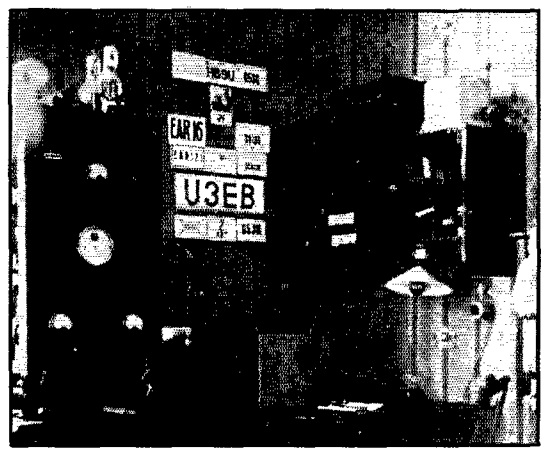
T.E. Nikirk in 1923

T.E. Nikirk in 1923.
(QST, Feb. 1923, p. 29.)

When I look for historical items for this blog, I usually start by browsing old magazines or newspapers looking for items of interest. In most cases, they’re interesting in their own right as showing what life was like in the early part of the twentieth century, especially with respect to the new field of wireless. I usually make some effort to follow up on the people involved, but the trail usually grows cold, and I’m often left wondering what happened to the people who had one newsworthy accomplishment.

Such was not the case, however, for one Thomas Edison Nikirk of Washington, D.C. Mr. Nikirk, born in 1901, was a thirteen-year-old Boy Scout in Troop 10 when he made the pages of the Washington Times on several occasions in 1914. The May 31 issue reported that young Mr. Nikirk had earned Personal Health merit badge. The October 11 issue reported his earning the Cooking merit badge.

The Wireless Merit Badge wasn’t created until 1918, so it’s unlikely that Thomas ever earned it. But had it been available, it’s likely that he would have been one of the first, as evidenced by this article in the paper’s June 7 edition:

Thomas Edison Nikirk a Wireless Operator

Scout Thomas Edison Nikirk, of Troop 10, is now registered as a wireless operator with permission to operate anywhere in the United States. He obtained his papers the first part of last week and has the distinction of being the only Boy Scout wireless operator in the District. Tom is in his fourtenth year, and has been for the past seven months a student of H.B. DeGroot, who teaches a wireless class in this city.

According to the 1916 Call Book, Nikirk held two call signs. His main call, licensed at 411 12th St. SE, Washington, D.C., was 3VU. He also held the call 3EE, which the book indicates was for a portable station. (According to the same book, his “Elmer,” H.B. DeGroot, was the licensee of special land station 3ZH.  It’s likely that DeGroot was affiliated with the Scout troop, since one Alfred DeGroot earned the rank of Eagle Scout on October 30, 1920, according to the National Eagle Scout Association database.)

According to the July 26 issue of the Times, young Mr. Nikirk, the ink barely dry on his new license, brought his wireless station to summer camp.  The paper reports that a number of national and council officials visited Camp Archibald Butt at Chesapeake Beach, Maryland. A number of them stayed overnight, and were able to see a demonstration of 3VU’s capabilities. The paper reports that Nikirk was “experimenting with his wireless outfit, receiving and sending messages at long distances. Recently he attempted to receive a wireless message from Washington, but did not succeed with the twenty-foot aerial now in use at the camp.”

(The Camp was operated from 1914-16 by the Washington and Baltimore Councils of the BSA, and was named after Maj. Archibald Butt, an aide to Presidents Taft and Roosevelt, who died in the sinking of the Titanic. I’m not sure of his connection with Scouting, but Butt is shown in this 1912 photo along with Lord Baden-Powell and President Taft.)

Undoubtedly disappointed by the poor July performance of the aerial, Thomas promptly set out to improve on it. The paper’s August 9 issue carries the following dispatch from camp:

CAMP BUTT RADIO TOWER IMPROVED

Thirty-Foot Aerial Expected to Send Messages for 100-Mile Radius.

Following many futile attempts with the thirty-foot wireless tower at Camp Archibald Butt, Cheseapeake Beach, Md., to transmit messages at long distances, a new aerial, twice the height of the one found wanting, has been devised and is now in operation with Scout Thomas Nikirk, of Troop No. 10, acting as wireless operator. Nikirk asserts that with the aid of the newly constructed aerial, he will, under normal conditions of the weather, be able to send and receive messages within a radius of 100 miles.

At some point between 1916 and 1920, Thomas moved to California. The 1920 edition of the amateur call book shows him licensed for 500 watts as 6KA, and the general call book shows him as the licensee of experimental station 6XBC, both at 1050 West 89th St., Los Angeles, Calif.

In many cases when I research an old name, the trail will grow cold at this point. But Thomas Nikirk went on to be a prominent California Ham operator, and continued to hold the call 6KA (later to become W6KA) until his death in 1955.

By 1923, Nikirk had by all accounts one of the best amateur stations on the West Coast. He is featured in two articles in the February, 1923, issue of QST. The first article (from which the photo above is taken) reports that his signals had bridged the Pacific, and had been heard off the coast of China, at a point reported as being 5830 miles west of San Francisco. And in addition, his signals had been copied in Europe. After listing the stations heard off the coast of China, QST opines:

With all due credit to the entire list of successful stations, we think that 6ZZ [in Douglas, Arizona] and 6KA are the stars, for they are in the China list and they also got over to Europe, including all the long 2500-mile drag over the Rockies and across the United States. That is real performance and represents so much more of an accomplishment than the Atlantic crossing by eastern stations.

It goes on to describe “6KA, the ether-buster of T.E. Nikirk at Los Angeles,” whose antenna was a “T”, with five wires on 14 foot spreaders, running 57 feet long and 73 feet high, and with a 9-wire counterpoise covering an area measuring 45 by 70 feet.

The transmitter consisted of a single tube rated at about 250 watts. The normal antenna current was 12-13 amps. It reports that the plate current could be run up to 8000 volts! Normally, however, he ran closer to 3000 volts.

How he managed to get that much DC voltage on the plate is described in another article in the same issue, authored by Nikirk, entitled, “Synchronous Rectifiers for Plate Supply: A 3600 R.P.M. Rectifier.”  In that article, he describes a mechanical rectifier consisting of a synchronous motor running at 3600 RPM, spinning a bakelite disc with two semicircular conductive edges. The high voltage AC from the transformer was fed to two brushes on opposite sides of the spinning disc. Two other brushes served as the output. The net effect was that the polarity reversed twice each cycle. Therefore, the output consisted of direct current.

According to a 1939 issue of Radio News, Nikirk served as chairman of the Federation of Radio Clubs. He is also the author of a Stray in the December 1946 issue of QST regarding the use of floor wax to repel water on transmission line.

According to his front-page obituary in the San Marino (Calif.) Tribune, July 14, 1955, he died of a heart attack. The paper reported that in addition to his ham station, he was the owner of an electronics store in Pasadena. He was a member of the Institute of Radio Engineers, the Pasadena Amateur Radio Club the ARRL, and a newly formed medical electronics group at Cal Tech. During World War 2, he served in the Air Force.

The call sign W6KA is still assigned, and is now held by the Pasadena Radio Club, of which Nikirk was a member.

Finally, it appears that Thomas Nikirk’s Troop 10 was in existence until about 1940. According to the NESA database, nineteen Scouts from that troop earned the rank of Eagle between 1919 and 1940. As noted above, one of those Scouts was Alfred DeGroot, who became an Eagle Scout in 1920, and who I suspect was the son of 3ZH. Surprisingly, one of those Troop 10 Eagle Scouts was science fiction author and religion founder L. Ron Hubbard. According to the  NESA database, his Eagle Board of Review date was March 28, 1924.

The Washington, D.C. Council, of which Troop 10 was a part, is now known as the National Capital Area Council of the BSA, and covers much of Maryland and Virginia, as well as the U.S. Virgin Islands. From the list of “Troop 10” Eagle Scouts, it appears that the troop number was reused multiple times, since there were Scouts from both Maryland and Virginia who became Eagles in the years 1959-1964, 1973-1977, 1989-1999, and 2001 through the present. The current caretaker of the Scouting legacy of Scout Thomas Edison Nikirk is Troop 10 of the Piedmont District of the National Capital Area Council, located in Warrenton, Virginia.


A 1922 Radio Class

This 1922 press service photo shows Elizabeth A. Bergner, the radio instructor at Lane Technical High School, Chicago, with some of her students. More details can be found in the January 1922 issue of Industrial Arts Magazine, wherein it is revealed that Miss Bergner was the Morse instructor. She reported success in grouping the boys in her class according to the speed they showed. Miss Bergner was the only woman in Chicago to have her wireless operator license. According to the 1922 call book, she was licensed as 9DET.


August 10, 1914: Wireless Sets Sealed

America was neutral, and was enforcing neutrality. The Harrisburg Telegraph and other papers report that U.S. Customs officers have begun sealing the wireless apparatus of all vessels flying the flags of the warring nations.

1914 USDA Yearbook

Wyoming Wheat, 1914 USDA Yearbook

In other war news, the U.S. price of wheat was rising, in part due to Canada’s offer to the British government of a million bags of flour.


Hiram Percy Maxim Catches a Breach of Neutrality

The New York Sun had a flurry of dispatches in its August 7, 1914, issue regarding wireless and U.S. neutrality. In the first, the French steamer Rochambeau, docked in New York, was reportedly sending wireless messages to the French cruisers Conde and Descartes. U.S. radio inspectors were investigating.

The Telefunken station at Sayville, Long Island

The Telefunken station at Sayville, Long Island (Google Books)

The report even mentioned that there were hundreds of licensed amateurs in the New York area, along with many more unlicensed operators of receivers. It pointed out that neither was allowed to divulge the contents of any message heard, but that “eager boys in Hoboken and this city who have been listening to war messages and then posting their friends are running the risk of $250 fine and three months in jail or both.”


Hiram Percy Maxim


One of the reports originated with none other than Hiram Percy Maxim:

NEW HAVEN, Conn., Aug 6–Hiram Percy Maxim, inventor of the Maxim Silencer, who is also an amateur wireless operator of note, said to-day that he had picked up messages flashed by the Telefunken tower at Sayville, L.I., to German merchantmen and warships. He has several messages in code and has advised Washington, accusing the Telefunken company of breach of neutrality.


More Mobile Wireless, 1914

SignalCorpsMules

In the early days of radio, the U.S. Army Signal Corps was always looking for ways to get the wireless equipment in the field, and one method is shown in this August 1914 article in Popular Mechanics.

This set could be transported with two mules and quickly set up wherever needed. The electronics were contained “in a case the size and shape of an ordinary suitcase,” and the mast for the antenna were made in “short sections that fit together like the sections of a fishing rod.”

Electric current was supplied by a generator run by hand. The operators must have had very strong arms, since the generator was reported to supply 500 watts. The setup was capable of transmitting 40 miles.


August 3, 1914: Germany Takes Control of Wireless

Base of one of the towers at the Telefunken Nauen station.  Google Books.

Base of one of the towers at the Telefunken Nauen station. Google Books.

The New York Sun, August 3, 1914, reports that the Kaiser has taken control of the two great wireless stations in the German Empire, and that commercial traffic to North America from those stations has now ceased. The station at Nauen, near Potsdam, was the flagship station of the Telefunken system, and had previously been in communication with the Telefunken station at Sayville, Long Island. The station near Hanover was the biggest station of the Goldschmidt System and had communicated with the station at Tuckerton, N.J.

The newspaper noted that if Britain entered the war, which was expected, that the last link with Europe would be cut. Howevver, the Marconi company was rushing to completion work on the station at Stavengar, Norway, which would keep North America linked to Europe.


Forest Service Radio, 1921

This 1921 photo shows U.S. Forest Service radio operator F.K. Teeter, Jr., at his post monitoring for forest fires. The Forest Service had aircraft equipped with a 1.8 kw spark transmitter, with a trailing wire with a lead weight at the end. The entire transmitter was encased in a torpedo-shaped shell mounted on the running gear. Only the key and ammeter were inside the plane. The aircraft was not equipped with a receiver, and the ground stations were not equipped with a transmitter. Instead, the aircraft transmitted in the blind, using a code indicating the type of fire and location by township, section, and range.

The system was reported to give very satisfactory results.

Read More at Amazon:


Portable Radio in 1923

CanoePortableRadio

This illustration from the August 1923 issue of Wireless Age shows Joan Jarvis listening to a portable receiver in her canoe. The accompanying article points out that the phonograph record industry should not be alarmed by Miss Jarvis’ entertainment options, since she is likely to purchase phonograph records of the songs she hears over the radio.