Category Archives: Radio history

The Regenerative Receiver Turns 100

1916Regen

True to our name here at OneTubeRadio.com, we frequently feature one tube radios.  And more often than not, they are regenerative receivers.  The regenerative receiver was popular in the early days of radio because it could deliver so much performance out of a simple circuit.  The single tube, in addition to serving as the detector, had some of its output fed back into the tube to amplify.  If there was too much feedback, the receiver would break into oscillation, which would result in a squealing sound from the headphones, as well as those of other nearby receivers.  The anti-squeal campaign featured in an earlier post showed how this could be the bane of other local listeners.  But this oscillation also allowed the reception of CW (and later SSB) signals by simple receivers.

As far as I can tell, the regenerative receiver was first introduced to the public a hundred years ago this month in an article in the January 1916 issue of Electrical Experimenter.

An article by Frank J. Collins entitled “Regenerating Audion Circuits for Wireless Receiving” includes the circuit diagram shown above. If the circuit looks familiar, it’s because it’s the same circuit, with minor variations, used in most of the one tube radios shown on this site.

The details given in the article are for the construction of a longwave version of the set. “As most of the high-power transatlantic and transpacific stations use wave lengths of from 5000 to 10,000 meters [30 to 60 kHz], dimensions are given to cover these wave lengths only.” The author reports that with an aerial 500 feet long at least 10 feet above ground, reception of strong stations 2000-4000 miles away was possible, day or night, but that the set would work well with an antenna of 100 feet.

Drawing from Armstrong patent.

Drawing from Armstrong patent.

While this seems to be the first popular construction article showing how to make a regenerative receiver, it was a couple of years old by the time this article was written. It was invented by Edwin Armstrong in 1912 and patented in 1914 (US Patent 1113149).

The article warns that “while the coils described herein may be constructed by experimenters, they are not permitted to sell them to others for the purposes described, as the invention is patented.”

The author concludes by noting that “this type of apparatus and connections are well worth constructing and using, as it constitutes the most advanced means known at the present time in the reception of both damped and undamped radio signals.”

Because of the relative simplicity of the circuit, a regenerative receiver is an ideal project even today.  I have featured numerous examples in this site, most of which can be easily constructed using the vintage plans, although some parts require a bit of creativity to replace with modern equivalents.  Sets designed for the AM broadcast band will give immediate gratification, since there’s guaranteed to be something that can be tuned in immediately after making the last connection.  Shortwave sets are surprisingly good performers, and will pull in signals from around the world with little difficulty.


For those wishing to bypass the parts procurement process, a number of good kits are available.  For example, the kit shown in the illustration here is available at Amazon at a reasonable price. It’s a two-tube set that tunes both standard AM and shortwave.  For those who don’t mind substituting modern transistors for the tubes, QRPkits.com puts out an excellent kit, the Scout Regen Receiver, It tunes only shortwave, but covers enough territory to almost ensure that you’ll be able to tune in something interesting, day or night.  At night, the dial will be packed with amateur, commercial, and shortwave broadcast signals from around the world.

My son and I put together the Scout Regen a few years ago, and it is an excellent performer for such a simple design.  One that appears to have similar performance, but probably a bit easier to put together because of its wide-open layout, is the Ozark Patrol receiver designed by David Cripe, NM0S and distributed by the Four State QRP Group.  If you build any of these, you’ll have a very sensitive receiver capable of pulling in many interesting signals, and you’ll also be working with the same circuit employed by experimenters a century ago.


Boswell Sisters, 1931

1931BoswellSisters

This photograph of the Boswell Sisters appeared 85 years ago in the January 1931 issue of What’s On The Air magazine.  They were then appearing on NBC’s Camel Pleasure Hour originating in San Francisco.

The sisters Martha (1905-58), Connie (later spelled Connee, 1907-76) and Helvetia “Vet” (1911-88) grew up in New Orleans where they studied classical music, but their mother also made sure that they were exposed to the African-American music the city had to offer. They were well known performers in New Orleans in their young teens, and in 1925, they made their first recording. The landed in California in the late 1920’s. After their NBC appearances, they moved to New York, where they had a program on CBS from 1931-33. The sisters were also shortwave pioneers, appearing in 1932 in the first broadcast of “Hello, Europe,” a CBS program beamed to Europe.

They also appeared in a number of films. One of the earliest uses of the phrase “Rock and Roll” was their rendition of a song by that title in the film Transatlantic Merry-Go-Round in 1934, performed here:

Even though they are not well known today, the Boswell Sisters did have a lasting impact on American music. The Andrews Sisters started out as imitators of the Boswell Sisters, and a young Ella Fitzgerald was a great fan and patterned her own singing style after Connie Boswell.

Listen at Amazon


Click Here For Today’s Ripley’s Believe It Or Not Cartoon


American Shortwave Broadcasting, 1941

1946JanPS

Seventy-five years ago, American shortwave broadcasters were clearly gearing up for war, as shown by an article in the January 1941 issue of Popular Science.

The article reports that in 1930, there were only three short-wave stations in Europe, but by 1941, there were at least 40, with more being built all of the time. In particular, the German radio, financed by the government, was pumping out Hitler’s speeches on as many as six transmitters at a time. They were targeting South America in particular, and the Americans wanted to keep up. Two million dollars was being spent on new transmitters, and according to the article, the investment was paying off. America had previously had only two transmitters running 50,000 watts or more, WLWO of Crosely Corporation in Mason, Ohio, and WGEO, owned by GE in Schenectady, N.Y.

New stations coming online included WNBI and WRCA, owned by NBC in Bound Brook, N.J., WCBX in Wayne, N.J., owned by CBS, WCAB and WCAU in Newtown Square, Pa., Westinghouse stations WBOS in Millis, Mass. and WPIT in Saxonburg, Pa., WRUL and WRUW in Scituate, Mass., and GE stations KGEI San Francisco and WGEA South Schenectady, NY.

There were 2.1 million shortwave receivers in South America, and they were a major target for the U.S. signals. NBC reported that in 1936, it reeceived fewer than fifty letters a month from South America, but was then receiving 2500 a month. Most of them were reportedly full of praise and reported their disgust with the propaganda fed by European stations.

For more information on the shortwave broadcast bands during World War II, see some of my previous posts:

Click Here For Today’s Ripley’s Believe It Or Not Cartoon



Virginia Hall: American Spy

CIA image via Wikipedia.

CIA image via Wikipedia.

Shown here at the key of a clandestine transmitter somewhere in German-occupied France is American spy Virginia Hall.

Born in Baltimore in 1908, she had her sights set on a career in the foreign service, and landed a job as a clerk at the U.S. Embassy in Warsaw in 1931. Unfortunately, while hunting in Turkey in 1932, she accidentally shot herself in the left leg, which later had to be amputated. She found herself in Paris at the start of the war and joined a French ambulance corps. After the fall of France, she made her way to London where she volunteered for the British Special Operations Executive (SOE).  Her cover story was as a correspondent for the New York Post, and she spent 15 months in both Vichy and occupied France, helping to coordinate the activities of the French Underground.

Forged identification certificate for “Marcelle Montagne.” Wikipedia image.

In 1942, Hall escaped to Spain and then back to London. In 1944, she joined the U.S. Office of Strategic Services (OSS) and was returned to France. Since her artificial leg prevented her from parachuting in, she was landed at the Brittany coast by a British boat. Using a forged identification for Marcelle Montagne, she contacted the Resistance in central France and mapped drop zones for supplies and commandos.

She died in Maryland in 1982 at the age of 76.

Read More at Amazon

Click Here For Today’s Ripley’s Believe It Or Not Cartoon


WTCN Minneapolis, 1936

WTCN1936


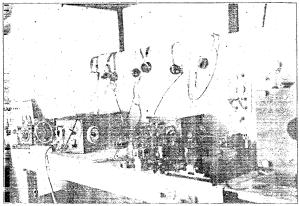
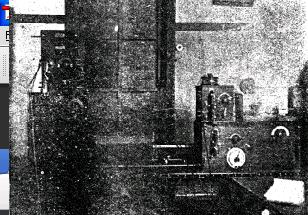
Shown here is a photo of WTCN radio in Minneapolis as it appeared in 1935.  The image is from the January 1936 issue of Radex magazine.

The station originally came on the air as WRHM, licensed to Rosedale Hospital at 4429 Nicollet Avenue in Minneapolis. In 1929, it became a CBS affiliate, switching to the NBC Blue Network in 1937.

In 1934, then on 1250 kHz, the station was sold to Twin Cities Newspapers, a partnership of the St. Paul Pioneer Press and the Minneapolis Tribune, at which time it took the WTCN call letters for “Twin Cities Newspapers”. The transmitter building shown here was near Snelling Avenue and Highway 36 in Roseville, where it remained until 1962. In March 1941, the station moved to 1280 kHz in accordance with NARBA. In 1964, the station took the WWTC call letters.

The WTCN call letters were used two other times in Minnesota broadcast history. The second television station in the area, channel 4, was originally co-owned with WTCN radio, and signed the WTCN-TV call letters. The call was later held by channel 11.  The call letters are now gone from the Minnesota airwaves, instead being used by a low power station in Florida.


Click Here For Today’s Ripley’s Believe It Or Not Cartoon


No-Sod-Er Radio Kits, 1926

NoSodEr
HopeHamiltonI’m not sure why, but some people have the idea that soldering is more complicated than it really is. Soldering is the process of splicing together two electrical connectors by melting over them a thin layer of metal, usually a mixture of tin and lead. In the photo shown here, movie star Hope Hampton is shown soldering together a radio in 1922.

To solder, you need a soldering iron and some solder.  They’ll set you back only a few dollars. For example, this kit at Amazon comes complete with solder for a very reasonable price, and will prove invaluable for all kinds of little repair jobs around the house. I can’t imagine not owning a soldering iron. But for some reason, there seem to be a lot of solderphobics in the world, and they refuse to consider the possibility of doing a job right by melting a little bit of solder.

Fortunately for these people, there are alternatives. An Amazon search for the word “solderless” gives over two thousand results for “improved” versions of various parts that don’t require soldering.

As shown by the ad at the top of the page, this is not a new phenomenon. Despite Hope Hampton showing the public how easy it was, many would-be radio hobbyists of the 1920’s were afraid of solder. The ad is for “No-Sod-Er Radio Kits” put out by the Radio Specialty Company of New York.  It appeared in the January 1926 issue of Radio Review, and promised the following:

Book explains what you want to know about new revolutionary way of assembling your radio set from our many kits–no solder, no bus bar, no poor connections, no waste of time, no skill required, no dissatisfaction, no tools needed except common screwdriver and pliers.  Even a boy can quickly assemble a completed kit.

This might all be true, and “even a boy” could put together such a kit.  But as Hope Hampton proved, even a girl could do it right, fire up her soldering iron, and build herself a real radio.

Click Here For Today’s Ripley’s Believe It Or Not Cartoon


Joan Ruth, WEAF, 1926

Joan Ruth, WEAF

Ninety years ago today, the January 16, 1926, issue of Radio Digest carried this portrait of soprano Joan Ruth, who appeared regularly on WEAF in New York.  In addition to her broadcasts at WEAF, whe was a member of he Metropolitan Opera.  The magazine notes that the Boston native bore “soulful eyes, the oval face, the black wavy hair and the suggestion of a halo in the dainty bit of silken cord with which it is tied.”

WEAF was the first broadcast station in New York.  Originally owned by Western Electric, it signed on in 1922.  In 1926, it was sold to RCA and became the flagship station for the NBC Red Network.  Starting in 1946, it took the call sign WNBC, which it swapped for WRCA in 1954.  In 1960, it switched back to the WNBC call letters.

The station signed off for the last time in 1988.  As part of a reshuffling of the New York dial, the station’s license, but not the station itself, were sold, and the clear channel 660 frequency was taken over by WFAN, which is owned and operated by rival CBS.

Click Here For Today’s Ripley’s Believe It Or Not Cartoon


Eugène Aisberg, Radio Writer

Eugène Aisberg, 1946.

Eugène Aisberg, 1946.

After a wartime absence, the January 1946 issue of Radio Craft carried an article by writer Eugène Aisberg.  While that name might not be familiar to American readers, Aisberg was a prolific author in the early days of radio, and wrote some of the best treatises on radio for the popular audience.  He was fluent in French, Esperanto, German, Russian, and English.

Aisberg was born in Odessa, Ukraine, in 1905, and lived most of his life in France. He was the director of the French magazine Toute la Radio and a prolific author of a number of books. His most popular book, which is still in print, is La Radio? Mais c’est très simple (Radio? But It’s So Simple!)  The book, currently in its 29th edition, an extremely solid background covering all aspects of electronics, and is written in a popular, easy-to-read style. While the book was ultimately translated into several languages, it was apparently never published in English.

The book consists mostly of a dialog between Ignotus and his uncle Curiosus, along with explanations by Professor Radiol, in which the characters explain in an interesting fashion all aspects of electronic theory.

Aisberg’s first radio book was actually published in Esperanto. Jen… mi komprenas la radion (“Now I understand the radio”).

1942 edition of Amélioration et modernisation des recepteurs.

1942 edition of Amélioration et modernisation des recepteurs.

During the war, under the noses of the occupying Germans, Aisberg published a book explaining how to pull in Radio London and other foreign stations. The technical title of the book, Amélioration et modernisation des recepteurs (“Improvement and Modernization of Radio Receivers”) was undoubtedly helpful in getting the book past the German censors.

While his most famous book was never translated into English, his later TV – It’s a Cinch was published in English in 1957. While analog TV is now an obsolete technology, the book is still an extremely interesting read, and the reader walks away knowing how the technology works.

The 1946 article, which marked his return to an American audience after the war, described a radio with automatic selectivity control.  The article also contains the following sidebar, which is a fascinating reminder of conditions prevailing in France immediately after the war:

Aisberg1946b

Because of the conditions prevailing in Paris, instead of a check, Aisberg preferred payment for the article to be in the form of “chocolate, cocoa, toilet soap, shaving cream, corned pork, coffee, needles and thread, canned ham, and high-speed razor blades.”

Aisberg died in Paris in 1980.

See also:  Fall of Paris, 1940

Click Here For Today’s Ripley’s Believe It Or Not Cartoon


1936 Vintage Station

1936JanPS

Amateur radio operators tend to be nostalgic about old gear, and this is apparently not a new phenomenon. Eighty years ago this month, the January 1936 issue of Popular Science
featured the station of Winton R. Jones, W3CAQ, of Baltimore. Jones was an employee of a Baltimore ship salvaging company, and used his position to fully equip his 40 meter CW station. As soon as a ship arrived at the Baltimore salvage yard, Jones made a beeline for the radio room, where he acquired the gear at scrap metal prices.

Most of the equipment told a story. One of his power supplies came from the Morro Castle, a liner which burned off the New Jersey coast in 1934.  The ship was en route from Havana to New York when it burned, resulting in the loss of 137 lives. The key came from the S.S. Jacob Luckenbach, a liner that went aground on the Mexican coast. Even the desk was salvaged from the captain’s quarters of a ship.

His oldest piece of equipment was an early Marconi galvanometer dating to use in the First World War aboard a Red Cross ship.

The station did get out.  The image below is a QSL from W3CAQ for a contact with W5BNQ, Wilmer, Texas, in 1933.

w3caq_33

w3caq_33_b

Acknowledgment

I would like to thank Bob Green, W8JYZ of OldQSLCards.com for providing the QSL card shown here.

Click Here For Today’s Ripley’s Believe It Or Not Cartoon


1926 Code Practice Set

1926JanPM

Ninety years ago, the January 1926 issue of Popular Mechanics showed this simple but ingenious device for practicing code. It allowed the aspiring radio operator a way to generate perfect code with a buzzer.

The board (preferably oak or ash) had a series of grooves.  At the beginning and end of each dot and dash a hole was drilled.  Copper wire was threaded up through the holes, forming a conductive path for each letter.  The other contact was slid over the letter at any desired speed, forming perfect code.

The article noted that a similar device had been used in the early days of the telegraph, presumably allowing unskilled operators to send (but not receive) messages.

Click Here For Today’s Ripley’s Believe It Or Not Cartoon