Category Archives: Radio history

75th Anniversary of End of Civilian Radio Production

1942MayRadioRetail

As we previously reported, on this date 75 years ago, April 22, 1942, the last civilian radio receivers rolled off the assembly lines.  For the duration of the war, no more radios or phonographs would be produced, the nation’s industrial output instead being devoted to the war effort.

The photo here shows one of the last RCA radios to be produced before the deadline.  This ad, which appeared in the May 1942 issue of Radio Retailing, shows RCA Victrola No. 17,199,547, which was the last set to be produced at RCA’s Camden plant, on April 7, 1942.

With no more new sets available, the nation’s radio servicemen were acutely aware that they would bear the full responsibility of keeping the nation informed and entertained by keeping existing sets running.


1942 Aircraft Detector

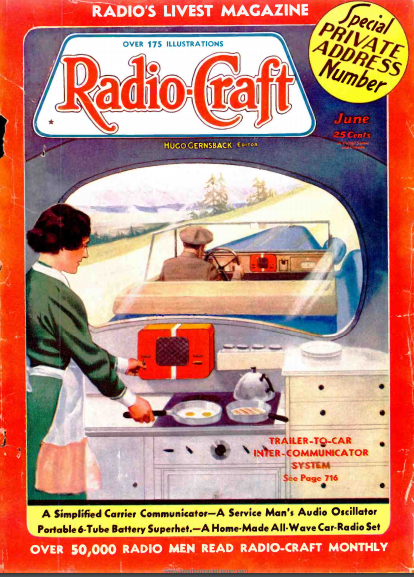
1942AprRadiocraftCover

Seventy-five years ago this month, the April 1942 issue of Radio Craft showed the defense-minded electronics hobbyist or serviceman how to put together this aircraft detector. According to the magazine, the detector would be of particular interest to civilian defense units around the country. Cost of parts was set at $50, and the detector used readily available parts. In tests, it was able to pick up conversations at three blocks, and the sound of a bomber ten miles away.

Detail of horn-microphone assembly.

Detail of horn-microphone assembly.

The “ear” consisted of an old phonograph horn with a sensitive microphone mounted at the base. The four-tube battery operated amplifier employed three 1H5GT and one 1G4G tubes and allowed the operator to scan the skies for approaching planes with headphones.


1942 Midget 3 Tube TRF

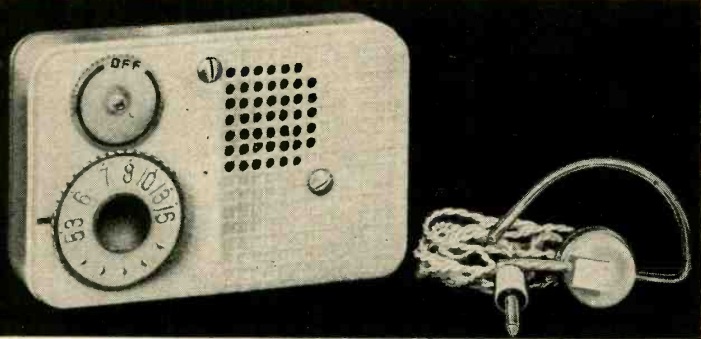
1942AprPS11942AprPS2Seventy-five years ago this month, the April 1942 issue of Popular Science showed how to put together this midget 3-tube broadcast receiver. The set was said to provide loudspeaker volume for stations up to fifty miles away. Thanks to the miniature tubes employed, the set could fit into a woman’s handbag.

The set used a type 9003 pentode as RF amplifier, with a type 9002 triode serving as detector. A 70L7GT dual tube served as audio amplifier and rectifier. The filaments were wired in series, with a 200 ohm line cord dropping the voltage.


For an antenna, the article recommended about 15 feet of stranded wire lying on the floor.

1942AprPSSchematic


1942 Ground Current Communication

1942AprQST

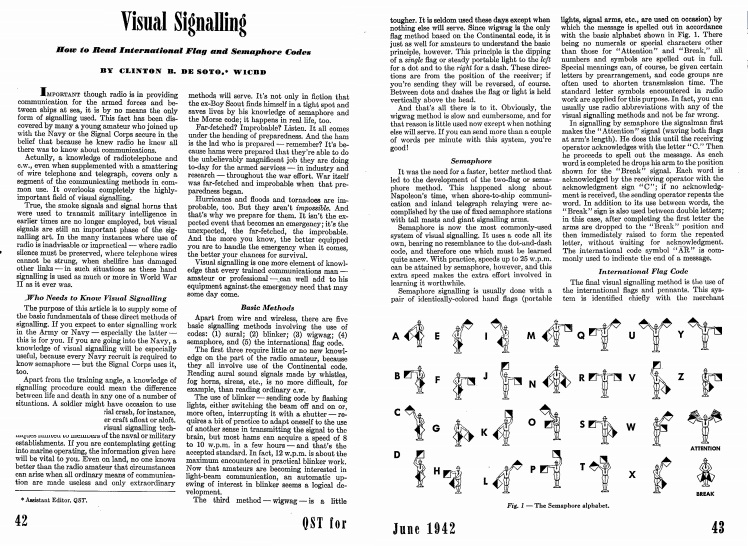
During World War II, Amateur Radio was off the air for the duration. However, unlike the situation in the First World War, hams were allowed to keep their equipment, and there were no restrictions on listening. Hams were eager to communicate, and with radio unavailable, they were eager to explore other possibilities. Starting with the March 1942 issue of QST, each issue included an experimenters’ section, which discussed many of the possibilities. Among the possibilities were carrier-current radio over power lines, and modulated light beams.

The first ideas started to trickle in 75 years ago this month in the April 1942 issue, and some of the first experiments focused on ground current communications. Leslie C. Merrill, W1NEI reported his preliminary results with the schematic shown above. The receiver consisted of the audio section of his receiver, and the transmitter consisted of the venerable spark coil from a Model T.

From the transmitter, the signal was fed to ground rods three feet apart. At the receiving end, the ground rods were only two feet apart. Despite the close spacing, he was able to copy the signal fifty feet away.

Merrill reported that he lived out in the country, and had the possibility to space ground rods 3/8 mile apart. By extrapolating his initial results, he speculated that a range of 30 miles might be possible with a similarly equipped station at the other end.

We’ve previously covered similar ideas.  In 1940, Popular Mechanics carried plans for a similar setup with a range of about 75 feet.  And in the First World War, the Signal Corps had a field buzzer that could be configured with a similar setup.  And a 1957 “Quist Quiz” showed a similar setup using a telephone, and even noted that old timers would be familiar with such a hookup.


Texas City Disaster, 1947

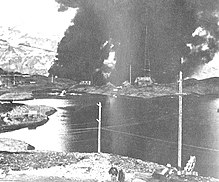
Parking lot a quarter mile from the blast. Wikipedia photo.

Today marks the 70th anniversary of the deadliest industrial accident in U.S. history, the Texas City disaster of April 16, 1947, which started as a fire aboard the French-registered vessel SS Grandcamp docked at Texas City, Texas, with 2200 tons of ammonium nitrate. The disaster killed at least 581 people, including all but one member of the Texas City fire department.

Smoke was spotted in the cargo hold of the Grandcamp at about 8:00 AM. The captain ordered his crew to steam the hold, which probably made matters worse by converting the ammonium nitrate to nitrous oxide.

Spectators gathered, believing that they were a safe distance away. The sealed hold began to bulge, and water splashing against the hull began to boil.

The cargo detonated at 9:12 AM, with a blast leveling over a thousand buildings on land and destroyed the Monsanto chemical plan and ignited refinery and chemical tanks on the waterfront. Bails of twine from the cargo were set afire and hurled around the city. People in Galveston, 10 miles away, were forced to their knees, and the shock wave was felt as far as 250 miles away.

The ironically named SS High Flyer was docked nearby, and the blast set fire to that ship’s cargo of ammounium nitrate. Fifteen hours later, that ship exploded.

As might be expected, the blast destroyed much of the city’s communication infrastructure, and amateur radio operators quickly responded to fill the gap.  Many of these stories are detailed in the July 1947 issue of QST (pages 38-40).

B.H. Standley, W5FQQ, on the air at city hall, along with city clerk Ernest Smith, Nurse Mrs. E.L. Brockman.

B.H. Standley, W5FQQ, on the air at city hall, along with city clerk Ernest Smith, Nurse Mrs. E.L. Brockman.

By noon, the first amateur portable and mobile stations had moved into the city and were on the air, working in conjuction with Army, Navy, Coast Guard, U.S. Engineers, FBI, and local and state police. Links were quickly set up between City Hall and stations in Houston and San Antonio. Most traffic was handled on 75 meter phone and 80 and 40 meter CW. W5KMZ reportedly handled over 200 messages, mostly involving needed medical supplies. As the hours went on, additional traffic was handled by W5FQQ at the mayor’s office, with over 300 messages passing on behalf of city officials, the Army, Red Cross, and Salvation Army.

An impromptu three-way net was established on 3989 kHz between Texas City, Galveston, and Houston.

Two hams, W5FQQ and W5EEX, had been advised to evacuate but remained at their stations. They narrowly escaped death when the High Flyer lived up to its name with its explosion. W5FQQ was on the air at the time of the blast, and the blast was heard by W5IGS in Houston. 21 seconds later, the Houston station experienced his windows shaking.

W1AW declared the emergency to be over 11 days later, on April 17.

As might be expected, considerable litigation followed, much of it under the Federal Tort Claims Act for alleged negligence of the U.S. Government. The case ultimately made its way to the U.S. Supreme Court, Dahelite v. United States, 346 U.S. 15 (1953), in which the court held that the Government was not liable, since all of the claimed government negligence amounted to discretionary acts.


1977 Fish Attractor

1977101projectsWe previously showed you the modern electrical method to catch worms.  (In fact, if you catch too many for your fishing needs, we even showed you how to make big money selling worms.)  But now that you have all of those worms, you’ll want to take them fishing, and this electronic project from 40 years ago practically guarantees that the big ones will start biting.

The circuit puts out a repeated click-click sound which is reportedly a dinner bell for fish.  With this circuit in a suitable waterproof container, the fish will be biting in not time.

The circuit appeared in the 1977 issue of 101 Electronic Projects, a special edition put out by the publishers of Elementary Electronics.


Station D-E-B-U-N-K, 1942

1942Apr12ChiTribSeventy-five years ago, the April 12, 1942, issue of the Chicago Tribune carried this story about a wartime curiosity on the shortwave bands, Station DEBUNK.

After the United State entered the war, the station sprung up on 7.2 MHz, and tried to pass itself off as a clandestine station operating from inside the United States.

But according to the newspaper, the FCC had confirmed what most SWL’s had already figured out, namely, that the station was broadcasting from Europe. The newspaper noted that the station was on the same frequency as the Berlin shortwave station.

The newspaper also noted that many listeners saw the hand of Freddy Kaltenbach in the station’s appearance, noting that it expressed his manner of expression and thinking. We previously wrote  (here and here) about propagandist Kaltenbach, a former Iowan of German birth.

The station was also profiled in the April 18, 1942, issue of Radio Guide, which noted that the station normally signed on to its 41 meter frequency between 7:30 and 8:00 PM Central War Time. The transmission began with an interval signal consisting of a piano playing part of the melody from the Star Spangled Banner, repeatedly playing the music for the words “by the dawn’s early light.”

The announcer then asked listeners to phone their neighbors to tune in and then played some jitterbug records. After about ten minutes, the announcer, one “Joe Scanlon” unleashed propaganda that was “anti-British, anti-American, anti-Communist, anti-Jewish, in fact, anti everything but National Socialism.”

After the diatribe, the station would sign off with the Star Spangled Banner. The Radio Guide profile noted that the station was amateurish in nature, with “the modulation as rotten as the talks.”

Announcer “Scanlon” was actually Herbert John Burgman, originally of Hokah, Minnesota.  Burgman served in the U.S. Army from 1918 to 1920, posted in Germany. In 1921, he was employed as a clerk at the U.S. Embassy in Berlin and married a German national. By 1941, he was a committed Nazi sympathizer, and declined repatriation to the U.S. along with the rest of the embassy staff, and he signed on as a propagandist for Radio DEBUNK.

After the war, he was arrested a tried for treason. The prosecution relied not only eyewitness testimony, but the recordings of the broadcasts from the FCC’s Silver Hill, Maryland, monitoring station. Despite a plea of insanity, Burgman was convicted of 13 acts of treason and sentenced to 6-20 years in prison. In 1951, the Court of Appeals affirmed his conviction. Burgman v. United States, 188 F.2d 637 (D.C. Cir. 1951).
He died in prison in 1953 at the age of 59.  He then found his way home to Minnesota and is buried in Austin, MN.

You can listen to a sound clip of Station DEBUNK at this link.


1947 One Tube Broadcast Regen

1947AprPM1947AprPM2Seventy years ago this month, the father-son team shown here at the kitchen table couldn’t decide which of them was going to get the one-tube radio after they finished putting it together. But fortunately, the circuit was simple enough that they decided to simply make two of them, one for each. They are following the plans that appeared in the April 1947 issue of Popular Mechanics.

The set was billed as being for the beginner, and both easy to build and simple to operate. It used a single 6J5-GT tube as the regenerative detector, and could pull in standard broadcast stations with good headphone reception up to about 400 miles. To keep things simple, it used a transformer to supply the 6 volt filament current, but used a 45 volt battery to supply the B+.

1947AprPMchasisConstruction was made easy by the “semibreadboard” chassis shown here, consisting of two wooden slats mounted on two wooden strips. The two slats were spaced so that the tube socket could be mounted between them, eliminating the need to cut a large hole for the socket.

The magazine promised that the next month’s issue would show how to convert the set into a more powerful all band 4-tube set, although the one-tube design was more than adequate for the beginner who simply wanted to build a set to pull in local stations.

1947AprPMschematic


Amateur Radio Shut Down, 1917

QST, April 1917.

QST, April 1917.

With the declaration of war, Amateur Radio in the United States was shut down for the duration.  Both transmitting and receiving were banned, and amateurs were required to take down their antennas.

The official order was printed in QST, May 1917:

DEPARTMENT OF COMMERCE
NAVIGATION SERVICE
Office of Radio Inspectoor

To all Radio Experimenters,

Sirs:

By virtue of the authority given the President of the United States by an act of Congress, approved August 13, 1912, entitled “An Act to Regulate Radio Communication,” and of all other authority vested in him, and in pursuance of an order issued by the President of the United States, I hereby direct the immediate closing of all stations for radio communications, both transmitting and receiving, owned or operated by you. In order to fully carry this order into effect, I direct that the antennae and all aerial wires be immediately lowered to the ground, and that all radio apparatus both for transmitting and receiving be disconnected from both the antennae and ground circuits and that it otherwise be rendered inoperative both for transmitting and receiving any radio messages or signals, and that it so remain until this order is revoked. Immediate compliance with this order is insisted upon and will be strictly enforced. Please report on the enclosed blank your compliance with this order, a failure to return such blank promptly will lead to a rigid investigation.

Lieutenant, U.S. Navy,
District Communication Superintendent


1937 Popular Mechanics One Tube Shortwave Regen

1937AprPM

Contrary to your initial impression, this is not an illustration of Junior helping Grandmother with her knitting. Instead, Grandmother is kindly obliging Junior in winding a coil for his new one tube radio. The radio builder is now almost a centenarian, since the illustration comes from the April 1937 issue of Popular Mechanics, which carried the plans for a simple one tube regenerative shortwave receiver.

1937AprPM2While the set was designed for the beginner, the circuit used a dual triode 6N7, and the inexpensive set demonstrated a “DX getting” ability equal to many sets with several tubes. It had a tight bandspread which made it an excellent performer in the crowded amateur bands as well as the 19 and 31 meter broadcast bands.

One half of the tube served as regenerative detector, with the other half serving as an audio amplifier to drive he headphones. In addition to the 6 volt filament supply, the set required a B+ of between 45 and 135 volts. While a battery eliminator could be used to run the set off household power, the article recommended use of batteries for best performance.

The chasis consisted of a wooden base, with an aluminum front panel. For tuning, one of the variable capacitors was set to the approximate frequency, with the smaller variable used to tune in the station’s exact frequency.

Coil winding instructions were included for four coils, covering the 160, 80, 40, and 20 meter bands. With all of those coils to wind, Grandmother’s help was almost certainly appreciated.

1937AprPMantAn antenna of 40 to 50 feet was recommended, and the illustration here shows Father helping to install it.  So that he can grow to become a centenarian, Junior is safely on terra firma while dad takes care of the climbing.

1937AprPMSchematic