Category Archives: Radio history

1933 Two Tube Shortwave Regen

1933FebSWcraftEighty-five years ago this month, the February 1933 issue of Short Wave Craft carried the plans for this two-tube shortwave set dubbed the “Band Spread 2.”

The set, designed by George W. Shuart, W2AMN/W2CBC, featured a type 58 tube serving as regenerative detector, with a 47 pentode amplifying the audio sufficiently to drive a speaker. The case consisted of an aluminum can measuring 5x6x9, which were said to be readily available. To facilitate easy changing of the coils, the author suggested that the can be purchased with a hole punched in the top, with a cover to fit. All parts were mounted on a metal shelf, held in place from the bottom by 7/8 inch spacers.

One variable capacitor was mounted directly on the coil form for rough tuning, with the main tuning control serving as a bandspread. Coil winding data was shown for the 40 and 20 meter ham bands.

A “long low wire” was recommended for the antenna, although it was pointed out that many foreign stations were pulled in with just a ten foot antenna.

1933SWcraft2


Simple 1918 Code Practice Circuit

1918FebPSA hundred years ago, the February 1918 issue of Popular Science showed this simple method for code practice without the need for a battery. A short length of wire was wrapped around the light circuit (the article noted that it wouldn’t work with a DC light circuit), through the key and headphones, and grounded. The result would be a convenient source of a 60-cycle tone.


Homemade Photovoltaic Cell

1943FebRadioCraftSeventy-five years ago this month, the February 1943 issue of Radio Craft showed how to make this rudimentary photovoltaic cell.

With some modification, it scould be easily duplicated today, and could be the basis for an interesting science fair project.

It consists of a strip of lead, as well as a copper plate covered with cuporus oxide.  To achieve the coating, the copper plate is heated in a flame until it is covered by a black flaky substance, which is cupric oxide.  Then, it is washed in a weak solution of ammonia, which reveals the light-sensitive cuprous oxide.

A sheet of lead should be available at a craft store, or can be ordered from Amazon.  Similarly, a small piece of copper is readily available at a hardware store or Amazon.

The electrolyte is a somewhat more difficult proposition.  The lead nitrate is somewhat hazardous, but should be safe if handled carefully.  The main problem is that it is expensive.  It is available on Amazon, both as a solution and as crystals,  However, the prices might be outside the young mad scientist’s budget.

Fortunately, this site seems to suggest that ordinary salt water will function adequately as the electrolyte.  Therefore, one suitable science fair project might be to determine what other electrolyte solutions might work best.  All that would be required would be a voltmeter to see which configuration puts out the most electricity.  The advanced student could skip buying the voltmeter and instead make this simple galvanometer.

Another fun project would be to demonstrate communication over a light beam, with a setup similar the one on this site.  Your homemade photocell is hooked to the input of a small audio amplifier, and you hook an LED to the headphone jack of a radio or other audio source.


1943 One-Tube Combination Code Oscillator/Regenerative Receiver

1943FebPSSeventy-five years ago this month, the February 1943 issue of Popular Science carried the plans for this one-tube combination receiver and code practice oscillator. The construction article, by Arthur C. Miller, noted that thousands of young men and women were learning code for civil defense purposes or prior to enlistment in the Signal Corps. A code oscillator was then impossible to buy.

A single switch changed the set from receiver to code oscillator. As a radio, the set ran on 45 volts, but the code oscillator required only 4.5 volts.

1943FebPSschematic


1938 Two-Tube Shortwave Regen

1938FebPS11938FebPS2The February 1938 issue of Popular Science carried the plans for this two-tube regenerative shortwave receiver.  While absent from the schematic diagram, the globe on the top was critical, since it allowed the shortwave fan to quickly spot the location of every new station logged, and easily spot the location where the message originated.

The circuit inside the box employed two type 30 tubes, one serving as regenerative detector, with the other serving as AF amplifier. Since regeneration operated more smoothly at a reduced voltage, the set employed two B batteries. A 22.5 volt battery powered the detector, with a 45 volt battery allowing for extra volume from the amplifier stage.

The cover of the set was hinged, to allow for changing the plug-in coils.

1938FebPS3


1958 Boys’ Life Shortwave Receiver: Part 2

WB3HLHradioWe recently wrote about this three-transistor regenerative receiver from the January 1958 issue of Boys’ Life magazine.

I just received this picture of the completed receiver, constructed by Tom, WB3HLH, of Rockville, Maryland.

As a Cub Scout, he saw the receiver in the magazine and was very interested. This is understandable, since the magazine also carried a feature extoling the virtues of SWL’ing, as well as a listing of the prizes in the annual radio contest.

About 50 years later, he located the magazine and took it upon himself to make one. The article noted that the set was not for beginners, and his experience agrees with this assessment. He notes that the audio stage was simple, but it was very tricky to get the detector oscillating.  As you can see, he very carefully duplicated the layout of the original project.

In addition to the coils described in the article (wound on plug-in coil forms), he wound a coil for the broadcast band. He reports that the set performs well on shortwave, both for broadcast and SSB signals. On the broadcast band, it pulls in all of the major East Coast stations, and signals as far west as KMOX in St. Louis.

The article calls for the use of four penlight batteries, but he reports using a 9 volt battery. The only other circuit modification is the addition of a 3.3 k resistor in parallel with a .01 uF capacitor on the emitter of the detector transistor.


Solar Fire Starter

1980SolarLighterWhen I worked for Radio Shack in an earlier lifetime, one of the more interesting products we sold was the solar cigarette lighter. It was something of a novelty item, but it was also fully functional. It was nothing more than a parabolic mirror, with a little holder at the focal point.  It’s shown above in the 1980 Radio Shack catalog. The idea was to place a cigarette in the holder, point it at the sun, and after several seconds, the cigarette would start smoldering. No, it didn’t work at night or on cloudy days, but on a sunny day, it worked flawlessly.

The same simple device is now available at Amazon.  Taking inflation into consideration, it’s not much more expensive than it was back in the day, and would serve as one method of starting a fire in an emergency. Yes, you’re better off if you have matches or a traditional lighter with you, but redundancy can be a good thing, and it’s kind of fun to amaze your friends by lighting a fire using solar power.

If you don’t smoke (this is one rare case where a cigarette could save your life), then you could use other similar tinder, such as tissue paper, dry grass, or leaves. This device won’t cause anything to burst into flame, so you’ll need more tinder at the ready. As soon as whatever you lit starts to smolder, you’ll need to transfer it to a larger pile of tinder, and then blow on it until it bursts into flame.  You then keep adding larger fuel until you have a fire of the desired size.  You don’t want the fire to go out after it gets dark, because obviously you won’t be able to light another one until morning.

(Some links on this page are affiliate links, meaning that we get a small advertising fee if you purchase from Amazon after clicking on the links.)


1968 QRP Rigs

1968JanRadTvExpFifty years ago this month, the January-February 1968 issue of Radio TV Experimenter devoted a considerable number of its pages to Amateur Radio QRP (low power) operation.

At the time, “QRP” generally referred to power levels of under 100 watts, but the introductory article by Robert M. Brown, K2ZSQ, revealed that many in what was known in ham circles as “that crazy QRP crowd” were seeing what could be done with flea-power setups, often consisting of a single transistor, IC, or tube.  He included these diagrams of minimalist one-transistor QRP transmitters:

1968JanRadTvExpSchematics

The cover feature was the “Mini-Mite,” a QRP transmitter designed by Howard Pyle, W7OE. This was a 4-band transmitter for 80, 40, 20, and 15 meters. The author reported that the set ran an input power of 1.2 watts with a 6 volt power supply, or up to 1.8 watts with a 9 volt supply. His best DX was 1100 miles on 15 meters, 600 miles on 20, 300 miles on 40, and a respectable 200 miles on 80.

1968JanRadTvExpIntlXtalThe transmitter actually consisted of four transmitters, since it used four of the ubiquitous International Crystal oscillator module kits, and ad for which is shown here from the same magazine. The oscillator cost $2.35, and an additional $3.75 for the necessary crystal. Essentially the oscillators, even though designed for test circuits, were functioning as transmitters, with just a bit of external matching network before the antenna. To switch bands, one transmitter was switched out of the circuit, and one for another band switched in.

It should be noted that it’s likely that none of these 1968 circuits would meet modern spectral purity requirements. Chances are, a bit more external filtering would be required. But the concept shown here is recognizable in many minimalist QRP rigs that are once again in style by “that crazy QRP crowd.”


1950 Soviet “Simplest Shortwave Receiver”

SovietSWReceiverBookCoverWe previously promised that we would be showing you more of this fascinating little book, and here it is!

The book in question is the 1950 Soviet book Простейший коротковолновый приемник (The simplest short-wave receiver) by V.A. Egorov, UA3AB,  part of the series Библиотека юного конструктора (Library of the young designer), a series of small books published between 1937 and 1964 showing various construction projects, many related to radio.

SovietSWReceiverBookSchematicAfter a few pages of introduction to shortwave radio, the book jumps right into a description of the circuit.  As the title of the book promises, the receiver is simple but elegant.  It uses a 6Н9М dual triode (that’s Cyrillic text, so you would read it as 6N9M), one half being used as regenerative detector, with the other half as audio amplifier.  The set employed plug-in coils, and was designed to tune the 40 and 20 meter ham bands.  (For those wishing to duplicate the set with Western parts, the tube appears to be equivalent to a 6SL7.)

The neatly constructed final product is shown below:SovietSWReceiverBook2

SovietSWReceiverBook1

If the book were published in the West, it would probably end there, along with a reminder that you needed to go to your friendly radio dealer or even drug store to buy a B battery for the plate voltage, and an A battery to light the filament.  But in the Soviet Union, it probably wasn’t a sure thing that you could find the battery.  So the book describes four methods to get the power.

The first two methods are power supplies that the reader could build, both of which are more complex than the receiver itself.  Both rely mostly on factory-made parts, but the second set of plans includes instructions for winding the filament transformer at home, with the B+ being rectified directly from the AC line:

SovietSWReceiverBookPS1

SovietSWReceiverBookPS2But even if the aspiring young Soviet radio fan wound his own transformer, getting the rectifier tube could be problematic.  Therefore, the third method of powering the receiver could be very attractive.  Chances are, the home was already equipped with a broadcast radio, and the broadcast radio had a perfectly good power supply inside.  So the third method involves simply tapping into it by unplugging one of the tubes, and powering the shortwave set right from the socket.  The young SWL just needed to locate the 6Ф6 tube in the family radio, remove the tube, plug his radio into the socket, and his radio would come to life!  Presumably, the other family members would be supportive of the SWL’s new hobby, and forego listening to the broadcast radio as he tuned the short waves.

SovietSWReceiverBookPS3

The fourth method recognizes that some builders might have enough connections so that they can simply go out and buy the battery.  In this case, a БАС-80 battery is required.

After recommending an antenna of 25-30 meters in length, the book jumps into some discussion of how to tune the amateur bands.  It notes, for example, that the 40 meter band can be expected to yield stations about 900-1000 kilometers away, with 20 meters pulling in stations more than 1000 km distant. It explains some of what the listener will hear. For example, in addition to listing some foreign call sign prefixes, it notes that UA call signs are in the RSFSR, UB calls are from Ukraine, and so forth.

It mentions some example SWL call signs, and even shows a reproduction of an SWL card from an SWL in Belarus, with the call sign of UC-2-2002, complete with the familiar address of Box 88 Moscow. Presumably, the text explains exactly how the young listener goes about getting such a call sign and getting his SWL cards printed, but I’m unable to read the text.

SovietSWReceiverBookPSswlcard

The book concludes with a table showing common Q-signals, common CW abbreviations, and the following listing of Soviet and European call sign prefixes.

SovietSWReceiverBookPSprefixes

The UA-UR prefixes for the various Soviet republics are listed at the left, with the right column showing the prefixes of Czechoslovakia, Romania, Bulgaria, Hungary, France, Belgium, Finland, Denmark, Italy, Britain, Sweden, Holland, Norway, and Germany.

The SWL card shown above is for reception of UA3AB, and a search for that call sign reveals that it was held by the author of the book, V.A. Egorov.

You can read more about this receiver at this link at the site of VA3ZNW (ex-UA3ZNW, ex-UA3-117-386).  He has a fascinating story of building this set in the 1970’s at the age of 13, and using it to tune in the Voice of America and Radio Liberty.  Even though the Soviets extensively jammed those stations, they didn’t bother jamming them on 16 and 13 meters, since Soviet receivers didn’t tune those bands.  But with the little one-tube homebrew set, they came in loud and clear.


1948 One Tube Broadcast Set for Beginners

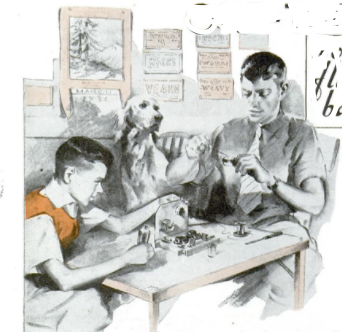
1948JanPM31948JanPM4Seventy years ago this month, the duo shown here are working on a one-tube broadcast set shown in the January 1948 issue of Popular Mechanics.  The set used a dual 6SL7 tube as regenerative detector and audio amplifier.  It was built on a wooden ladder-style chassis, allowing the tube and coil sockets to be mounted neatly without need of any drilling.

The set was the first in a series of progressive receivers.  As later issues of the magazine came out, the parts could be re-used to make more complex designs.

1948JanPM5