Category Archives: Radio history

ARRL Petition for Technician Digital & Voice HF Privileges

Thumbnail for version as of 15:00, 4 October 2017The ARRL recently made a Petition for Rulemaking with the FCC.  The request boils down to giving Technician class licensees some phone and digital privileges on 80, 40, and 15 meters.

I think this is long overdue, since it will allow Technicians, holders of what is now the entry-level license in Amateur Radio, some minimal but meaningful privileges on HF, similar to what I had as a beginner over 40 years ago.

The Entry-Level License in 1974

When I was first licensed, the entry level license was the Novice class.  I had to pass a simple multiple-choice test, as well as a simple 5 WPM code test.  When I did so at the age of 12, I was allowed meaningful HF privileges.  And in my case, it wasn’t until I actually received the privileges that I realized how meaningful they were.

IonosphereBefore I got the license, I realized conceptually that hams could communicate around the world.  But I didn’t really believe it.  I assumed, incorrectly it turns out, that to really get out, you needed a lot of power and/or a big antenna.  I assumed, incorrectly it turns out, that with 75 watts and a wire antenna, I would be able to get out locally, and maybe with good conditions, I might make occasional contacts with the next state.  But I didn’t really believe that I would be able to communicate around the country and around the world on a regular basis.

Nobody told me this.  In fact, I was told the opposite.  But I didn’t quite believe it.  I didn’t believe it until I actually got on the air.  When I did get on the air, I was soon filling up my log with contacts from all over the United States.  Eventually, when I discovered 15 meters, I was getting out all over the world, all with 75 watts and some wire in the air.

What got me licensed in the first place was a somewhat undefined interest in radio and electronics.  What got me hooked was the realization of how much fun it was to bounce my radio waves off the ionosphere whenever I wanted.  New licensees need the same thing to get hooked today, but it’s not readily available.

The Entry-Level License Today

New hams today don’t have this same opportunity.  The entry-level license is now the Technician license, with privileges mostly on VHF.  As a practical matter, this means that most of them get an inexpensive handheld such as the Baofeng UV-5R shown here.

There’s nothing inherently wrong with this radio.  In fact, for the price, it’s amazing what it will do, and I’ve written about it previously.  But this is the opposite of how I got started.  I started on HF, and was able to bounce signals off the ionosphere, an activity that greatly exceeded my expectations.  From the very first day I was licensed, I was able to interfere with Radio Moscow, and I did!  Only after I had upgraded, to either General or Technician, was I able to get on VHF.  At the time, that was something of an incentive, because there was a great deal of local repeater activity.  Long before the age of cell phones, I was able to communicate with a handheld device, and even make phone calls.  But an HT such as this really doesn’t have much capability beyond that of even the cheapest cell phone.  It’s hardly an upgrade.  In fact, in many areas, 2 meter FM is practically vacant.  Repeaters are still up and running, but there are generally only the same handful of local operators day in and day out.

Technicians are also currently allowed to use SSB and data on 10 meters.  This is somewhat of an improvement, since this band occasionally opens up to worldwide communications.  Unfortunately, it’s not open most of the time.  This is very different from my experience as a novice.  With just one band, 40 meters, I could talk to someone almost any hour of the day or night.  During the day, it would be 500 miles or so.  At night, it would be over most of the continent.

Current technicians are also currently allowed to use CW (Morse code) on 80, 40, and 15 meters, and I think they should take advantage of this opportunity.  But unfortunately, unlike when I was first licensed, there aren’t too many people willing or able to teach them the code and help them get on the air.  And there’s also the question of price, since the cost of a radio for CW (or SSB) is often considerably more than the cost of a digital radio.

Digital Modes for New Licensees

The ARRL’s proposal will allow new licensees to do exactly what I did over 40 years ago:  With inexpensive equipment, they would be able to get on the air immediately with digital signals on the lower HF bands.  They would be immediately  bouncing signals off the ionosphere, just like I did 40 years ago.

This can currently be done with equipment that costs about $125, assuming that they already own a computer, tablet, or smartphone.  If there was a demand for the product, there would be other models available, probably at a lower price, and it would also be possible for them to make it in a group-build of a kit project.

UT5JCW Digital Transceiver.

UT5JCW Digital Transceiver.

Currently, the only standalone digital rig available are a set of transceivers produced by UT5JCW in Ukraine.  They plug directly into a computer, and can be used for all digital modes, including JT65, FT8, and PSK31.  They require only a simple antenna, which could be as simple as a quarter-wave piece of wire strung in the backyard.  For 40 meters, the band I would recommend for a beginner, this would be 33 feet long.

With a radio such as this one, a new ham could be on the air almost immediately, making meaningful contacts all around the country.  It would be a much more meaningful introduction to ham radio than simply talking with the same handful of locals on a 2 meter repeater.

And the cost could be very comparable.  As noted above, the only radio currently on the market costs $125 shipped from Ukraine.  But this hasn’t always been the case.  Until several years ago, a kit called the PSK Warbler was available in kit form for about $40.  With guidance (perhaps as part of a licensing class), construction of such a kit was within the expertise of even a beginner.

I think that there could be a very meaningful introduction to ham radio if beginners were able to get their license and start out right away with a radio such as this one.  It would be more or less the functional equivalent of how I got started on 40 meter CW 40 years ago.

Is Today’s Test Really Easier?

20110502-motivationOne argument against changing the rules is that the test has allegedly been “dumbed down” over the years, and that beginners should not be given HF privileges until they have taken a test that is sufficiently difficult.

However, this argument is based on a false premise.  When I took the test for the entry-level test in early 1974 at the age of 12, it was much easier than the current Technician exam.  I had to take a 20 question multiple choice test.  That test was very easy:  I had to memorize the meaning of some new vocabulary words (such as “pecuniary”).  I had to learn some pieces of trivia.  For example, I had to know that transistors were made out of silicone and geranium.  (Actually, it turns out that it’s silicon and germanium, but that was close enough.)

Transistor raw materials. USDA photo.

Transistor raw materials. USDA photo.

I had to memorize a few equations, such as Ohm’s law.  I didn’t need to understand what was going on.  I needed to know, for example, that if the question included the words “Volts” and “Ohms”, then I needed to divide Volts by Ohms, and that was the right answer.  I also had to memorize the formula for the length of a dipole antenna, 468/f.

I was well aware that there was going to be one complicated word problem on the test.  This appears as question number 46 below, which called for me to calculate the input power to a final amplifier stage.  I knew to an absolute certainty that this question was going to be on the test, and it was there, more or less verbatim.  The only thing that changed was the actual numbers.  I had to ignore the filament numbers.  Like any word problem, irrelevant information was included.  I had to multiply screen voltage and screen current, and then multiply plate voltage times plate current.  Then, I added up those numbers, and also added drive power.  And sure enough, when I did this, even if I didn’t really understand what was going on, that number was one of the multiple-choice answers.

To give some idea of how easy the novice test was, I scanned the novice questions and answers from the 1975 license manual.  By simply reading these six pages, and making sure that some critical facts were memorized, it was almost certain that anyone attempting the test could pass with flying colors, even if, like me, they didn’t really understand most of the material.

Here are those six pages from the 1975 license manual.  These questions might have changed slightly from when I took it in 1974, but they are almost identical.  (To download these pages to your computer as a PDF file, use this link.)

As you can see, there are a couple of questions in the study guide asking you to draw a particular circuit.  However, the exam was strictly multiple choice, and it was known in advance that it was multiple choice.  So there might have been a question with the drawing asking to name a part, or identify a missing part.  But I didn’t have to draw any diagrams, and I knew going in that I wouldn’t have to.

Basically, just about anyone could have passed the Novice license test 40 years ago after reading these six pages.  I’m the author of a study guide for the current Technician exam, and I use 160 pages to explain the material.  Yes, I probably go into a bit more detail than the License Manual did 40 years ago, but I didn’t include much excess details.  Based upon my familiarity with both exams, I would say that the test I took was a lot easier, yet it gave me the opportunity to interfere with Radio Moscow.

In other words, it’s simply not true that the entry-level license test today is easier than it was 40 years ago.  It’s not much more difficult, but I was never required to take a difficult test before getting on HF.  There’s no reason why the same thing shouldn’t be true today.


What’s Wrong With This 1943 Radio?

1943PSWhatsWrongThis puzzle comes from the March 1943 issue of Popular Science.

The picture shows a four-tube AC-DC TRF receiver. But there are eight things wrong with the picture. A few are obvious, and a few you’ll be able to spot with a little bit of thought. If you can spot all eight, then you can consider yourself an expert on vintange radio.

The answers will appear tomorrow.


1918 Boys’ Life Looks at Wireless

1918MarBLA hundred years ago this month, the March 1918 issue of Boys’ Life magazine included this article by F.A. Collins (probably Archie Frederick Collins) about the state of radio, especially as it related to war.  He starts by explaining that “the thing that was impossible yesterday, today is indispensable in commerce and war, wireless telegraphy.”

And he makes clear that the radio section of the Signal Corps was something especially within the grasp of scouts:

Probably no country in the world can recruit men for this exciting service in such numbers as the United States. There are already tens of thousands of boys throughout the country who have had valuable training as amateurs. It has been estimated that this army of amateurs exceeded over 100,000 boys and girls. Thousands of Boy Scouts, for example, have an excellent working knowledge of wireless and have learned to transmit at a rate of twenty words a minute or faster. The Government does not accept operators under eighteen years of age and many of these boys are practical wireless operators by the time they reach this age ready to enlist in this interesting branch of service.


1941 Lew Bonn Company Catalog

LewBonnCatalog011One of our readers recently sent us the catalog shown here. The full catalog is 168 pages, and we’ll periodically post a few pages.

The catalog is from a distributor I had never heard of, Lew Bonn Co., 1211 LaSalle Avenue, Minneapolis. It doesn’t seem to have a date, but it appears to be from early 1941. The book listing includes the “new” 1941 edition of the Radio Handbook, and it also includes the Rider Manuals up through volume 11, covering 1940-41 radios. It also notes that the 12th volume will be available soon.

The catalog also contains a full selection of amateur gear, indicating that the catalog came out before Pearl Harbor. Therefore, I conclude that the catalog dates to early 1941.

Included here are the first twelve pages of the 168 page catalog.  In the coming weeks, we’ll add more pages until it’s completely available.  You can click on any of the images below to see a larger version.

Today, we present the index (pages 1-3), some of the specials to be found in the Bargain Basement (pages 4-7), electrical appliances (pages 8-10), car radios (page 11), and power supplies and inverters (page 12).

LewBonnCatalog001

LewBonnCatalog002

LewBonnCatalog003

LewBonnCatalog004

LewBonnCatalog005

LewBonnCatalog006


LewBonnCatalog007

LewBonnCatalog008

LewBonnCatalog009

LewBonnCatalog010

LewBonnCatalog011

LewBonnCatalog012


1938 Miniature UHF Transceiver

1938MarPS1938MarPS1Eighty years ago this month, the March 1938 issue of Popular Science carried the plans for this transceiver, which it billed as the world’s smallest two-way radio. Weighing less than ten ounces, the set could be carried in a coat pocket. The set shown here was for the 3/4 meter band, but could also be built for the 1-1/2 meter band. The heart of the circuit was a 955 acorn tube.

A DPDT switch was used to switch 1938MarPS2from transmit to receive. In the transmit position, the circuit was an efficient oscillator, and in receive, a grid leak and condenser were added to the circuit to produce a sensitive receiver.

The external batteries were acually larger than the radio. Two 3-volt flashlight batteries were used for the filaments, with a 45 volt battery providing the B+.

In order to make sure the radio was operating within the amateur band, the article described a simple wave meter, consisting of a flat U-shaped loop of No. 12 wire hooked to a galvanometer. The transmitter was held close to the loop and moved along until the highest current rating was shown. The transmitter wavelength was equal to the distance along the wire to the meter.

The construction article reminded readers that an amateur license was necessary to use the transmitter. But for those considering trying for the license in the near future, the construction of the set would teach many of the radio fundamentals that would be on the test.

The circuit here is similar to this WERS transceiver shown here previously. In case you’re wondering, the 955 tubes do seem to be readily available on eBay.

1938MarPSSchematic


1933 One-Tube Shortwave Portable

1933SWcraft3

This one-tube shortwave portable was featured 85 years ago this month in  the February 1933 issue of Short Wave Craft.

The set was awarded honorable mention in a contest sponsored by the magazine, and had been designed for a trip by the author to northern Michigan, where neither AC power nor replacement batteries would be available. Therefore, the main design consideration was low battery drain.  The set was built in the venerable cigar box, which housed all of the parts, including batteries and  antenna.

The author noted that the set could also be used as a shortwave converter with a broadcast receiver by running a wire to the phono input of the radio.  The author reported pulling in W1 and W4 stations at Detroit using only a copper screen in the lid of the radio as an antenna.

1933SWcraft4


1958 WRL Ham Shack

1958FebRadioTVNewsShown here on the cover of the February 1958 issue of Radio & TV News is Dorothy Hicks, K0BRZ, of Omaha, Nebraska, at the controls of the demonstration ham shack of World Radio Laboratories (WRL) in neighboring Council Bluffs, Iowa. The store maintained the station to showcase available products, both its own and those of other manufacturers, which were rotated through the station on a regular basis. The station was made available to hams passing through who might need to maintain a schedule, as well as to new novices.

Advertisement:


Try Audible and Get Two Free Audiobooks

Dorothy’s home station was more modest, with a Viking Ranger transmitter, National NC-300 receiver, and WRL tri-band beam. She typically did about three hours a day of ragchewing, usually on 10 and 15 meter phone.

Dorothy’s husband was Curt Hicks, K0AMM, the president of the Ak-Sar-Ben Radio Club. Their son Paul received his novice ticket at age 11, with the call KN0GZJ.

Shown at the WRL station is an Astatic D-104 microphone, Hallicrafters HT-32 transmitter, and Vibroplex bug for CW operation. The output of the HT-32 exciter fed a WRL Globe King 500 B transmitter, capable of 720 watts PEP input. Either the Hallicrafters or WRL could be used individually as transmitter.

Two receivers are shown, a Hammarlund HQ-110 and a National NC-109.


1948 One-Tube Shortwave Converter

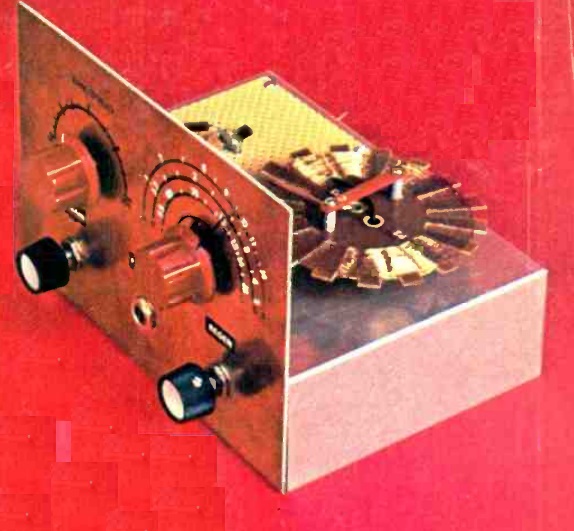
1948FebPSSeventy years ago this month, the February 1948 issue of Popular Science showed how to put together this handsome one-tube converter to pull in shortwave signals with a standard broadcast receiver.

The simple circuit, by S.T. Van Esen, W2OXD, was built around a 6BE6 pentagrid converter tube, and tuned 6-16 MHz.  The radio was set to an empty spot on the dial near 1500 kHz, and tuning was accomplished with a tuning dial on the converter.  A second variable capacitor was used to peak the mixer section.

For power, you could tap into the power supply of a transformer set.  Or if the proper voltages were not available, or if an AC-DC set was being used, the schematic for an appropriate power supply was also included.

The article promised the ability to pull in London, Lima, Sydney, Johannesburg, and other sources of news, information, and entertainment that were pouring out of foreign skies.

1948FebPSschematic

Rural Radio Magazine, 1938

1938FebRuralRadioThis month eighty years ago saw the beginning of the short-lived run of Rural Radio magazine with the February 1938 issue.  That issue’s cover, shown above, depicts a modern progressive farm family listening to the modern version of the party line, with an image of the old-fashioned version also shown.

The magazine was published by Rural Radio, Inc., of Nashville, which, of course, just happened to be the home of WSM. Edwin Craig, the President of the company that had founded WSM, in 1934 invited fourteen other clear channel stations to a meeting in Chicago where an organization called the Clear Channel Group was formed to lobby on behalf of the powerful stations. One result was the magazine, designed to promote the interests of the clear channel stations to their rural listener base.

The magazine lasted less than two years, since the editor, Ed Kirby, was wooed away by the National Association of Broadcasters to head its public relations department. The magazine was left in the hands of the printer, and was merged into Radio Varieties in 1939.

Morse Salisbury

Morse Salisbury

The first issue carried an article, “What Radio Means to the Farmer,” penned by Morse Salisbury, the Radio Chief of the U.S. Department of Agriculture. Salisbury was the host of the “Farm and Home Hour,” which was heard over 93 NBC stations for an hour each weekday.  (A script of a 1937 broadcast is available at this link.)  Salisbury noted that farm families, in addition to having access to the same entertainment, culture, and news as their city counterparts, also relied upon radio for “quick and close contact with knowledge that is important in a business way.”

He noted that the nation’s six million farm families did not have the capability of gathering the scientific and economic information necessary to their livelihood, but the Government provided that information through the Land Grant Colleges, extension services, and now radio.