Category Archives: Radio history

Brox Sisters

File:BroxSistersRadioTeddyBear.jpgShown here in the mid-1920s are the Brox Sisters tuning in to some program on their radio.

The Brox Sisters, Patricia, Bobbe, and Loryane, (left to right in the photo)  grew up in Tennessee and began touring the U.S. and Canada on the Vaudeville circuit in the 1910’s, and at the start of the 1920’s, they moved to Broadway, where they performed in Irving Berlin’s Music Box Revue from 1921 to 1924.  They also appeared on stage with the Marx Brothers and the Ziegfeld Follies of 1927.  They also appeared in a number of movies, both shorts and feature films, in the 1930’s.

The sisters can be heard in this 1929 recording of Singing In The Rain:


Midwest Blizzard of 1949

As I write this, snow is once again forecast for my region. Since the calendar says that it’s the first day of spring, it’s likely that the snow will be little more than a temporary inconvenience.

But I was recently reminded that a snowstorm wasn’t always just a minor inconvenience, and I learned about one of the Midwest’s largest winter storms ever, the blizzard of January 2-5, 1949.

Ida McNeil, KGFX.

Ida McNeil, KGFX.

I don’t think I had ever heard about this storm until I had a comment on my post about KGFX, a one-woman broadcast station run out of the home of Ida McNeil in Pierre, SD.  As I mentioned in the previous post, Mrs. McNeil did take commercial advertising, but she viewed the station mostly as a public service.  And this is borne out from the story of the 1949 blizzard shared by reader Dwight Small:

I well remember her broadcasting during the blizzard of 1949. We were completely snowbound on the former Hugh Jaynes ranch 15 miles NNW of Pierre. She was our only window to the outside world for at least a couple of weeks. We had no electricity but the battery powered radio lasted sustained our spirits. We learned from her that there were hundreds of others in the same boat.

I did some research about the storm, and it appears that many were, indeed, in the same boat.  The winter of 1948-49 was severe in many respects, but it delivered it’s biggest punch to the northern plains in the early days of January, 1949.

The April, 1949, issue of QST describes its entry to South Dakota:

Things began on the morning of January 3rd in South Dakota, when KOTA, Rapid City’s broadcaster, let loose with the first hint that the impending storm was to be of record-breaking proportions. Unfortunately many ranchers, traveling people and others failed to hear the broadcast warnings and were totally unprepared for what was to come. It started coming down on the 3rd, and continued until about noon on the 5th. The actual snowfall was not of record-breaking proportions, but high winds, sometimes in gusts of 65 to 70 miles per hour, piled the snow into mountainous drifts, oftentimes 30 to 50 feet deep.

Many others found themselves isolated by the storm.    In 2013, the Rapid City Journal carried the reminiscence of schoolteacher Grace Roberts, who was stranded at her post in Creighton, a small town about 25 miles north of Wall. She and her four-year-old daughter made it to school, but then found themselves trapped there for 38 days. The road to the school was plowed a few times, but was quickly covered over with snow.

She reminisced in 2013 that she ate a lot of canned soup, but managed due to the kindness of neighbors, the closest of whom was a mile away. The neighbor would ride over on horseback, “and when his wife baked bread he’d bring us some bread or when he milked a cow, he would bring some milk.”

The school had a small bed, and was well stocked with coal. They also had a battery radio, and would listen occasionally, but mostly passed the time by talking and reading.

Another survivor, Everett Follette of Sturgis, like many South Dakotans, had a phone line that kept working through the storm and served as the lifeline. Interestingly, though, Follette recounted in 2009 that the family also had a battery-powered radio, “but the only station they could tune in came from Bismarck, N.D.”

Battery radio of the era, a Philco 41-841.

Battery radio of the era, a Philco 41-841.

The family used as much milk and cream as they could from their dairy farm, but with roads impassible, they had to dump the excess. Eventually, the Sturgis creamery called about the availability of milk, and made a deal to follow a military snowblower. When neighbors learned that the truck was coming, they quickly phoned the grocery store in Sturgis to have groceries delivered.

As might be expected, hams sprang to action to deal with the communications needs of the region, as detailed in the April 1949 issue of QST. In South Dakota, when the snow first started coming down, W0ADJ and W0CZQ made arrangments with the Air Force base to maintain contact with the base at Colorado Springs, “just in case.” Hams also played a role in coordinating the massive air operations after the storm had passed. Planes were used to search for survivors and drop supplies for both humans and livestock.

Broadcast stations advised incommunicado ranchers of which marks to make in the snow to request drops of feed and other supplies.

The railroad plow which bored through on the North Western line from Pierre east of Rapid City after dynamite as used to loosen ice-encrusted snow. Photo courtesy of the Rapid City Journal.

One of the most dramatic uses of amateur radio took place in Ogallala, NE, a town of about 3000 in western Nebraska. A train was stalled in the snow west of town, and a major transcontinental highway was blocked. State snowplows managed to break through, and led a mile-long convoy of cars into town. Suddenly, the town of 3000 was pressed into service to shelter, feed, and supply communications for an additional 2000 people.

The communications duties fell upon W0LOD, the town’s only ham, whose station was limited to running 50 watts with a single 807, and only on 40 meters. Despite his modest station, “all around W0LOD–north, south, east and west–were hams with sensitive receivers, and perhaps greater power, and, as the skip ebbed and flowed he was able to sit at his operating position handling emergency traffic in unbelievable quantity much as he had been accustomed to handle routine traffic night after night. It was a 48-hour session at the key, but no heroics, no frantic ‘QRRR’–just a traffic man doing that which he likes best.”

The April 1949 QST article tells of other storms that winter, many of which overlapped each other. For example, when railroad telegraph lines went down, hams were called upon to assist the railroads in keeping te trains running. In Kansas, W0EQD didn’t even realize that his town had been cut off from the outside world. The power was out, so he got his station running on the emergency generator and checked into the Kansas Phone Net, which had traffic waiting for the phone company. As soon as he delivered the message and local officials found out he was on the air, he was kept busy for the next 48 hours as his town’s only communications facility.

Missouri was hard hit by an ice storm on January 11, and many commercial telegraph lines were down. Western Union called on hams to deliver both company and weather bureau messages. The cartoon below appeared in the Springfield (Mo.) News & Leader, and was reprinted in QST. It shows a ham being scoffed for spending so much time and money to take part in a “kid’s hobby” only to talk to people he didn’t even know. But in the next panel, after the ice hits, the same man is begging the ham to get news of his mother who was cut off from the outside world.

1949AprilQSTCartoon


References

It’s ‘Going Down in History”: The Blizzards of 1949. South Dakota History Vol. 29, p. 263 (1999).

Albert E. Hayes, Jr., W1IIN, Deep Freeze, QST, Apr. 1949, p. 35.


Three Soviet Battery Receivers

SovietBatteryRadioThe young comrade shown here is pulling in the latest bulletins from Moscow thanks to the battery powered receiver he built himself, courtesy of the plans contained in a little booklet entitled, Самодельный батарейный радиоприемник (Homemade Battery Radio), published in 1956 as part of the series Для умелых рук, (For skillful hands).

SovietBatteryRadio1There are actually three different sets included, both one and two tube models. They appear to cover medium wave (200-500 meters) and long wave (800-2000 meters).

The first set is a one-tube model using a 2К2М tube, SovietBatteryRadio2shown at left. The single tube serves as regenerative detector, with the switch near the coils switching from mediumwave to longwave.  The second model, shown at the right, uses a second 2К2М as an audio amplifier. The final set, shown below, uses a 1К1П detector and 2П2П audio amplifier. All are apparently designed to run from a БАС-80 battery  supplying filament voltage and 45 volts B+.

SovietBatteryRadio3

I found this web page showing a modern reconstruction of a circuit almost identical to the first one-tube design shown here.  According to the site, the design was originally published by F.I. Tarasov in 1949.  In fact, I see Tarasov’s name cited in this booklet as well.

The main modification seems to be a potentiometer added to adjust the filament voltage, along with a voltmeter to monitor it.  The page is in Russian, but Google translate does an excellent job of translating it.  The video below shows the completed receiver in use, and it appears to be a good performer:

SovietBatteryRadio4


1933 Four Tube Superhet

1933MarSWCraft85 years ago this month, we see this young radio enthusiast who just managed to wake up his parents at 5:30 in the morning. When they came to investigate, they were shocked to learn that he was pulling in Australia with the four-tube superheterodyne described in the March 1933 issue of Short Wave Craft magazine.

The set employed two tubes in the RF section with an additional tube serving as AF amplifier. The set ran off AC power, and contained a power transformer and rectifier completing the tube lineup.

1933MarSWCraft1


1943 Test Equipment

1943MarQST11942AprQSTOne item that was in short supply 75 years ago were meter movements. There was a backlog in their manufacture to the point where hams were being encouraged to sell their old ones, as shown from the form at left from the April 1942 issue of QST.

But the absence of a meter didn’t have to mean that it was impossible to measure things. The device shown above was a simple bridge circuit for measuring the values of resistors, capacitors, and inductors. The circuit was contained in an article in the March 1943 issue of QST, submitted by W.J. Mertz, VE4UN, using whatever was available. An audio signal is fed into the input, and the potentiometer adusted until the circuit is in balance, at which point the audio output disappears. By calibrating the dial with a few known values, the unknown value can be quickly determined.

The author didn’t have an audio oscillator, so he instead used the device by feeding in the squeal from a regenerative receiver. And in the absence of anything else to make the dial pointer, he used the handle of a broken toothbrush.

While inexpensive multimeters such as the one shown at the left make this project less necessary today, it could serve as the basis for an interesting science fair project for relatively advanced students.  For information about the theory involved, a trip to Wikipedia will provide the necessary background.

1943MarQST2


1928 Power Supply With Homemade Rectifiers

1928MarPM1Tired of the bother and expense of having to buy batteries for his radio, the gentleman shown here is taking matters into his own hands by constructing a B-battery eliminator, following the plans in the March 1928 issue of Popular Mechanics. We showed a 1926 version earlier, and this one is more refined.

In this case, hum is dealt with by electrolytic capacitors, which were available for purchase. Rectifiers, on the other hand, weren’t as easy to come by. But undaunted, he just made his own, consisting of plates of lead and aluminum carefully suspended in pickle jars containing an electrolyte solution. That solution could be borax, sodium bicarbonate, or ammonium phosphate.

The rectifiers were just a bit tricky to get going, which explains the light bulb in series with the transformer primary. If the rectifiers were doing their job, the lamp would light briefly and then dim. If the light remained on, it meant that one of the cells needed attention. In either case, the light bulb served to limit the current and protect the expensive transformer.

Since modern rectifiers are so inexpensive, there’s little practical reason to make your own.  However, they’re so simple to construct that a homemade rectifier would probably be the basis of an excellent science fair project for the advanced student.


1928MarPM2


1938 Admiral Model 55 Car Radio

1938MarRadioTodayEighty years ago this month, the March 1938 issue of Radio Today carried this ad for the Admiral Model 55 Auto Radio.  The 5 tube superheterodyne featured five preset buttons.  Unlike earlier models in which each button contained a tuned circuit, in this one, pushing the button moved the main tuning dial.

Some competing Delco models from three years later are shown below, from the 1941 catalog we showed a few days ago.

LewBonnCatalog011


1968 One Tube Transmitter

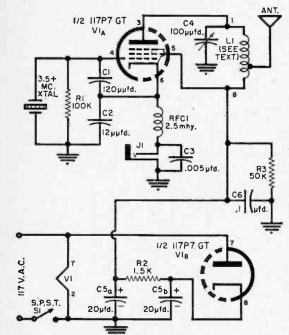
1968MarEIFifty years ago this month, the March 1968 issue of Electronics Illustrated showed how to put together this transmitter for 40 and 80 meters. As the photo makes clear, it’s about as simple as can be.

It uses a 50C5 (or 50L6) tube, with the filament powered directly off the AC line with a 400 ohm resistor. Two silicon rectifiers are used as a voltage doubler to provide about 350 volts for th plate.

All components are mounted on a wooden board, with connections soldered to finishing nails on the board.

The neon lamp in the schematic is there as a safety precaution. Since one side of the key is connected directly to the power cord, the lamp comes on to show that it’s plugged in the wrong way–with the hot side on the key. If you plug it in and the light comes on, then you should reverse the plug. (And you’ll probably have the added complication of blowing the ground fault interrupter of modern house wiring.)

Also, since there’s no filtering of the output, this transmitter probably doesn’t meet modern spectral purity requirements.

1968MarEISchematic


1977 Soviet Youth Telegraph, With Bonus Machine Gun & Radio

Masterok1At first glance, this appears to be an American Boy Scout working on his signaling. But it’s not. It’s actually his Soviet counterpart, a Young Pioneer getting the message through. The image is from the cover of a 1977 issue of Masterok magazine, a Soviet journal designed to instill in middle school age children the necessary skills for labor education.

This issue seems to focus on communications skills, and for the beginners, it describes how to make this tin-can telephone, albeit a rather advanced version of the old staple:

Masterok2

It moves next to Morse signaling, showing how to make this buzzer set:

Masterok3Masterok4

Of course, the young comrades need something to communicate about, so the magazine shows them how to make this realistic looking machine gun, perfect for taking out invading capitalist imperialists:

Masterok5

After all that excitement in the field, the Pioneers can relax by listening to the radio after building this three-transistor TRF set.  It employs permeability tuning, one stage of RF amplification, and two audio stages for good headphone volume.

Masterok6


Answers to Yesterday’s Puzzle

1943PSWhatsWrongYesterday, we showed this picture from the March 1943 issue of Popular Science of a radio with eight things wrong with it. As promised, here’s what’s wrong:


1943PSAnswers