There’s a theory that history generally follows 80 year cycles. The reason seems to be that when the last people to remember the past die, then their descendants repeat the same mistakes. The American Revolution, the U.S. Civil War, and the Second World War were American historical landmarks separated by approximately 80 years.
A letter published 80 years ago seems to confirm this theory. The August 1938 issue of Radio News (page 36) contains a letter by newly elected ARRL director Fred Young, W9MZN. Young recounts showing up at his first board meeting under the impression that he was sent there to represent the members who elected him.
But when he presented those ideas, they were dismissed as “ill-advised,” owing to a supposedly uninformed membership. To that, Young suggested that the members ought to be informed, and suggested doing that by having the issues be fully argued in the pages of QST. But this idea was quashed. Young also noted that the ARRL was “very largely a publishing concern.”
The ARRL has done a reasonably good job in representing the interests of members over the past 80 years, so I suspect that Young had some measure of success. But history repeats itself, and today, practically the same issues are once again at the forefront of ARRL politics. Many members (myself included) believe that the League is dangerously close to no longer being a member service organization and turning completely into what Young called a mere “publishing concern.”
I encourage all ARRL members to inform themselves on how the ARRL governs itself. You’ll find a background on the issues at the myARRLvoice website and Facebook group. I encourage you to contact your director and let your voice be heard. And if you live in the Hudson (parts of New York and New Jersey) or Northwest (Alaska, Washington, Oregon, Idaho, Montana) Divisions, I encourage you to consider supporting Ria Jairam, N2RJ and Mike Ritz, W7VO in their bids for election to the board.
Like Fred Young 80 years ago, they seem to get it that the League is “of, by, and for” the Radio Amateur.
Here’s what Fred Young had to say 80 years ago. But most of it could be written today:
Impressions of the 1938 ARRL Board Meeting by FRED W. YOUNG, W9MZN, ARRL Dakota Div. Director
A NUMBER of things impress the newcomer to the ARRL Board Meeting. I may have been a bit self-conscious and conspicuous as the only Director who had not attended at least one previous meeting. In any event, it can be said that my notions as to what constitutes representing a division differed widely from those held by most of the other members of the Board.
Prior to attending the meeting, I had sent a letter to every ARRL member in the Dakota Division advising what important issues faced the League. A brief questionnaire was included covering the major issues likely to come up as well as the proposed changes in the Constitution and By-Laws. It seems now that the meeting is over, that I certainly misunderstood section 14 of the Revised June 1937 Constitution and By-Laws which reads “… They (Directors) shall keep themselves informed on conditions and activities in their respective divisions, and on the needs and desires of the League members therein, that they may faithfully and intelligently represent them in the Board of Directors.” It is my understanding of this passage that the director is to present and attempt to carry out the wishes of the members when they are known. In each case, I voted as a majority of my constituents wished as shown by the questionnaires returned, and if their wishes did not come up as a motion by another Director, I presented such a motion.
For attempting to carry out such a policy, I was placed at some discomfort a number of times, and roundly criticized by officials and Board members at others. A number of remarks were made concerning the questionnaire results which I took occasion to mention several times. Such results could not mean anything, some felt, because members were not properly informed on issues. Others dogmatically said that the membership took no interest in amateur affairs except concerning frequency allocations. Still others felt that a Director is not bound to follow the wishes of the majority in his division. Speaking of some of the desires of the majority of the Dakota Division membership reporting, one member of the Board said that they were “half-baked” which he later changed to “ill-advised” when I pressed him to justify his statement.
The Secretary took occasion to say that it was too bad that I was so poorly informed on League affairs (all I know is what I get from him), seeming to take the officious attitude that anyone who would criticize any of the League policies or practices must be uninformed.
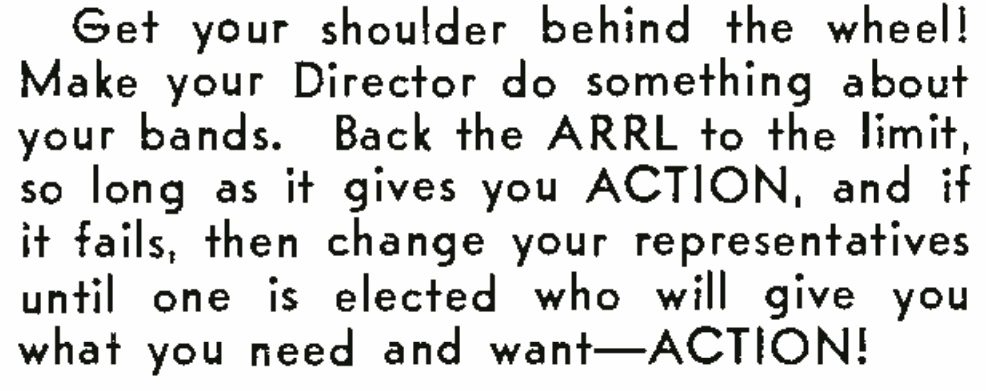
As many of you know, I attempted to keep members informed and interested concerning the Board meeting by arranging with W9PZU to broadcast late developments, and during the meeting, brief summaries of its action. A member of the Board took occasion to say to me that such action was ill-advised because it tended to agitate the members concerning the Board meeting.
I was much impressed by the rather arbitrary presumption on the part of most Board members that the membership as a whole was not interested in League policies and affairs. Most of the Directors admitted that they had not made any attempt to canvass their divisions. Many took the attitude that even though the membership is canvassed or seemed interested, results would necessarily be based on misinformation or insufficient information, and therefore, in any case, not worth serious consideration. Thusly do members of the Board excuse themselves from any systematic effort to find out and carry out the wishes of their constituents. The results of my questionnaire canvass showed that members were interested in League affairs. To accuse the membership of being uninformed seems, in my opinion, very unfair because I think that the Director, QST, and the officials should see to it that it is informed.
Further, the Board seemed to take the position that the Director should wait to make up his mind on issues until he had heard the ideas of the other Directors, seeming to place much value in pro and con discussion. However, when I introduced a motion to permit pro and con correspondence to be published in QST over the Director’s signature, the Board voted it down. Then they have the audacity to take the position that the Member is both uninterested and uninformed, and therefore unable to state a wish or opinion that can be counted to be worth anything. I feel that if anyone is at fault in this situation, it is the Board with this attitude.
I still have the conviction that the Directors should keep faith with the majority in their Divisions, that the ARRL is very largely a publishing concern that as such can expect very little government or legislative support; and that the HQ officials are very anxious to keep important issues from members and to keep membership unrest well isolated. To this end they are opposed to conventions on the ground that they are badly managed and often indecent (admittedly some are). I feel that the real reason for this opposition, however, is because conventions permit amateurs to get together, find out what other amateurs are thinking, which might result in criticism becoming too articulate. They are also opposed to opening QST to any critical articles or differences of opinion for the same reason.
It is further my conviction, even after the Board meeting and the majority notwithstanding, that there should be a bigger part for the membership in League affairs, that there should he a budget of expenditures, that the League should be made much more than just a publishing concern, that the HQ station and HQ should be near the center of the US, and that a verbatim report of the Board meeting would be most interesting to the membership, presumably in their behalf.
Previously I felt that the HQ staff was at fault in the conduct of League affairs. Now I am definitely of the opinion that the fault lies with the Board itself. Some Directors demonstrate outright apathy, others a presumptuous tendency to speak for member whom they have never consulted. Most of them seem perfectly willing to take at their fact value the statements and attitudes of the HQ staff. Too many are on the Board without actuallv having been elected by members of their divisions through indifference to technicalities in qualifications.
I maintain that Directors should try to stir up interest and participation even if it results in competition in elections. In my way of thinking, the HQ staff feel they have a good thing of it, and therefore, want no change. With things as they are, one can hardly blame them for that position, but I do feel that the Board should be more critical in its action.
If the membership is not taken into confidence, coming events are likely to weaken or destroy the effectiveness of the League. The Secretary mentioned at the meeting that it was his opinion that at the next international conference at Rome four years hence, the amateurs will lose both the forty and twenty meter bands. It is likely that no official QST mention will be made to amateurs at large of this condition. Should this loss happen as is predicted, the League will be severely criticised unless members are prepared for it by being acquainted with European conditions which will foreshadow this loss.
Again I must say that positive action awaits an alert, vigorous, and militant membership which must be solicited from the rank and file of those amateurs presently outside as well as inside the League.

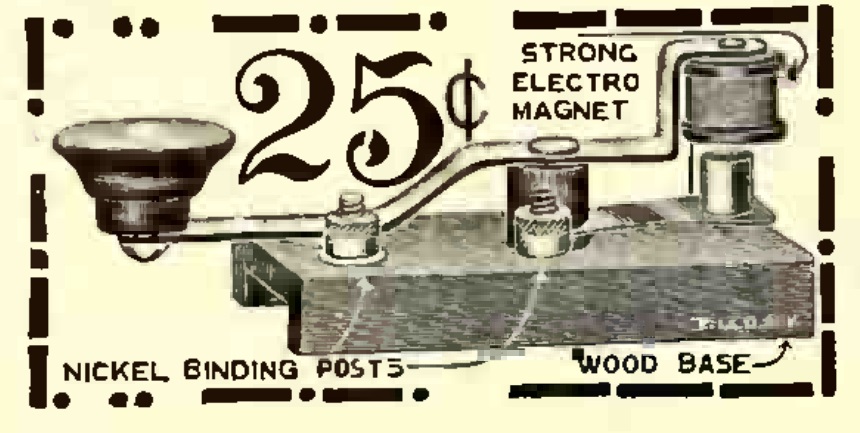
 This ad from the August 1918 issue of Electrical Experimenter magazine shows an interesting code practice set which appears to be a combination key and sounder, for the low price of 25 cents (plus six cents for the catalog the company wants to get in as many hands as possible.