Category Archives: Radio history

1938 One Tube Shortwave Regen

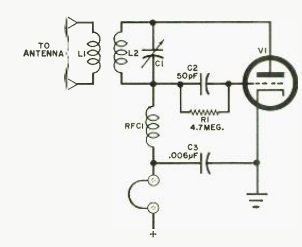
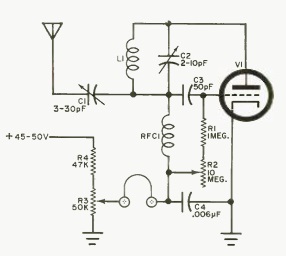
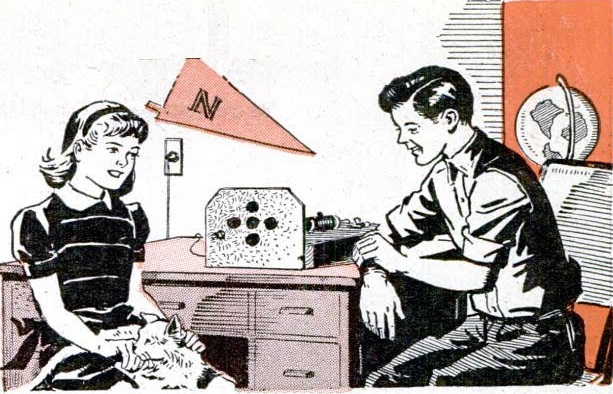
Screen Shot 2018-04-27 at 11.30.06 AMWhile Fido keeps a watchful eye, the father-son team here is putting together the one tube regenerative shortwave set shown 80 years ago this month in the April 1938 issue of Popular Mechanics.

Screen Shot 2018-04-27 at 11.35.06 AMThe set ran on three flashlight batteries. Two of them in series provided the 3 volts of B+ necessary to run the type 49 tube, with another powering the filament.

With four plug-in coils, the set covered 18 to 200 meters. A good antenna and ground were required, as were high-impedance headphones. But as evidenced by the QSL cards shown in the illustration above, the simple circuit was capable of pulling in DX.

Screen Shot 2018-04-27 at 11.35.30 AM


1959 Young Soviet Radio Enthusiasts

1959AprSoviet

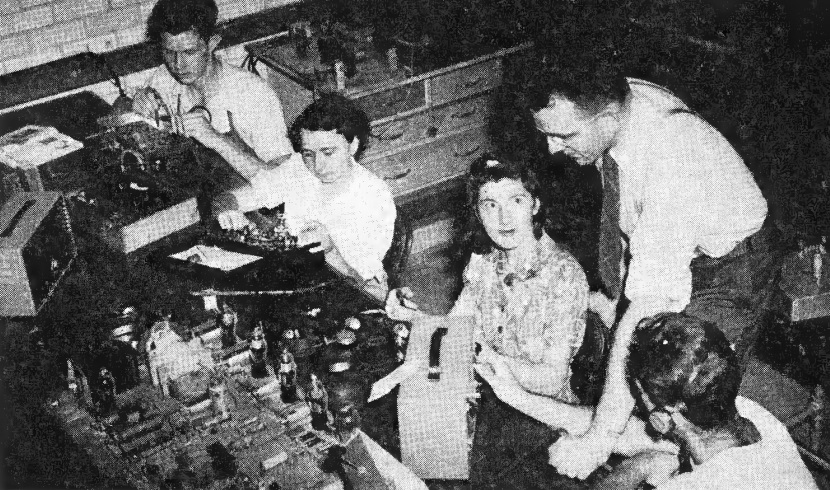
These young comrades were pictured on the cover of Семья и школа (Family and School) magazine, April 1959. Unfortunately, I can’t find any article inside the magazine that goes with the cover. Perhaps one of our Russian readers can fill us in!

But these gentlemen, now about 70 years old, seem to be having a good time pulling voices out of the aether.


WNAX Yankton, 1943

1943Apr26BCSeventy-five years ago today, the April 26, 1943 issue of Broadcasting carried this ad for South Dakota blowtorch WNAX in Yankton. As the ad noted, the the station’s tower stood 927 feet, then the highest in the country.

Due to the area’s good ground conductivity and the station’s low spot on the dial, the station still has the second largest daytime coverage area in the nation, putting a respectable daytime signal into Minneapolis/St. Paul, Fargo, Kansas City, Omaha, and Des Moines.  The station’s current tower stands 911 feet, and is also accompanied by two other towers used for the station’s nighttime pattern.

The station’s transmitter building shown here still stands.  The studio in Yankton was destroyed by fire in 1983 and rebuilt outside of town.


1948 Australian “Crystal King”

1948AprilRadioAndHobbies

Seventy years ago this month, the April 1948 issue of the Australian magazine Radio and Hobbies showed how to make this simple crystal set, dubbed the “Crystal King.”

The author noted that the magazine’s readership including a lot of “young chaps who are just beginning to discover what radio is all about,” and that he remembered the first radio he ever built, and that the questions and problems he came up against, while silly in retrospect, seemed very important at the time. Accordingly, the article goes into sometimes excruciating detail as to such minutiae as what kind of wire to buy.

The set was neatly built on a wooden basebaord with a shellacked front panel. It was said to be able to pull in stations within about 10-15 miles. Occasionally, more distant signals could be heard, but “everything must be on your side if such reception is to be certain.”

The main advantage of the crystal set was that it needed no battery and thus no operating costs. However, “if you are a young lad who has built this set just for experiment and your Dad already has a license for a set you won’t need to pay for another one. Only if you intend to keep it built up as a permanent installation is another license required for it.”

I wonder how many young Australians built the set as a permanent installation, which presumably required a license.

The circuit is quite basic, with the coil tapped on both the antenna and detector side, with a vairable condenser for tuning. The crystal is mounted on the front panel, and the article notes that other types of crystal holders can be employed.

1948AprilRadioAndHobbies2


American Leader Midget Pocket Radio, 1938

1938Apr23RadioGuideEighty years ago today, the April 23, 1938, issue of Radio Guide carried this ad for a midget pocket radio from American Leader, 1606 W. 78th Street, Chicago.  Since it needs “no batteries, tubes, or electrical connection,” it appears to be a crystal set.  The ad promised that you can use it anywhere–“in auto, bed, office, hotel, etc.” and that it’s not a toy.  The set sold for $2.99, and the seller covered the postage on cash orders, or you paid a few cents if sent C.O.D.

I suspect that the antenna and ground connections would get a bit tricky in a car,   But subsequent research reveals that it was a quite attractive little crystal set.  The image below appears at Wikimedia Commons:

The caption of that photo reveals that the headphone is stored in a compartment inside the set.  So as long as you had an antenna and ground connection nearby, the set probably was something more than just a toy.


SPARS Radioman

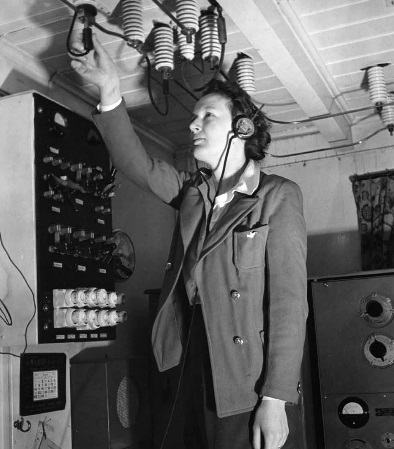
1943AprRadioServiceDealerCover1943AprRadioServiceDealerShown here on the cover of the April 1943 issue of Radio Service Dealer is a SPARS Radioman, a member of the female branch of the Coast Guard. The magazine noted that women were relieving trained radiomen for combat duty, and in the process earning ratings and regular Coast Guard pay and training.

A recruiting ad in the same issue encourages women ages 20-36 to “get into a trim uniform” and put the country one step closer to victory. Those with two years college work and experience were eligible to apply at once for an officer’s commission.


Philips Adagio 52

PhilipsAdagio52This avid shortwave listener is pulling in a program on her Philips Adagio 52, model BA-511A.  The six-tube Austrian set from 1951 covered longwave, medium wave, and two shortwave bands.  One of the bands covered 15-51 meters.  The second band featured a bandspread to separate stations on the crowded 31 meter band.


1948 Crystal Set & Audio Amp

1948AprPMThe young man shown here earned his girl’s admiring gaze by putting together two companion projects shown in the April 1948 issue of Popular Mechanics. The first was a relatively modest crystal set featuring a tapped coil, capable of pulling in the local stations with suitable antenna and ground connections.

1948AprPM5But what really impressed her was the loudspeaker volume achieved with the audio amplifier using a 1H5GT and 1Q5GT tube to drive the  3″ speaker handsomely mounted on the front panel. The crystal set, of course, needed no power source. The amplifier ran from a 1-1/2 volt dry cell and two 45 volt batteries in series.

In addition to working well with the crystal set, the amplifier could be used with a crystal phono pickup or other electronic projects.

1948AprPM2


When the SOS Flashes: 1928

1928AprRadioNewsNinety years ago this month, the April 1928 issue of Radio News carried this article explaining some of what happened when an SOS was heard on the airwaves.

As soon as an SOS was heard, coastal stations WNY in Brooklyn or NAH at the Brooklyn Navy Yard would immediately flash the message “QST DE NAH QRT SOS,” meaning that all stations–including broadcasters–along the Eastern Seaboard would need to immediately silence their transmitters. Network programs would continue over the wire to stations further west, but the key stations themselves would be silent. As the article pointed out, this sometimes led listeners who tuned in late to think something was wrong with their receivers. But for the radio buffs, this added some opportunities.

First of all, with all of the New York stations dark, listeners in that city had some DX opportunities. Stations such as KDKA and those further west would still be on the air.

And “broadcast listeners who are able to read the Continental Morse code and the quick flashes of radio abbreviations can often follow the rescue arrangements; for the broadly-tuned signals will penetrate into the upper reaches of the broadcast band.” The article noted that NAH used spark for these transmissions, exactly because the signal covered more bandwidth and thus had a better chance of being picked up. Similarly, under the radio regulations, the ship in distress was allowed to have its “transmitting set adjusted in such a manner as to produce a maximum of radiation irrespective of the amount of interference which may be caused.”


Soviet P-250 “Kit” Communications Receiver

The receiver shown above is the creme de la creme of Soviet radio technology, the P-250, better known simply as “Кит” (kit). This receiver was produced from 1949-1980 for the Soviet Military and government, and its performance appears to rival just about anything produced in the West during that time period.

The set was originally developed for the Soviet armed forces, under the direction of Anton Antonovich Saveliev, to fill the need for a high quality receiver for use on vehicles and ships. It had a number of revisions over the years, and had the designations P-250 for the land forces, and P-670 for the navy. The receiver was a success, and the developers were awarded the Stalin Prize of the second degree in 1950.

The receiver started out strictly for official use, both by the military, as well as the KGB and GRU. The set was the apex of reliability. One example is a 1953 P-670 originally installed in a submarine, where it was used until 1970. It continued service in the coastal service until 1985, with no repairs other than scheduled maintenance.

The original 1949 version was a dual conversion superheterodyne with a tuning range of 1.5 – 25.5 MHz spread over twelve bands. A set-top box was available to extend the tuning range to 35.5 MHz. The tuning scale was customized for each receiver, with the scale printed by a photographic method. The first IF was variable from 1.5 to 3.5 MHz, with a second IF of 215 kHz. Bandwidth was switchable between 1, 3, 6, and 12 kHz. The standard power suppl6y was 127/220 volts, 50 Hz, but other supply options were available.

An improved version, the P-250M, was produced between 1957 and 1969. Among other improvements was greater precision on the tuning scale, with calibrations reduced from 2 kHz to 1 kHz.

The final version, the P-250M2, was produced from 1968 until 1980. The main change was the tube type, as the set moved from metal octal tubes to miniature tubes. A special tropical version was also available.

The set was declassified in 1959, and eventually it became sought after by Soviet amateurs. You can see the receiver in action at this video: