Category Archives: Radio history

High School Radio Training, 1943

1943JuneQSTShown here in the June 1943 issue of QST are students at Northbridge Senior and Junior High Schools, Whitinsville, Mass., learning Morse Code under the tutelage of assistant principal James Perkins Saunders, W1BDV.

Before the War, there had been some instruction in radio for interested students, but it had consisted mostly of informal coaching of students interested in obtaining their ham licenses. But with war, radio became a vital skill, and the school vigorously undertook pre-induction training in the radio arts, including both theory and Morse Code.

1943JuneQSTKeyTo accommodate code training, the school’s schedule was adjusted. Two minutes were shaved off each of the seven class periods, and the lunch period was reduced by one minute. This allowed the time period from 8:05 to 8:20 AM to be set aside exclusively for code practice. Each day, Saunders manned the key in the school office, as shown here, and code was piped throughout the building. Later, a tape machine was procured, and Army-Navy code training tapes were played. A student assistant monitored the tapes and copied along, and at the end of the session, he read back the text that had been sent.

The code training was intended primarily for students in the high school, but since the P.A. system was shared with the junior high, the younger students were also encouraged to participate.

Participation was optional, and some students used the period as a study hall. Initially, 250 students were participating, but this number dropped to 75 at the end of the term.  Each week, a test was given, and teachers sent the classroom’s copy to the office for scoring.  At the start of the next term, the program again started from scratch, with advanced students moving on to a dedicated 45 minute class.

1943JuneQSTMillThe typing class, shown here, was conducted by Saunders one day a week. Instead of their normal typing lesson, the students listened to code being sent by Saunders, and they learned to copy on the “mill”.

Other typing students were trained to transcribe the paper tapes being used to run the code machines. They intently watched a character of the tape be revealed and typed the corresponding letter. Many students were particular fond of this activity, and expressed disappointment that the fun ended when the bell rang.

Students were also trained to copy by flashing light. After they had mastered copying code by sound, they were instructed to watch a flashing light which flashed along with the aural code. Then, the sound was turned off, and they continued to copy by sight.

Sending practice was also given, with sending stations being set up on old laboratory tables. These were wired up so that students could listen to perfect code from the machine and then listen as they tried to duplicate the sounds with their own fists.

1943JuneQST4Interested students, both boys and girls, also took part in classes in radio theory, largely following ARRL study materials. By rounding up defunct receivers, they were able to scrounge components to build projects such as code oscillators, as the students here demonstrate.

Saunders reported that it had been a lot of work getting the school geared up to study radio, but he and the students were very enthused about it. He reported that the many extra hours spent at school working on it were a suitable substitute for ham radio’s being off the air for the duration. In fact, his wife reported that “it is even worse now than before the war” since he was at least at home–albeit in his shack–in the prewar years.


WTCN Minneapolis Remote Unit, 1948

1948JuneFM

This picture of the remote unit of WTCN radio in Minneapolis appeared in the June 1948 issue of FM and Television magazine. It operated in the 152-162 MHz range. According to the accompanying article, the FCC had moved the allocation for that service to the 450-460 MHz band, which caused some consternation for broadcasters, since equipment for that band was not yet available. Existing licensees would be able to continue on the old allocation for a few more years, but the cost of installing a new system would be prohibitive, since it could be amortized over only a few years, due to the pending change.

The WTCN system was provided by Link Radio Corporation of 125 W. 17th Street, New York. The mobile unit was a 50 FM transmitter operated by a 12 volt dynamotor. Twelve volts was chosen rather than six due to the power consumption and long duty cycle. It was also possible to switch over to operation from AC power where available. A vertical antenna was mounted on the roof.

At the receiving end, the station had a vertical antenna mounted on top of its FM broadcast antenna on the Foshay Tower, which was also pictured in the article. A rack-mounted receiver picked up the program for delivery to the station. Other types of antennas could be employed.

Bell 47B. Wikipedia photo.

For a history of the WTCN call sign, see this link and this link.  The station was owned by the Twin Cities Newspapers, hence the call sign.  Since the article is about the remote unit, there’s no explanation of the Minneapolis Star and Tribune helicopter shown next to it.  It appears to be a two-seat Bell 47B, as shown at left.


Claire Trevor, CBS Radio 1938

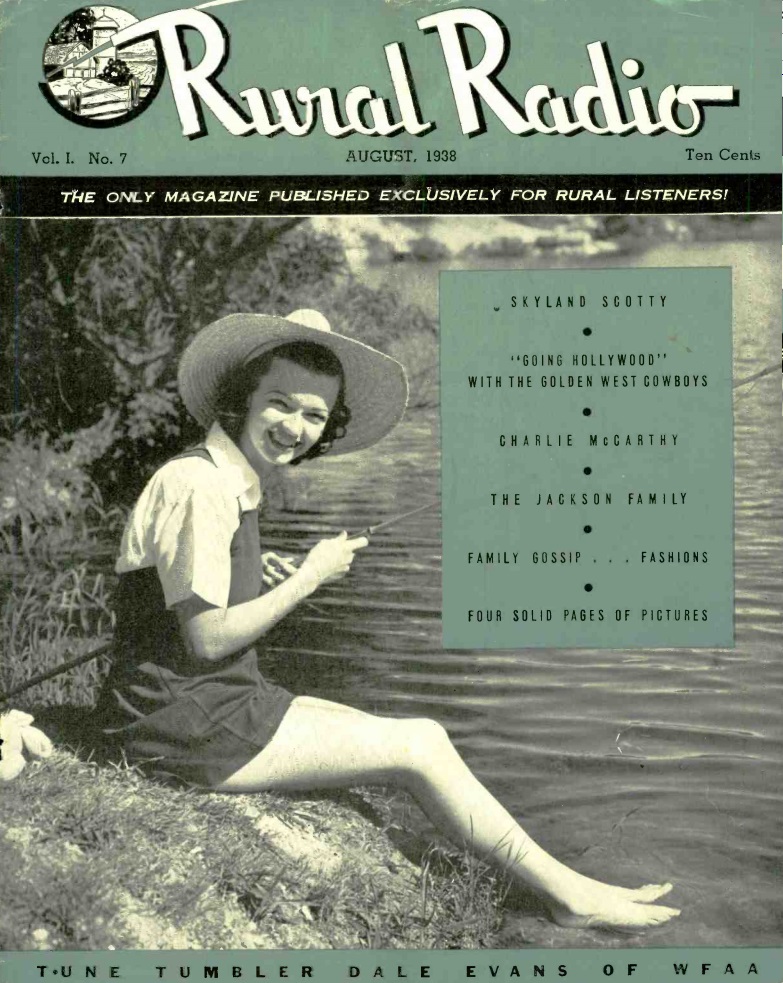
1938MayRadioNewsCoverUndoubtedly, most of the hams who bought the May 1938 issue of Radio News did so for the articles, such as the one on page 37 showing how to build a portable six-tube transmitter for 28 MHz. But the issue’s cover shows actress Claire Trevor at the CBS microphone, performing her role of Lorelei opposite co-star Edward G. Robinson in the series Big Town.

Miss Trevor is most famous for her film roles, including an Oscar for best supporting actress in 1948’s Key Largo. According to the magazine, she made her stage debut in 1930 and appeared in numerous Broadway plays. She made a number of film shorts before going to Hollywood in 1933.

According to the magazine, it was hard to say whether her popularity was due to moving pictures or radio, but that she was a talented, versatile, and beautiful artist.

She died in California in 2000 at the age of 90. Her only son, Charles, was killed in 1978 in the crash of Pacific Southwest Airlines flight 182.


1958 One Tube Transmitter

Screen Shot 2018-05-08 at 11.00.50 AMSixty years ago this month, the May 1958 issue of Popular Science showed how to make this compact one-tube transmitter for local or standby use. The set used a 117P7 or 117L7 tube, which combined a rectifier and pentode, to put out about six watts on 80 or 40.  Band choice was accomplished with plug-in coils, and the rig ran directly off AC power.

Since the Altoid tin had apparently not been invented, a card file box was used for the enclosure.

Screen Shot 2018-05-08 at 11.07.08 AM


1978 Two-Transistor Shortwave Regen

1978MayEE The plans for this somewhat “retro” looking receiver appeared in Elementary Electronics magazine forty years ago, May-June 1978. The two-transistor regenerative set tuned 550 kHz to 14 MHz with the use of three plug-in coils.

Good performance was obtained through the use of “spiderweb” coils, which also added to the nostalgic appearance of the set. As the article noted, this type of coil was very popular in the early days of radio, since such coils exhibit a very high Q factor.

Another advantage of this type of coil is that it doesn’t require the use of now-unobtainium plug-in coil forms, since the article explains how to make the form. A template is included in the article, which is to be traced onto tissue paper, and then used as the template for cutting the forms from a sheet of plastic with a jigsaw or hacksaw. Brass eyelets (“available at notions counters in department stores”) were then used as the plug connections.


1943 Radio “Service Girl”

1943MayRadioRetailingTodaySeventy five years ago this month, the May 1943 issue of Radio Retailing Today detailed the experiences of Ben De Young, the owner of the De Young Radio & Television Shop, 126 S. Aurora St., Ithaca, NY. The magazine had earlier discussed the possibility of hiring “girls” to do radio repair work, and De Young had commented that the concept was hardly new, since he had been using girls since 1935. Wartime labor shortages were just then showing the wisdom of the veteran repairman’s foresight.

De Young noted that hiring experienced employees was always difficult, and that he often had to take his chances on an inexperienced man by training him. His experience, however, was that if the new man turned out good, then a manufacturer or jobber hired him away and he had to start the process all over again. And if the man turned out to be no good, the he wasn’t of any use to De Young either. Since girls were presumably less likely to be hired away in this manner, De Young found that hiring them was ideal. He noted that a girl had more agile fingers and in general did a neater job.

1943MayRadioRetailingToday3The secret to De Young’s success was having his shop equipped with the best test equipment. He was able to quickly diagnose the problem, and then letting the girl actually replace the components. He had a large bench so that she could get to work while he started diagnosing the next set. In the picture above, his assistant, identified only as a Miss Gould, is soldering in an IF coil that he had previously identified as the culprit.

She was also able to read schematics, and often saved him time by taking1943MayRadioRetailingToday2 care of details such as looking up values of components.  When she wasn’t wielding the soldering iron back in the shop, she worked in the front of the store, as shown here taking in a set for service.


1968 Marine Receiver

1968MayEEThe plans for this ambitious looking receiver appeared fifty years ago in the May-June 1968 issue of Elementary Electronics.  The transistorized set is written up as being for the SWL, but as the design suggests, the article points out that it’s also a suitable receiver for the “yachtsman.”

Construction is simplified by the inclusion of two pre-wired circuit boards available from Lafayette, the IF amplifier and audio amplifier stages. An additional four transistors make up the portions of the circuit that needed to be built. The completed receiver tuned longwave (150-420 kHz), standard broadcast (550 to 1700 kHz), and shortwave (1.6 to 4.3 MHz). In addition, a separate detector tuned VHF (144-162 MHz). A BFO was included for tuning in CW signals.

The actual construction consisted of building four separate modules, and then assembling them into the completed unit. There were actually two bandswitches, one for the preselector stage, and another for the main receiver. Switching bands meant flipping both switches.

While not explained in the article, the purpose of the rotating loopstick antenna was for use in radio direction finding, as explained in an earlier post.


1943: Dealing With Wartime Parts Shortages

1943MayServiceSeventy-five years ago, the radio serviceman had to deal with wartime parts shortages, and this often called for creativity. As with many such magazines of the era, the May 1943 issue of Service magazine gave some pointers.

In most areas, the common tubes for “All American Five” receivers had become unobtainium. If a tube went bad, something had to be substituted. The diagram here shows how the serviceman could deal with a shortage of 12SA7 tubes. A 6SA7 might be available, and was identical in all respects other than filament voltage. In these AC-DC sets, the filaments were wired in series, and the filament voltages had to add up to 120 volts. If the 6-volt tube was simply plugged in, the filament would quickly burn out.

The solution is shown above. A resistor (such as a “curtain burner” cord) is placed in series with the filaments, dropping the total voltage in half. The problem, of course, is that the other tubes still required their original voltage. This was solved by pairing up the other tubes, wiring two tubes in parallel, and then putting all of the pairs in series.

Other pointers addressed in the article included making delicate repair of speaker windings and IF coils. In most cases, the break was close to one end, so the patient serviceman could locate it and solder in a new lead. Volume controls were also hard to come by, and the article discussed how to clean and repair them.

The article noted that these kinds of procedures were necessary not just to keep revenue flowing in, but as a public service to keep America’s radios in service to bring in war news and entertainment.


Electronics Illustrated, 1958-1972

1958MayEISixty years ago this month, the first issue of Electronics Illustrated, May-June 1958, rolled off the presses of Fawcett Publications, the publisher of Mechanix Illustrated. Construction articles in the first issue included the 40 meter novice transmitter shown here, as well as a code practice 1958MayEI2oscillator featuring a 2N107 transistor. For the more ambitious, the magazine also included plans for a garage door opener system, using tube type transmitter and receiver. (The B+ for the transmitter came from the rectified output of a small inverter designed to operate an electric shaver in the car.)

For those starting out in electronics, the issue also included a tutorial on how to solder.

My own introduction to electronics came largely from discovering this magazine amongst the offerings of the Publishers Clearing House (sent to me personally by Robert H. Treller, who added a number of personal notes to the mailing).  It looks like the first issue I received was the one for May 1970, and I even managed to get my name in the March 1972 issue as a finalist (but alas, not a winner) in their “Win The World” SWL contest by sending in a batch of QSL cards.

Emboldened by seeing my name in print, I was strategizing as to how I could win the next year’s contest. Unfortunately, the magazine ceased publication with the November 1972 issue, so that second chance was not to be.

The remainder of my subscription was satisfied with a subscription to Mechanix Illustrated, which for a time included something to the effect of “including Electronics Illustrated” on its cover.


1948 Heathkit Ad

1948MayPSHeathThis early ad for Heathkit appeared in Popular Science 70 years ago this month, May 1948.  These were among the Heath Company’s first offerings in electronic kits, which they offered from 1947 to 1992.

Their offerings included a regenerative receiver for $5.95, which covered the standard broadcast band and shortwave. It was available as either a two-tube battery set, or for AC operation, a three-tube set including rectifier tube.

Also included was a compact one watt 80 meter transmitter, complete with tube and crystal for only $3.95.