Category Archives: Radio history

1968 Soviet 10 Meter AM QRP Transmitter & Receiver

1968-07Model1I’m not quite sure what the function of this Soviet electronic project was. It appeared in the magazine Моделист конструктор (Model Designer) issue number 7 of 1968, with the cryptic title “In the air – the coach.” The magazine covers model building, so at first I assumed that it was a radio control transmitter and receiver. But the transmitter appears to be connected to a microphone, and the receiver is connected to an earphone. So it appears to be intended for voice communication, and it appears to be for the 10 meter amateur band. The text mentions “300 – 500 meters,” so I assume that’s the intended range of the set. Elsewhere in the magazine is a discussion of “what is the procedure for registration and operation of amateur receiving and transmitting radio stations.”

In any event, the illustrations speak for themselves, and presumably some young comrades put together this QRP 10 meter AM station. Here’s the schematic and pictorial diagrams of the transmitter:

1968-07ModelTransmitterSchematic

1968-07ModelTransmitterPictorial

And here are the schematic and pictorial diagrams of the receiver:

1968-07ModelReceiverSchematic

1968-07ModelReceiverPictorial


KIRO 1968 CB Traffic Reports

1968OctRadioElecThis photo from the October 1968 issue of Radio Electronics shows KIRO Seattle disc jockey Jim French taking a traffic report via CB radio. The article noted that instead of depending on helicopter reports, the station had a network of 40 CB-equipped motorists sending in live reports. The studio and CB antenna were located atop the 600 foot Space Needle. The location ensured a coverage radius of 20 miles, but the QRM was described as unbelievable at times.


1928: Buy or Build?

1928OctPSNinety years ago this month, the October 1928 issue of Popular Science tackled the vexing question of whether you should buy or build your radio receiver. The magazine noted that as between building and buying, the magazine championed neither option. It viewed its function as assisting with a wise purchase for those who so desired, or to help solve home construction problems for those who decided to build.

The gentleman shown in the illustration opted to build, and the magazine noted that if you enjoyed working with tools, then assembling your own set would yield good results.

It noted, however, that building a radio was really a misnomer. It was really a matter of assembling factory-built parts.

Either way, the magazine stressed that it was important to identify your needs. Was bringing in distant stations the main appeal, or did you put tone quality first?  By first answering these kinds of questions, the radio consumer would wind up with a suitable set, whether they decided to buy or build.


1943 Toothbrush Twins

1943OctPM2

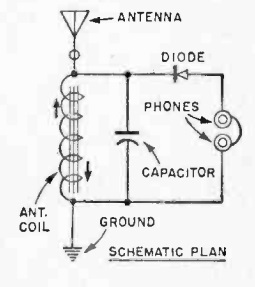
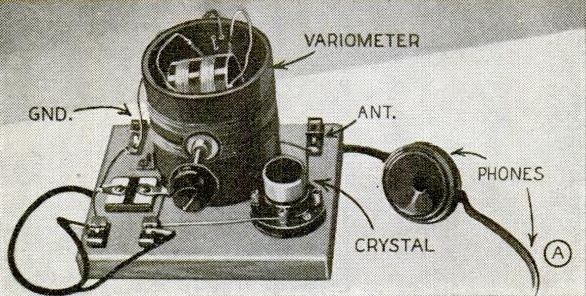
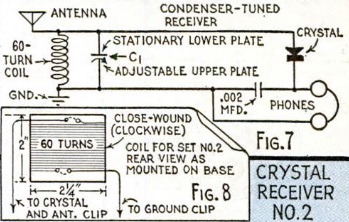
1943OctPM3If you look closely at this picture from the October 1943 issue of Popular Mechanics, you’ll see a 1H5 tube lying on the table. This means that the trio shown here decided to build the one-tube version of the receiver described in the issue. Included were the plans for two almost identical receivers, the difference being that the one shown at left used a crystal detector, while this group decided to tackle the only slightly more complicated,tube version, shown below.

1943OctPMTubeFor either set, as long as the builder had a good set of headphones, a quick look at the junk box, or a trip to the dime store, would produce the necessary parts.

Either set was mounted on a 10 x 13-1/2 inch breadboard, with the coil wound on a toilet paper tube. The coils were tapped and hooked to the switch that gave the sets, the Toothbrush Twins, their name. The switch was made with the handle of a toothbrush from which the bristles were removed with a pair of pliers. This was used as the slider, which contacted thumb tacks layed out on the board with the help of a compass.

If a shorter antenna was used, this was fed to the coil. A longer antenna had its own Fahnestock clip, and bypassed the coil.  Either set was said to provide excellent results with local stations, with the tube version showing a bit more selectivity.

1943OctPMSchematics


1943 One Tube AC-DC Shortwave Regen

1943OctRadioCraftThe October 1943 issue of Radio Craft carried this schematic for a one-tube AC-DC shortwave receiver. The circuit had been sent in by Leo Silber of Springfield, Mass., who reported that in 25 nights, he had pulled in over 200 stations from as far away as Little America, Antarctica.

The set used a 6C8G, with half the tube serving as rectifier and the other half as regenerative detector. Plug-in coils were used along with a variable capacitor for tuning. Silber reported that the set could drive either headphones or a small speaker.

For those wishing to duplicate the circuit, it appears that a 6SC7 can be substituted.  Those tubes are still rolling off the Russian assembly lines of Sovtek, and are available on Amazon.  For information on winding the plug-in coils, see our plug-in coils page, and for sourcing other parts, you can get ideas at our crystal set parts page.

If the circuit looks familiar, it’s because the magazine’s March 1943 issue had carried a slight variation on the same circuit, also sent in by Mr. Silber.  Silber, then a high school senior, was apparently not licensed before the War, but the 1949 call book shows him as holding W1NRP.  He went on to receive his Ph.D. in Physics from Purdue University, and later served as Professor of Electrophysics at the Polytechnic Institute of New York, Brooklyn.  A 1981 biography is available at this link.


1943 Cable Reel

1943OctPM

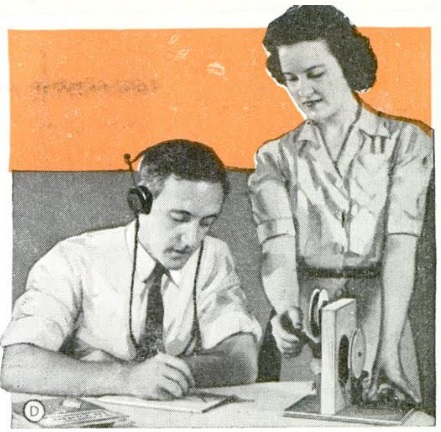
In 1943, teen girls went for the boys on the Audio-Visual crew, as shown by this illustration from the October 1943 issue of Popular Mechanics.  (Note the book bag at her feet, ready to be carried home by one or both of the helpful lads.)

The two shown here are running wire to an extension speaker using the large diameter reel shown in the magazine. Not only are they impressing the girl with their knowledge and skill, but they’re being patriotic by being careful with wartime strategic materials, since storing the cable on such a reel made it last longer than if simply hung on a nail or small diameter peg.

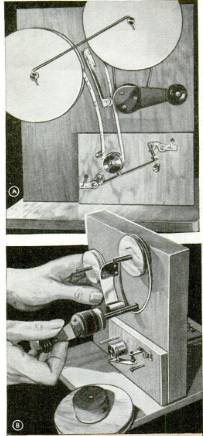
1943OctPM1The boys probably made the reel in wood shop where they showed their skill, since the magazine noted that the unusual design, shown here, “provides an interesting sawing problem for students.”


1928 eCommerce Prediction

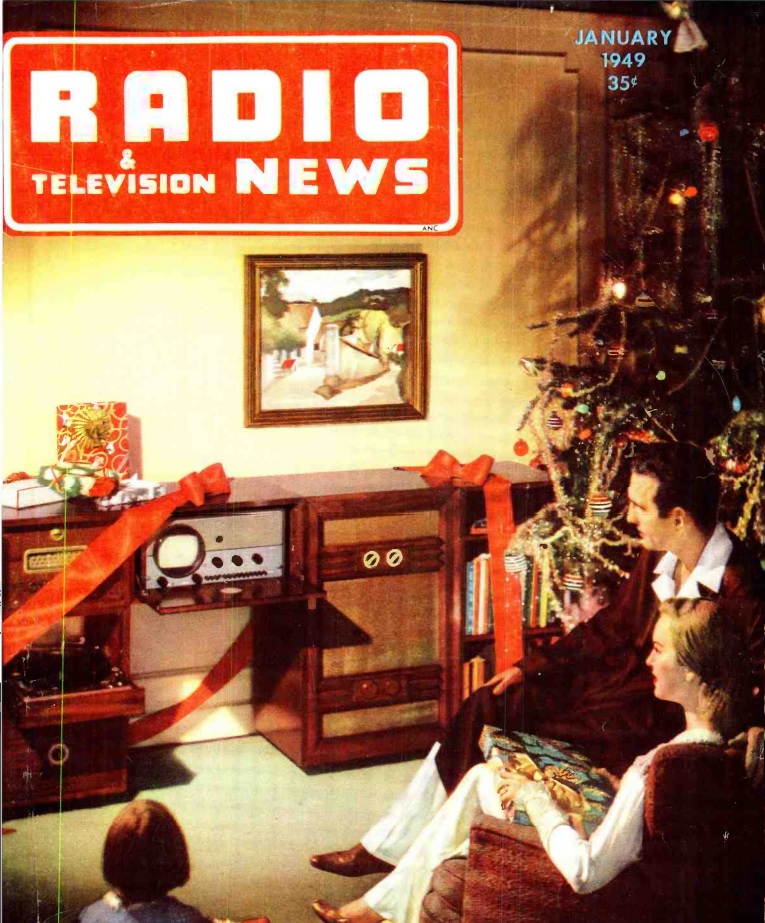
1928SepRadioNewsThere doesn’t appear to be anything in the way of explanation inside the magazine, other than the promise of “soon” on the cover. But Hugo Gernsback seems to have anticipated Amazon with this illustration on the cover of Radio News 90 years ago this month, September 1928.

The TV seems to be selling suits, and the viewer seems to have a button in his hand, getting ready to order as soon as the one he wants appears on the screen.


1958 Portable Phonograph

1958SeptEEThe young woman shown here on the cover of the September 1958 issue of Electronics Illustrated is listening wistfully to some music courtesy of the portable phonograph she constructed according to the plans contained in that issue.

She was able to put the project together in just a few hours, and it allowed her to listen to music wherever she pleased, thanks to the fact that the set ran entirely on batteries. Both the motor (three speeds–45, 33, and 16 RPM) and the amplifier were powered by four flashlight batteries, and the completed phonograph was no larger than a small overnight bag, light enough for a child to carry.

The circuit consisted of two CK722 transistors, as well as a 2N255 mounted on a heatsink, which provided enough power to drive the speaker. Volume was said to be adequate for dancing and mood music, although the article pointed out that it was not a high fidelity instrument.

1958SeptEE2

While there’s no way of knowing for sure, it’s likely that she is being entertained by a former Vice President of the United States.  Topping the charts that month was “It’s All In The Game” performed by Tommy Edwards, which you can listen to in the video below.

Chas G Dawes-H&E.jpg

Charles Dawes. Wikipedia image.

The melody of that song, originally unimaginatively entitled “Melody in A Major,” was composed in 1911 by Charles G. Dawes, who went on to become Vice President under Calvin Coolidge and earned the Nobel Peace Prize in 1925.  Under President Hoover, Dawes served as ambassador to the United Kingdom.  The song has the distinction of being the only number one single to have been composed by a Vice President of the United States.  The Wikipedia entry for the song incorrectly states that the song is the only one to have been composed by a Nobel laureate, but the Dawes biography points out that this distinction is now shared with Bob Dylan.  Dawes shares with Sonny Bono the distinction of being the only members of the U.S. Senate or House of Representatives to be credited with a number one hit.

In addition to being a banker, composer, diplomat, soldier, and politician, Dawes was a rather prolific author, as can be seen at his Amazon author page.  A 2016 edition of his Journal of the Great War is still available.

https://www.youtube.com/watch?v=Gtizr2G_7Bk


1958 Personal Stereo & Simple TImer

1958SepPE1

Maybe it’s just our imagination, but the girl in this photo from the September 1958 issue of Popular Electronics looks just a bit disappointed. She was told that she was going to have the opportunity to listen to a personal stereo player, not long after the concept of stereophonic music had been introduced to the public, and a full four decades before the Sony Walkman hit the market and made the concept of “personal stereo player” familiar. Instead, she’s listening to the phonograph through a set of crystal set headphones, thanks to this simple project shown in the magazine.

1958SepPE2She probably did have to admit, though, that it was a clever idea. As the magazine pointed out: “If you are anxious to try the new stereo records, there’s no need to wait until you can acquire a two-channel audio amplifier and a pair of speaker systems.” Instead, the ceramic stereo phono cartridge was hooked directly to the crystal earphones. As with a crystal set, the circuit was entirely self-powered, and didn’t require any amplification. According to the magazine, the set was useful as a demonstrator for entertaining friends or for listening without disturbing others. It also pointed out that public libraries and record stores could use a similar setup.

For listening to mono records, the circuit included a switch which put the two earphones in parallel.

This wasn’t the only extremely simple circuit included in the magazine. The issue also included the timer circuit shown below, which was said to be good for measuring 5-50 seconds, depending on the setting of R1. The timer worked by charging up the large capacitor with a 9 volt battery. After being fully charged, the capacitor discharged through the solenoid of a sensitive relay. When the capacitor discharged sufficiently, the normally-closed relay disengaged, setting off whatever alarm was desired.

1958SepPE3


Bringing the Car Radio Inside

1943SepPM2With the family car out of service for the duration, the September 1943 issue of Popular Mechanics offers this suggestion for putting the radio and battery to work by bringing the radio into the house.

Here, the set is mounted on a small shelf, with a speaker mounted above it. The six-volt car battery is in a carrier on the floor underneath, connected to an optional trickle charger. The antenna is mounted on a bracket on the wall. The ground wire is run to a metal plate which could be placed under a carpet or, on the ground floor, to a piece of sheet metal placed under the floor joists.

The magazine points out that the car radio probably provided good reception. If the project looks familiar, we previously carried a similar one for mounting the radio inside, and another for putting the radio on a bicycle.